• Some protistsare plantlike because
they are primarily autotrophic
• Others are animal-like because they
are primarily heterotrophic
3.
• Protozoa traditionallyreferred to
chemoorganotrophic protists.
• organisms that use organic
compounds as a source of energy,
electrons, and carbon for
biosynthesis i.e. Heterotrophic
4.
• A protozoanis a complete organism in
which all life activities are carried out
within a single plasma membrane.
• Protozoans lack collagen and chitinous cell
walls.
• Protozoa show unicellular eukaryote
organization
FEATURES OF PROTOZOA
5.
• Often, theyare more complex than any
particular cell in higher organisms.
• Some protozoans form colonies yet
independent on one another for most
functions.
• Some colonies can become complex
6.
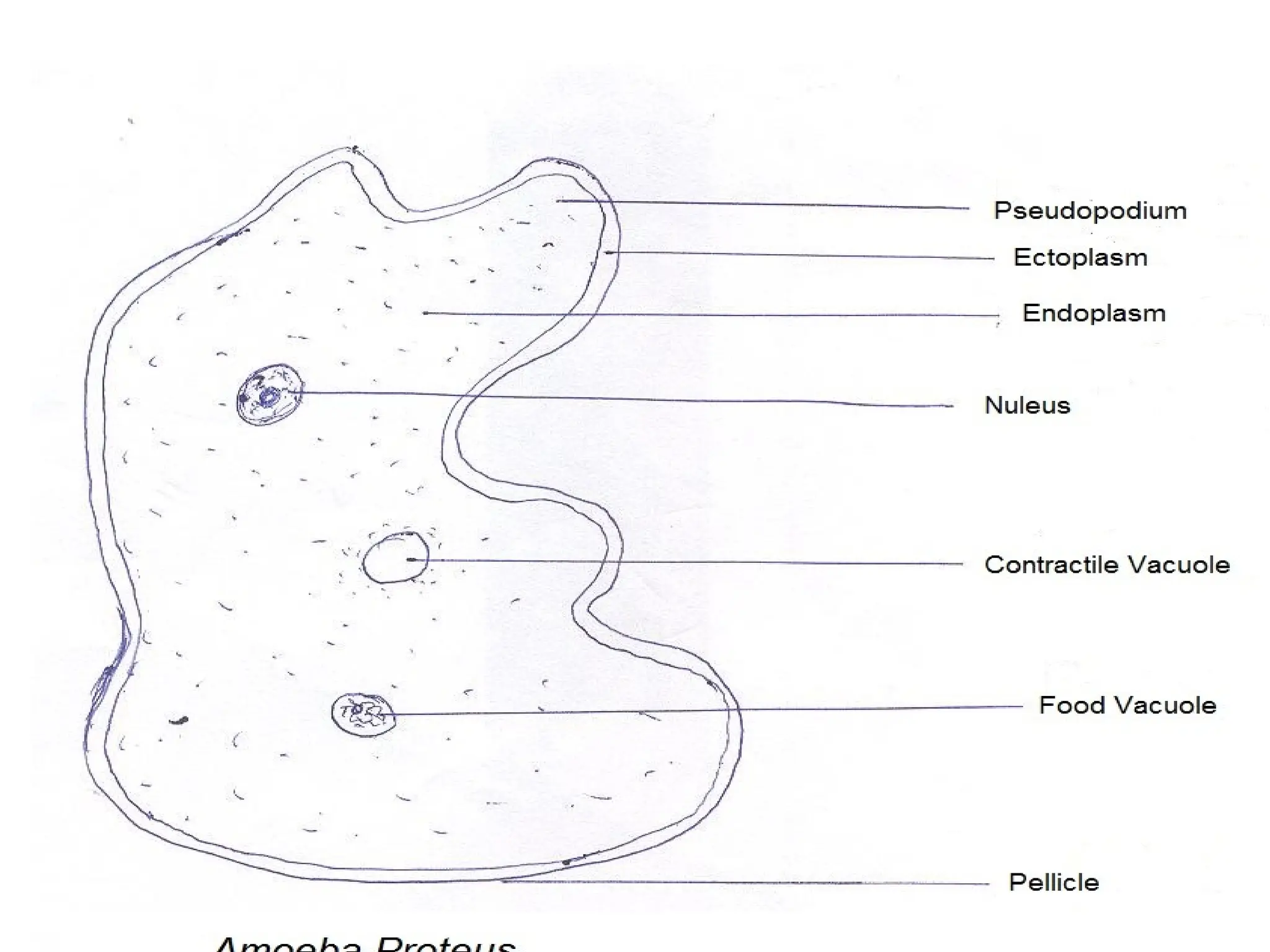
• A regulararrangement of microtubules,
called the pellicle, underlies the plasma
membrane of many protozoa.
• The pellicle is rigid enough to maintain
the shape of the protozoan, but it is also
flexible
7.
• The cytoplasmof a protozoan is
differentiated into two regions.
• ectoplasm
• endoplasm
8.
• Water entersfreshwater protozoa with
higher solute concentrations by osmosis.
• Contractile vacuoles remove this excess
water
• Most protozoa absorb dissolved
nutrients either by active transport or by
ingesting whole or particulate food
through endocytosis.
9.
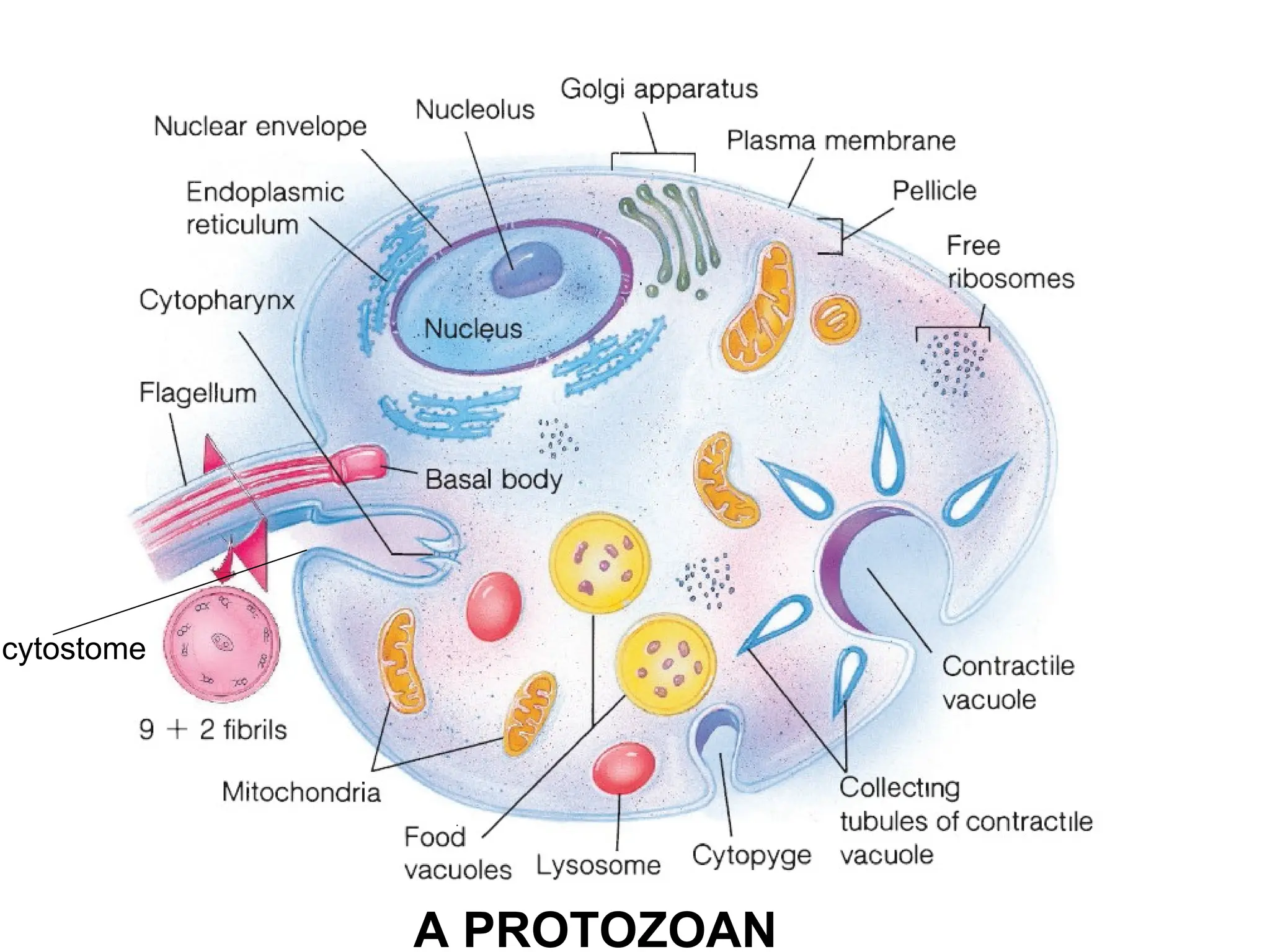
• Some protozoaingest food through a
specialized region cytostome
cytostome and
cytopharynx
cytopharynx, analogous to a mouth.
• Digestion and transport of food occurs in
food vacuoles
food vacuoles that form during endocytosis.
• Food vacuoles fuse with enzyme containing
lysosomes
lysosomes and circulate through the
cytoplasm, distributing the products of
digestion.
10.
• After digestionis complete, the egestion
vacuoles release their waste contents by
exocytosis
exocytosis at a specialized region of the
plasma membrane or pellicle called the
cytopyge
cytopyge.
REPRODUCTION
• Protozoa reproduceboth sexually and
asexually
• One of the simplest and most common
forms of asexual reproduction is binary
fission.
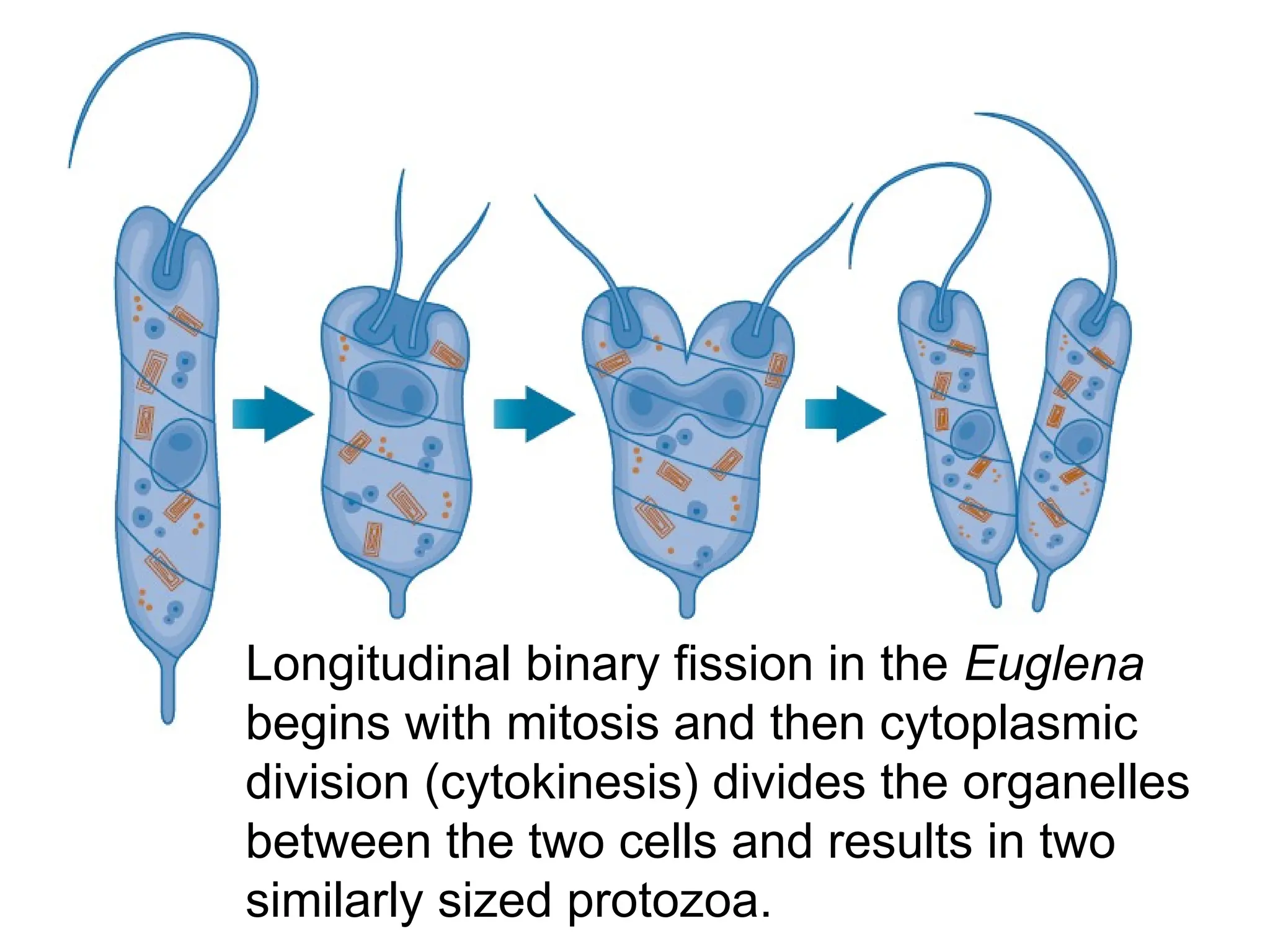
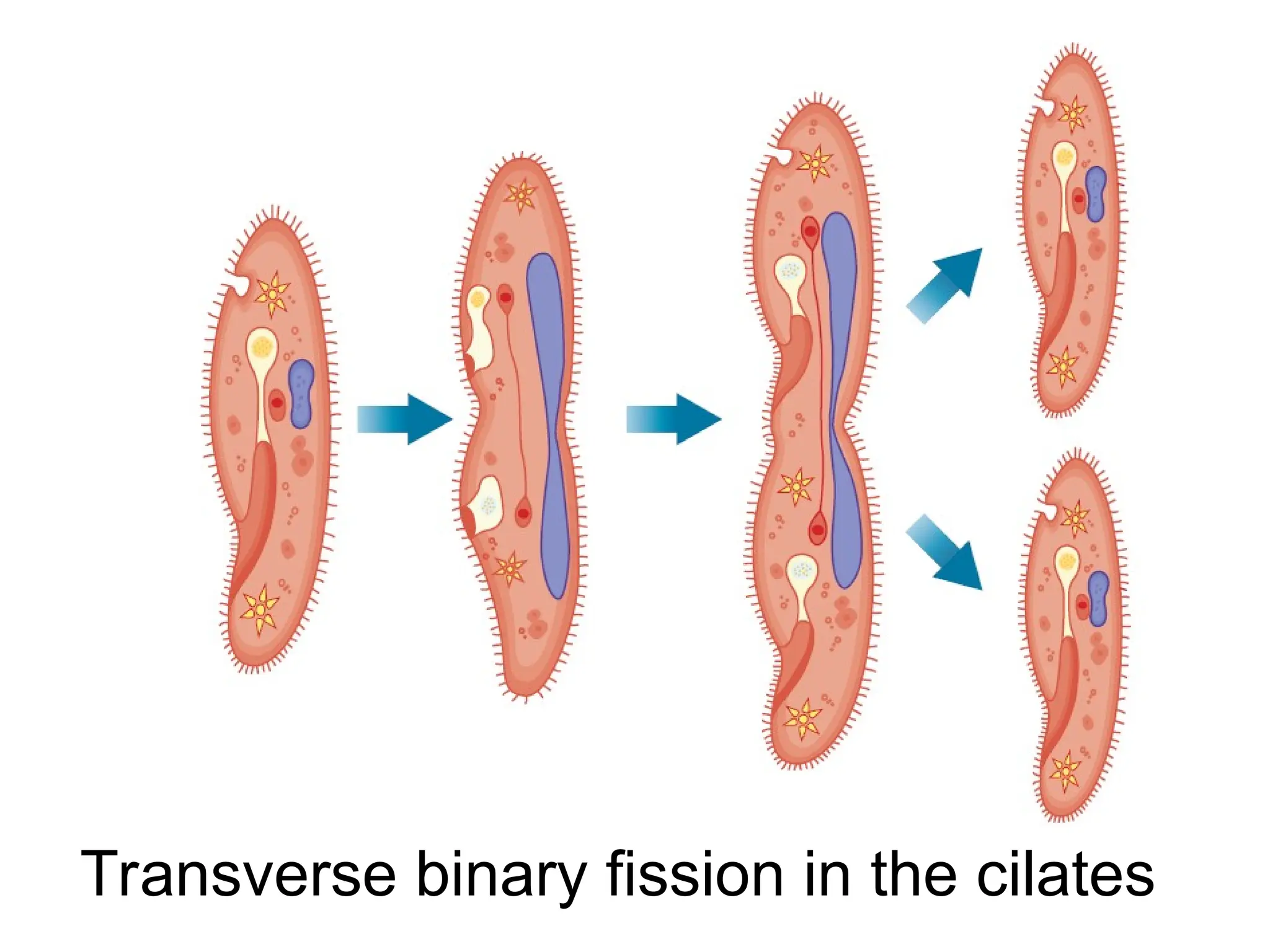
• Binary fission can be longitudinal (e.g.,
euglenoids) or transverse (e.g., ciliates).
13.
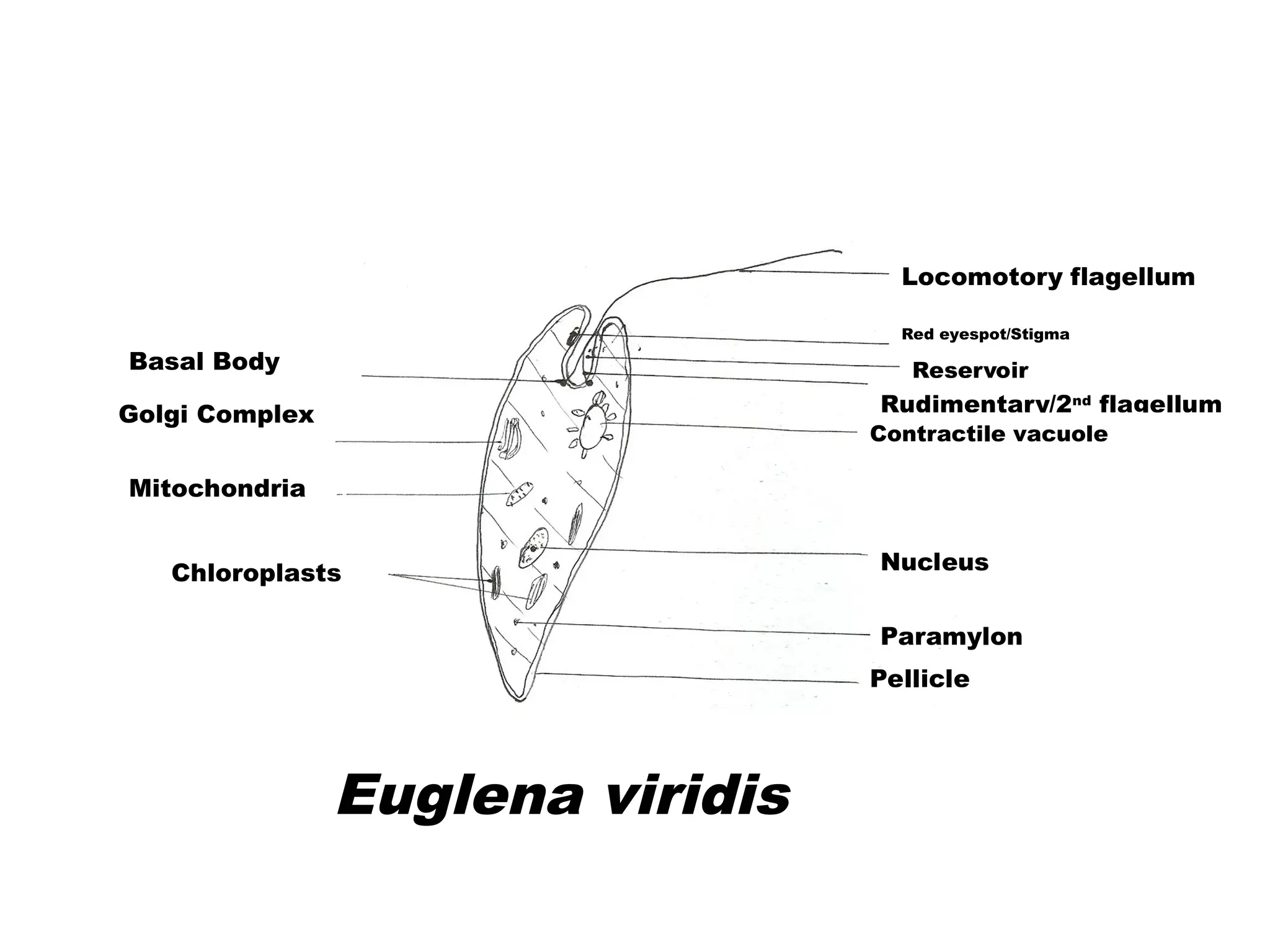
Longitudinal binary fissionin the Euglena
begins with mitosis and then cytoplasmic
division (cytokinesis) divides the organelles
between the two cells and results in two
similarly sized protozoa.
• Budding isanother form of asexual
reproduction in which mitosis is followed by
the incorporation of one nucleus into a
cytoplasmic mass that is much smaller than
the parent cell.
• Schizogony or multiple fission results in a
large number of daughter cells from the
division of a single parent.
16.
• Sexual reproduction
Sexualreproduction involves gamete formation
and the subsequent fusion of gametes to form a
zygote.
• In most protozoa, the sexually mature individual
is haploid.
• Gametes are produced by mitosis, and meiosis
follows the union of the gametes.
17.
CLASSIFICATION
• Protists constitutesuch an
unnatural group
• Some protist are more closely
related to plants fungi or animals
than they are to other protist
18.
• 7 Phylaof the protozoan are recognized
using the older classification:
Sarcomastigophora
• Labyrinthomorpha
• Apicomplexa
• Microspora
• Acetospora
• Myxozoa
• Ciliophora
19.
• Recent classificationusing metagenomic
studies grouped the protozoans
according to their phylogenetic
relatedness.
• Microsporidians once considered
amitochondriate protists are now
classified as fungi
20.
Phylum Sarcomastigophora
• Possessonly one type of nucleus and
flagella or pseudopodia or both as
locomotor or feeding organelles
• Contains 3 sub-phyla
Mastigophora, Sarcodina & Opalinata
21.
• Subphylum Mastigophoransare
flagellates that move by means of one
flagellum or more flagella
• Phytoflagellates are mostly
biflagellated chlorophyll-bearing
autotrophs or mixotrophs eg Euglenids
22.
• Zooflagellates bearone to many
flagella and are heterotrophic
• Asexual reproduction is by longitudinal
fission
• Although there are some free-living
species, most are commensal or
parasitic
23.
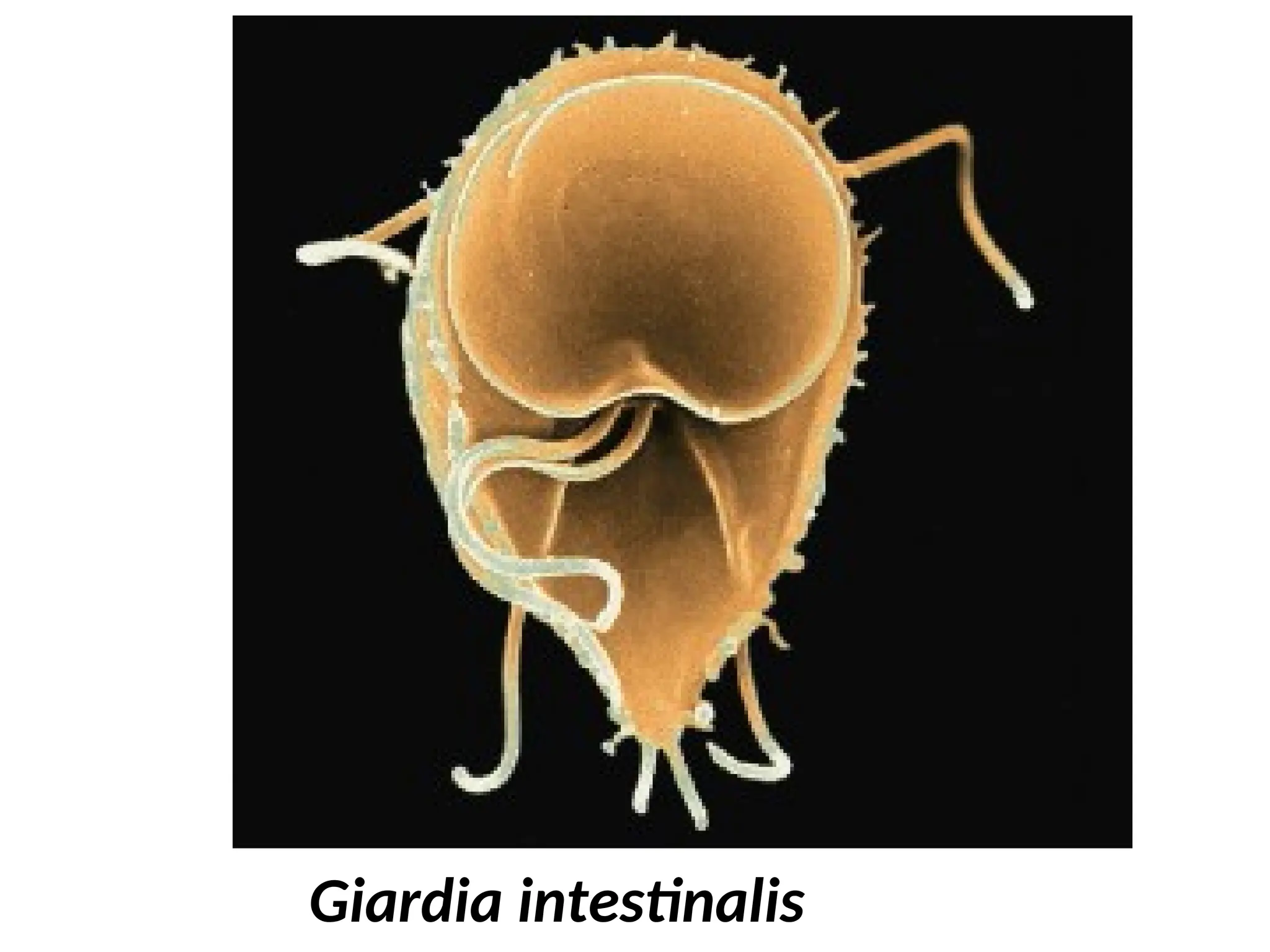
• Recent groupingplaced Giardia
intestinalis under Diplomonads based on
modified mitochondria called mitosomes
• Mitosomes lack functional electron
transport chains and hence get the
energy they need from anaerobic
pathway
24.
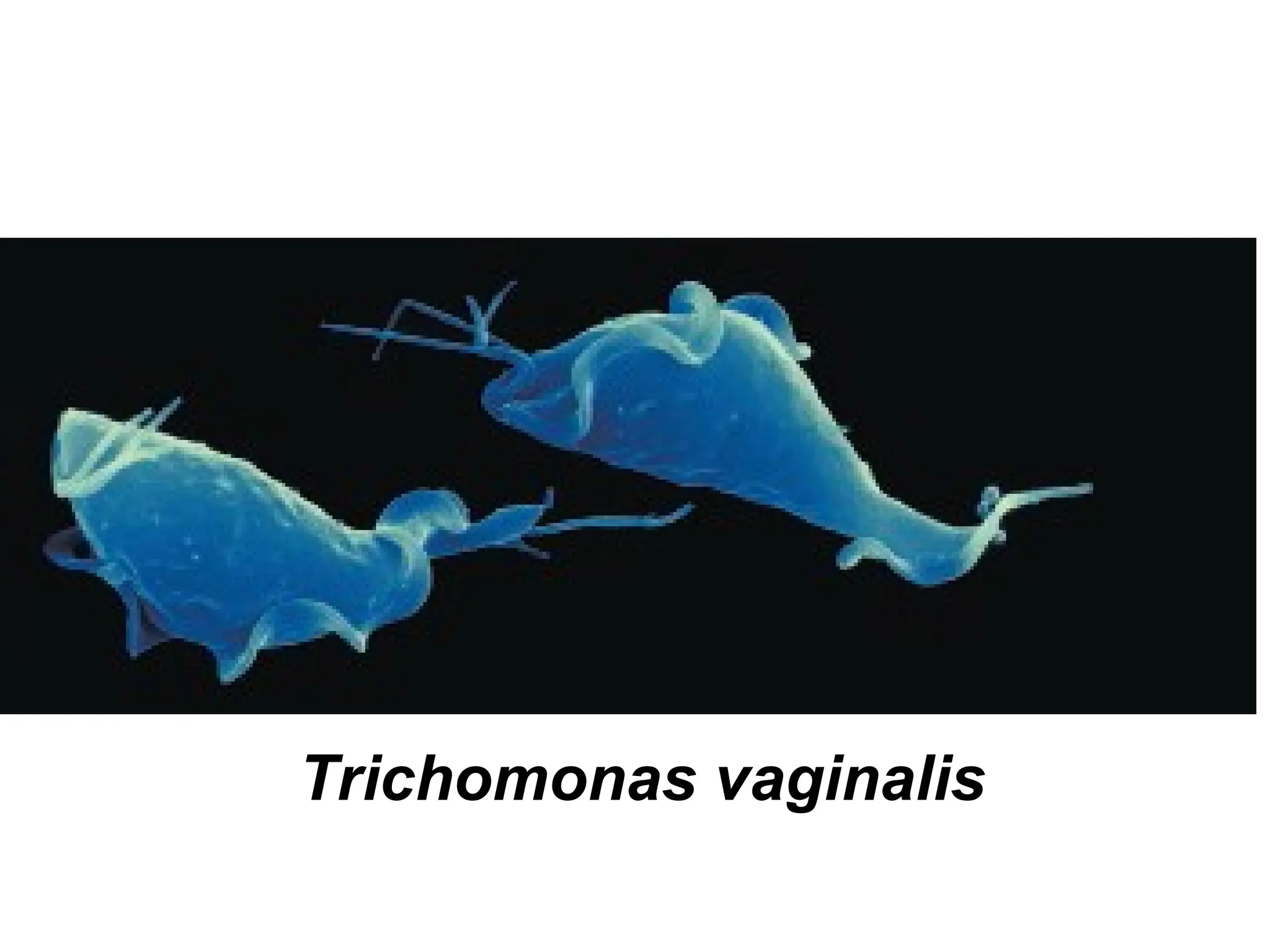
• Trichomonas vaginaliswhich cause the
STD trichomoniasis is grouped as
parabasalia have reduced mitochondria
called hydrogenosome.
• Hydrogenosome can generate energy
anaerobically releasing hydrogen gas
• The Diplomonads,Parabasalids and
Euglenozoans are grouped under a
supergroup EXCAVATA because of the
presence of excavated groove on one
side of the cell body
• Excavata has a posteriorly directed
flagellum which generate feeding current
29.
Sub-phylum Opalinata
• Membersoccur in the rectum of frogs &
toads
• All are parasitic with monomorphic
nuclei (not differentiated macronuclei &
micronuclei)
30.
Numerous cilia-like organelle(obliquely
arranged) cover entire body surface & are
of equal size
Some have many nuclei, others have
only two
There is no cytostome
31.
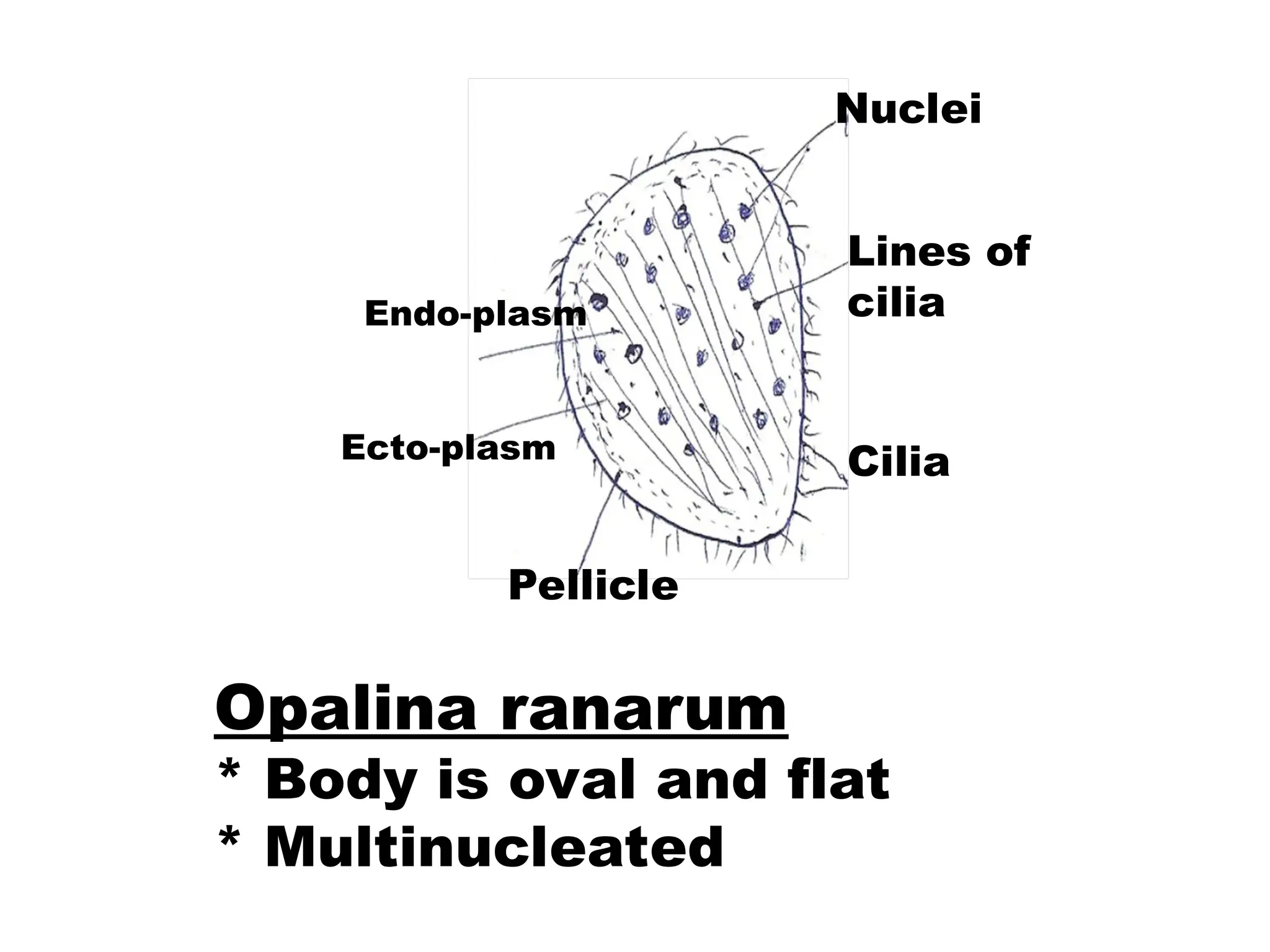
Opalina ranarum
* Bodyis oval and flat
* Multinucleated
Nuclei
Lines of
cilia
Cilia
Pellicle
Ecto-plasm
Endo-plasm
32.
Sub-phylum Sarcodina
• Theypossess pseudopodia (flowing
extensions of the body)
• Possess fewer organelles than ciliates
and flagellates
• Distinguished by the form of
pseudopodia and cytoskeleton.
33.
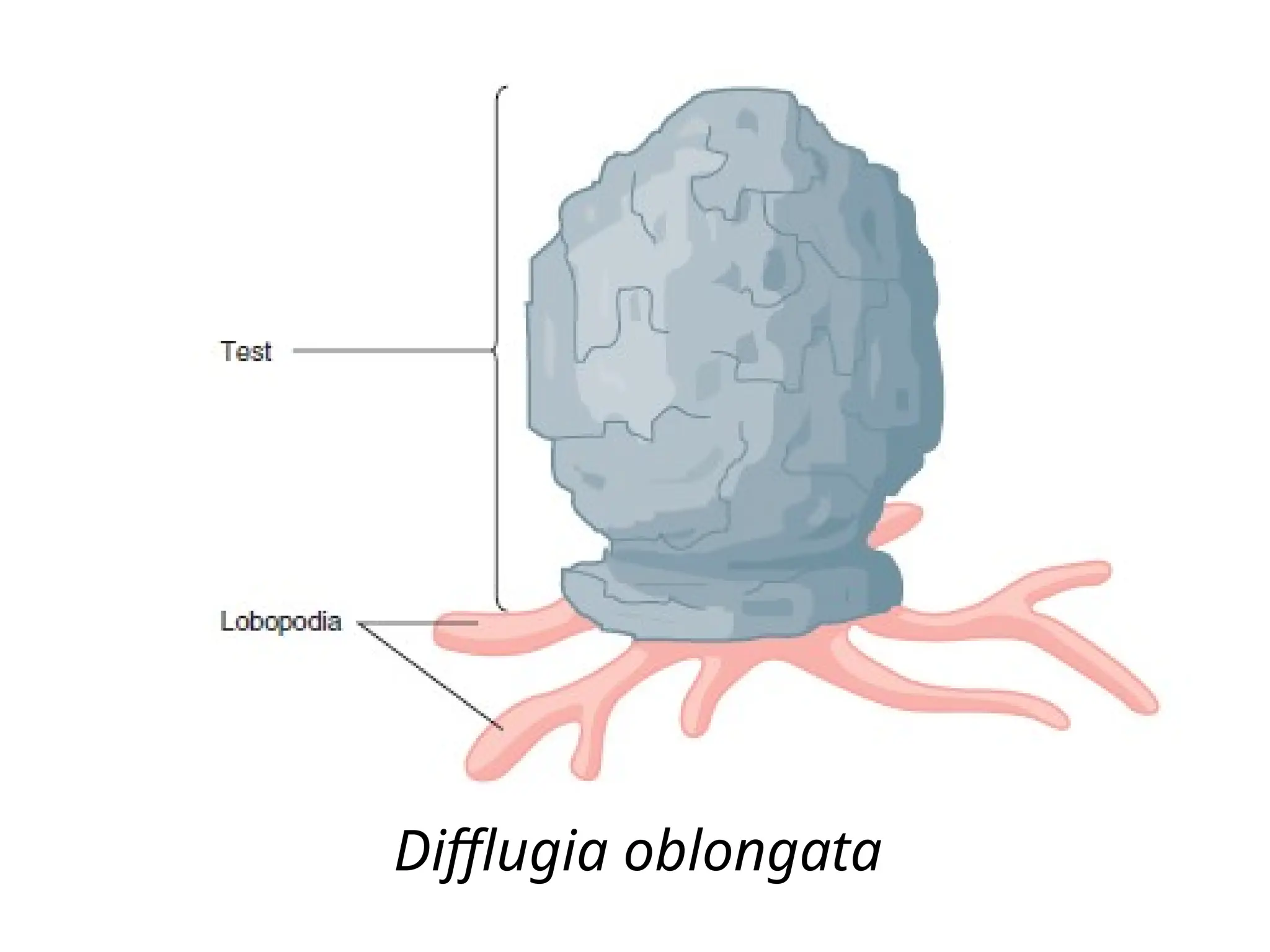
• Lobopodia
Lobopodia arebroad cell processes
containing ectoplasm and endoplasm
• Filopodia
Filopodia are thread-like and contain
ectoplasm only
• Reticulopodia
Reticulopodia are net-like series of cell
extensions
34.
• Axopodia
Axopodia arethin filamentous cell extension
supported by a central axis of microtubules
35.
• Amoebozoa engulffood by phagocytosis
• Free-living Amoebas feed on bacteria,
diatoms, algae, rotifers
• Entamoeba coli is a commensal species that
feed on bacteria and intestinal debris
• The parasitic E. histolitica is causative agent
of amoebic dysentery
• Both leave as cyst in feces and reinfect via
the mouth
36.
• Binary fissionoccurs when an aboeba
reaches a certain size limit
• No sexual reproduction is known to occur
37.
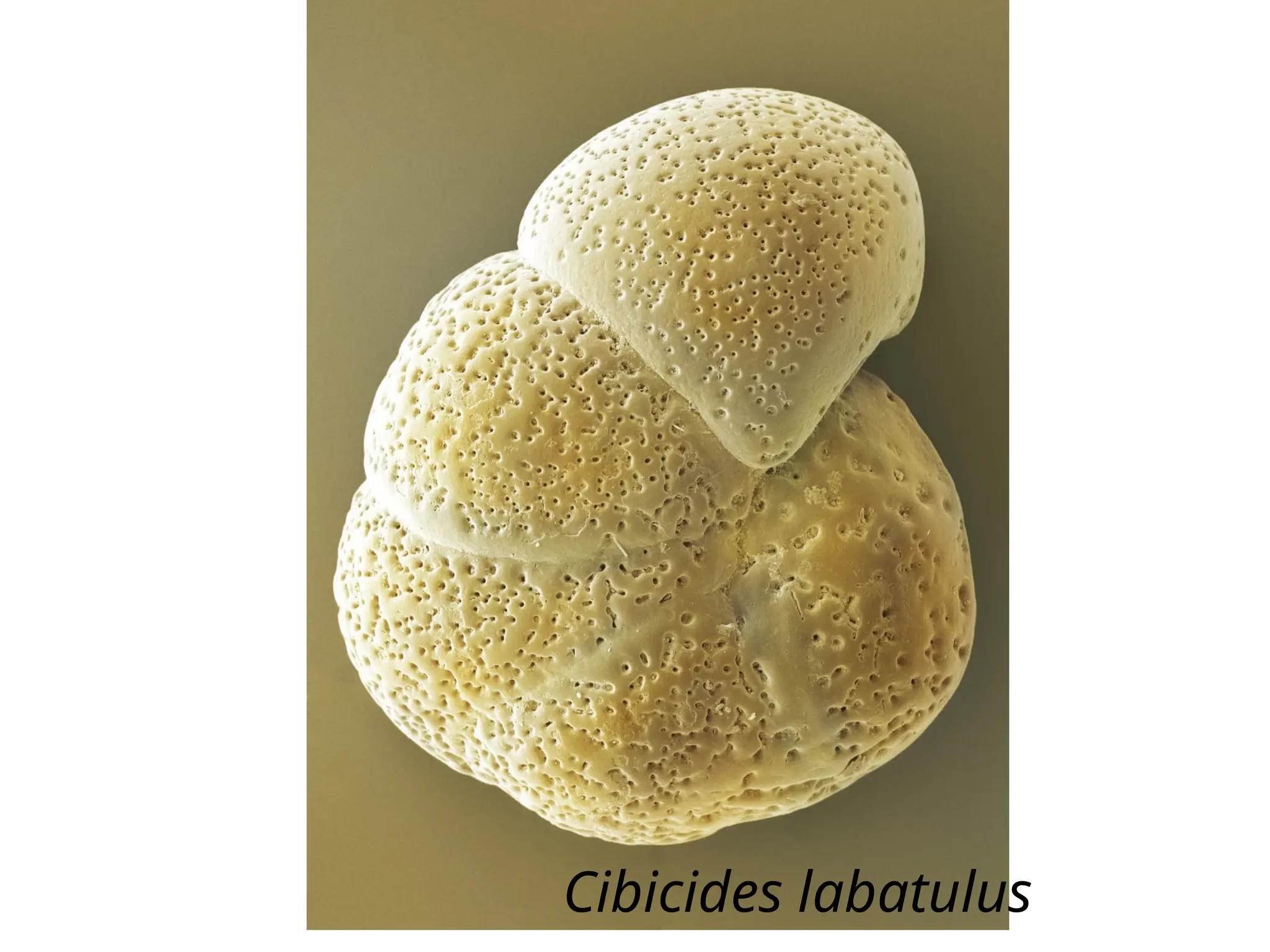
• Some membersof the sarcodines lack a
test (shell) or other supporting structures
• Others possess test which may be
calcareous proteineous, siliceous or
chitinous.
• Other test may compose of sand and
debris cemented into a secreted matrix
38.
• Supper ClassRhizopoda
• Pseudopodia used for locomotion and
feeding
• Some spp have shell composed of mineral
particles cemented together
• Large opening in the shell permit extension
of the body and pseudopodia
39.
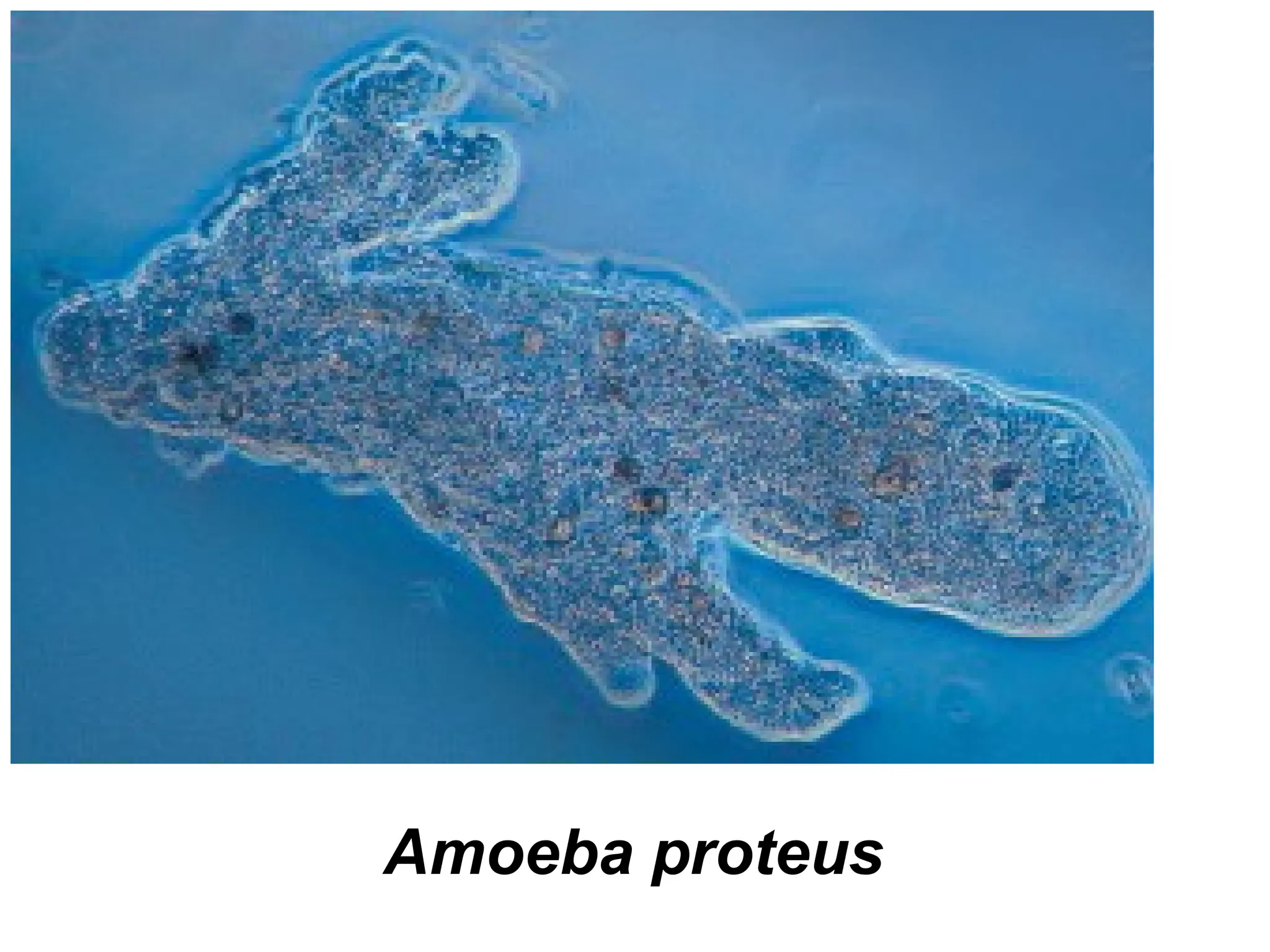
• Class Lobosea
•Shelled or naked amoebae.
• Pseudopodia is large and blunt
(Lobopods)
• Amoeba proteus, Diffugia
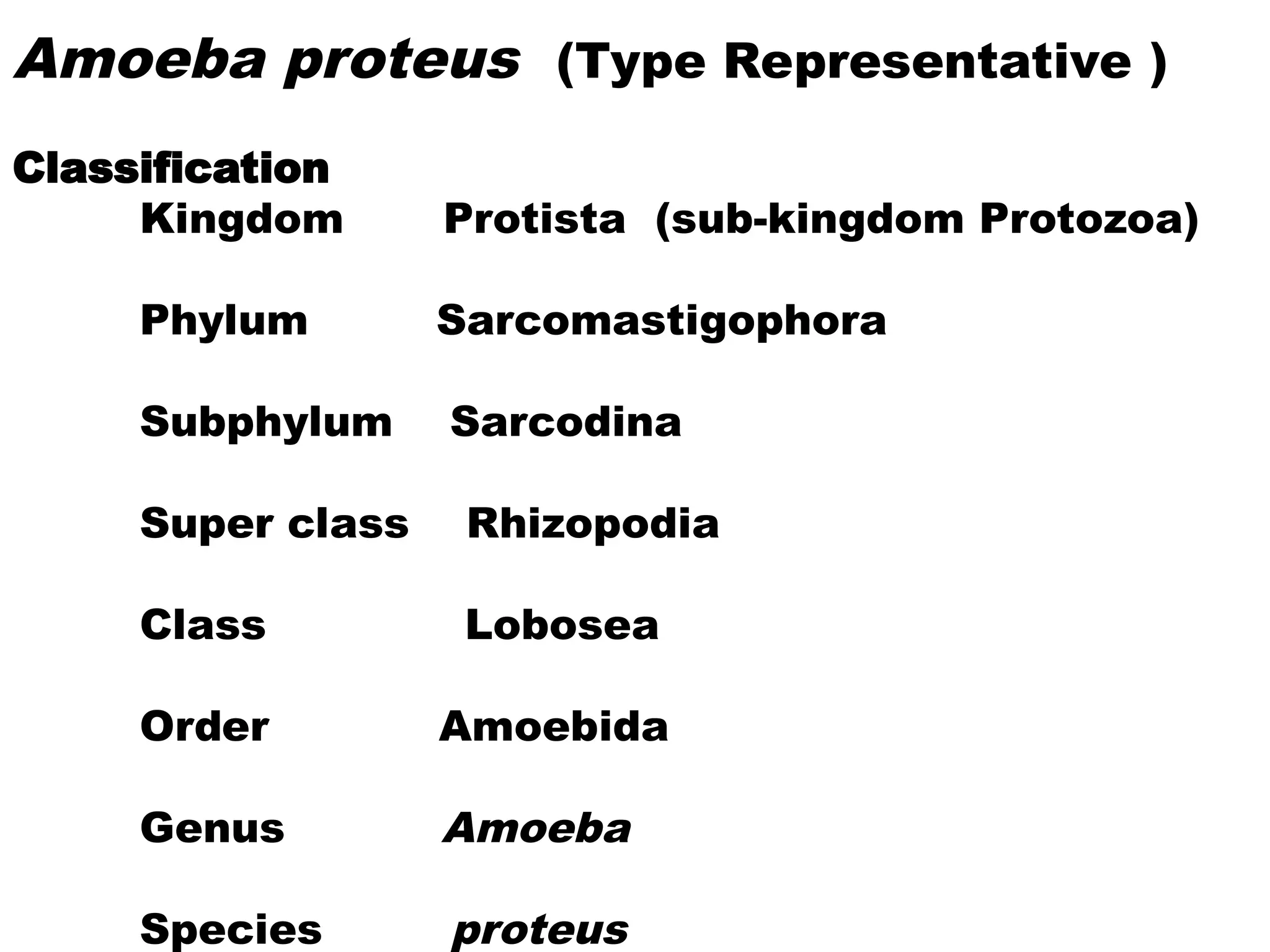
Amoeba proteus (TypeRepresentative )
Classification
Kingdom Protista (sub-kingdom Protozoa)
Phylum Sarcomastigophora
Subphylum Sarcodina
Super class Rhizopodia
Class Lobosea
Order Amoebida
Genus Amoeba
Species proteus
Supper Class Actinopoda
•Floating or sessile sarcodines with
radiating rodlike pseudopodia (axopods)
used in feeding only
• Composed of medulla that contains one
to many nuclei and an outer cortex of
highly vacuolated cytoplasm
47.
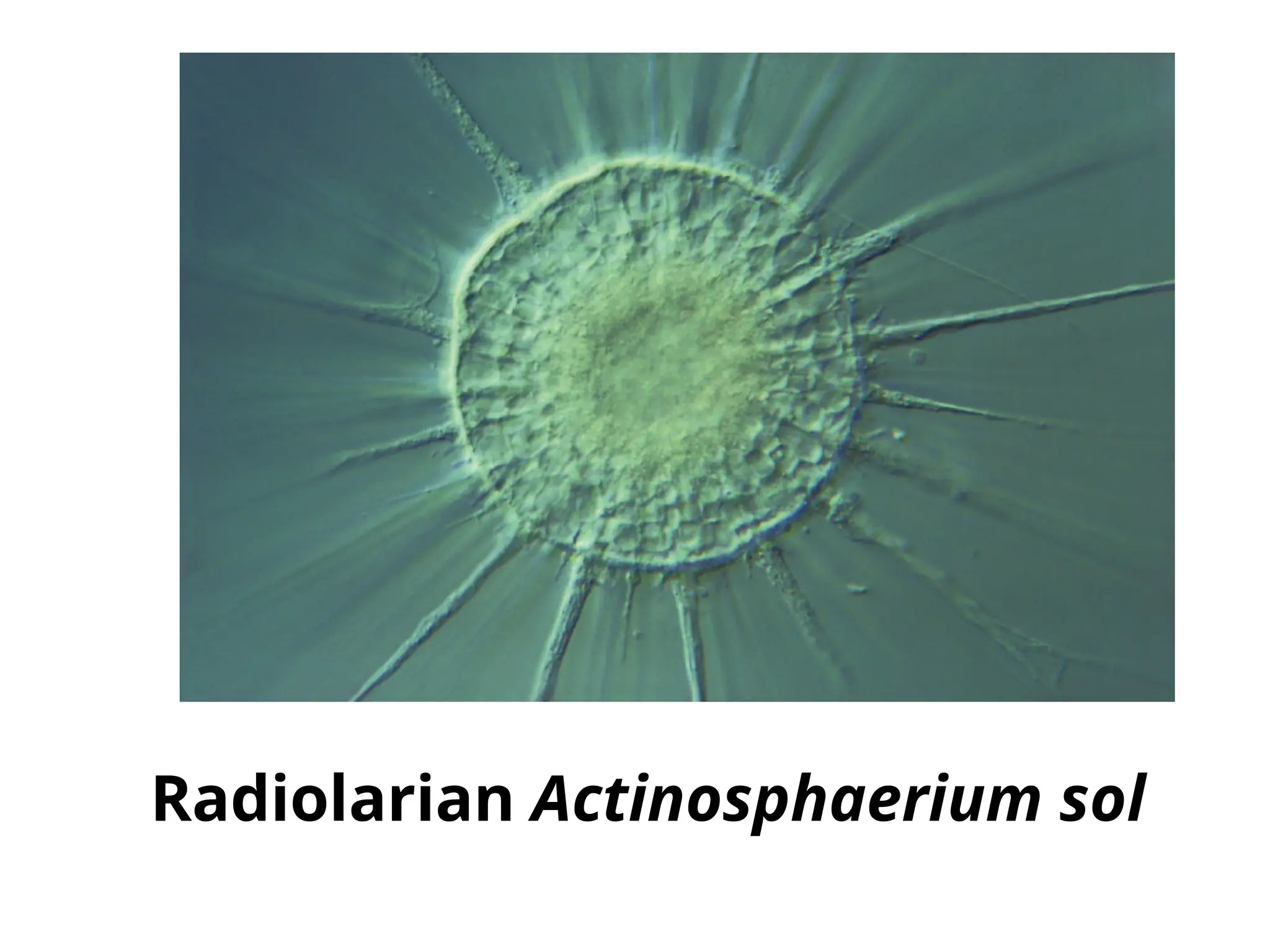
• Class Polycystinea(Radiolarian)
• Medulla encased within a membranous
capsule perforated to permit
communication with the outer cortex
• Siliceous skeleton
• Class Heliozoea
•Heliozoans are mostly marine and freshwater
sarcodines lacking a central capsule
• Skeleton of siliceous scales, tubes spheres or
needles embedded in the cortex
51.
• The recentclassification grouped
amoeboid protozoans that possess
filopodia into monophyletic clade called
Rhizaria (Forams, Radiolarians,
Heliozoans)
• The amoebas with lobopodia form
another clade called Amoebozoa
• Amoebozoa include Tubulinea,
Acanthamoebida and Entamoeba
52.
LIFE HISTORY
Growth& multiplication is by
fission :
Involving nuclear division by
mitosis followed by cytoplasmic
division
Two amoebae separate to feed &
grow to maximum sizes.
53.
Under unfavourable conditions
Amoebaforms cyst & remain inactive ,
until moisture or warm temperature are
restored
They then emerge, begin to feed and
grow.
54.
Asexual binaryfission is triggered off when the
surface area : volume ratio
and / or
cytoplasmic volume : nuclear volume ratio reach
a limit.
There may be sporulation in other species like
Entamoeba histolytica which undergo spore
formation
55.
References
• Intergrated Principlesof
Zoology.---- Hickman, Roberts &
Larson
• Zoology.---- Miller& Harley
• Invertebrate Zoology.--- Jordan
&Verma
• Campbell Biology.--- Reece et al