WELCOME
TO
MEDICAL
PARASITOLOGY II
1. INTRODUCTION TO
MEDICAL
PROTOZOOLOGY
2
Learning Objectives
Up on completion of this unit, you should be able
to:
Describe the general characteristics of
protozoans
Describe the basic structure of protozoa
Describe the basic properties of protozoa
Describe the classification of parasitic protozoa
3
OUTLINE
 General Introduction to protozoa
 Definition
 Diversity and importance of protozoa
 General morphology of protozoa
 Basic structure of protozoa
 Basic properties of protozoa
 Protozoan life cycle stages
 Protozoan taxonomy
 General characteristics of the five main groups of
protozoa
4
5
What are Protozoa?
Definition
 single-celled eukaryotic organisms
 kingdom Protista
 Vary in size (1 -150um )
6
General introduction to protozoa
=Unknown until the invention of the microscope in 1675
=First recognized by antony van leewenhoek in 1676
= He described it as little animal or animacula
Int…
7
Diversity
 protozoa are extremely diverse organisms and
found in a variety of niches
Diversity and importance of protozoa
8
9
Div…
 200,000 named species
 Most species are free-living in
=Freshwater
=marine environments
=decaying organic matter and soil
 Few are adapted to a parasitic life but all plant and
animal species have at least one protozoan parasite
10
Div…
=~10,000 are parasites in a wide range of hosts
=Vertebrate
= invertebrate
= Plants
 ~20 human pathogens
 Adapted to life in a wide range of sites within the
host
11
Ecological Niches in the Human Body
 Skin: Leishmania
 Eye: Acanthamoeba
 Mouth: Amoebae and flagellates (usually non-
pathogenic)
 Gut: Giardia, Entamoeba (and invasion to liver),
Cryptosporidium, Isospora, Balantidium
 G.U. tract: Trichomonas
 Bloodstream: Plasmodium, Trypanosoma
12
Div…
 Spleen: Leishmania
 Liver: Leishmania, Entamoeba
 Muscle: Trypanosoma cruzi
 CNS: Trypanosoma, Naegleria, Toxoplasma,
Plasmodium
13
Importance of protozoa
 Medical importance:
 Cause of more sickness and death than any other
disease-causing organisms
 significant damage to specific organs
 brain (African sleeping sickness), eyes
(acanthamoeba keratitis), heart (toxoplasmosis)
 reduced working capacity
 Loss of productivity
14
 Veterinary importance:
 Death
 Potential losses
 coccidiosis costs £8 million/yr.. Prophylactics
 Animal trypanosomiasis
 Zoonoses
15
Imp…
General morphology of protozoa
 Protozoa exhibit a wide variety of morphologies
16
morp…
 Size: range from 1-150um
 The smaller members, 1-10um
 include most of the intracellular parasites (e.g.
plasmodium, Leishmania …
 The biggest in size belongs to ciliate
e.g. Balantidium coli
 Shape:
 No single shape that represent all
 Ranges from amorphous shapeless amoeba to
relatively rigid forms
17
Basic structure of protozoa
1. Cell membrane
2. Cytoplasm: ectoplasm & endoplasm
3. Nucleus: two kinds of nuclei:
 Vesicular & compact
18
1. Cell membrane: chemically similar to all eukaryotic
cells
 Thin & flexible layer called plasmalemma (sarcodina)
 Also called pellicle or ectoderm or outer membrane
 More rigid wall, usually supported by microtubules
(sub-pellicular microtubules)
 Results in more constant and uniform shape than
that of amorphous amoeba
 Characteristics of some flagellates and most
ciliates
19
Stru …
20
2. Cytoplasm: divided in two areas
 Ectoplasm=outer transparent layer
 Locomotion
 protection
 Sensation, respiration
 Excretion, Ingestion of food & etc
 Endoplasm= inner granular layer
 More fluid than ectoplasm, contains nuclei,
mitochondria, vacuoles & etc
 metabolism
21
Stru…
3. Nucleus
 well defined nuclei bounded by nuclear envelop
 Most easily identifiable structure in protozoan cell
 Single/multiple
 Important for reproduction
 Similar in size or not
E.g. G. lamblia, ciliate (micronuclei & macronuclei)
22
Stru…
Stru…
 Two morphologically distinct nuclei:
 Vesicular:
 with a clearly defined internal space resulting
from irregular distribution of chromatin
 Nucleoplasm contains one or more Karyosome
 Karyosome
nucleoli-like body
 Most protozoa of humans exhibit the vesicular
type
23
Stru…
 Compact:
 appears to be a solid mass
 densely packed chromatin
 Larger than vesicular nucleus
 Are found in ciliates
 Other structures like;
 Mitochondria: sites for aerobic metabolism
 Lysosomes: degradation of ingested materials
 Ribosome: sites for protein synthesis
24
25
A. Locomotion: Structures that mediate
26
B. Reproduction
-General Protozoan Reproduction
Asexual
Reproduction
Sexual
Reproduction
Binary Fission
Mutiple Fission
Endodyogeny
Conjugation
Singamy
27
Prop…
Prop…
1. Asexual reproduction
 Fission
 Division follows a sequence:
Organelles nucleus cytoplasm
A. Binary fission
 Each parent gives rise to two progeny
 Seen in amoeba, flagellates, ciliates
28
Prop…
B. Multiple fission/ Schizogony/ Merogony
 Rapid organell and nuclear divisions occur at the
cell periphery
 Cytoplasmic segmentation to form separate
organisms called merozoites
 The parent or multinucleated cell is called the
schizont or segmenter and the daughter cells are
merozoites
 Seen in apicomplexan
29
C. Endopolyogeny
 Daughter cells form in the center of the mother
cell (internal budding) rather than at the
periphery
 Endodyogeny is a form of endopolyogeny
where two daughters are formed
30
Prop…
31
2. Sexual Reproduction
A. Conjugation
 Specialized sexual reproduction (mostly in ciliates)
 Involves nuclear exchange and union after cells join
32
Sexual Recombination in Paramecium
33
B. Syngamy
Union of the entire cell (gametes fuse), seen in
apicomplexan
34
C. Feeding
 Most parasitic protozoa are heterotrophic
 ingest particulates (phagotrophy)
 Phagocytosis:
 Engulfment of solid material
 predation on bacteria or other protozoa
 Pinocytosis:
 Invagination of membrane surrounding liquids
35
 Peristome or cytostomal feeding
 Food is ingested at a definite site, using a
specialized feeding structure
 Diffusion =absorb solutes (osmotrophy) through
cell membrane
 Food may be retained in special intracellular reserves,
or vacuoles
 Some protozoan are photosynthetic (autotrophy) or
combination
36
D. Excretion
 Undigested particles and wastes are extruded at the
cell surface by mechanisms that are the reverse of
those used in ingestion
 diffusion (primary mechanism)
 contractile vacuole (osmo-regulation)
37
E. Respiration
 Both aerobic (Malaria) and anaerobic respiration
(dysenteric amoeba)
 Most parasitic protozoa are facultative anaerobes
 They can live in reduced oxygen environments
38
Prop…
Protozoan life cycle stages/terms
1. Vegetative form: trophozoites
 stage of active feeding and reproduction
 commonly the pathogenic protozoan form
 Excystation: For the completion of life cycle, cysts
ingested by the definitive host has to change to
vegetative form
2. Resístant form: cyst
 Stage of inactivity
 Most resistant stage = hard to kill (no medication)
40
Encystation
 Many protozoa form cysts – round cytoplasmic mass
surrounded by a rigid or semi-rigid cyst wall secreted
by organism
 Function:
 Protect against unfavorable external environmental
conditions
 Are the infective or transmissible form of parasite
41
Conditions for encystment:
 Deficiency of host nutrient essential to the parasites
 Desiccation/dryness
 increase in osmotic pressure
 Accumulation of waste product in the medium
 Crowding
 Low pH, Temperature change
42
3. Oocyst:
 results from fusion of gametes in the Sporozoa
 Infective stage in most cases:
 passed in host feces in case of intestinal
protozoans or
 in gut of the mosquito vector in the case of
Plasmodium
43
4. Sporozoite:
 Formed within oocyst via asexual fission & infects
new host cells of
 intestinal epithelial cells in intestinal protozoans or
 hepatocytes in case of Plasmodium
44
5. Merozoite:
 Resulted from schizogony of sporozoites
 May infect:
 intestinal epithelial cells in intestinal coccidian or
 Red blood cells in the case of Plasmodium. …
45
6. Gametocyte:
 result of merozoite cell fission
 Fusion of these results in formation of oocyst
 Other life cycle stages:
 Amastigote, Promastigote, Epimastigote ,
Trypomastigote & Metacyclic Trypomastigote
46
Example of Protozoan life cycle
47
Intestinal Coccidian Life cycle
48
49
Life cycle of Plasmodium species
Protozoan Taxonomy
• Confused, controversial and constantly changing
• No universal agreement = many systems & frequent
changes
• Several bases of classification;
• light microscope = Originally based on motility
• electron microscope =Ultra-structural criteria used
since 1960’s;
 4-6 phyla? In the kingdom protista
• Molecular technique: DNA sequences
50
51
General Characteristics of five main groups
of protozoa
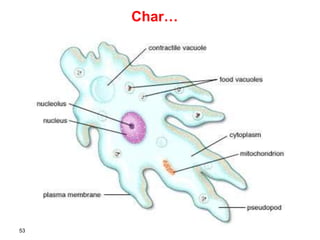
1. Amoebas (Subphylum Sarcodina)
= Move by extending blunt, lobe like projections -
pseudopodia (false feet)
= Amoebas engulf food with pseudopods &
phagocytize it
52
Char…
53
 Several genera:
•Entamoeba
•Iodamoeba
•Endolimax
•Naegleria (CNS)
•Acanthamoeba (CNS)
54
Char…
= Move by means of rotation of a whip-like organelle
called a Flagellum (plural: flagella)
= The flagella can also be used for gathering and sorting
of food
= Some species have organelles for the purpose of food
ingestion (gullet or cytostome), and for excretion
(cytopyge)
2. Flagellates (Mastigophora)
55
Char…
 several genera:
 Giardia
 Chilomastix
 Dientamoeba
 Trypanosoma
 Leishmania
 Trichomonas
Char…
56
Giardia intestinalis
Cyst Trophozoite
57
Char…
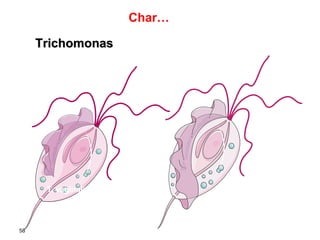
Trichomonas
T. intestinalis
T. vaginalis
58
Char…
Trypanosoma
59
Char…
Leishmania
Amastigote
Promastigote
60
Char…
C. Apicomplexans (Phylum
Apicomplexa)
 Have specialized
organelles at tip (apex) of
cells that penetrate host
tissues
 Locomotion of mature form
by body flexion or gliding
61
Char…
 Obligate intracellular parasites
 usually 2 or more hosts required
 Their life cycles have asexual and sexual phases
 several forms: sporozoites, trophozoites, merozoites,
gametocytes, schizont, oocyst & cyst.
62
Char…
Toxoplasma gondii (Toxoplasmosis)
Bradyzoite
Gamete
Merozoite
Oocyst
Sporulated
oocyst
Sporocyst
63
Char…
Char…
 Includes:
1. Intestinal coccidian
 Cryptosporidium
 Isospora
 Cyclospora
2. Blood and tissue coccidian
 Plasmodium
 Toxoplasma
 Babesia
 Sarcocystis
64
D. Ciliates (Phylum Ciliophora)
 Move and obtain food using
cilia
 Distinct cytostome (mouth)
Structure
 Dimorphic nuclei, typically
larger macronuclei and
smaller micronuclei
 Only known human pathogen
is Balantidium coli
65
Char…
E. Microsporans (Phylum Microsporidia)
 Obligate intracellular spore forming parasites
 Discovered in 1984 to cause chronic diarrhea and
conjunctivitis, mainly in AIDS patients
 at least 14 microsporidian species identified as human
pathogens: Enterocytozoon bieneusi, Encephalitozoon
intestinalis, Encephalitozoon hellem ….
66
Char…
1.7. Protozoans associated with HIV/AIDS
 C. parvum, I. belli and C. cayatenensis: causing
enteritis
 Microsporidia species: causing a diarrhea with
wasting, eye disease, and disseminated disease
 Pneumocystis carnii: causing life threatening
pneumonia
 Blastocystis hominis: cause severe enteritis
67
Pro …
T. gondii: causing cerebral toxoplasmosis
Leishmania species: emerging as a major
pathogens in HIV infected persons
68
Unit-1.ppt

Unit-1.ppt

  • 1.
  • 2.
  • 3.
    Learning Objectives Up oncompletion of this unit, you should be able to: Describe the general characteristics of protozoans Describe the basic structure of protozoa Describe the basic properties of protozoa Describe the classification of parasitic protozoa 3
  • 4.
    OUTLINE  General Introductionto protozoa  Definition  Diversity and importance of protozoa  General morphology of protozoa  Basic structure of protozoa  Basic properties of protozoa  Protozoan life cycle stages  Protozoan taxonomy  General characteristics of the five main groups of protozoa 4
  • 5.
  • 6.
    Definition  single-celled eukaryoticorganisms  kingdom Protista  Vary in size (1 -150um ) 6 General introduction to protozoa
  • 7.
    =Unknown until theinvention of the microscope in 1675 =First recognized by antony van leewenhoek in 1676 = He described it as little animal or animacula Int… 7
  • 8.
    Diversity  protozoa areextremely diverse organisms and found in a variety of niches Diversity and importance of protozoa 8
  • 9.
  • 10.
    Div…  200,000 namedspecies  Most species are free-living in =Freshwater =marine environments =decaying organic matter and soil  Few are adapted to a parasitic life but all plant and animal species have at least one protozoan parasite 10
  • 11.
    Div… =~10,000 are parasitesin a wide range of hosts =Vertebrate = invertebrate = Plants  ~20 human pathogens  Adapted to life in a wide range of sites within the host 11
  • 12.
    Ecological Niches inthe Human Body  Skin: Leishmania  Eye: Acanthamoeba  Mouth: Amoebae and flagellates (usually non- pathogenic)  Gut: Giardia, Entamoeba (and invasion to liver), Cryptosporidium, Isospora, Balantidium  G.U. tract: Trichomonas  Bloodstream: Plasmodium, Trypanosoma 12
  • 13.
    Div…  Spleen: Leishmania Liver: Leishmania, Entamoeba  Muscle: Trypanosoma cruzi  CNS: Trypanosoma, Naegleria, Toxoplasma, Plasmodium 13
  • 14.
    Importance of protozoa Medical importance:  Cause of more sickness and death than any other disease-causing organisms  significant damage to specific organs  brain (African sleeping sickness), eyes (acanthamoeba keratitis), heart (toxoplasmosis)  reduced working capacity  Loss of productivity 14
  • 15.
     Veterinary importance: Death  Potential losses  coccidiosis costs £8 million/yr.. Prophylactics  Animal trypanosomiasis  Zoonoses 15 Imp…
  • 16.
    General morphology ofprotozoa  Protozoa exhibit a wide variety of morphologies 16
  • 17.
    morp…  Size: rangefrom 1-150um  The smaller members, 1-10um  include most of the intracellular parasites (e.g. plasmodium, Leishmania …  The biggest in size belongs to ciliate e.g. Balantidium coli  Shape:  No single shape that represent all  Ranges from amorphous shapeless amoeba to relatively rigid forms 17
  • 18.
    Basic structure ofprotozoa 1. Cell membrane 2. Cytoplasm: ectoplasm & endoplasm 3. Nucleus: two kinds of nuclei:  Vesicular & compact 18
  • 19.
    1. Cell membrane:chemically similar to all eukaryotic cells  Thin & flexible layer called plasmalemma (sarcodina)  Also called pellicle or ectoderm or outer membrane  More rigid wall, usually supported by microtubules (sub-pellicular microtubules)  Results in more constant and uniform shape than that of amorphous amoeba  Characteristics of some flagellates and most ciliates 19 Stru …
  • 20.
  • 21.
    2. Cytoplasm: dividedin two areas  Ectoplasm=outer transparent layer  Locomotion  protection  Sensation, respiration  Excretion, Ingestion of food & etc  Endoplasm= inner granular layer  More fluid than ectoplasm, contains nuclei, mitochondria, vacuoles & etc  metabolism 21 Stru…
  • 22.
    3. Nucleus  welldefined nuclei bounded by nuclear envelop  Most easily identifiable structure in protozoan cell  Single/multiple  Important for reproduction  Similar in size or not E.g. G. lamblia, ciliate (micronuclei & macronuclei) 22 Stru…
  • 23.
    Stru…  Two morphologicallydistinct nuclei:  Vesicular:  with a clearly defined internal space resulting from irregular distribution of chromatin  Nucleoplasm contains one or more Karyosome  Karyosome nucleoli-like body  Most protozoa of humans exhibit the vesicular type 23
  • 24.
    Stru…  Compact:  appearsto be a solid mass  densely packed chromatin  Larger than vesicular nucleus  Are found in ciliates  Other structures like;  Mitochondria: sites for aerobic metabolism  Lysosomes: degradation of ingested materials  Ribosome: sites for protein synthesis 24
  • 25.
  • 26.
  • 27.
    B. Reproduction -General ProtozoanReproduction Asexual Reproduction Sexual Reproduction Binary Fission Mutiple Fission Endodyogeny Conjugation Singamy 27 Prop…
  • 28.
    Prop… 1. Asexual reproduction Fission  Division follows a sequence: Organelles nucleus cytoplasm A. Binary fission  Each parent gives rise to two progeny  Seen in amoeba, flagellates, ciliates 28
  • 29.
    Prop… B. Multiple fission/Schizogony/ Merogony  Rapid organell and nuclear divisions occur at the cell periphery  Cytoplasmic segmentation to form separate organisms called merozoites  The parent or multinucleated cell is called the schizont or segmenter and the daughter cells are merozoites  Seen in apicomplexan 29
  • 30.
    C. Endopolyogeny  Daughtercells form in the center of the mother cell (internal budding) rather than at the periphery  Endodyogeny is a form of endopolyogeny where two daughters are formed 30 Prop…
  • 31.
  • 32.
    2. Sexual Reproduction A.Conjugation  Specialized sexual reproduction (mostly in ciliates)  Involves nuclear exchange and union after cells join 32
  • 33.
  • 34.
    B. Syngamy Union ofthe entire cell (gametes fuse), seen in apicomplexan 34
  • 35.
    C. Feeding  Mostparasitic protozoa are heterotrophic  ingest particulates (phagotrophy)  Phagocytosis:  Engulfment of solid material  predation on bacteria or other protozoa  Pinocytosis:  Invagination of membrane surrounding liquids 35
  • 36.
     Peristome orcytostomal feeding  Food is ingested at a definite site, using a specialized feeding structure  Diffusion =absorb solutes (osmotrophy) through cell membrane  Food may be retained in special intracellular reserves, or vacuoles  Some protozoan are photosynthetic (autotrophy) or combination 36
  • 37.
    D. Excretion  Undigestedparticles and wastes are extruded at the cell surface by mechanisms that are the reverse of those used in ingestion  diffusion (primary mechanism)  contractile vacuole (osmo-regulation) 37
  • 38.
    E. Respiration  Bothaerobic (Malaria) and anaerobic respiration (dysenteric amoeba)  Most parasitic protozoa are facultative anaerobes  They can live in reduced oxygen environments 38 Prop…
  • 40.
    Protozoan life cyclestages/terms 1. Vegetative form: trophozoites  stage of active feeding and reproduction  commonly the pathogenic protozoan form  Excystation: For the completion of life cycle, cysts ingested by the definitive host has to change to vegetative form 2. Resístant form: cyst  Stage of inactivity  Most resistant stage = hard to kill (no medication) 40
  • 41.
    Encystation  Many protozoaform cysts – round cytoplasmic mass surrounded by a rigid or semi-rigid cyst wall secreted by organism  Function:  Protect against unfavorable external environmental conditions  Are the infective or transmissible form of parasite 41
  • 42.
    Conditions for encystment: Deficiency of host nutrient essential to the parasites  Desiccation/dryness  increase in osmotic pressure  Accumulation of waste product in the medium  Crowding  Low pH, Temperature change 42
  • 43.
    3. Oocyst:  resultsfrom fusion of gametes in the Sporozoa  Infective stage in most cases:  passed in host feces in case of intestinal protozoans or  in gut of the mosquito vector in the case of Plasmodium 43
  • 44.
    4. Sporozoite:  Formedwithin oocyst via asexual fission & infects new host cells of  intestinal epithelial cells in intestinal protozoans or  hepatocytes in case of Plasmodium 44
  • 45.
    5. Merozoite:  Resultedfrom schizogony of sporozoites  May infect:  intestinal epithelial cells in intestinal coccidian or  Red blood cells in the case of Plasmodium. … 45
  • 46.
    6. Gametocyte:  resultof merozoite cell fission  Fusion of these results in formation of oocyst  Other life cycle stages:  Amastigote, Promastigote, Epimastigote , Trypomastigote & Metacyclic Trypomastigote 46
  • 47.
    Example of Protozoanlife cycle 47
  • 48.
  • 49.
    49 Life cycle ofPlasmodium species
  • 50.
    Protozoan Taxonomy • Confused,controversial and constantly changing • No universal agreement = many systems & frequent changes • Several bases of classification; • light microscope = Originally based on motility • electron microscope =Ultra-structural criteria used since 1960’s;  4-6 phyla? In the kingdom protista • Molecular technique: DNA sequences 50
  • 51.
  • 52.
    General Characteristics offive main groups of protozoa 1. Amoebas (Subphylum Sarcodina) = Move by extending blunt, lobe like projections - pseudopodia (false feet) = Amoebas engulf food with pseudopods & phagocytize it 52
  • 53.
  • 54.
  • 55.
    = Move bymeans of rotation of a whip-like organelle called a Flagellum (plural: flagella) = The flagella can also be used for gathering and sorting of food = Some species have organelles for the purpose of food ingestion (gullet or cytostome), and for excretion (cytopyge) 2. Flagellates (Mastigophora) 55 Char…
  • 56.
     several genera: Giardia  Chilomastix  Dientamoeba  Trypanosoma  Leishmania  Trichomonas Char… 56
  • 57.
  • 58.
  • 59.
  • 60.
  • 61.
    C. Apicomplexans (Phylum Apicomplexa) Have specialized organelles at tip (apex) of cells that penetrate host tissues  Locomotion of mature form by body flexion or gliding 61 Char…
  • 62.
     Obligate intracellularparasites  usually 2 or more hosts required  Their life cycles have asexual and sexual phases  several forms: sporozoites, trophozoites, merozoites, gametocytes, schizont, oocyst & cyst. 62 Char…
  • 63.
  • 64.
    Char…  Includes: 1. Intestinalcoccidian  Cryptosporidium  Isospora  Cyclospora 2. Blood and tissue coccidian  Plasmodium  Toxoplasma  Babesia  Sarcocystis 64
  • 65.
    D. Ciliates (PhylumCiliophora)  Move and obtain food using cilia  Distinct cytostome (mouth) Structure  Dimorphic nuclei, typically larger macronuclei and smaller micronuclei  Only known human pathogen is Balantidium coli 65 Char…
  • 66.
    E. Microsporans (PhylumMicrosporidia)  Obligate intracellular spore forming parasites  Discovered in 1984 to cause chronic diarrhea and conjunctivitis, mainly in AIDS patients  at least 14 microsporidian species identified as human pathogens: Enterocytozoon bieneusi, Encephalitozoon intestinalis, Encephalitozoon hellem …. 66 Char…
  • 67.
    1.7. Protozoans associatedwith HIV/AIDS  C. parvum, I. belli and C. cayatenensis: causing enteritis  Microsporidia species: causing a diarrhea with wasting, eye disease, and disseminated disease  Pneumocystis carnii: causing life threatening pneumonia  Blastocystis hominis: cause severe enteritis 67
  • 68.
    Pro … T. gondii:causing cerebral toxoplasmosis Leishmania species: emerging as a major pathogens in HIV infected persons 68