PROTEINS
Dr.N.C.J.Packia Lekshmi
Allied Health Sciences
Noorul Islam Centre for Higher
Education
INTRODUCTION
• Protein is a macromolecule composed of one or more polypeptide
chains
• It’s a polymer of L α-amino acids.
• The term protein is derived from Greek: Proteuo means primary
or holding first place.
• The term protein was first proposed by Berzelius
• Most abundant organic molecules of the living system.
• Its fundamental basis of structures and function of life.
• Proteins make up 12% of the protoplasm - 50 % of dry weight of
every cell.
• They are body builders
• They contain carbon, hydrogen, oxygen, nitrogen and sometimes
sulphur
• They are constructed largely of aminoacids
• 300 different amino acids occur in nature – only 20 as standard
amino acids.
• 21st amino acid added - Selenocysteine
Sources of Protein
• Proteins are obtained both from animal and
plant souces.
• The animal sources of proteins include milk,
egg, meat, fish, liver etc…
• Plant sources of proteins are pulses, nuts and
cereals
Nutritive value
• Nutritive value of a protein is based on two factors –
amino acid composition and digestability
• Different foods contain different amounts and
different combinations of amino acids (the building
blocks of proteins).
• Protein from animal sources (e.g. meat, fish, eggs and
dairy products) contains the full range of essential
amino acids needed by the body – the nutritive value
is high called as first class proteins
• However, vegans and vegetarians can get all the
amino acids they need by combining different plant
sources of protein, e.g. pulses and cereals – nutritive
value is low is called as second class proteins
Elemental Composition of Protein
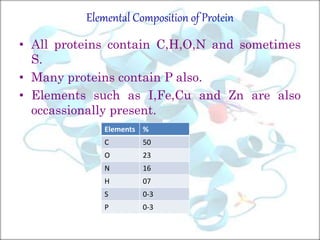
• All proteins contain C,H,O,N and sometimes
S.
• Many proteins contain P also.
• Elements such as I,Fe,Cu and Zn are also
occassionally present.
Elements %
C 50
O 23
N 16
H 07
S 0-3
P 0-3
What made Proteins
• Proteins are made of polymers of aminoacids.
• The aminoacids are the building blocks or
monomers of proteins.
• An amino acid consists of five parts:
– An amino group (NH2)
– A carboxyl group (COOH)
– A hydrogen atom
– An R group or a side chain or alkyl
– A carbon atom
• There are more than 100 amino acids.
• All proteins of the biological system from
bacteria to man are constructed out of 20
amino acids only.
• The 20 amino acids make up thousands of
proteins. For eg., bacterial cell contains 1000
to 2000 proteins and the human cell contains
as many as 100000 protein molecules.
How amino acids are linked to form Protein?
• In proteins, amino acids are linked together by a bond
called peptide bond
• A peptide bond is a chemical bond formed between two
molecules when the carboxyl group of one molecule
reacts with the amino group of the other molecule,
releasing a molecule of water (H2O).
• This is a dehydration synthesis reaction (also known
as a condensation reaction), and usually occurs
between amino acids.
• The resulting CO-NH bond is called a peptide bond,
and the resulting molecule is an amide.
• The four-atom functional group -C(=O)NH- is called
an amide group or (in the context of proteins) a
peptide group.
Formation of Peptide bond
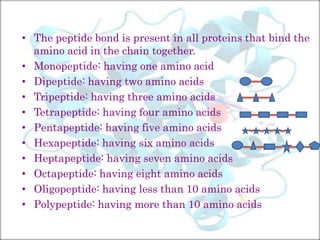
• The peptide bond is present in all proteins that bind the
amino acid in the chain together.
• Monopeptide: having one amino acid
• Dipeptide: having two amino acids
• Tripeptide: having three amino acids
• Tetrapeptide: having four amino acids
• Pentapeptide: having five amino acids
• Hexapeptide: having six amino acids
• Heptapeptide: having seven amino acids
• Octapeptide: having eight amino acids
• Oligopeptide: having less than 10 amino acids
• Polypeptide: having more than 10 amino acids
How does a polypeptide chain becomes a Protein?
• A peptide is two or more amino acids joined together by
peptide bonds; a polypeptide is a chain of many amino
acids; and a protein contains one or more polypeptides
• Many protein such as myoglobin consist of a single
polypeptide chain.
• Others contain two or more chains, which may be either
identical or different. Eg., haemoglobin is formed of 4
polypeptide chains of which two chains are of one kind and
the other two are of another kind.
• The polypeptide chains are linked by disulphide bonds. Eg.,
insulin has two chains joined by two disulphide bonds
What Is the Difference Between a Peptide and a Protein?
• The basic distinguishing factors are size and
structure. Peptides are smaller than proteins.
• Traditionally, peptides are defined as molecules that
consist of between 2 and 50 amino acids, whereas
proteins are made up of 50 or more amino acids.
• In addition, peptides tend to be less well defined in
structure than proteins, which can adopt complex
conformations known as secondary, tertiary, and
quaternary structures.
Occurrence of amino acids in various Proteins
• The amino acid compositions for a large variety of proteins of microbial,
plant and animal origin have reliably been established.
• The sequence of amino acids in a protein is closely related to the genetic
code.
• Alanine, glycine, leucine are most commonly found in proteins. But each
protein has its own amino acid composition.
• Protamines, simple protein found in fish sperm, contain as much as 85%
arginine, but lack threonine and lysine as well as cyclic, acidic and
sulphur containing amino acids.
• Fibroin, protein of silk contains 50% of glycine.
• Collagen, contains hydroxylysine and hydroxyproline which are absent
in other proteins.
Classification of Proteins
• They are classified into two ways
– On the basis of their solubility or shape
– On the basis of increasing complexity of
structure
Classification of Protein on the basis on solubility or shape
• Proteins are classified into two groups
on the basis of their solubility or shape.
– Globular proteins
– fibrous proteins
Globular proteins
– Spherical in shape
– Soluble in water
– Highly branched
– Polypeptide chains are linked by usual peptide
bonds
– Tightly folded into spherical or globular shapes
– Eg., enzymes, protein hormones, antibodies,
haemoglobin, myoglobin
Fibrous Protein
– Insoluble in water
– In the form of fibres
– Highly resistant to digestion by proteolytic enzymes
– Unbranched – linear molecules
– Long linear protein chains are held together by
intermolecular hydrogen bonds
– Not folded in to globular molecules
– Serve as structural proteins
– Eg., collagen of tendons, elastin of connective tissue, fibroin of
silk, keratin of silk, actin and myosin
Classsification of protein On the basis of increasing complexity of
structure
• On the basis of increasing complexity of
structure, proteins are classified into
three groups
– Simple proteins
– Conjugated proteins
– Derived proteins
Simple Proteins
• They are composed of amino acids only.
• Some examples are;
Protamine:
• They are positively charged (basic) proteins mostly present in animals
and fishes (sperm)
• Protamines binds with DNA in embryonic stage and later replaced by
histone
• It is soluble in water and ammonium hydroxide solution
• It is not coagulated by heat
• It precipitate out in aqueous solution of alcohol
• Protamine are rich in arginine and lysine whereas devoid of sulfur
containing and aromatic amino acids.
Histone:
• They are basic protein but weak base in comparison to
protamine.
• Histone is low molecular weight protein and are water
soluble.
• Histones are rich in basic amino acids like histidine and
arginine, but deficient in tryptophan and contain little
cystine or methionine.
• It is not coagulated by heat.
• Histone is present in nucleic acids as nucleohistone binding
with DNA.
Albumin:
• It is the most abundant protein in nature
• It is most commonly found in seeds in plants and in
blood and muscles in animals.
• Molecular weight of albumin is 65000 KD
• It is water soluble and can be coagulated by heat
• Plant albumins; Leucosine, Legumelins etc
• Animal albumins; serum albumin, myosin,
lactalbumin, ova-albumin etc
Globulin:
• Pseudoglobulin (water soluble) and Euglobulin (water insoluble)
• They are coagulated by heat.
• They are precipitated by lower concentrations of salts such as
ammonium sulphate or sodium sulphate
• Eg., plasma globulin, serum globulin, ovaglobulin in egg white, myosin
in muscles and edestin in hemp seed.
Glutelins:
• Water insoluble. Eg. Glttenin (wheat), glutelin (corn), oryzenin (rice)
• They are coagulated by heat.
• They are rich in arginine, proline and glutamic acid
• Eg., Glutenin in wheat oryzenin in rice.
Prolamine:
• They are storage protein found in seeds.
• They are water insoluble. But soluble in dilute
acid or detergents and 60-80% alcohol.
• They are coagulated by heat
• Prolamine is rich in proline and glutamine
• Examples; Gliadin (wheat), zein (corn), Hordein
(barley), Avenin (oats)
Conjugated Proteins
• These proteins in which protein are always linked by non-protein moiety to become
functional. So, they are composed of both protein and non- protein components. The
non-protein component is known as prosthetic group.
• On the basis of prosthetic group, they are classified as follows;
Metalloprotein:
• They have metal prosthetic group.
• Some metals such as Hg, Ag, CU, Zn etc, strongly binds with proteins such as collagen,
albumin, casein by –SH group of side chain of amino acids.
• Eg. Ceruloplasmin; contains copper as prosthetic group
• Some other metals such as Calcium weakly binds with protein. Eg. Calsequestrin,
calmodulin
• Some metals such as Na, K etc do not binds with protein but associate with nucleic
acids protein.
Chromoprotein:
• They have colored prosthetic group.
• These are simple proteins linked to a metallic prosthetic group which
gives the colour to the protein
• Some examples are;
• Haemoprotein: Haemoglobin, myoglobin, chlorophyll, cytochrome,
peroxidase, haemocyanin
• Flavoprotein: Riboflavin (Vit B2) give yellow/orange color to FAD
requiring enzymes
Glycoprotein/Mucoprotein:
• They have carbohydrate as prosthetic group
• On hydrolysis they yield amino sugars
• Eg. Antibody, complement proteins, Heparin, Hyaluronic acid
Phosphoprotein:
• They have phosphate group as prosthetic group.
• The phosphoric acid is attached to the hydroxyl group of
protein by an ester linkage
• Eg. Caesein (milk protein binds with calcium ion to form
calcium salt of caseinate)
• Ovovitellin; present in egg yolk
• Calcineurin
Lipoprotein:
• They have lipid as prosthetic group.
• Eg. Lipovitelline, chylomicrons
Derived Protein
• These protein are the derivatives of either simple or complex protein resulting from the
action of heat, enzymes and chemicals.
• Some artificially produced protein are included in this group.
• They are classified as primary derived protein and secondary derived protein.
Primary derived protein:
• The derived protein in which the size of protein molecules are not altered materially
but only the arrangement is changed.
• Some examples are;
Proteans:
• Obtained as a first product after the action of acid or enzymes or water on protein.
• They are denatured protein
• They are insoluble in water.
• Eg. Edestan, myosin
Metaprotein:
• They are produced by further action of acid or alkali on protein at
30-60°C.
• They are water insoluble but soluble in dil acid or alkali.
• Also known as Infraprotein.
• Eg. Curd
Coagulated protein:
• They are produced by the action of heat or alcohol on protein.
• They are insoluble in water.
• Eg. Coagulated egg white
Secondary derived protein:
• The derived protein in which size of original protein are altered.
• Hydrolysis has occurred due to which size of protein molecule are smaller than original
one.
• Examples; a) Proteoses:
• They are produced by the action of dilute acid or digestive enzymes when the
hydrolysis proceeds beyond the level of metaprotein.
• They are soluble in water
• They are not coagulated by heat. • Eg. Albumose, Globulose etc.
Peptones
• They are soluble in water
• They are not coagulated by heat
• They are precipitated by saturating their solutions with ammonium sulphate
Polypeptides
• They are derivatives of proteins containing many amino acid units
Properties of Proteins
Physical Properties
Chemical Properties
Physical Properties of Proteins
Colour and Taste
• Proteins are colourless except chromoproteins and usually tasteless. These are
homogeneous and crystalline.
Shape and Size
• The proteins range in shape from simple crystalloid spherical structures to long
fibrillar structures. Two distinct patterns of shapehave been recognized :
A. Globular proteins- These are spherical in shape and occur mainly in plants,
esp., in seeds and in leaf cells. These are bundles formed by folding and
crumpling of protein chains. e.g., pepsin, edestin, insulin, ribonuclease etc.
B. Fibrillar proteins- These are thread-like or ellipsoidal in shape and occur
generally in animal muscles. Most of the studies regarding protein structure have
been conducted using these proteins. e.g., fibrinogen, myosin etc.
Molecular Weight
• The proteins generally have large molecular weights ranging between 5
× 103 and 1 × 10⁶. It might be noted that the values of molecular
weights of many proteins lie close to or multiples of 35,000 and 70,000.
Colloidal Nature
• Because of their giant size, the proteins exhibit many colloidal
properties, such as; Their diffusion rates are extremely slow and they
may produce considerable light-scattering in solution, thus resulting in
visible turbidity (Tyndall effect).
Denaturation
• Denaturation refers to the changes in the properties of a protein. In
other words, it is the loss of biologic activity. In many instances the
process of denaturation is followed by coagulation— a process where
denatured protein molecules tend to form large aggregates and to
precipitate from solution.
Amphoteric Nature
• Like amino acids, the proteins are amphoteric, i.e., they act as
acids and alkalies both. These migrate in an electric field and the
direction of migration depends upon the net charge possessed by
the molecule. The net charge is influenced by the pH value. Each
protein has a fixed value of isoelectric point (pl) at which it will
move in an electric field.
Ion Binding Capacity
• The proteins can form salts with both cations and anions based
on their net charge.
Solubility
• The solubility of proteins is influenced by pH. Solubility is
lowest at isoelectric point and increases with increasing
acidity or alkalinity. This is because when the protein
molecules exist as either cations or anions, repulsive forces
between ions are high, since all the molecules possess
excess charges of the same sign. Thus, they will be more
soluble than in the isoelectric state.
Optical Activity
• All protein solutions rotate the plane of polarized light to
the left, i.e., these are levoratotory.
Chemical Properties of Proteins
Hydrolysis
• Proteins are hydrolyzed by a variety of hydrolytic agents.
• A. By acidic agents: Proteins, upon hydrolysis with conc. HCl (6–12N) at
100–110°C for 6 to 20 hrs, yield amino acids in the form of their
hydrochlorides.
• B. By alkaline agents: Proteins may also be hydrolyzed with 2N NaOH.
Reactions involving SH Group
• A. Nitroprusside test: Red colour develops with sodium nitroprusside in
dilute NH4.OH. The test is specific for cysteine.
• B. Sullivan test: Cysteine develops red colour in the presence of sodium
1, 2-naphthoquinone- 4-sulfonate and sodium hydrosulfite.
Reactions involving COOH Group
• A. Reaction with alkalies (Salt formation)
• B. Reaction with alcohols (Esterification)
• C. Reaction with amines
Reactions involving NH2 Group
• A. Reaction with mineral acids (Salt formation): When either free amino acids or
proteins are treated with mineral acids like HCl, the acid salts are formed.
• B. Reaction with formaldehyde: With formaldehyde, the hydroxy-methyl derivatives
are formed.
• C. Reaction with benzaldehyde: Schiff ‘s bases are formed
• D. Reaction with nitrous acid (Van Slyke reaction): The amino acids react with HNO2
to liberate N2 gas and to produce the corresponding α-hydroxy acids.
• E. Reaction with acylating agents (Acylation)
• F. Reaction with FDNB or Sanger’s reagent
• G. Reaction with dansyl chloride
Reactions involving both COOH AND NH2 Group
• A. Reaction with triketohydrindene hydrate (Ninhydrin reaction)
• B. Reaction with phenyl isocyanate: With phenyl isocyanate,
hydantoic acid is formed which in turn can be converted to
hydantoin.
• C. Reaction with phenyl isothiocyanate or Edman reagent
• D. Reaction with phosgene: With phosgene, N-carboxyanhydride
is formed
• E. Reaction with carbon disulfide: With carbon disulfide, 2-thio-5-
thiozolidone is produced
Reactions involving R Group or Side Chain
• A. Biuret test
• B. Xanthoproteic test
• C. Millon’s test
• D. Folin’s test
• E. Sakaguchi test
• F. Pauly test
• G. Ehrlich test
Functions of Proteins
Enzyme Catalyst
– Almost all chemcial reactions in the biological system are catalyzed by enzymes.
They increase reaction rates atleast a million fold.
Transport system
– Proteins transport ions and small molecules
– Haemoglobin – conjugated protein of blood, transports oxygen
– Myoglobin – a muscle protein, transports oxygen in the muscles
– Transferrin – carries iron in the plasma of blood
– The membrane proteins – transport glucose, aminoacids and other nutrients
across the membrane of the cell
Storage
– Certain protein function as a storage molecules
– Ferritin – a protein stores iron in the liver
– Seeds – stores nutrient proteins eg., Wheat, corn, rice etc…
Nutrients
– Certain proteins function as a storage molecule
– The egg contains ovalbumin
– Milk contains casein
Contraction and Movement
– The contraction of muscle is brought about by two fibrous proteins called actin and
myosin
– The microtubules of flagella and cilia are built on tubulin, a protein
Mechanical Support
– Many proteins serve as supporting filaments, cables or sheets to give biological
structures, strength, support and protection
– Collagen – fibrous protein – major component of tendons, cartilage and leather
– Ligaments contain elastin, a structural protein
– Keratin – an insoluble protein, is the main component of hair, finger nails and
feathers
– Fibroin – major component of silk fibres and spider web
Immune Protection
– Many proteins defend against invading organisms
– Antibodies are protein immunoglobulins
Blood clotting
– Blood clotting factors such as fibrinogen and thrombin are proteins
Transmission of Nerve Impulse
– The nerve impulse is transmitted through synapse with the help of receptor
proteins
Gene Expression
– The inactivation of genes is brought by repressor proteins
Hormonal Action
– Insulin, growth hormone, parathyroid hormone etc.. are proteins
Thermoregulation
– The blood plasma of some antarctic fish contains antifreeze proteins, which protect
the blood from freezing
SOMETIMES WE’RE TESTED NOT TO SHOW OUR WEAKNESSES, BUT TO DISCOVER OUR
STRENGTHS
THANK YOU

Proteins

  • 1.
    PROTEINS Dr.N.C.J.Packia Lekshmi Allied HealthSciences Noorul Islam Centre for Higher Education
  • 2.
    INTRODUCTION • Protein isa macromolecule composed of one or more polypeptide chains • It’s a polymer of L α-amino acids. • The term protein is derived from Greek: Proteuo means primary or holding first place. • The term protein was first proposed by Berzelius • Most abundant organic molecules of the living system. • Its fundamental basis of structures and function of life. • Proteins make up 12% of the protoplasm - 50 % of dry weight of every cell. • They are body builders • They contain carbon, hydrogen, oxygen, nitrogen and sometimes sulphur • They are constructed largely of aminoacids • 300 different amino acids occur in nature – only 20 as standard amino acids. • 21st amino acid added - Selenocysteine
  • 3.
    Sources of Protein •Proteins are obtained both from animal and plant souces. • The animal sources of proteins include milk, egg, meat, fish, liver etc… • Plant sources of proteins are pulses, nuts and cereals
  • 4.
    Nutritive value • Nutritivevalue of a protein is based on two factors – amino acid composition and digestability • Different foods contain different amounts and different combinations of amino acids (the building blocks of proteins). • Protein from animal sources (e.g. meat, fish, eggs and dairy products) contains the full range of essential amino acids needed by the body – the nutritive value is high called as first class proteins • However, vegans and vegetarians can get all the amino acids they need by combining different plant sources of protein, e.g. pulses and cereals – nutritive value is low is called as second class proteins
  • 5.
    Elemental Composition ofProtein • All proteins contain C,H,O,N and sometimes S. • Many proteins contain P also. • Elements such as I,Fe,Cu and Zn are also occassionally present. Elements % C 50 O 23 N 16 H 07 S 0-3 P 0-3
  • 6.
    What made Proteins •Proteins are made of polymers of aminoacids. • The aminoacids are the building blocks or monomers of proteins. • An amino acid consists of five parts: – An amino group (NH2) – A carboxyl group (COOH) – A hydrogen atom – An R group or a side chain or alkyl – A carbon atom
  • 7.
    • There aremore than 100 amino acids. • All proteins of the biological system from bacteria to man are constructed out of 20 amino acids only. • The 20 amino acids make up thousands of proteins. For eg., bacterial cell contains 1000 to 2000 proteins and the human cell contains as many as 100000 protein molecules.
  • 8.
    How amino acidsare linked to form Protein? • In proteins, amino acids are linked together by a bond called peptide bond • A peptide bond is a chemical bond formed between two molecules when the carboxyl group of one molecule reacts with the amino group of the other molecule, releasing a molecule of water (H2O). • This is a dehydration synthesis reaction (also known as a condensation reaction), and usually occurs between amino acids. • The resulting CO-NH bond is called a peptide bond, and the resulting molecule is an amide. • The four-atom functional group -C(=O)NH- is called an amide group or (in the context of proteins) a peptide group.
  • 9.
  • 10.
    • The peptidebond is present in all proteins that bind the amino acid in the chain together. • Monopeptide: having one amino acid • Dipeptide: having two amino acids • Tripeptide: having three amino acids • Tetrapeptide: having four amino acids • Pentapeptide: having five amino acids • Hexapeptide: having six amino acids • Heptapeptide: having seven amino acids • Octapeptide: having eight amino acids • Oligopeptide: having less than 10 amino acids • Polypeptide: having more than 10 amino acids
  • 11.
    How does apolypeptide chain becomes a Protein? • A peptide is two or more amino acids joined together by peptide bonds; a polypeptide is a chain of many amino acids; and a protein contains one or more polypeptides • Many protein such as myoglobin consist of a single polypeptide chain. • Others contain two or more chains, which may be either identical or different. Eg., haemoglobin is formed of 4 polypeptide chains of which two chains are of one kind and the other two are of another kind. • The polypeptide chains are linked by disulphide bonds. Eg., insulin has two chains joined by two disulphide bonds
  • 12.
    What Is theDifference Between a Peptide and a Protein? • The basic distinguishing factors are size and structure. Peptides are smaller than proteins. • Traditionally, peptides are defined as molecules that consist of between 2 and 50 amino acids, whereas proteins are made up of 50 or more amino acids. • In addition, peptides tend to be less well defined in structure than proteins, which can adopt complex conformations known as secondary, tertiary, and quaternary structures.
  • 14.
    Occurrence of aminoacids in various Proteins • The amino acid compositions for a large variety of proteins of microbial, plant and animal origin have reliably been established. • The sequence of amino acids in a protein is closely related to the genetic code. • Alanine, glycine, leucine are most commonly found in proteins. But each protein has its own amino acid composition. • Protamines, simple protein found in fish sperm, contain as much as 85% arginine, but lack threonine and lysine as well as cyclic, acidic and sulphur containing amino acids. • Fibroin, protein of silk contains 50% of glycine. • Collagen, contains hydroxylysine and hydroxyproline which are absent in other proteins.
  • 15.
    Classification of Proteins •They are classified into two ways – On the basis of their solubility or shape – On the basis of increasing complexity of structure
  • 16.
    Classification of Proteinon the basis on solubility or shape • Proteins are classified into two groups on the basis of their solubility or shape. – Globular proteins – fibrous proteins
  • 17.
    Globular proteins – Sphericalin shape – Soluble in water – Highly branched – Polypeptide chains are linked by usual peptide bonds – Tightly folded into spherical or globular shapes – Eg., enzymes, protein hormones, antibodies, haemoglobin, myoglobin
  • 18.
    Fibrous Protein – Insolublein water – In the form of fibres – Highly resistant to digestion by proteolytic enzymes – Unbranched – linear molecules – Long linear protein chains are held together by intermolecular hydrogen bonds – Not folded in to globular molecules – Serve as structural proteins – Eg., collagen of tendons, elastin of connective tissue, fibroin of silk, keratin of silk, actin and myosin
  • 19.
    Classsification of proteinOn the basis of increasing complexity of structure • On the basis of increasing complexity of structure, proteins are classified into three groups – Simple proteins – Conjugated proteins – Derived proteins
  • 20.
    Simple Proteins • Theyare composed of amino acids only. • Some examples are; Protamine: • They are positively charged (basic) proteins mostly present in animals and fishes (sperm) • Protamines binds with DNA in embryonic stage and later replaced by histone • It is soluble in water and ammonium hydroxide solution • It is not coagulated by heat • It precipitate out in aqueous solution of alcohol • Protamine are rich in arginine and lysine whereas devoid of sulfur containing and aromatic amino acids.
  • 21.
    Histone: • They arebasic protein but weak base in comparison to protamine. • Histone is low molecular weight protein and are water soluble. • Histones are rich in basic amino acids like histidine and arginine, but deficient in tryptophan and contain little cystine or methionine. • It is not coagulated by heat. • Histone is present in nucleic acids as nucleohistone binding with DNA.
  • 22.
    Albumin: • It isthe most abundant protein in nature • It is most commonly found in seeds in plants and in blood and muscles in animals. • Molecular weight of albumin is 65000 KD • It is water soluble and can be coagulated by heat • Plant albumins; Leucosine, Legumelins etc • Animal albumins; serum albumin, myosin, lactalbumin, ova-albumin etc
  • 23.
    Globulin: • Pseudoglobulin (watersoluble) and Euglobulin (water insoluble) • They are coagulated by heat. • They are precipitated by lower concentrations of salts such as ammonium sulphate or sodium sulphate • Eg., plasma globulin, serum globulin, ovaglobulin in egg white, myosin in muscles and edestin in hemp seed. Glutelins: • Water insoluble. Eg. Glttenin (wheat), glutelin (corn), oryzenin (rice) • They are coagulated by heat. • They are rich in arginine, proline and glutamic acid • Eg., Glutenin in wheat oryzenin in rice.
  • 24.
    Prolamine: • They arestorage protein found in seeds. • They are water insoluble. But soluble in dilute acid or detergents and 60-80% alcohol. • They are coagulated by heat • Prolamine is rich in proline and glutamine • Examples; Gliadin (wheat), zein (corn), Hordein (barley), Avenin (oats)
  • 25.
    Conjugated Proteins • Theseproteins in which protein are always linked by non-protein moiety to become functional. So, they are composed of both protein and non- protein components. The non-protein component is known as prosthetic group. • On the basis of prosthetic group, they are classified as follows; Metalloprotein: • They have metal prosthetic group. • Some metals such as Hg, Ag, CU, Zn etc, strongly binds with proteins such as collagen, albumin, casein by –SH group of side chain of amino acids. • Eg. Ceruloplasmin; contains copper as prosthetic group • Some other metals such as Calcium weakly binds with protein. Eg. Calsequestrin, calmodulin • Some metals such as Na, K etc do not binds with protein but associate with nucleic acids protein.
  • 26.
    Chromoprotein: • They havecolored prosthetic group. • These are simple proteins linked to a metallic prosthetic group which gives the colour to the protein • Some examples are; • Haemoprotein: Haemoglobin, myoglobin, chlorophyll, cytochrome, peroxidase, haemocyanin • Flavoprotein: Riboflavin (Vit B2) give yellow/orange color to FAD requiring enzymes Glycoprotein/Mucoprotein: • They have carbohydrate as prosthetic group • On hydrolysis they yield amino sugars • Eg. Antibody, complement proteins, Heparin, Hyaluronic acid
  • 27.
    Phosphoprotein: • They havephosphate group as prosthetic group. • The phosphoric acid is attached to the hydroxyl group of protein by an ester linkage • Eg. Caesein (milk protein binds with calcium ion to form calcium salt of caseinate) • Ovovitellin; present in egg yolk • Calcineurin Lipoprotein: • They have lipid as prosthetic group. • Eg. Lipovitelline, chylomicrons
  • 28.
    Derived Protein • Theseprotein are the derivatives of either simple or complex protein resulting from the action of heat, enzymes and chemicals. • Some artificially produced protein are included in this group. • They are classified as primary derived protein and secondary derived protein. Primary derived protein: • The derived protein in which the size of protein molecules are not altered materially but only the arrangement is changed. • Some examples are; Proteans: • Obtained as a first product after the action of acid or enzymes or water on protein. • They are denatured protein • They are insoluble in water. • Eg. Edestan, myosin
  • 29.
    Metaprotein: • They areproduced by further action of acid or alkali on protein at 30-60°C. • They are water insoluble but soluble in dil acid or alkali. • Also known as Infraprotein. • Eg. Curd Coagulated protein: • They are produced by the action of heat or alcohol on protein. • They are insoluble in water. • Eg. Coagulated egg white
  • 30.
    Secondary derived protein: •The derived protein in which size of original protein are altered. • Hydrolysis has occurred due to which size of protein molecule are smaller than original one. • Examples; a) Proteoses: • They are produced by the action of dilute acid or digestive enzymes when the hydrolysis proceeds beyond the level of metaprotein. • They are soluble in water • They are not coagulated by heat. • Eg. Albumose, Globulose etc. Peptones • They are soluble in water • They are not coagulated by heat • They are precipitated by saturating their solutions with ammonium sulphate Polypeptides • They are derivatives of proteins containing many amino acid units
  • 31.
    Properties of Proteins PhysicalProperties Chemical Properties
  • 32.
    Physical Properties ofProteins Colour and Taste • Proteins are colourless except chromoproteins and usually tasteless. These are homogeneous and crystalline. Shape and Size • The proteins range in shape from simple crystalloid spherical structures to long fibrillar structures. Two distinct patterns of shapehave been recognized : A. Globular proteins- These are spherical in shape and occur mainly in plants, esp., in seeds and in leaf cells. These are bundles formed by folding and crumpling of protein chains. e.g., pepsin, edestin, insulin, ribonuclease etc. B. Fibrillar proteins- These are thread-like or ellipsoidal in shape and occur generally in animal muscles. Most of the studies regarding protein structure have been conducted using these proteins. e.g., fibrinogen, myosin etc.
  • 33.
    Molecular Weight • Theproteins generally have large molecular weights ranging between 5 × 10³ and 1 × 10⁶. It might be noted that the values of molecular weights of many proteins lie close to or multiples of 35,000 and 70,000. Colloidal Nature • Because of their giant size, the proteins exhibit many colloidal properties, such as; Their diffusion rates are extremely slow and they may produce considerable light-scattering in solution, thus resulting in visible turbidity (Tyndall effect). Denaturation • Denaturation refers to the changes in the properties of a protein. In other words, it is the loss of biologic activity. In many instances the process of denaturation is followed by coagulation— a process where denatured protein molecules tend to form large aggregates and to precipitate from solution.
  • 34.
    Amphoteric Nature • Likeamino acids, the proteins are amphoteric, i.e., they act as acids and alkalies both. These migrate in an electric field and the direction of migration depends upon the net charge possessed by the molecule. The net charge is influenced by the pH value. Each protein has a fixed value of isoelectric point (pl) at which it will move in an electric field. Ion Binding Capacity • The proteins can form salts with both cations and anions based on their net charge.
  • 35.
    Solubility • The solubilityof proteins is influenced by pH. Solubility is lowest at isoelectric point and increases with increasing acidity or alkalinity. This is because when the protein molecules exist as either cations or anions, repulsive forces between ions are high, since all the molecules possess excess charges of the same sign. Thus, they will be more soluble than in the isoelectric state. Optical Activity • All protein solutions rotate the plane of polarized light to the left, i.e., these are levoratotory.
  • 36.
    Chemical Properties ofProteins Hydrolysis • Proteins are hydrolyzed by a variety of hydrolytic agents. • A. By acidic agents: Proteins, upon hydrolysis with conc. HCl (6–12N) at 100–110°C for 6 to 20 hrs, yield amino acids in the form of their hydrochlorides. • B. By alkaline agents: Proteins may also be hydrolyzed with 2N NaOH. Reactions involving SH Group • A. Nitroprusside test: Red colour develops with sodium nitroprusside in dilute NH4.OH. The test is specific for cysteine. • B. Sullivan test: Cysteine develops red colour in the presence of sodium 1, 2-naphthoquinone- 4-sulfonate and sodium hydrosulfite.
  • 37.
    Reactions involving COOHGroup • A. Reaction with alkalies (Salt formation) • B. Reaction with alcohols (Esterification) • C. Reaction with amines Reactions involving NH2 Group • A. Reaction with mineral acids (Salt formation): When either free amino acids or proteins are treated with mineral acids like HCl, the acid salts are formed. • B. Reaction with formaldehyde: With formaldehyde, the hydroxy-methyl derivatives are formed. • C. Reaction with benzaldehyde: Schiff ‘s bases are formed • D. Reaction with nitrous acid (Van Slyke reaction): The amino acids react with HNO2 to liberate N2 gas and to produce the corresponding α-hydroxy acids. • E. Reaction with acylating agents (Acylation) • F. Reaction with FDNB or Sanger’s reagent • G. Reaction with dansyl chloride
  • 38.
    Reactions involving bothCOOH AND NH2 Group • A. Reaction with triketohydrindene hydrate (Ninhydrin reaction) • B. Reaction with phenyl isocyanate: With phenyl isocyanate, hydantoic acid is formed which in turn can be converted to hydantoin. • C. Reaction with phenyl isothiocyanate or Edman reagent • D. Reaction with phosgene: With phosgene, N-carboxyanhydride is formed • E. Reaction with carbon disulfide: With carbon disulfide, 2-thio-5- thiozolidone is produced
  • 39.
    Reactions involving RGroup or Side Chain • A. Biuret test • B. Xanthoproteic test • C. Millon’s test • D. Folin’s test • E. Sakaguchi test • F. Pauly test • G. Ehrlich test
  • 40.
    Functions of Proteins EnzymeCatalyst – Almost all chemcial reactions in the biological system are catalyzed by enzymes. They increase reaction rates atleast a million fold. Transport system – Proteins transport ions and small molecules – Haemoglobin – conjugated protein of blood, transports oxygen – Myoglobin – a muscle protein, transports oxygen in the muscles – Transferrin – carries iron in the plasma of blood – The membrane proteins – transport glucose, aminoacids and other nutrients across the membrane of the cell Storage – Certain protein function as a storage molecules – Ferritin – a protein stores iron in the liver – Seeds – stores nutrient proteins eg., Wheat, corn, rice etc…
  • 41.
    Nutrients – Certain proteinsfunction as a storage molecule – The egg contains ovalbumin – Milk contains casein Contraction and Movement – The contraction of muscle is brought about by two fibrous proteins called actin and myosin – The microtubules of flagella and cilia are built on tubulin, a protein Mechanical Support – Many proteins serve as supporting filaments, cables or sheets to give biological structures, strength, support and protection – Collagen – fibrous protein – major component of tendons, cartilage and leather – Ligaments contain elastin, a structural protein – Keratin – an insoluble protein, is the main component of hair, finger nails and feathers – Fibroin – major component of silk fibres and spider web
  • 42.
    Immune Protection – Manyproteins defend against invading organisms – Antibodies are protein immunoglobulins Blood clotting – Blood clotting factors such as fibrinogen and thrombin are proteins Transmission of Nerve Impulse – The nerve impulse is transmitted through synapse with the help of receptor proteins Gene Expression – The inactivation of genes is brought by repressor proteins Hormonal Action – Insulin, growth hormone, parathyroid hormone etc.. are proteins Thermoregulation – The blood plasma of some antarctic fish contains antifreeze proteins, which protect the blood from freezing
  • 43.
    SOMETIMES WE’RE TESTEDNOT TO SHOW OUR WEAKNESSES, BUT TO DISCOVER OUR STRENGTHS THANK YOU