Definition
Proteins are organiccomplex nitrogenous compounds of high molecular weight, formed
of C, H, O, N [N= 16%].
They are formed of a number of amino acids linked together by peptide linkage
[-CO-NH-].
The carboxylic group[COOH] of the first amino acid unites with the amino group of the
second amino acid and so on.
3.
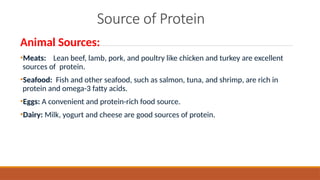
Source of Protein
AnimalSources:
•Meats: Lean beef, lamb, pork, and poultry like chicken and turkey are excellent
sources of protein.
•Seafood: Fish and other seafood, such as salmon, tuna, and shrimp, are rich in
protein and omega-3 fatty acids.
•Eggs: A convenient and protein-rich food source.
•Dairy: Milk, yogurt and cheese are good sources of protein.
4.
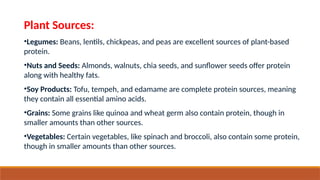
Plant Sources:
•Legumes: Beans,lentils, chickpeas, and peas are excellent sources of plant-based
protein.
•Nuts and Seeds: Almonds, walnuts, chia seeds, and sunflower seeds offer protein
along with healthy fats.
•Soy Products: Tofu, tempeh, and edamame are complete protein sources, meaning
they contain all essential amino acids.
•Grains: Some grains like quinoa and wheat germ also contain protein, though in
smaller amounts than other sources.
•Vegetables: Certain vegetables, like spinach and broccoli, also contain some protein,
though in smaller amounts than other sources.
5.
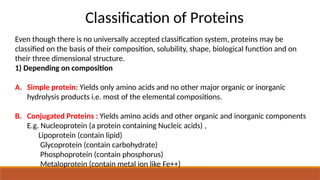
Classification of Proteins
Eventhough there is no universally accepted classification system, proteins may be
classified on the basis of their composition, solubility, shape, biological function and on
their three dimensional structure.
1) Depending on composition
A. Simple protein: Yields only amino acids and no other major organic or inorganic
hydrolysis products i.e. most of the elemental compositions.
B. Conjugated Proteins : Yields amino acids and other organic and inorganic components
E.g. Nucleoprotein (a protein containing Nucleic acids) ,
Lipoprotein (contain lipid)
Glycoprotein (contain carbohydrate)
Phosphoprotein (contain phosphorus)
Metaloprotein (contain metal ion like Fe++)
6.
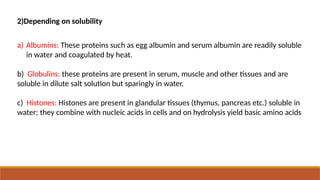
2)Depending on solubility
a)Albumins: These proteins such as egg albumin and serum albumin are readily soluble
in water and coagulated by heat.
b) Globulins: these proteins are present in serum, muscle and other tissues and are
soluble in dilute salt solution but sparingly in water.
c) Histones: Histones are present in glandular tissues (thymus, pancreas etc.) soluble in
water; they combine with nucleic acids in cells and on hydrolysis yield basic amino acids
7.
3. Depending onOverall Shape
A. Fibrous proteins In these protein, the molecule are constituted by several coiled
cross-linked polypeptide chains, they are insoluble in water and highly resistant to
enzyme digestion. The ratio of length to breath (axial ratio) is more than 10 in
such protein. A few sub groups are listed below.
1. Collagens: the major protein of the connective tissue, insoluble in water, acids
or alkalis. But they are convertible to water-soluble gelatin, easily digestible by
enzymes.
2. Elastins: present in tendons, arteries and other elastic tissues, not convertible to
gelatin. 3. Keratins: protein of hair, nails etc.
B. B. Globular proteins: These are globular or ovoid in shape, soluble in water and
constitute the enzymes, oxygen carrying proteins, hormones etc. the axial ratio is
3 to 4 or less. Subclasses include:- Albumin, globulins and histones.
8.
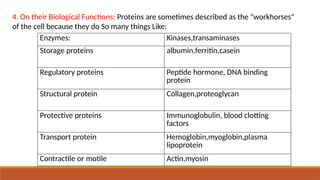
4. On theirBiological Functions: Proteins are sometimes described as the "workhorses"
of the cell because they do So many things Like:
Enzymes: Kinases,transaminases
Storage proteins albumin,ferritin,casein
Regulatory proteins Peptide hormone, DNA binding
protein
Structural protein Collagen,proteoglycan
Protective proteins Immunoglobulin, blood clotting
factors
Transport protein Hemoglobin,myoglobin,plasma
lipoprotein
Contractile or motile Actin,myosin
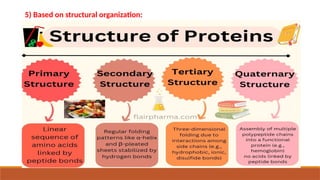
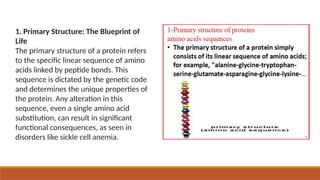
1. Primary Structure:The Blueprint of
Life
The primary structure of a protein refers
to the specific linear sequence of amino
acids linked by peptide bonds. This
sequence is dictated by the genetic code
and determines the unique properties of
the protein. Any alteration in this
sequence, even a single amino acid
substitution, can result in significant
functional consequences, as seen in
disorders like sickle cell anemia.
11.
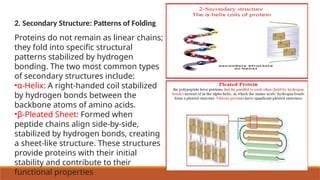
2. Secondary Structure:Patterns of Folding
Proteins do not remain as linear chains;
they fold into specific structural
patterns stabilized by hydrogen
bonding. The two most common types
of secondary structures include:
•α-Helix: A right-handed coil stabilized
by hydrogen bonds between the
backbone atoms of amino acids.
•β-Pleated Sheet: Formed when
peptide chains align side-by-side,
stabilized by hydrogen bonds, creating
a sheet-like structure. These structures
provide proteins with their initial
stability and contribute to their
functional properties
12.
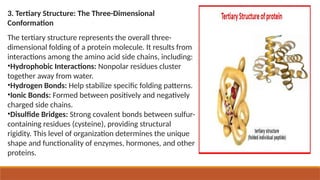
3. Tertiary Structure:The Three-Dimensional
Conformation
The tertiary structure represents the overall three-
dimensional folding of a protein molecule. It results from
interactions among the amino acid side chains, including:
•Hydrophobic Interactions: Nonpolar residues cluster
together away from water.
•Hydrogen Bonds: Help stabilize specific folding patterns.
•Ionic Bonds: Formed between positively and negatively
charged side chains.
•Disulfide Bridges: Strong covalent bonds between sulfur-
containing residues (cysteine), providing structural
rigidity. This level of organization determines the unique
shape and functionality of enzymes, hormones, and other
proteins.
13.
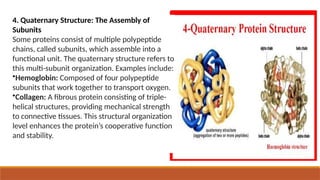
4. Quaternary Structure:The Assembly of
Subunits
Some proteins consist of multiple polypeptide
chains, called subunits, which assemble into a
functional unit. The quaternary structure refers to
this multi-subunit organization. Examples include:
•Hemoglobin: Composed of four polypeptide
subunits that work together to transport oxygen.
•Collagen: A fibrous protein consisting of triple-
helical structures, providing mechanical strength
to connective tissues. This structural organization
level enhances the protein’s cooperative function
and stability.
14.
General Characteristics ofProteins
1.Molecular Complexity: Proteins have a high molecular weight and complex
structures.
2.Amphoteric Nature: They can act as acids or bases.
3.Solubility: Some proteins are water-soluble (globular), while others are
insoluble (fibrous).
4.Denaturation: Heat, pH changes, or chemicals can disrupt protein structure,
leading to loss of function.
5.Specificity: Each protein has a unique structure that determines its specific
function.
6.Hydrolysis: Proteins can be broken down into amino acids by enzymes or acids.
15.
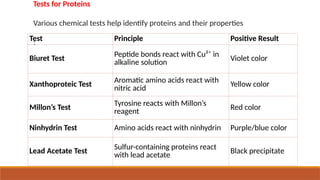
Tests for Proteins
Variouschemical tests help identify proteins and their properties
:
Test Principle Positive Result
Biuret Test Peptide bonds react with Cu²⁺ in
alkaline solution Violet color
Xanthoproteic Test
Aromatic amino acids react with
nitric acid Yellow color
Millon’s Test
Tyrosine reacts with Millon’s
reagent Red color
Ninhydrin Test Amino acids react with ninhydrin Purple/blue color
Lead Acetate Test Sulfur-containing proteins react
with lead acetate
Black precipitate
16.
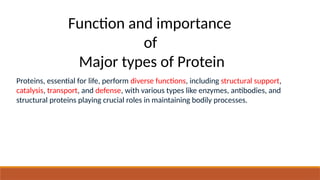
Function and importance
of
Majortypes of Protein
Proteins, essential for life, perform diverse functions, including structural support,
catalysis, transport, and defense, with various types like enzymes, antibodies, and
structural proteins playing crucial roles in maintaining bodily processes.
17.
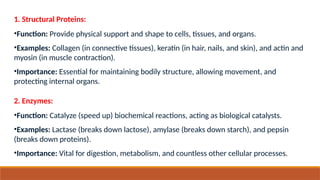
1. Structural Proteins:
•Function:Provide physical support and shape to cells, tissues, and organs.
•Examples: Collagen (in connective tissues), keratin (in hair, nails, and skin), and actin and
myosin (in muscle contraction).
•Importance: Essential for maintaining bodily structure, allowing movement, and
protecting internal organs.
2. Enzymes:
•Function: Catalyze (speed up) biochemical reactions, acting as biological catalysts.
•Examples: Lactase (breaks down lactose), amylase (breaks down starch), and pepsin
(breaks down proteins).
•Importance: Vital for digestion, metabolism, and countless other cellular processes.
18.
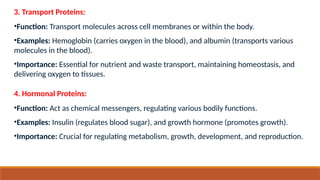
3. Transport Proteins:
•Function:Transport molecules across cell membranes or within the body.
•Examples: Hemoglobin (carries oxygen in the blood), and albumin (transports various
molecules in the blood).
•Importance: Essential for nutrient and waste transport, maintaining homeostasis, and
delivering oxygen to tissues.
4. Hormonal Proteins:
•Function: Act as chemical messengers, regulating various bodily functions.
•Examples: Insulin (regulates blood sugar), and growth hormone (promotes growth).
•Importance: Crucial for regulating metabolism, growth, development, and reproduction.
19.
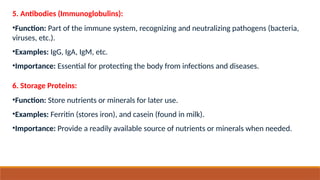
5. Antibodies (Immunoglobulins):
•Function:Part of the immune system, recognizing and neutralizing pathogens (bacteria,
viruses, etc.).
•Examples: IgG, IgA, IgM, etc.
•Importance: Essential for protecting the body from infections and diseases.
6. Storage Proteins:
•Function: Store nutrients or minerals for later use.
•Examples: Ferritin (stores iron), and casein (found in milk).
•Importance: Provide a readily available source of nutrients or minerals when needed.
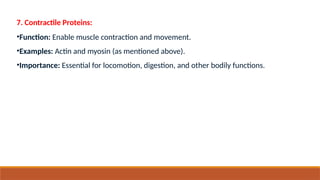
20.
7. Contractile Proteins:
•Function:Enable muscle contraction and movement.
•Examples: Actin and myosin (as mentioned above).
•Importance: Essential for locomotion, digestion, and other bodily functions.

![Definition
Proteins are organic complex nitrogenous compounds of high molecular weight, formed
of C, H, O, N [N= 16%].
They are formed of a number of amino acids linked together by peptide linkage
[-CO-NH-].
The carboxylic group[COOH] of the first amino acid unites with the amino group of the
second amino acid and so on.](https://image.slidesharecdn.com/proteinpart1-250417085044-7018fb34/85/basic-understanding-about-protein-structure-and-classification-2-320.jpg)