Structure and Classifications of Proteins
Prepared By:-
Harsh Jaswal
(CUHP19CCS09)
M.Sc Chemistry (3rd Semester)
.
Can any
body tell me
what are
Proteins?
Proteins are polymers
of L-alpha Amino Acids.
The term protein is
derived from a Greek
word proteios, meaning
holding the first place.
.
Can we
see
Proteins?
No, we can’t see Proteins
from our naked eyes.
However we can see
them via Microscope, and
thus we have different
types of Structures of
Proteins.
,m
Can we
discuss
different
structures of
Proteins?
Yes, we should
discuss the
different
Structures of
Proteins.
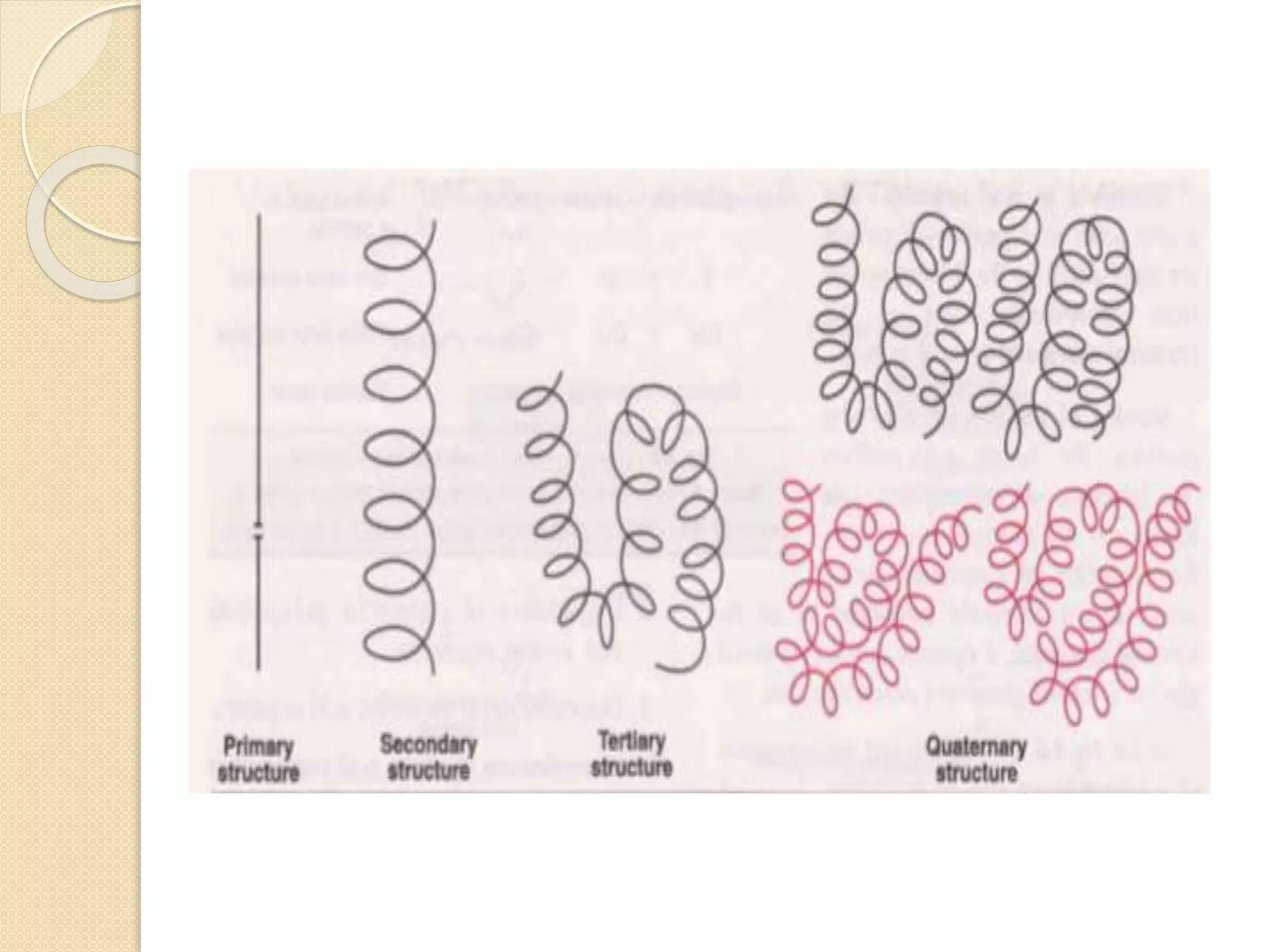
PRIMARY STRUCTURE OF
PROTEIN
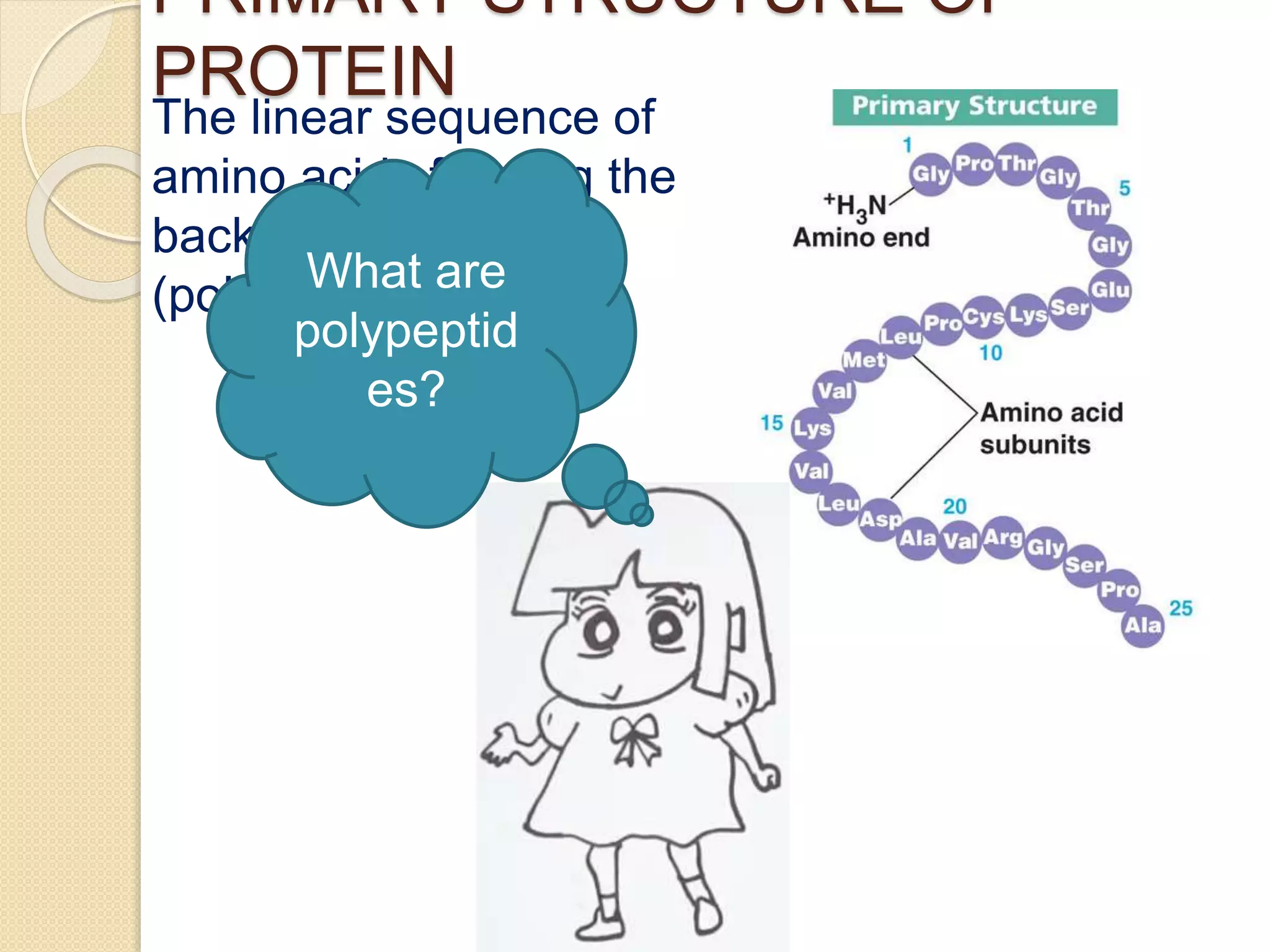
The linear sequence of
amino acids forming the
backbone of proteins
(polypeptides).What are
polypeptid
es?
r r
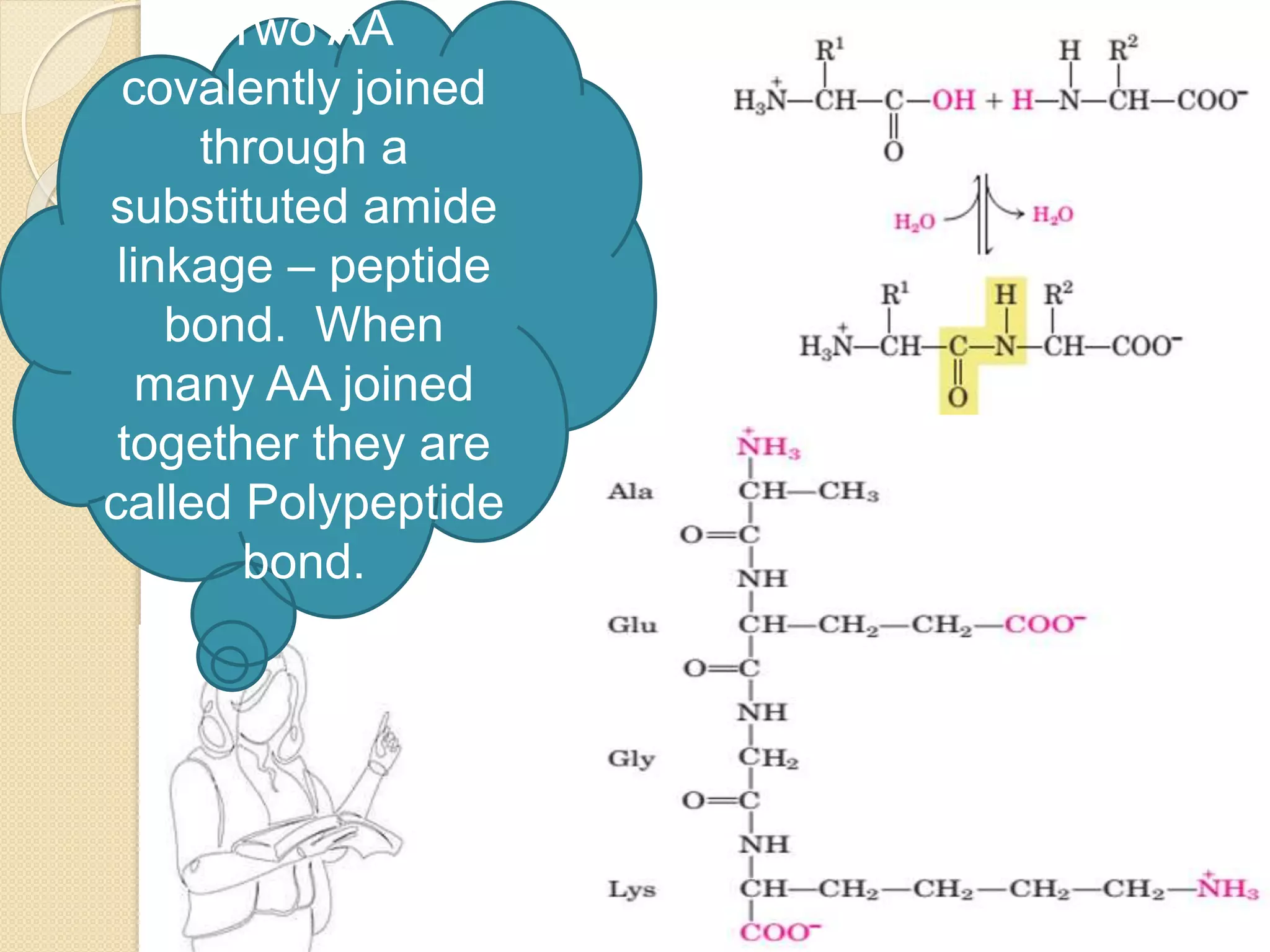
Two AA
covalently joined
through a
substituted amide
linkage – peptide
bond. When
many AA joined
together they are
called Polypeptide
bond.
SECONDARY STRUCTURE OF
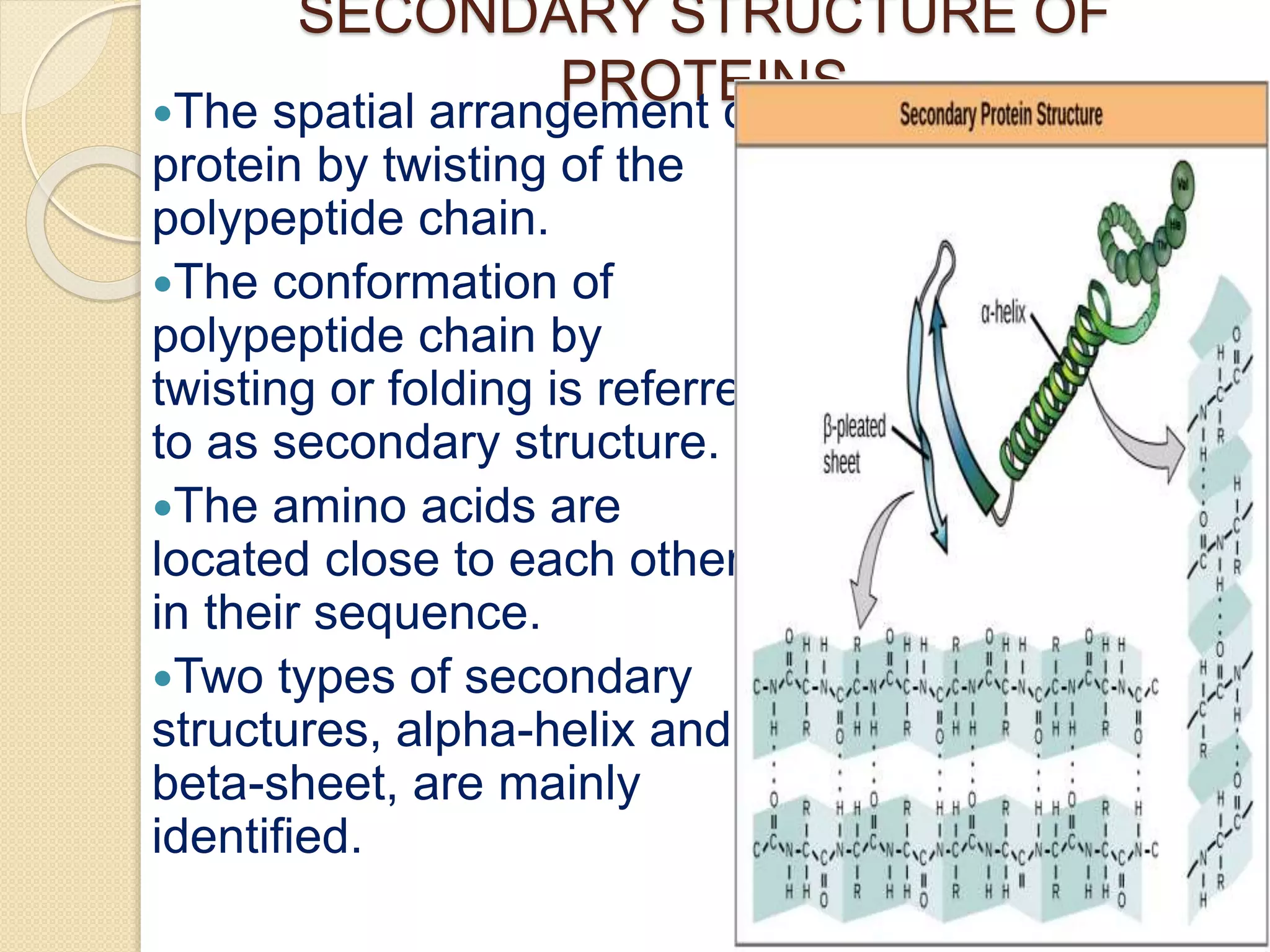
PROTEINSThe spatial arrangement of
protein by twisting of the
polypeptide chain.
The conformation of
polypeptide chain by
twisting or folding is referred
to as secondary structure.
The amino acids are
located close to each other
in their sequence.
Two types of secondary
structures, alpha-helix and
beta-sheet, are mainly
identified.
Alpha(α) Helix
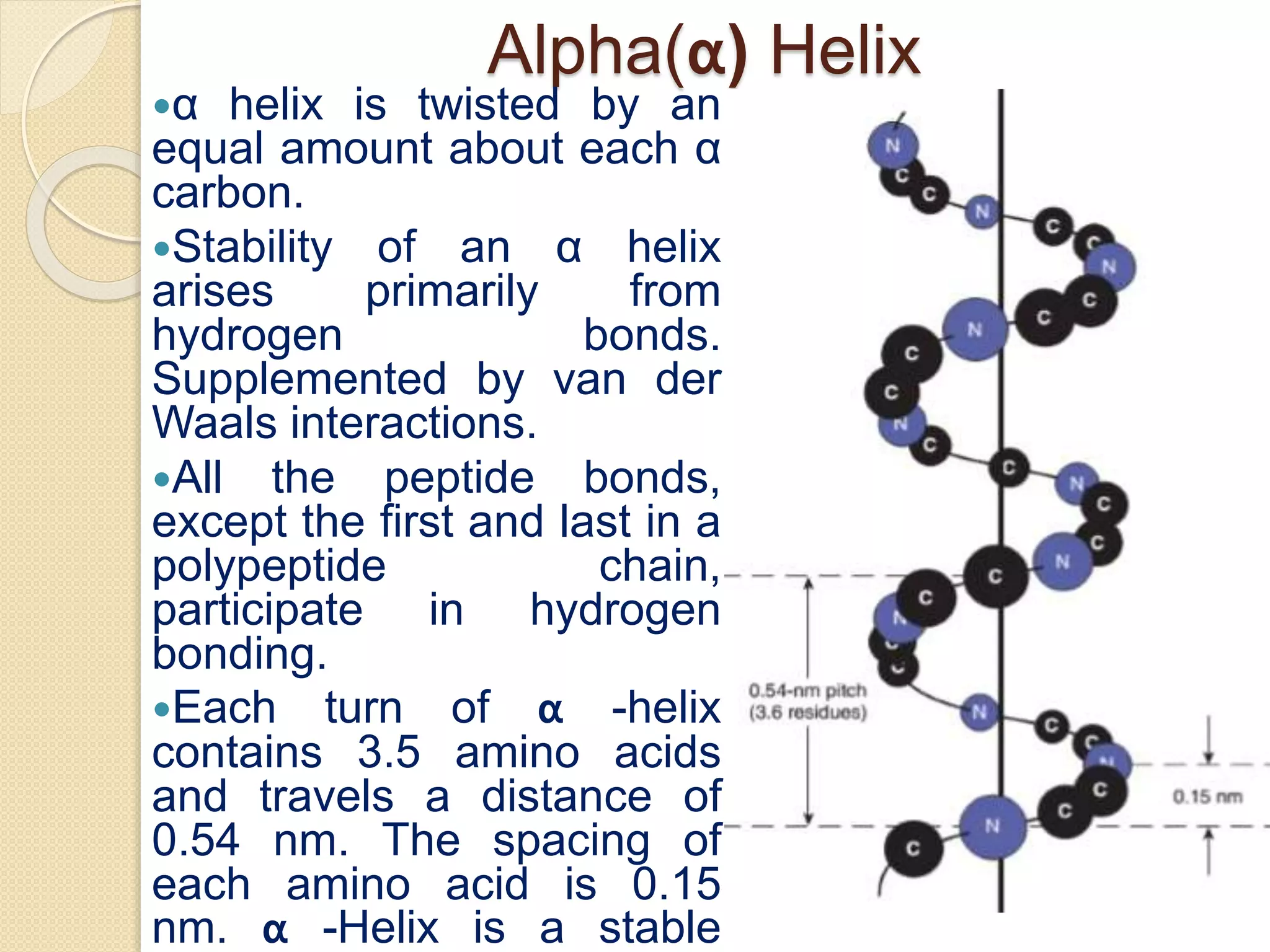
α helix is twisted by an
equal amount about each α
carbon.
Stability of an α helix
arises primarily from
hydrogen bonds.
Supplemented by van der
Waals interactions.
All the peptide bonds,
except the first and last in a
polypeptide chain,
participate in hydrogen
bonding.
Each turn of α -helix
contains 3.5 amino acids
and travels a distance of
0.54 nm. The spacing of
each amino acid is 0.15
nm. α -Helix is a stable
Beta (β)-Pleated sheet
This is the second type
of structure by Pauling
and Corey.
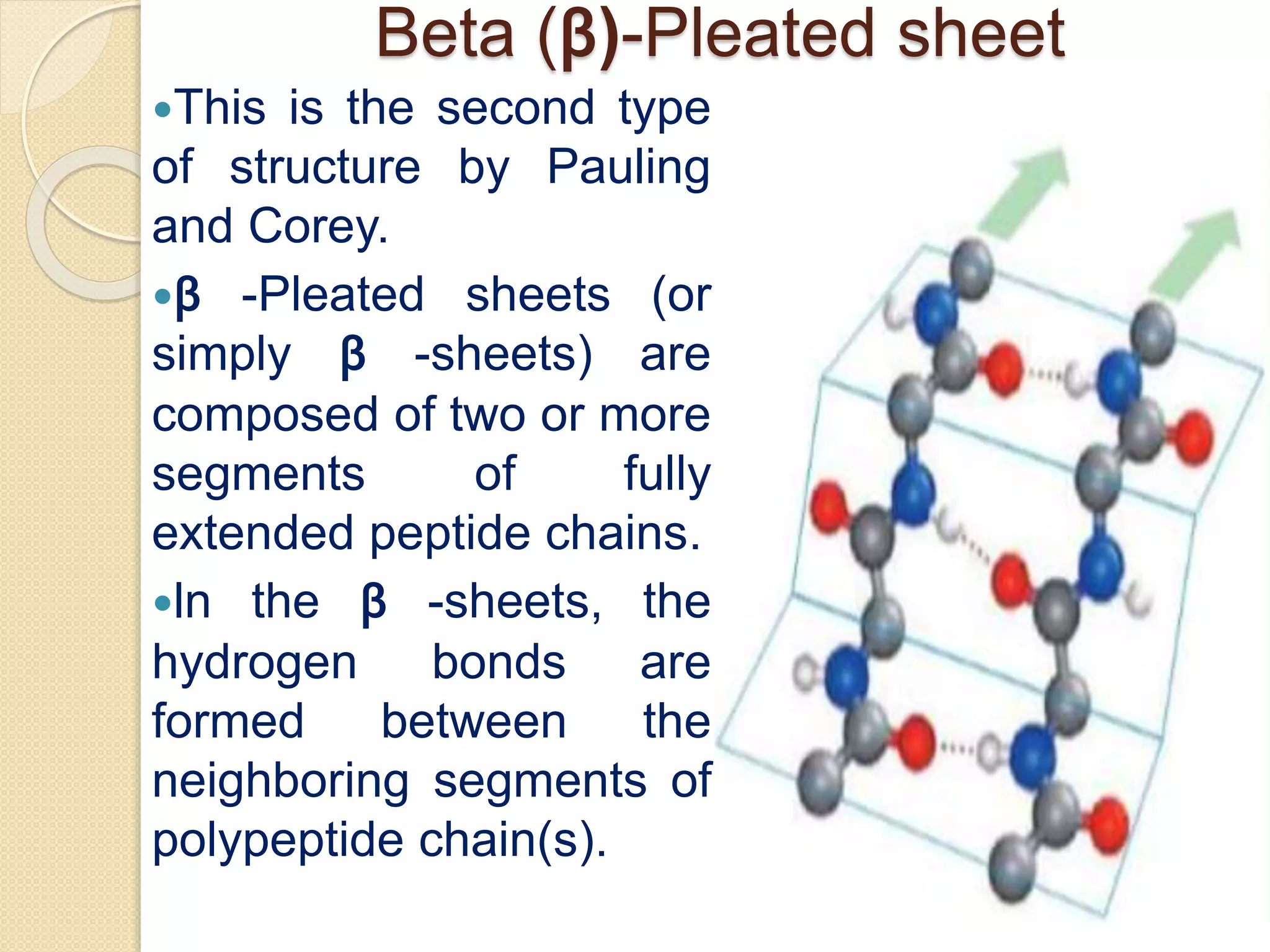
β -Pleated sheets (or
simply β -sheets) are
composed of two or more
segments of fully
extended peptide chains.
ln the β -sheets, the
hydrogen bonds are
formed between the
neighboring segments of
polypeptide chain(s).
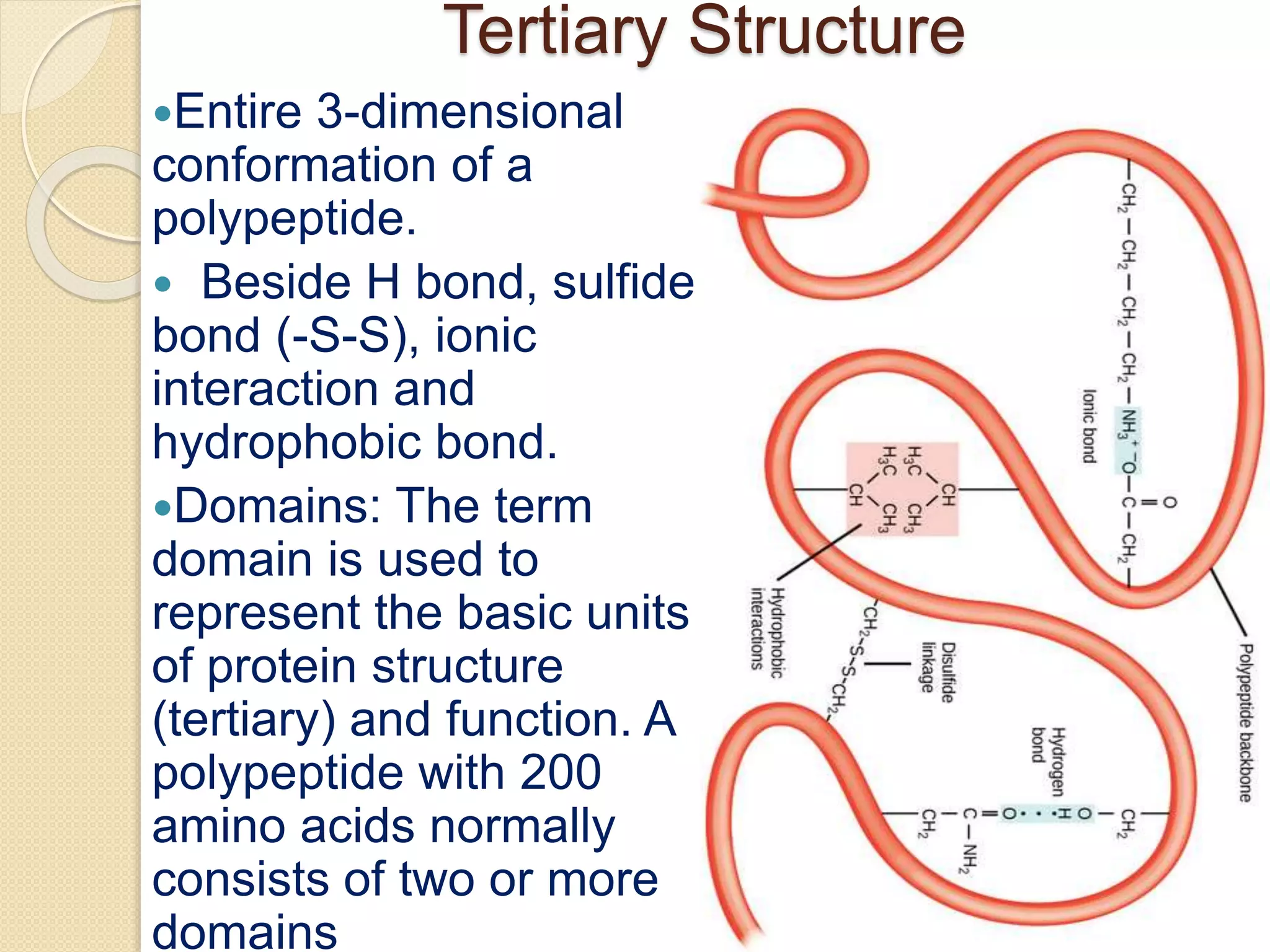
Tertiary Structure
Entire 3-dimensional
conformation of a
polypeptide.
 Beside H bond, sulfide
bond (-S-S), ionic
interaction and
hydrophobic bond.
Domains: The term
domain is used to
represent the basic units
of protein structure
(tertiary) and function. A
polypeptide with 200
amino acids normally
consists of two or more
domains
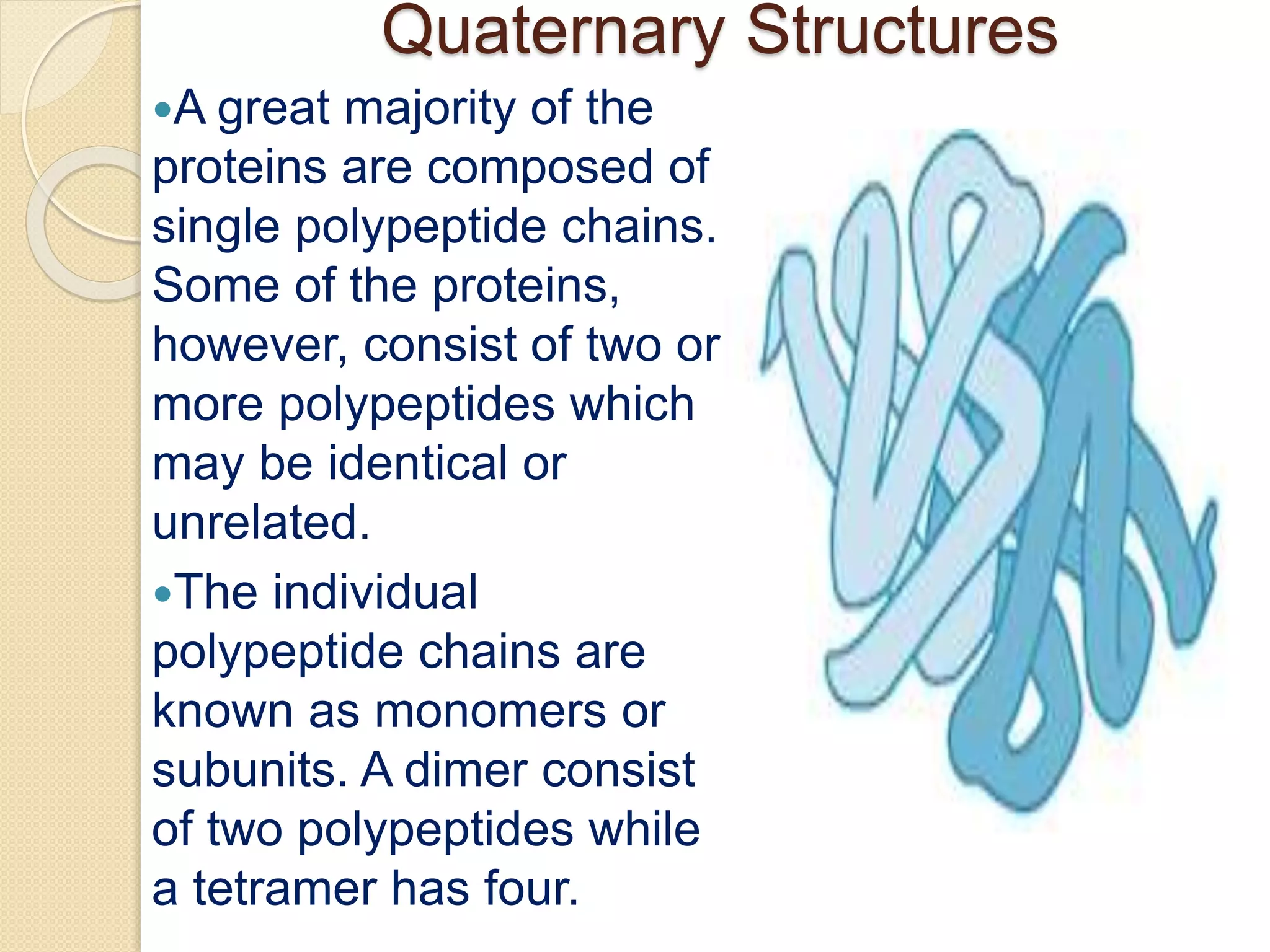
Quaternary Structures
A great majority of the
proteins are composed of
single polypeptide chains.
Some of the proteins,
however, consist of two or
more polypeptides which
may be identical or
unrelated.
The individual
polypeptide chains are
known as monomers or
subunits. A dimer consist
of two polypeptides while
a tetramer has four.
What are
the forces
that binds
Proteins?
Hydrogen bonding,
Ionic bonding,
Co- Valent bonding,
Peptide bond
r
Can we
Classify
Proteins?
Yes we can
Classify the
Proteins. Let us
discuss about the
classification of
Proteins.....
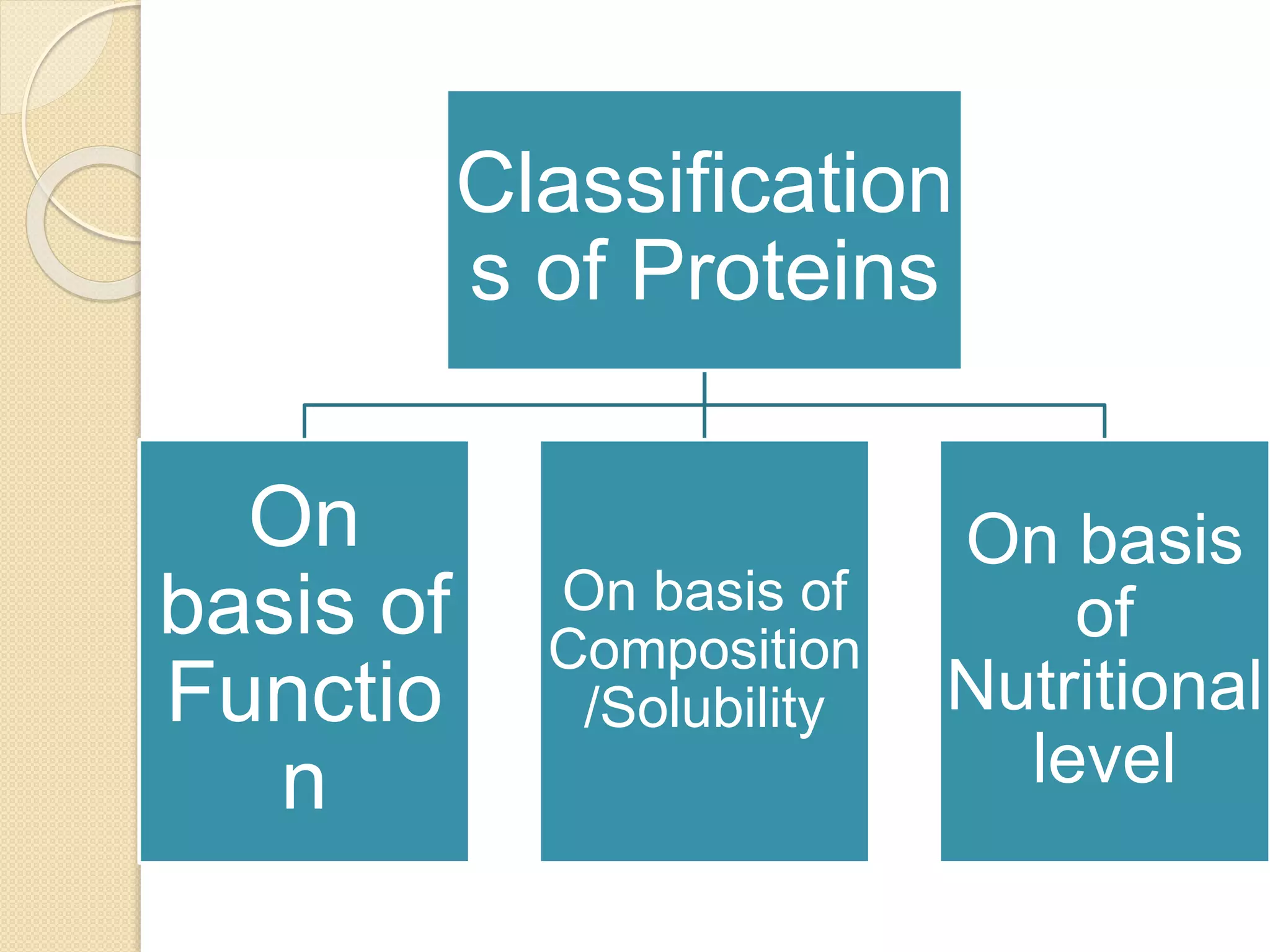
Classification
s of Proteins
On
basis of
Functio
n
On basis of
Composition
/Solubility
On basis
of
Nutritional
level
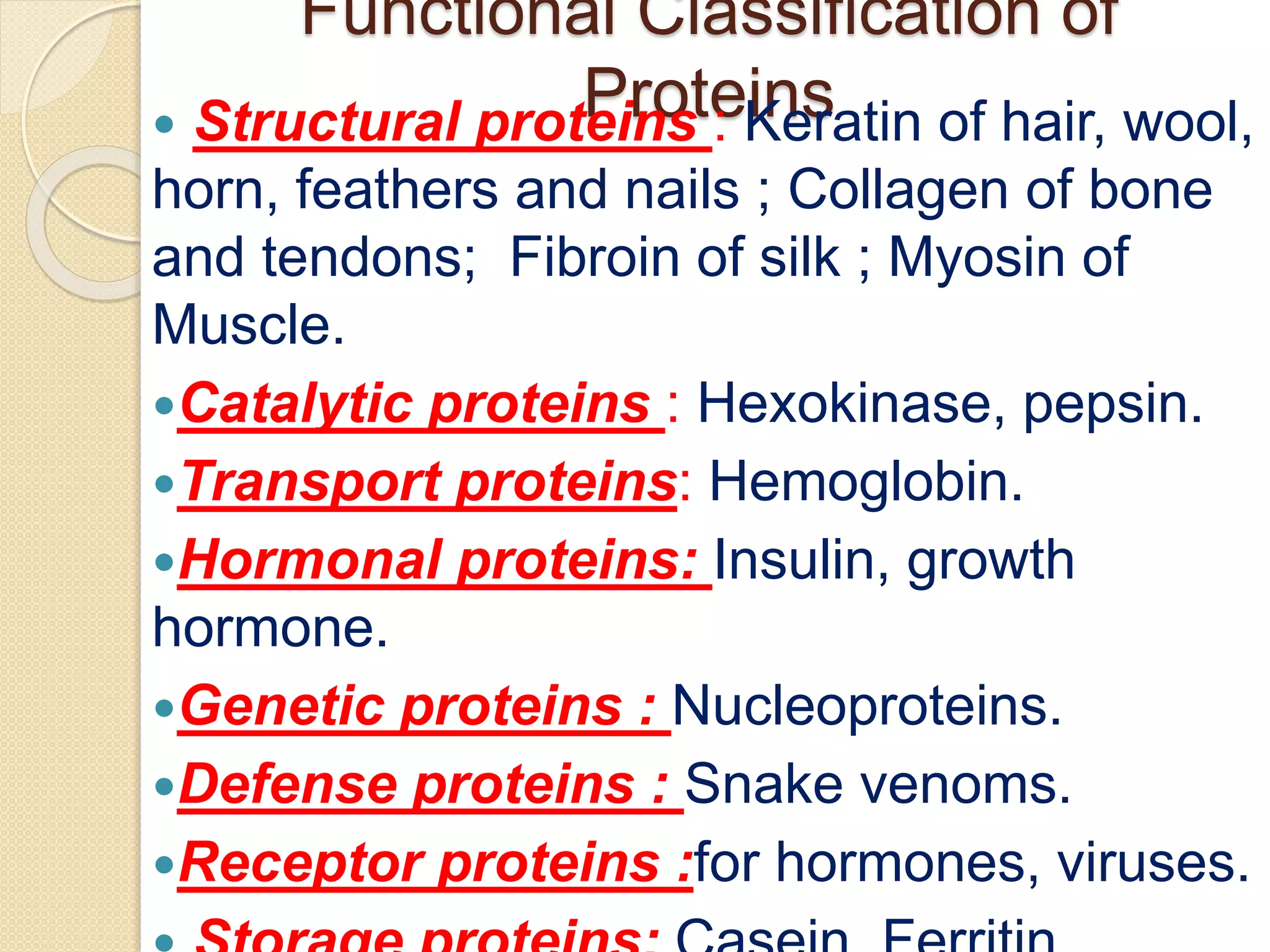
Functional Classification of
Proteins Structural proteins : Keratin of hair, wool,
horn, feathers and nails ; Collagen of bone
and tendons; Fibroin of silk ; Myosin of
Muscle.
Catalytic proteins : Hexokinase, pepsin.
Transport proteins: Hemoglobin.
Hormonal proteins: Insulin, growth
hormone.
Genetic proteins : Nucleoproteins.
Defense proteins : Snake venoms.
Receptor proteins :for hormones, viruses.
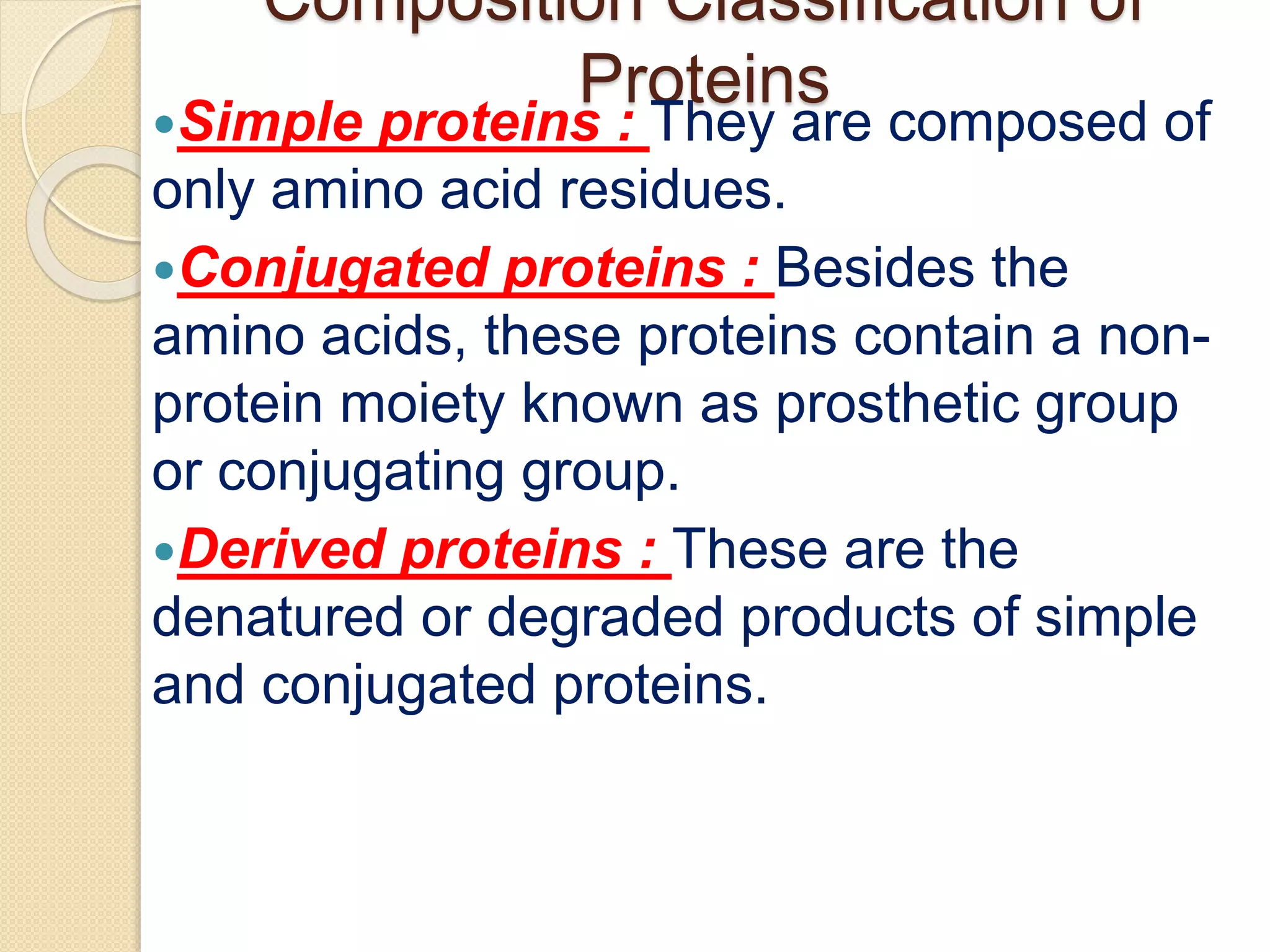
Composition Classification of
Proteins
Simple proteins : They are composed of
only amino acid residues.
Conjugated proteins : Besides the
amino acids, these proteins contain a non-
protein moiety known as prosthetic group
or conjugating group.
Derived proteins : These are the
denatured or degraded products of simple
and conjugated proteins.
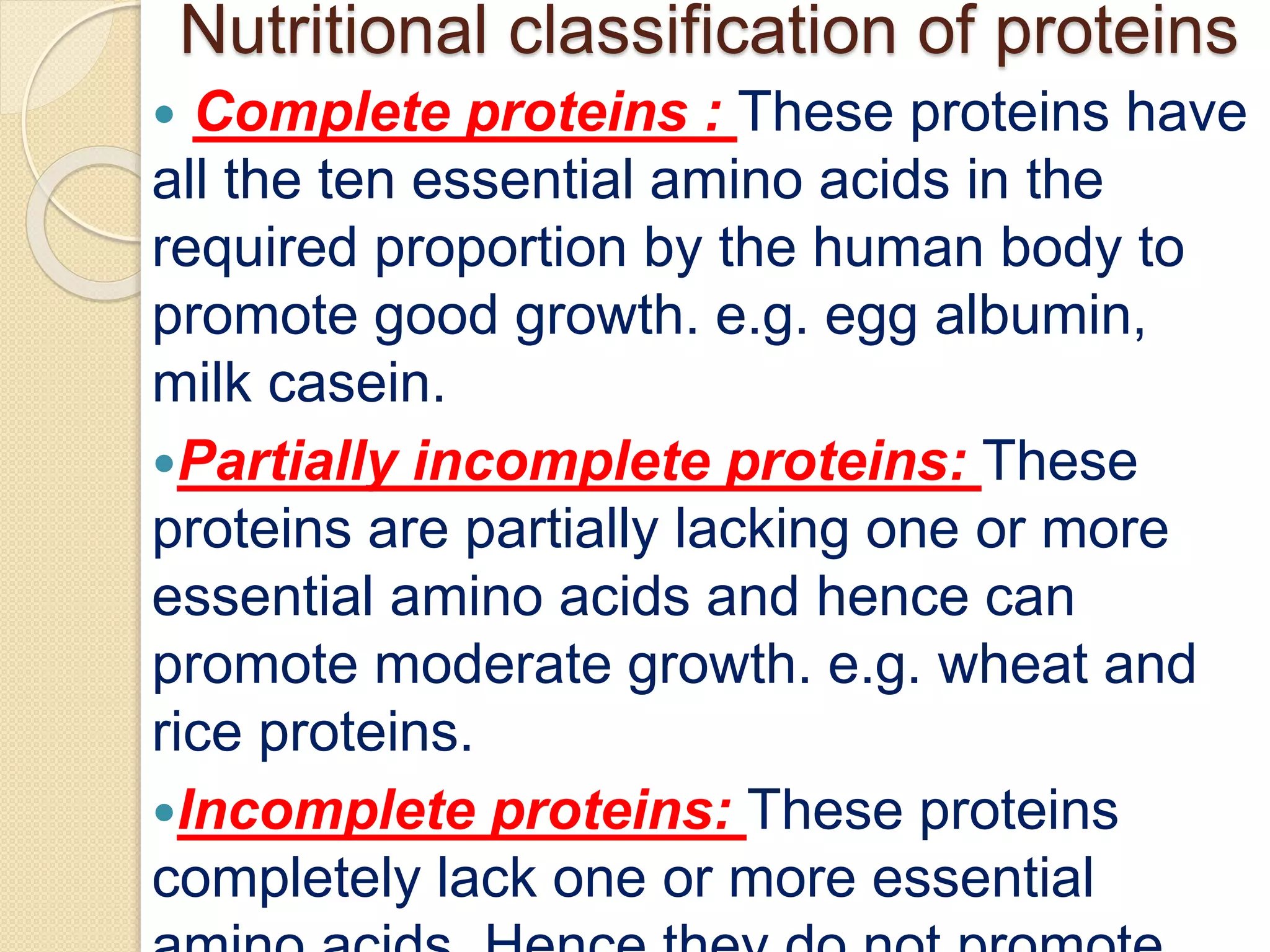
Nutritional classification of proteins
 Complete proteins : These proteins have
all the ten essential amino acids in the
required proportion by the human body to
promote good growth. e.g. egg albumin,
milk casein.
Partially incomplete proteins: These
proteins are partially lacking one or more
essential amino acids and hence can
promote moderate growth. e.g. wheat and
rice proteins.
Incomplete proteins: These proteins
completely lack one or more essential
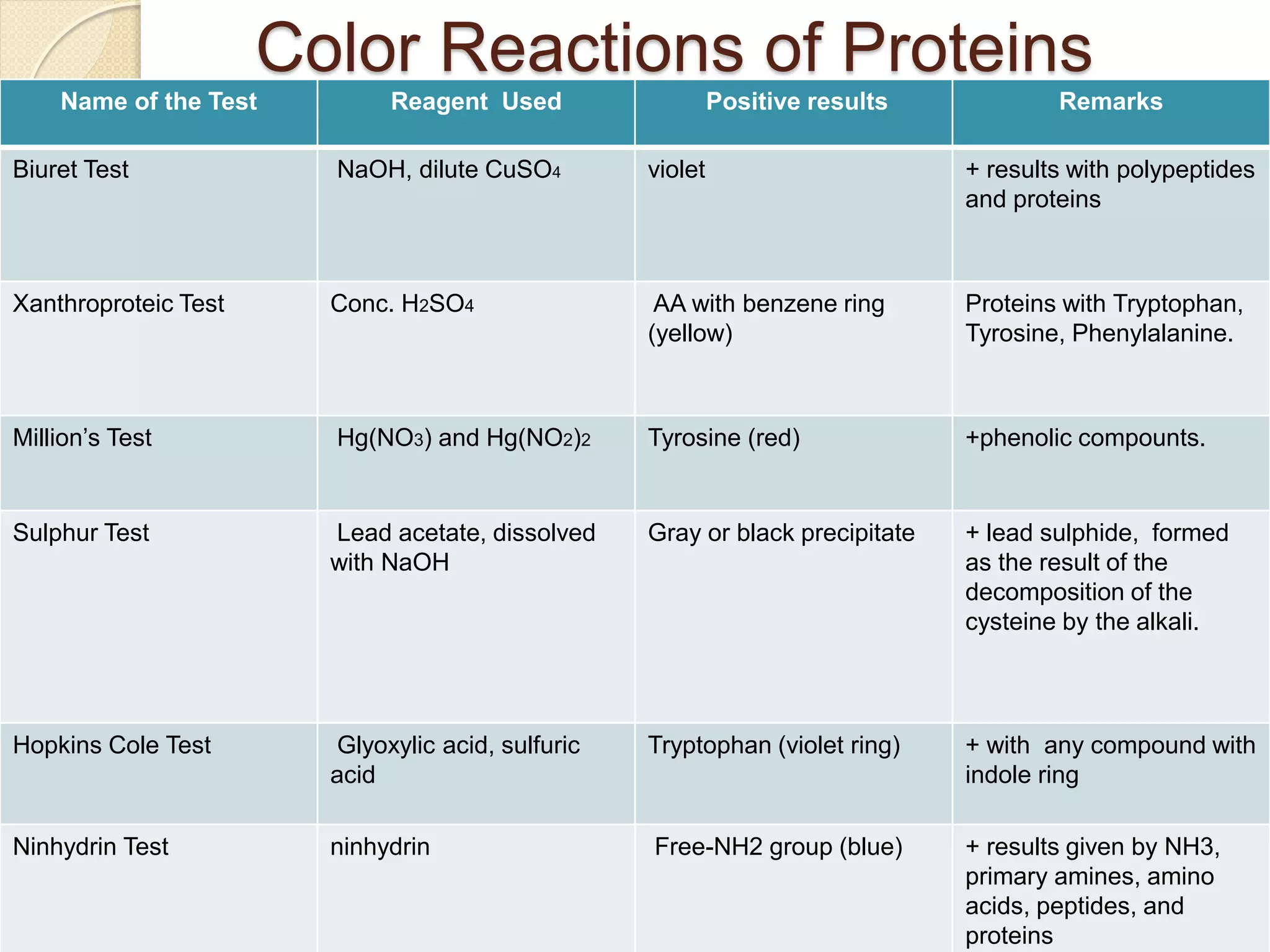
Color Reactions of Proteins
Name of the Test Reagent Used Positive results Remarks
Biuret Test NaOH, dilute CuSO4 violet + results with polypeptides
and proteins
Xanthroproteic Test Conc. H2SO4 AA with benzene ring
(yellow)
Proteins with Tryptophan,
Tyrosine, Phenylalanine.
Million’s Test Hg(NO3) and Hg(NO2)2 Tyrosine (red) +phenolic compounts.
Sulphur Test Lead acetate, dissolved
with NaOH
Gray or black precipitate + lead sulphide, formed
as the result of the
decomposition of the
cysteine by the alkali.
Hopkins Cole Test Glyoxylic acid, sulfuric
acid
Tryptophan (violet ring) + with any compound with
indole ring
Ninhydrin Test ninhydrin Free-NH2 group (blue) + results given by NH3,
primary amines, amino
acids, peptides, and
proteins
Structure and classifications of proteins

Structure and classifications of proteins

  • 1.
    Structure and Classificationsof Proteins Prepared By:- Harsh Jaswal (CUHP19CCS09) M.Sc Chemistry (3rd Semester)
  • 2.
    . Can any body tellme what are Proteins? Proteins are polymers of L-alpha Amino Acids. The term protein is derived from a Greek word proteios, meaning holding the first place.
  • 3.
    . Can we see Proteins? No, wecan’t see Proteins from our naked eyes. However we can see them via Microscope, and thus we have different types of Structures of Proteins.
  • 4.
    ,m Can we discuss different structures of Proteins? Yes,we should discuss the different Structures of Proteins.
  • 5.
    PRIMARY STRUCTURE OF PROTEIN Thelinear sequence of amino acids forming the backbone of proteins (polypeptides).What are polypeptid es?
  • 6.
    r r Two AA covalentlyjoined through a substituted amide linkage – peptide bond. When many AA joined together they are called Polypeptide bond.
  • 7.
    SECONDARY STRUCTURE OF PROTEINSThespatial arrangement of protein by twisting of the polypeptide chain. The conformation of polypeptide chain by twisting or folding is referred to as secondary structure. The amino acids are located close to each other in their sequence. Two types of secondary structures, alpha-helix and beta-sheet, are mainly identified.
  • 8.
    Alpha(α) Helix α helixis twisted by an equal amount about each α carbon. Stability of an α helix arises primarily from hydrogen bonds. Supplemented by van der Waals interactions. All the peptide bonds, except the first and last in a polypeptide chain, participate in hydrogen bonding. Each turn of α -helix contains 3.5 amino acids and travels a distance of 0.54 nm. The spacing of each amino acid is 0.15 nm. α -Helix is a stable
  • 9.
    Beta (β)-Pleated sheet Thisis the second type of structure by Pauling and Corey. β -Pleated sheets (or simply β -sheets) are composed of two or more segments of fully extended peptide chains. ln the β -sheets, the hydrogen bonds are formed between the neighboring segments of polypeptide chain(s).
  • 10.
    Tertiary Structure Entire 3-dimensional conformationof a polypeptide.  Beside H bond, sulfide bond (-S-S), ionic interaction and hydrophobic bond. Domains: The term domain is used to represent the basic units of protein structure (tertiary) and function. A polypeptide with 200 amino acids normally consists of two or more domains
  • 11.
    Quaternary Structures A greatmajority of the proteins are composed of single polypeptide chains. Some of the proteins, however, consist of two or more polypeptides which may be identical or unrelated. The individual polypeptide chains are known as monomers or subunits. A dimer consist of two polypeptides while a tetramer has four.
  • 13.
    What are the forces thatbinds Proteins? Hydrogen bonding, Ionic bonding, Co- Valent bonding, Peptide bond
  • 14.
    r Can we Classify Proteins? Yes wecan Classify the Proteins. Let us discuss about the classification of Proteins.....
  • 15.
    Classification s of Proteins On basisof Functio n On basis of Composition /Solubility On basis of Nutritional level
  • 16.
    Functional Classification of ProteinsStructural proteins : Keratin of hair, wool, horn, feathers and nails ; Collagen of bone and tendons; Fibroin of silk ; Myosin of Muscle. Catalytic proteins : Hexokinase, pepsin. Transport proteins: Hemoglobin. Hormonal proteins: Insulin, growth hormone. Genetic proteins : Nucleoproteins. Defense proteins : Snake venoms. Receptor proteins :for hormones, viruses.
  • 17.
    Composition Classification of Proteins Simpleproteins : They are composed of only amino acid residues. Conjugated proteins : Besides the amino acids, these proteins contain a non- protein moiety known as prosthetic group or conjugating group. Derived proteins : These are the denatured or degraded products of simple and conjugated proteins.
  • 18.
    Nutritional classification ofproteins  Complete proteins : These proteins have all the ten essential amino acids in the required proportion by the human body to promote good growth. e.g. egg albumin, milk casein. Partially incomplete proteins: These proteins are partially lacking one or more essential amino acids and hence can promote moderate growth. e.g. wheat and rice proteins. Incomplete proteins: These proteins completely lack one or more essential
  • 19.
    Color Reactions ofProteins Name of the Test Reagent Used Positive results Remarks Biuret Test NaOH, dilute CuSO4 violet + results with polypeptides and proteins Xanthroproteic Test Conc. H2SO4 AA with benzene ring (yellow) Proteins with Tryptophan, Tyrosine, Phenylalanine. Million’s Test Hg(NO3) and Hg(NO2)2 Tyrosine (red) +phenolic compounts. Sulphur Test Lead acetate, dissolved with NaOH Gray or black precipitate + lead sulphide, formed as the result of the decomposition of the cysteine by the alkali. Hopkins Cole Test Glyoxylic acid, sulfuric acid Tryptophan (violet ring) + with any compound with indole ring Ninhydrin Test ninhydrin Free-NH2 group (blue) + results given by NH3, primary amines, amino acids, peptides, and proteins