CLASSIFICATION OF PROTEIN BASED OF
SOLUBILITY, SHAPE, COMPOSITION
AND FUNCTION
Proteins are classified based on their
• Solubility and composition
• Function
• Shape & size
CLASSIFICATION BASED ON SOLUBILITY
AND COMPOSITION
According to this classification, proteins are divided into three main groups as :
• Simple
• Conjugated
• Derived proteins
Simple proteins
Simple proteins are those which, on hydrolysis, give only amino acids. According to
their solubility .These proteins can further classified based on their solubility in
different solvents as well as their heat coagulability
• Albumins
Albumins are readily soluble in water,dilute acids and alkalies.coagulated by heat.Seed
proteins contain albumin in lesser quantities. Albumins may be precipitated out from solution
using high salt concentration,a process called 'salting out'. They are deficient in glycine.Serum
albumin and ovalbumin (egg white) are examples.
• Globulins
Globulins are insoluble or sparingly soluble in water, but their solubility is greatly
increased by the addition of neutral salts such as sodium chloride. These proteins
are coagulated by heat.They are deficient in methionine. Serum globulin,
fibrinogen, myosin of muscle and globulins of pulses are examples.
• Prolamins
Prolamins are insoluble in water but soluble in 70-80% aqueous alcohol. Upon
hydrolysis they yield much proline and amide nitrogen, hence the name
prolamin.They are deficient in lysine. Gliadin of wheat and zein of corn are
examples of prolamins.
• Glutelins
Glutelins are insoluble in water and absolute alcohol but soluble in dilute alkalies
and acids.They are plant proteins e.g., glutenin of wheat.
• Histones
Histones are small and stable basic proteins.They contain fairly large amounts
of basic amino acid, histidine.Theyare soluble in water, but insoluble in
ammonium hydroxide.They are not readilycoagulated by heat.They occur in
globin of hemoglobin and nucleoproteins.
• Protamines
Protamines are the simplest of the proteins. They are soluble in water and are not
coagulated by heat.They are basic in nature due to the presence of large quantities
of arginine. Protamines are found in association with nucleic acid in the sperm
cells of certain fish.Tyrosine and Tryptophan are usually absent in protamines.
• Albuminoids
These are characterized by great stability and insolubility in water and
salt solutions.These are called albuminoids because they are essentially similar to
albumin and globulins.They are highly resistant to proteolytic enzymes.They are
fibrous in nature and form most of the supporting structures of animals. They occur
as chief constituent of exoskeleton structure such as hair, horn and nails.
• Conjugated or compound proteins:
Conjugated proteins are complex proteins which on hydrolysis yield not only amino
acids but also other organic or inorganic components. The non-amino acid portion of a
conjugated protein is called prosthetic group. Unlike simple proteins, conjugated
proteins are classified on the basis of the chemical nature of their prosthetic groups.
• Nucleoproteins
Nucleoproteins are simple basic proteins (protamines or histones) in salt
combination with nucleic acids as the prosthetic group.They are the important
constituents of nuclei and chromatin.
• Chromoproteins
These are proteins containing coloured prosthetic groups e.g., haemoglobin,
flavoprotein and cytochrome.
• Lipoproteins
• These are proteins conjugated with lipids such as neutral fat, phospholipids and
cholesterol
• Metalloproteins
These are metal-binding proteins. A ß-globulin, termed transferrin is capable of
combining with iron, copper and zinc. This protein constitutes 3% of the total
plasma protein. Another example is ceruloplasmin, which contains copper.
• Phosphoproteins
These are proteins containing phosphoric acid. Phosphoric acid is linked to the
hydroxyl group of certain amino acids like serine in the protein e.g., casein of milk
Derived proteins:
These are proteins derived by partial to complete hydrolysis from the simple or
conjugated proteins by the action of acids, alkalies or enzymes. They include two types
of derivatives, primary-derived proteins and secondary-derived proteins
Primary-derived protein:These protein derivatives are formed by processes
causing only slight changes in the protein molecule and its properties.
Secondary-derived proteins:These proteins are formed in the progressive
hydrolytic cleavage of the peptide bonds of protein molecule.
CLASSIFICATION OF PROTEINS BASED ON
FUNCTION
• Proteins are classified based on their functions as
Catalyticproteins – Enzymes
The most striking characteristic feature of these proteins is their ability to function
within the living cells as biocatalysts. These biocatalysts are called as
enzymes. Enzymes represent the largest class. Nearly 2000 different kinds of
enzymes are known, each catalyzing a different kind of reaction.They enhance the
reaction rates a million fold
• Regulatoryproteins - Hormones
These are polypeptides and small proteins found in relatively lower concentrations in
animal kingdom but play highly important regulatory role in maintaining order in
complex metabolic reactions. e.g., growth hormone, insulin etc.
• Protective proteins - Antibodies
These proteins have protective defense function.These proteins combine with
foreign protein and other substances and fight against certain diseases.e.g.,
immunoglobulin. These proteins are produced in the spleen and lymphatic cells in
response to foreign substances called antigen. The newly formed protein is called
antibody which specifically combines with the antigen which triggered its synthesis
thereby prevents the development of diseases. Fibrin present in the blood is also a
protective protein.
• Storage proteins
It is a major class of proteins which has the function of storing amino acids as
nutrients and as building blocks for the growing embryo. Storage proteins are source
of essential amino acids, which cannot be synthesized by human beings.The major
storage protein in pulses is globulins and prolamins in cereals. In rice the major
storage protein is glutelins. Albumin of egg and casein of milk are also storage
proteins.
• Transport proteins
Some proteins are capable of binding and transporting specific types of molecules
through blood. Haemoglobin is a conjugated protein composed of colourless basic
protein, the globin and ferroprotoporphyrin or haem. It has the capacity to bind with
oxygen and transport through blood to various tissues. Myoglobin,a related protein,
transports oxygen in muscle. Lipids bind to serum proteins like albumin and
transported as lipoproteins in the blood
• Toxic proteins
Some of the proteins are toxic in nature. Ricin present in castor bean is extremely
toxic to higher animals in very small amounts. Enzyme inhibitors such as trypsin
inhibitor bind to digestive enzyme and prevent the availability of the protein.Lectin, a
toxic protein present in legumes, agglutinates red blood cells. A bacterial toxin
causes cholera, which is a protein. Snake venom is protein in nature.
• Structural proteins
These proteins serve as structural materials or as important components of extra
cellular fluid.Examples of structural proteins are myosin of muscles, keratin of skin
and hair and collagen of connective tissue. Carbohydrates, fats, minerals and other
cellular components are organized around such structural proteins that form the
molecular framework of living material
• Contractileproteins
Proteins like actin and myosin function as essential elements in contractile system of
skeletal muscle.
• Secretary proteins
Fibroin is a protein secreted by spiders and silkworms to form webs and cocoons.
• Exotic proteins
Antarctic fishes live in -1.9ºC waters, well below the temperature at which their blood
is expected to freeze. These fishes are prevented from freezing by antifreeze
glycoproteins present in their body.
AMINO ACID
• Amino acids are small molecules that are the building blocks of proteins.
• Proteins serve as structural support inside the cell and they perform many vital chemical
reactions.
• Each protein is a molecule made up of different combinations of 20 types of smaller, simpler
amino acids.
• Protein molecules are long chains of amino acids that are folded into a three-dimensional shape.
• Chemically, an amino acid is a molecule that has a carboxylic acid group and an amine group that
are each attached to a carbon atom called the α carbon.
• The process of making protein is called Translation and involves the step-by-step addition of amino
acids to a growing protein chain by Ribozyme that is called a Ribosome.
• The order in which amino acids are added is read through the genetic code from mRNA template.
• 22 amino acids are naturally incorporated into polypeptides and are called proteinogenic or
Natural Amino Acids.
• Of these 20 are encoded by the universal genetic code. The remaining 2 , Selenocysteine and
Pyrrolysine are incorporated into proteins by unique synthetic mechanisms.
• Selenocysteine: Incorporated when mRNA translated included SECIS (selenocysteine insertion
seq) element, causes the UGA codon to encode selenocysteine instead of stop codon)
• Pyrrolysine: used by methanogenic archaea in enzyme that they use to produce methane. It is
coded for UAG stop codon.
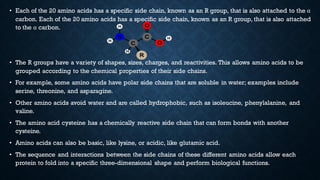
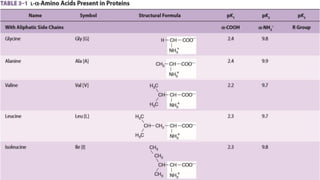
• Each of the 20 amino acids has a specific side chain, known as an R group, that is also attached to the α
carbon. Each of the 20 amino acids has a specific side chain, known as an R group, that is also attached
to the α carbon.
• The R groups have a variety of shapes, sizes, charges, and reactivities. This allows amino acids to be
grouped according to the chemical properties of their side chains.
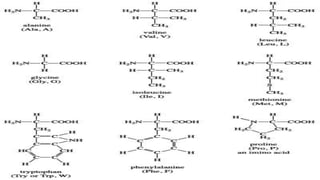
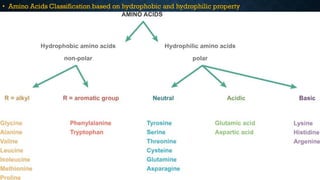
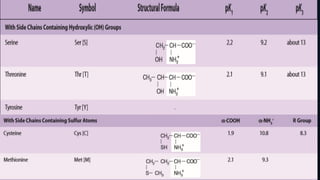
• For example, some amino acids have polar side chains that are soluble in water; examples include
serine, threonine, and asparagine.
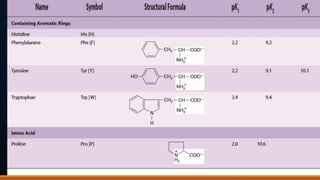
• Other amino acids avoid water and are called hydrophobic, such as isoleucine, phenylalanine, and
valine.
• The amino acid cysteine has a chemically reactive side chain that can form bonds with another
cysteine.
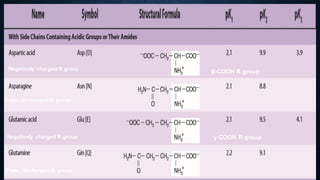
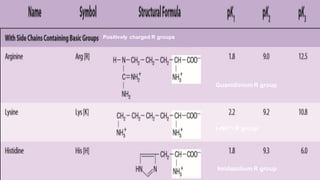
• Amino acids can also be basic, like lysine, or acidic, like glutamic acid.
• The sequence and interactions between the side chains of these different amino acids allow each
protein to fold into a specific three-dimensional shape and perform biological functions.
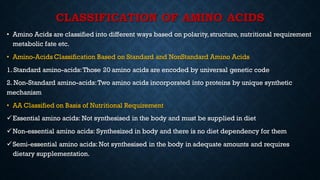
CLASSIFICATION OF AMINO ACIDS
• Amino Acids are classified into different ways based on polarity, structure, nutritional requirement
metabolic fate etc.
• Amino-Acids Classification Based on Standard and NonStandard Amino Acids
1. Standard amino-acids:Those 20 amino acids are encoded by universal genetic code
2. Non-Standard amino-acids:Two amino acids incorporated into proteins by unique synthetic
mechanism
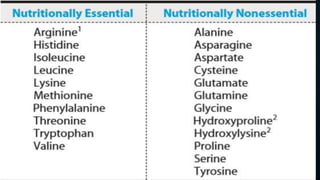
• AA Classified on Basis of Nutritional Requirement
✓Essential amino acids: Not synthesised in the body and must be supplied in diet
✓Non-essential amino acids: Synthesized in body and there is no diet dependency for them
✓Semi-essential amino acids: Not synthesised in the body in adequate amounts and requires
dietary supplementation.
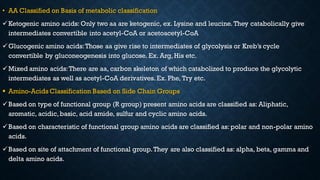
• AA Classified on Basis of metabolic classification
✓Ketogenic amino acids: Only two aa are ketogenic, ex. Lysine and leucine. They catabolically give
intermediates convertible into acetyl-CoA or acetoacetyl-CoA
✓Glucogenic amino acids:Those aa give rise to intermediates of glycolysis or Kreb’s cycle
convertible by gluconeogenesis into glucose. Ex. Arg, His etc.
✓Mixed amino acids:There are aa, carbon skeleton of which catabolized to produce the glycolytic
intermediates as well as acetyl-CoA derivatives. Ex. Phe, Try etc.
▪ Amino-Acids Classification Based on Side Chain Groups
✓Based on type of functional group (R group) present amino acids are classified as: Aliphatic,
aromatic, acidic,basic, acid amide, sulfur and cyclic amino acids.
✓Based on characteristic of functional group amino acids are classified as: polar and non-polar amino
acids.
✓Based on site of attachment of functional group.They are also classified as: alpha, beta, gamma and
delta amino acids.
• Amino Acids Classification based on hydrophobic and hydrophilic property
•
Negatively charged R group
β-COOH R group
Polar, Uncharged-R group
Negatively charged R group γ-COOH R group
Polar, Uncharged-R group
Positively charged R groups
Guanidinium R group
ε-NH+3 R group
Imidazolium R group
Peptide Bond
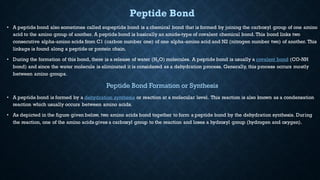
• A peptide bond also sometimes called eupeptide bond is a chemical bond that is formed by joining the carboxyl group of one amino
acid to the amino group of another. A peptide bond is basically an amide-type of covalent chemical bond. This bond links two
consecutive alpha-amino acids from C1 (carbon number one) of one alpha-amino acid and N2 (nitrogen number two) of another. This
linkage is found along a peptide or protein chain.
• During the formation of this bond, there is a release of water (H2O) molecules. A peptide bond is usually a covalent bond (CO-NH
bond) and since the water molecule is eliminated it is considered as a dehydration process. Generally, this process occurs mostly
between amino groups.
Peptide Bond Formation or Synthesis
• A peptide bond is formed by a dehydration synthesis or reaction at a molecular level. This reaction is also known as a condensation
reaction which usually occurs between amino acids.
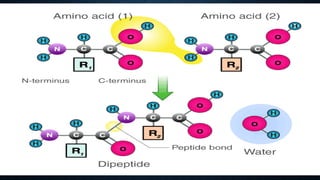
• As depicted in the figure given below, two amino acids bond together to form a peptide bond by the dehydration synthesis. During
the reaction, one of the amino acids gives a carboxyl group to the reaction and loses a hydroxyl group (hydrogen and oxygen).
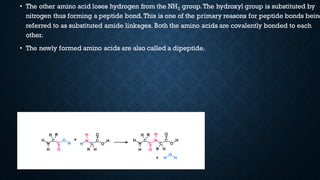
• The other amino acid loses hydrogen from the NH2 group.The hydroxyl group is substituted by
nitrogen thus forming a peptide bond.This is one of the primary reasons for peptide bonds being
referred to as substituted amide linkages. Both the amino acids are covalently bonded to each
other.
• The newly formed amino acids are also called a dipeptide.
CHARACTERISTICS OF PEPTIDE BONDS
1. Peptide bonds are strong with partial double bond character:
• They are not broken by heating or high salt concentration.
• They can be broken by exposing them to strong acid or base for a long time at elevated
temperature. Also by some specific enzymes (digestive enzymes).
2. Peptide bonds are rigid and planar bonds therefore they stabilize protein structure.
3. Peptide bond contains partial positive charge groups (polar hydrogen atoms of amino groups) and
partial negative charge groups (polar oxygen atoms of carboxyl groups).
DIFFERENT FORMS OF PEPTIDE BOND
• Dipeptide= contains 2 amino acid units.
• Tripeptide = contains 3 amino acid units.
• Tetrapeptide = contains 4 amino acid units.
• Oligopeptide = contains not more than 10 amino acid units.
• Polypeptide = contains more than 10 amino acid units, up to 100 residues.
• Macropeptides = made up of more than 100 amino acids.
Degradation of Peptide Bond
Degradation of peptide bond involves a reaction in which breaking of the peptide bonds between
the molecules occurs. Hydrolysis (addition of water) is the reaction used for the degradation of the
peptide bond. During the reaction, they will emit Gibbs energy in an amount of 8-16 kJ/mol. But
generally, this is a very slow process having a half-life of 350 to 600 years per bond at a temperature
of 25oC.Enzymes like proteases are used as the catalysts for this process.
PEPTIDE BOND STRUCTURE
• A peptide bond is a planar, trans and rigid configuration. It also shows a partial double bond
character. The coplanarity of the peptide bond denotes the resonance or partial sharing of two pairs
of electrons between the amide nitrogen and carboxyl oxygen.
• The atoms C, H, N, O of the peptide bond lies in the same plane, like the hydrogen atom of the amide
group and the oxygen atom of the carboxyl group are trans to each other.
• Linus Pauling and Robert Corey are the scientists who found that the peptide bonds are rigid and
planar.

Classification of Protein.pdf

  • 1.
    CLASSIFICATION OF PROTEINBASED OF SOLUBILITY, SHAPE, COMPOSITION AND FUNCTION
  • 2.
    Proteins are classifiedbased on their • Solubility and composition • Function • Shape & size
  • 3.
    CLASSIFICATION BASED ONSOLUBILITY AND COMPOSITION According to this classification, proteins are divided into three main groups as : • Simple • Conjugated • Derived proteins Simple proteins Simple proteins are those which, on hydrolysis, give only amino acids. According to their solubility .These proteins can further classified based on their solubility in different solvents as well as their heat coagulability
  • 4.
    • Albumins Albumins arereadily soluble in water,dilute acids and alkalies.coagulated by heat.Seed proteins contain albumin in lesser quantities. Albumins may be precipitated out from solution using high salt concentration,a process called 'salting out'. They are deficient in glycine.Serum albumin and ovalbumin (egg white) are examples. • Globulins Globulins are insoluble or sparingly soluble in water, but their solubility is greatly increased by the addition of neutral salts such as sodium chloride. These proteins are coagulated by heat.They are deficient in methionine. Serum globulin, fibrinogen, myosin of muscle and globulins of pulses are examples. • Prolamins Prolamins are insoluble in water but soluble in 70-80% aqueous alcohol. Upon hydrolysis they yield much proline and amide nitrogen, hence the name prolamin.They are deficient in lysine. Gliadin of wheat and zein of corn are examples of prolamins. • Glutelins Glutelins are insoluble in water and absolute alcohol but soluble in dilute alkalies and acids.They are plant proteins e.g., glutenin of wheat.
  • 5.
    • Histones Histones aresmall and stable basic proteins.They contain fairly large amounts of basic amino acid, histidine.Theyare soluble in water, but insoluble in ammonium hydroxide.They are not readilycoagulated by heat.They occur in globin of hemoglobin and nucleoproteins. • Protamines Protamines are the simplest of the proteins. They are soluble in water and are not coagulated by heat.They are basic in nature due to the presence of large quantities of arginine. Protamines are found in association with nucleic acid in the sperm cells of certain fish.Tyrosine and Tryptophan are usually absent in protamines. • Albuminoids These are characterized by great stability and insolubility in water and salt solutions.These are called albuminoids because they are essentially similar to albumin and globulins.They are highly resistant to proteolytic enzymes.They are fibrous in nature and form most of the supporting structures of animals. They occur as chief constituent of exoskeleton structure such as hair, horn and nails.
  • 6.
    • Conjugated orcompound proteins: Conjugated proteins are complex proteins which on hydrolysis yield not only amino acids but also other organic or inorganic components. The non-amino acid portion of a conjugated protein is called prosthetic group. Unlike simple proteins, conjugated proteins are classified on the basis of the chemical nature of their prosthetic groups. • Nucleoproteins Nucleoproteins are simple basic proteins (protamines or histones) in salt combination with nucleic acids as the prosthetic group.They are the important constituents of nuclei and chromatin. • Chromoproteins These are proteins containing coloured prosthetic groups e.g., haemoglobin, flavoprotein and cytochrome. • Lipoproteins • These are proteins conjugated with lipids such as neutral fat, phospholipids and cholesterol
  • 7.
    • Metalloproteins These aremetal-binding proteins. A ß-globulin, termed transferrin is capable of combining with iron, copper and zinc. This protein constitutes 3% of the total plasma protein. Another example is ceruloplasmin, which contains copper. • Phosphoproteins These are proteins containing phosphoric acid. Phosphoric acid is linked to the hydroxyl group of certain amino acids like serine in the protein e.g., casein of milk Derived proteins: These are proteins derived by partial to complete hydrolysis from the simple or conjugated proteins by the action of acids, alkalies or enzymes. They include two types of derivatives, primary-derived proteins and secondary-derived proteins Primary-derived protein:These protein derivatives are formed by processes causing only slight changes in the protein molecule and its properties. Secondary-derived proteins:These proteins are formed in the progressive hydrolytic cleavage of the peptide bonds of protein molecule.
  • 8.
    CLASSIFICATION OF PROTEINSBASED ON FUNCTION • Proteins are classified based on their functions as Catalyticproteins – Enzymes The most striking characteristic feature of these proteins is their ability to function within the living cells as biocatalysts. These biocatalysts are called as enzymes. Enzymes represent the largest class. Nearly 2000 different kinds of enzymes are known, each catalyzing a different kind of reaction.They enhance the reaction rates a million fold • Regulatoryproteins - Hormones These are polypeptides and small proteins found in relatively lower concentrations in animal kingdom but play highly important regulatory role in maintaining order in complex metabolic reactions. e.g., growth hormone, insulin etc.
  • 9.
    • Protective proteins- Antibodies These proteins have protective defense function.These proteins combine with foreign protein and other substances and fight against certain diseases.e.g., immunoglobulin. These proteins are produced in the spleen and lymphatic cells in response to foreign substances called antigen. The newly formed protein is called antibody which specifically combines with the antigen which triggered its synthesis thereby prevents the development of diseases. Fibrin present in the blood is also a protective protein. • Storage proteins It is a major class of proteins which has the function of storing amino acids as nutrients and as building blocks for the growing embryo. Storage proteins are source of essential amino acids, which cannot be synthesized by human beings.The major storage protein in pulses is globulins and prolamins in cereals. In rice the major storage protein is glutelins. Albumin of egg and casein of milk are also storage proteins.
  • 10.
    • Transport proteins Someproteins are capable of binding and transporting specific types of molecules through blood. Haemoglobin is a conjugated protein composed of colourless basic protein, the globin and ferroprotoporphyrin or haem. It has the capacity to bind with oxygen and transport through blood to various tissues. Myoglobin,a related protein, transports oxygen in muscle. Lipids bind to serum proteins like albumin and transported as lipoproteins in the blood • Toxic proteins Some of the proteins are toxic in nature. Ricin present in castor bean is extremely toxic to higher animals in very small amounts. Enzyme inhibitors such as trypsin inhibitor bind to digestive enzyme and prevent the availability of the protein.Lectin, a toxic protein present in legumes, agglutinates red blood cells. A bacterial toxin causes cholera, which is a protein. Snake venom is protein in nature.
  • 11.
    • Structural proteins Theseproteins serve as structural materials or as important components of extra cellular fluid.Examples of structural proteins are myosin of muscles, keratin of skin and hair and collagen of connective tissue. Carbohydrates, fats, minerals and other cellular components are organized around such structural proteins that form the molecular framework of living material • Contractileproteins Proteins like actin and myosin function as essential elements in contractile system of skeletal muscle. • Secretary proteins Fibroin is a protein secreted by spiders and silkworms to form webs and cocoons. • Exotic proteins Antarctic fishes live in -1.9ºC waters, well below the temperature at which their blood is expected to freeze. These fishes are prevented from freezing by antifreeze glycoproteins present in their body.
  • 12.
    AMINO ACID • Aminoacids are small molecules that are the building blocks of proteins. • Proteins serve as structural support inside the cell and they perform many vital chemical reactions. • Each protein is a molecule made up of different combinations of 20 types of smaller, simpler amino acids. • Protein molecules are long chains of amino acids that are folded into a three-dimensional shape. • Chemically, an amino acid is a molecule that has a carboxylic acid group and an amine group that are each attached to a carbon atom called the α carbon.
  • 13.
    • The processof making protein is called Translation and involves the step-by-step addition of amino acids to a growing protein chain by Ribozyme that is called a Ribosome. • The order in which amino acids are added is read through the genetic code from mRNA template. • 22 amino acids are naturally incorporated into polypeptides and are called proteinogenic or Natural Amino Acids. • Of these 20 are encoded by the universal genetic code. The remaining 2 , Selenocysteine and Pyrrolysine are incorporated into proteins by unique synthetic mechanisms. • Selenocysteine: Incorporated when mRNA translated included SECIS (selenocysteine insertion seq) element, causes the UGA codon to encode selenocysteine instead of stop codon) • Pyrrolysine: used by methanogenic archaea in enzyme that they use to produce methane. It is coded for UAG stop codon.
  • 14.
    • Each ofthe 20 amino acids has a specific side chain, known as an R group, that is also attached to the α carbon. Each of the 20 amino acids has a specific side chain, known as an R group, that is also attached to the α carbon. • The R groups have a variety of shapes, sizes, charges, and reactivities. This allows amino acids to be grouped according to the chemical properties of their side chains. • For example, some amino acids have polar side chains that are soluble in water; examples include serine, threonine, and asparagine. • Other amino acids avoid water and are called hydrophobic, such as isoleucine, phenylalanine, and valine. • The amino acid cysteine has a chemically reactive side chain that can form bonds with another cysteine. • Amino acids can also be basic, like lysine, or acidic, like glutamic acid. • The sequence and interactions between the side chains of these different amino acids allow each protein to fold into a specific three-dimensional shape and perform biological functions.
  • 16.
    CLASSIFICATION OF AMINOACIDS • Amino Acids are classified into different ways based on polarity, structure, nutritional requirement metabolic fate etc. • Amino-Acids Classification Based on Standard and NonStandard Amino Acids 1. Standard amino-acids:Those 20 amino acids are encoded by universal genetic code 2. Non-Standard amino-acids:Two amino acids incorporated into proteins by unique synthetic mechanism • AA Classified on Basis of Nutritional Requirement ✓Essential amino acids: Not synthesised in the body and must be supplied in diet ✓Non-essential amino acids: Synthesized in body and there is no diet dependency for them ✓Semi-essential amino acids: Not synthesised in the body in adequate amounts and requires dietary supplementation.
  • 18.
    • AA Classifiedon Basis of metabolic classification ✓Ketogenic amino acids: Only two aa are ketogenic, ex. Lysine and leucine. They catabolically give intermediates convertible into acetyl-CoA or acetoacetyl-CoA ✓Glucogenic amino acids:Those aa give rise to intermediates of glycolysis or Kreb’s cycle convertible by gluconeogenesis into glucose. Ex. Arg, His etc. ✓Mixed amino acids:There are aa, carbon skeleton of which catabolized to produce the glycolytic intermediates as well as acetyl-CoA derivatives. Ex. Phe, Try etc. ▪ Amino-Acids Classification Based on Side Chain Groups ✓Based on type of functional group (R group) present amino acids are classified as: Aliphatic, aromatic, acidic,basic, acid amide, sulfur and cyclic amino acids. ✓Based on characteristic of functional group amino acids are classified as: polar and non-polar amino acids. ✓Based on site of attachment of functional group.They are also classified as: alpha, beta, gamma and delta amino acids.
  • 19.
    • Amino AcidsClassification based on hydrophobic and hydrophilic property
  • 22.
    • Negatively charged Rgroup β-COOH R group Polar, Uncharged-R group Negatively charged R group γ-COOH R group Polar, Uncharged-R group
  • 23.
    Positively charged Rgroups Guanidinium R group ε-NH+3 R group Imidazolium R group
  • 25.
    Peptide Bond • Apeptide bond also sometimes called eupeptide bond is a chemical bond that is formed by joining the carboxyl group of one amino acid to the amino group of another. A peptide bond is basically an amide-type of covalent chemical bond. This bond links two consecutive alpha-amino acids from C1 (carbon number one) of one alpha-amino acid and N2 (nitrogen number two) of another. This linkage is found along a peptide or protein chain. • During the formation of this bond, there is a release of water (H2O) molecules. A peptide bond is usually a covalent bond (CO-NH bond) and since the water molecule is eliminated it is considered as a dehydration process. Generally, this process occurs mostly between amino groups. Peptide Bond Formation or Synthesis • A peptide bond is formed by a dehydration synthesis or reaction at a molecular level. This reaction is also known as a condensation reaction which usually occurs between amino acids. • As depicted in the figure given below, two amino acids bond together to form a peptide bond by the dehydration synthesis. During the reaction, one of the amino acids gives a carboxyl group to the reaction and loses a hydroxyl group (hydrogen and oxygen).
  • 27.
    • The otheramino acid loses hydrogen from the NH2 group.The hydroxyl group is substituted by nitrogen thus forming a peptide bond.This is one of the primary reasons for peptide bonds being referred to as substituted amide linkages. Both the amino acids are covalently bonded to each other. • The newly formed amino acids are also called a dipeptide.
  • 28.
    CHARACTERISTICS OF PEPTIDEBONDS 1. Peptide bonds are strong with partial double bond character: • They are not broken by heating or high salt concentration. • They can be broken by exposing them to strong acid or base for a long time at elevated temperature. Also by some specific enzymes (digestive enzymes). 2. Peptide bonds are rigid and planar bonds therefore they stabilize protein structure. 3. Peptide bond contains partial positive charge groups (polar hydrogen atoms of amino groups) and partial negative charge groups (polar oxygen atoms of carboxyl groups).
  • 29.
    DIFFERENT FORMS OFPEPTIDE BOND • Dipeptide= contains 2 amino acid units. • Tripeptide = contains 3 amino acid units. • Tetrapeptide = contains 4 amino acid units. • Oligopeptide = contains not more than 10 amino acid units. • Polypeptide = contains more than 10 amino acid units, up to 100 residues. • Macropeptides = made up of more than 100 amino acids. Degradation of Peptide Bond Degradation of peptide bond involves a reaction in which breaking of the peptide bonds between the molecules occurs. Hydrolysis (addition of water) is the reaction used for the degradation of the peptide bond. During the reaction, they will emit Gibbs energy in an amount of 8-16 kJ/mol. But generally, this is a very slow process having a half-life of 350 to 600 years per bond at a temperature of 25oC.Enzymes like proteases are used as the catalysts for this process.
  • 30.
    PEPTIDE BOND STRUCTURE •A peptide bond is a planar, trans and rigid configuration. It also shows a partial double bond character. The coplanarity of the peptide bond denotes the resonance or partial sharing of two pairs of electrons between the amide nitrogen and carboxyl oxygen. • The atoms C, H, N, O of the peptide bond lies in the same plane, like the hydrogen atom of the amide group and the oxygen atom of the carboxyl group are trans to each other. • Linus Pauling and Robert Corey are the scientists who found that the peptide bonds are rigid and planar.