
Peptide Mass Fingerprinting
Creative Proteomics-Presentation
Protein Identification
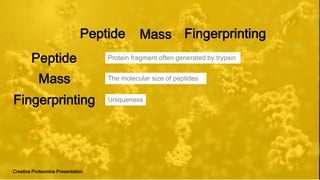
Peptide
Creative Proteomics-Presentation
Protein fragment often generated by trypsin
The molecular size of peptides
Uniqueness
Mass Fingerprinting
Mass
Fingerprinting
Peptide
Introduction
Creative Proteomics-Presentation
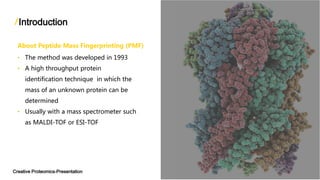
About Peptide Mass Fingerprinting (PMF)
• The method was developed in 1993
• A high throughput protein
identification technique in which the
mass of an unknown protein can be
determined
• Usually with a mass spectrometer such
as MALDI-TOF or ESI-TOF
2D-Gel
Database
Is identical to
Creative Proteomics-Presentation
The Principles
Is identical to
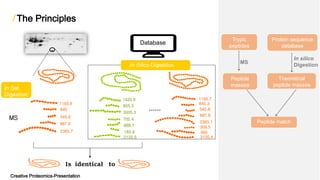
In Gel
Digestion
MS
1193.8
845
545.6
2383.7
887.6
In Silico Digestion
Database
1433.8
805.3
3005.3
702.4
988.7
183.9
2133.5
……
1193.7
845.3
545.8
887.8
2383.1
308.5
995
3100.4
Protein sequence
database
Theoretical
peptide masses
In silico
Digestion
Peptide match
Trypic
peptides
MS
Peptide
masses
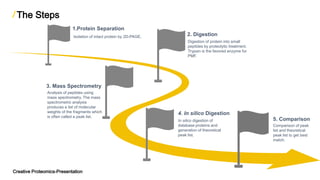
1.Protein Separation
Isolation of intact protein by 2D-PAGE. 2. Digestion
Digestion of protein into small
peptides by proteolytic treatment.
Trypsin is the favored enzyme for
PMF.
3. Mass Spectrometry
Analysis of peptides using
mass spectrometry. The mass
spectrometric analysis
produces a list of molecular
weights of the fragments which
is often called a peak list.
4. In silico Digestion
In silico digestion of
database proteins and
generation of theoretical
peak list.
5. Comparison
Comparison of peak
list and theoretical
peak list to get best
match.
The Steps
Creative Proteomics-Presentation
6
Advantages
Creative Proteomics-Presentation
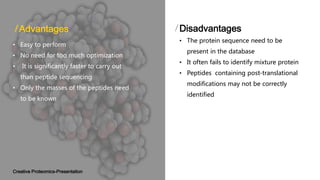
• The protein sequence need to be
present in the database
• It often fails to identify mixture protein
• Peptides containing post-translational
modifications may not be correctly
identified
Disadvantages
• Easy to perform
• No need for too much optimization
• It is significantly faster to carry out
than peptide sequencing
• Only the masses of the peptides need
to be known
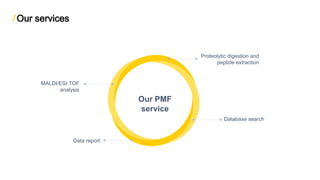
Our PMF
service
MALDI/ESI TOF
analysis
Proteolytic digestion and
peptide extraction
Data report
Database search
Our services
Creative Proteomics-Presentation
Thank you
Please contact us for more information
Web
Email
www.creative-proteomics.com
info@creative-proteomics.com

Protein identification - peptide mass fingerprinting

  • 1.
    Peptide Mass Fingerprinting CreativeProteomics-Presentation Protein Identification
  • 2.
    Peptide Creative Proteomics-Presentation Protein fragmentoften generated by trypsin The molecular size of peptides Uniqueness Mass Fingerprinting Mass Fingerprinting Peptide
  • 3.
    Introduction Creative Proteomics-Presentation About PeptideMass Fingerprinting (PMF) • The method was developed in 1993 • A high throughput protein identification technique in which the mass of an unknown protein can be determined • Usually with a mass spectrometer such as MALDI-TOF or ESI-TOF
  • 4.
    2D-Gel Database Is identical to CreativeProteomics-Presentation The Principles Is identical to In Gel Digestion MS 1193.8 845 545.6 2383.7 887.6 In Silico Digestion Database 1433.8 805.3 3005.3 702.4 988.7 183.9 2133.5 …… 1193.7 845.3 545.8 887.8 2383.1 308.5 995 3100.4 Protein sequence database Theoretical peptide masses In silico Digestion Peptide match Trypic peptides MS Peptide masses
  • 5.
    1.Protein Separation Isolation ofintact protein by 2D-PAGE. 2. Digestion Digestion of protein into small peptides by proteolytic treatment. Trypsin is the favored enzyme for PMF. 3. Mass Spectrometry Analysis of peptides using mass spectrometry. The mass spectrometric analysis produces a list of molecular weights of the fragments which is often called a peak list. 4. In silico Digestion In silico digestion of database proteins and generation of theoretical peak list. 5. Comparison Comparison of peak list and theoretical peak list to get best match. The Steps Creative Proteomics-Presentation
  • 6.
    6 Advantages Creative Proteomics-Presentation • Theprotein sequence need to be present in the database • It often fails to identify mixture protein • Peptides containing post-translational modifications may not be correctly identified Disadvantages • Easy to perform • No need for too much optimization • It is significantly faster to carry out than peptide sequencing • Only the masses of the peptides need to be known
  • 7.
    Our PMF service MALDI/ESI TOF analysis Proteolyticdigestion and peptide extraction Data report Database search Our services
  • 8.
    Creative Proteomics-Presentation Thank you Pleasecontact us for more information Web Email www.creative-proteomics.com info@creative-proteomics.com

Editor's Notes

  • #2 Hello, welcome to watch the creative proteomics videos about protein identification,. Today, we are going to learn some basic knowledge about peptide mass fingerprinting, it is a technology to identify peotein.
  • #3 In this name Peptide Mass Fingerprinting. Peptide means protein fragment, which is often generated by trypsin. Mass means the molecular size of peptides. And the fingerprinting present the uniqueness of the mass of peptide. It means that the digestion of a protein by an enzyme can provide a fingerprint of great specificity--so specific, in fact, that it is often possible to identify the protein from this information alone, without ambiguity.
  • #4 Peptide Mass Fingerprinting, also known as mass fingerprinting, was developed in 1993. It is a high throughput protein identification technique in which the mass of an unknown protein can be determined. Peptide Mass Fingerprinting is always performed with Matrix-assisted laser/desorption ionization mass spectrometry
  • #5 After separation of proteins by gel electrophoresis or liquid chromatography and being cleaved with proteolytic enzyme, we can get experimental peptide mass through mass spectrometry. And the theoretical masses are achieved by using computer programs that translate the known genome of the organism into proteins or the proteins in the database, then theoretically cut proteins into peptides, and calculate the absolute masses of the peptides. The experimentally obtained peptide masses are compared with theoretical peptide masses. The results are statistically analyzed to find the best match.
  • #6 There are several steps for Peptide Mass Fingerprinting . The first step is Protein separation. The protein of interest from a sample are separated by gel electrophoresis, usually with 2D PAGE The second step is Digestion. The protein of interest is digested by proteolytic enzyme. Trypsin is the favored enzyme for Peptide Mass Fingerprinting . Trypsin is relatively cheap, high effective and generates peptides with an average size of about 8 to 10 amino acids, which is suitable for MS analysis. The are other endoprotease are available for specific needs. The next step is Mass Spectrometric analysis. The peptides can be analyzed with different types of mass spectrometers. MALDI-MS which is fast, sensitive, accurate and can be automated is the most commonly used technique to perform PMF for the reason that it allows higher sample throughput and several proteins can be analyzed in a single experiment. The mass spectrometric analysis produces a list of molecular weights of the fragments which is often called a peak list.  The forth step is In silico digestion. Software performs in silico digestion on database proteins with the same enzyme used in the experimental digestion and generate a theoretical peak list. Mascot, MS-Fit and Profound are the most frequently used search programs for PMF. Last, Compare peak list and theoretical peak list to get a best match.
  • #7 peptide mass fingerprinting is easy to perform and no need for too much optimization. It is significantly faster to carry out than peptide sequencing and in this method, only the masses of the peptides is need to be known. Although peptide mass fingerprinting does have some advantages, it has some advantages. The protein sequences of interest need to be present in the database. If the sequence database does not contain the unknown protein, then a successful search will identify those entries that exhibit the closest sequence homology, often equivalent proteins from related species. Peptide mass fingerprinting fails to identify the mixture protein which can complicate the analysis and compromise the results. What’s more, peptides containing post-translational modifications may not be correctly identified.
  • #8 Our service throughout the peptides mass fingerprinting process, including Proteolytic digestion and peptide extraction, Matrix-assisted laser/desorption ionization time of flight mass spectrometry or Electrospray Ionization time of flight analysis, Database search and data report.
  • #9 Thanks for watching our video. At creative proteomics, we provide the most reliable services for protein identification not only by peptide mass fingerprinting, but some other technologies. If you have any questions or specific requirements. Please do not hesitate to contact us. We are very glad to cooperate with you.