

Brief Introduction of
Stable Isotope Labeling
Using Amino Acids in Cell
Culture (SILAC)
Creative Proteomics Presentation
Introduction
• Stable isotope labeling using amino acids in cell
culture (SILAC) is a powerful method based on
mass spectrometry that identifies and quantifies
relative differential changes in protein abundance.
SILAC Based on MS Quantitative Proteomics
• First used in quantitative proteomics in 2002, it
provides accurate relative quantification without any
chemical derivatization or manipulation.
The Principle of SILAC
The principle of SILAC is based on metabolically incorporating stable isotope labeled amino
acids into the entire proteome.
“Light” “Heavy”
m/z m/z
m/z
Intensity
Intensity
Intensity
• The “light” medium that contains amino
acids with the natural isotope and the
“heavy” medium that contains stable
isotope labeled amino acids.
• After a sufficient number of cell divisions,
all the proteins from the cells cultured in
"heavy" medium contain amino acids in
the heavy state.
• Analyzed with LC-MS/MS, the
quantification of SILAC is based on
testing the ratio of introduced isotope-
labeled peptides to unlabeled peptides.
• The signal intensities from light and
heavy samples allow for quantitative
comparison of their relative abundances
in the mixture.
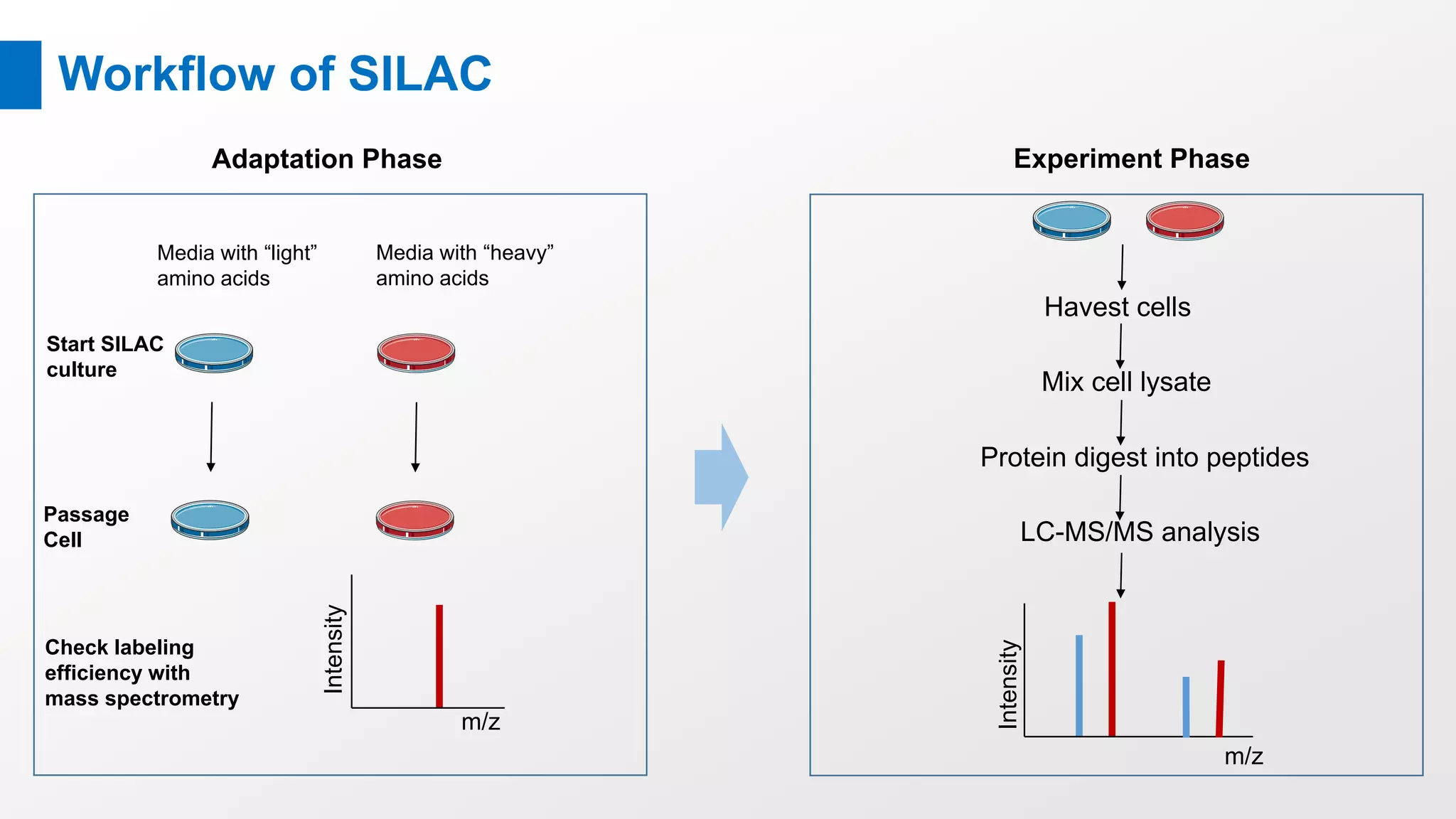
Workflow of SILAC
Adaptation Phase
Havest cells
Mix cell lysate
Protein digest into peptides
LC-MS/MS analysis
m/z
Intensity
Media with “light”
amino acids
Media with “heavy”
amino acids
m/z
IntensityStart SILAC
culture
Passage
Cell
Check labeling
efficiency with
mass spectrometry
Experiment Phase
Applications
1
2
3
• Characterize protein quantitative
differences between different samples
• Investigate the changes of protein
post-translational modifications (PTMs)
• Distinguish specific interacting proteins in the
protein-protein interactions (PPIs) networks
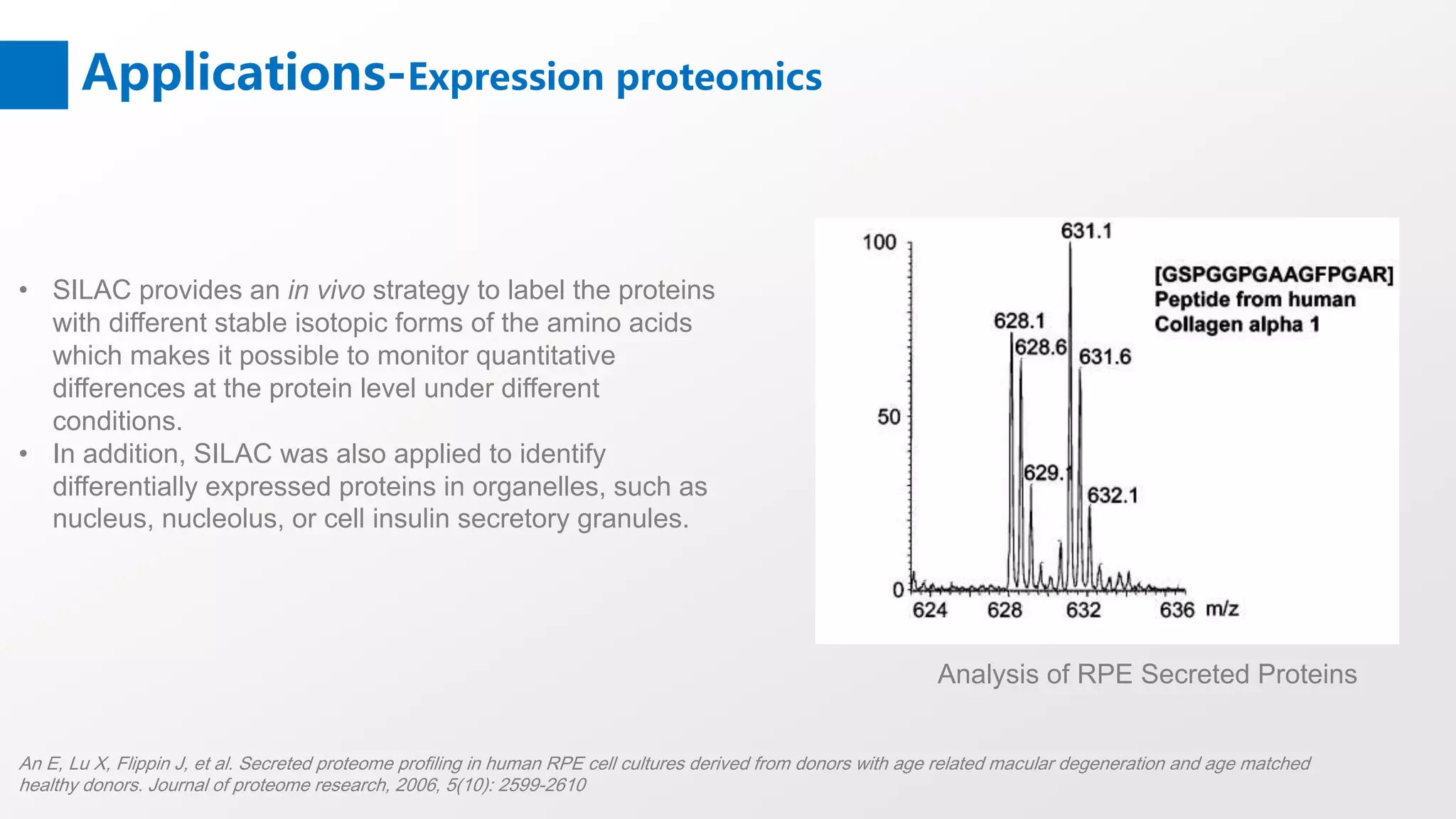
Applications-Expression proteomics
• SILAC provides an in vivo strategy to label the proteins
with different stable isotopic forms of the amino acids
which makes it possible to monitor quantitative
differences at the protein level under different
conditions.
• In addition, SILAC was also applied to identify
differentially expressed proteins in organelles, such as
nucleus, nucleolus, or cell insulin secretory granules.
An E, Lu X, Flippin J, et al. Secreted proteome profiling in human RPE cell cultures derived from donors with age related macular degeneration and age matched
healthy donors. Journal of proteome research, 2006, 5(10): 2599-2610
Analysis of RPE Secreted Proteins
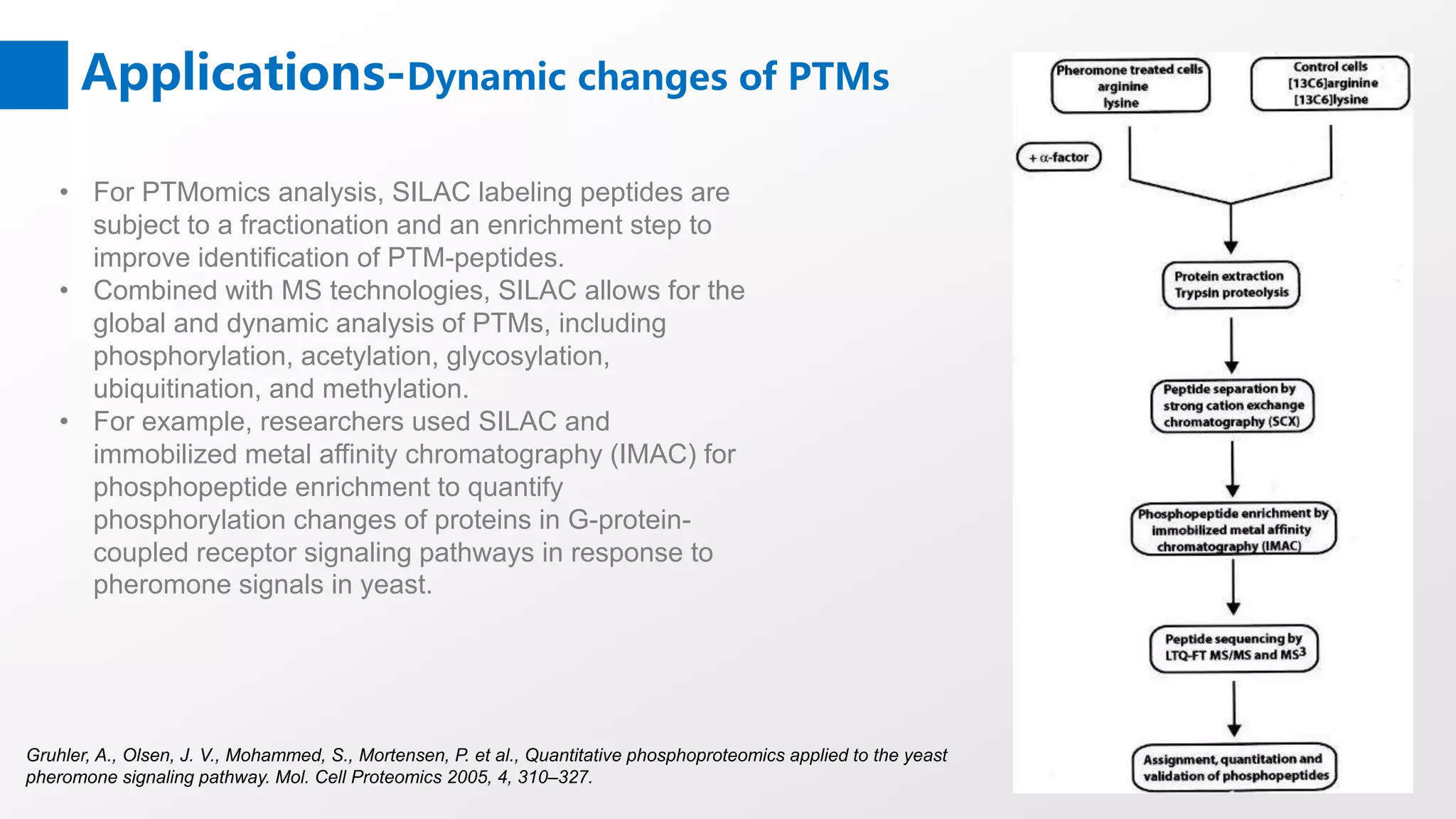
Applications-Dynamic changes of PTMs
• For PTMomics analysis, SILAC labeling peptides are
subject to a fractionation and an enrichment step to
improve identification of PTM-peptides.
• Combined with MS technologies, SILAC allows for the
global and dynamic analysis of PTMs, including
phosphorylation, acetylation, glycosylation,
ubiquitination, and methylation.
• For example, researchers used SILAC and
immobilized metal affinity chromatography (IMAC) for
phosphopeptide enrichment to quantify
phosphorylation changes of proteins in G-protein-
coupled receptor signaling pathways in response to
pheromone signals in yeast.
Gruhler, A., Olsen, J. V., Mohammed, S., Mortensen, P. et al., Quantitative phosphoproteomics applied to the yeast
pheromone signaling pathway. Mol. Cell Proteomics 2005, 4, 310–327.
Applications-PPIs study
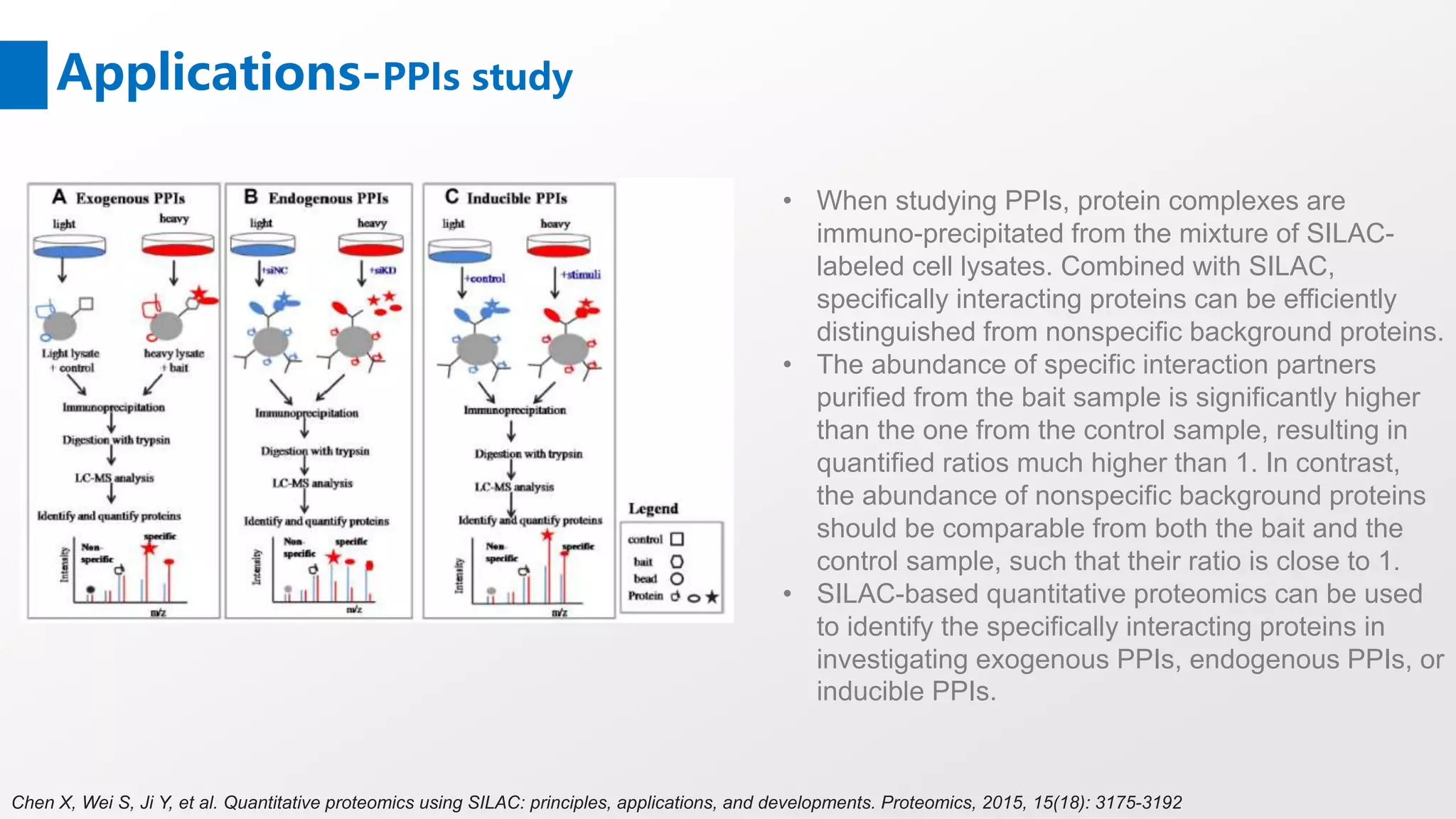
• When studying PPIs, protein complexes are
immuno-precipitated from the mixture of SILAC-
labeled cell lysates. Combined with SILAC,
specifically interacting proteins can be efficiently
distinguished from nonspecific background proteins.
• The abundance of specific interaction partners
purified from the bait sample is significantly higher
than the one from the control sample, resulting in
quantified ratios much higher than 1. In contrast,
the abundance of nonspecific background proteins
should be comparable from both the bait and the
control sample, such that their ratio is close to 1.
• SILAC-based quantitative proteomics can be used
to identify the specifically interacting proteins in
investigating exogenous PPIs, endogenous PPIs, or
inducible PPIs.
Chen X, Wei S, Ji Y, et al. Quantitative proteomics using SILAC: principles, applications, and developments. Proteomics, 2015, 15(18): 3175-3192
SILAC
SILAC is a simple and powerful method for quantitative analysis of proteins, characterized by quantitative accuracy
and reproducibility. Differentially treated samples can be combined at the level of intact cells or proteins, namely at
the very first step of the experimental workflow, and can be processed together to minimize experimental error or
bias. But it is only appropriate for cell samples, which requires a long time due to cell culture.
Our Sevices
At Creative Proteomics, we are confident to provide professional
and reliable SILAC services and other proteomics quantification
services, including:
• iTRAQ-based proteomics analysis service
• TMT-based proteomics analysis service
• Absolute quantification (AQUA) service
• Label-free quantification service
• Semi-quantitative proteomics analysis service
Thanks for Your Attention
Email: info@creative-proteomics.com
Web: www.creative-proteomics.com/services/itraq-based-
proteomics-analysis.htm

Brief Introduction of SILAC

  • 1.
    Brief Introduction of StableIsotope Labeling Using Amino Acids in Cell Culture (SILAC) Creative Proteomics Presentation
  • 2.
    Introduction • Stable isotopelabeling using amino acids in cell culture (SILAC) is a powerful method based on mass spectrometry that identifies and quantifies relative differential changes in protein abundance. SILAC Based on MS Quantitative Proteomics • First used in quantitative proteomics in 2002, it provides accurate relative quantification without any chemical derivatization or manipulation.
  • 3.
    The Principle ofSILAC The principle of SILAC is based on metabolically incorporating stable isotope labeled amino acids into the entire proteome. “Light” “Heavy” m/z m/z m/z Intensity Intensity Intensity • The “light” medium that contains amino acids with the natural isotope and the “heavy” medium that contains stable isotope labeled amino acids. • After a sufficient number of cell divisions, all the proteins from the cells cultured in "heavy" medium contain amino acids in the heavy state. • Analyzed with LC-MS/MS, the quantification of SILAC is based on testing the ratio of introduced isotope- labeled peptides to unlabeled peptides. • The signal intensities from light and heavy samples allow for quantitative comparison of their relative abundances in the mixture.
  • 4.
    Workflow of SILAC AdaptationPhase Havest cells Mix cell lysate Protein digest into peptides LC-MS/MS analysis m/z Intensity Media with “light” amino acids Media with “heavy” amino acids m/z IntensityStart SILAC culture Passage Cell Check labeling efficiency with mass spectrometry Experiment Phase
  • 5.
    Applications 1 2 3 • Characterize proteinquantitative differences between different samples • Investigate the changes of protein post-translational modifications (PTMs) • Distinguish specific interacting proteins in the protein-protein interactions (PPIs) networks
  • 6.
    Applications-Expression proteomics • SILACprovides an in vivo strategy to label the proteins with different stable isotopic forms of the amino acids which makes it possible to monitor quantitative differences at the protein level under different conditions. • In addition, SILAC was also applied to identify differentially expressed proteins in organelles, such as nucleus, nucleolus, or cell insulin secretory granules. An E, Lu X, Flippin J, et al. Secreted proteome profiling in human RPE cell cultures derived from donors with age related macular degeneration and age matched healthy donors. Journal of proteome research, 2006, 5(10): 2599-2610 Analysis of RPE Secreted Proteins
  • 7.
    Applications-Dynamic changes ofPTMs • For PTMomics analysis, SILAC labeling peptides are subject to a fractionation and an enrichment step to improve identification of PTM-peptides. • Combined with MS technologies, SILAC allows for the global and dynamic analysis of PTMs, including phosphorylation, acetylation, glycosylation, ubiquitination, and methylation. • For example, researchers used SILAC and immobilized metal affinity chromatography (IMAC) for phosphopeptide enrichment to quantify phosphorylation changes of proteins in G-protein- coupled receptor signaling pathways in response to pheromone signals in yeast. Gruhler, A., Olsen, J. V., Mohammed, S., Mortensen, P. et al., Quantitative phosphoproteomics applied to the yeast pheromone signaling pathway. Mol. Cell Proteomics 2005, 4, 310–327.
  • 8.
    Applications-PPIs study • Whenstudying PPIs, protein complexes are immuno-precipitated from the mixture of SILAC- labeled cell lysates. Combined with SILAC, specifically interacting proteins can be efficiently distinguished from nonspecific background proteins. • The abundance of specific interaction partners purified from the bait sample is significantly higher than the one from the control sample, resulting in quantified ratios much higher than 1. In contrast, the abundance of nonspecific background proteins should be comparable from both the bait and the control sample, such that their ratio is close to 1. • SILAC-based quantitative proteomics can be used to identify the specifically interacting proteins in investigating exogenous PPIs, endogenous PPIs, or inducible PPIs. Chen X, Wei S, Ji Y, et al. Quantitative proteomics using SILAC: principles, applications, and developments. Proteomics, 2015, 15(18): 3175-3192
  • 9.
    SILAC SILAC is asimple and powerful method for quantitative analysis of proteins, characterized by quantitative accuracy and reproducibility. Differentially treated samples can be combined at the level of intact cells or proteins, namely at the very first step of the experimental workflow, and can be processed together to minimize experimental error or bias. But it is only appropriate for cell samples, which requires a long time due to cell culture.
  • 10.
    Our Sevices At CreativeProteomics, we are confident to provide professional and reliable SILAC services and other proteomics quantification services, including: • iTRAQ-based proteomics analysis service • TMT-based proteomics analysis service • Absolute quantification (AQUA) service • Label-free quantification service • Semi-quantitative proteomics analysis service
  • 11.
    Thanks for YourAttention Email: info@creative-proteomics.com Web: www.creative-proteomics.com/services/itraq-based- proteomics-analysis.htm