Protein
Purification
Techniques
Presented by
AnamTariq
Protein Purification
A series of processes by which a single protein type is isolated
from a complex mixture such as a cell lysate
Need to purify proteins:
 Characterize function, structure and interactions
 Identify the molecular basis of an activity
 Drug development
 Generate antibodies
 Conduct binding assays
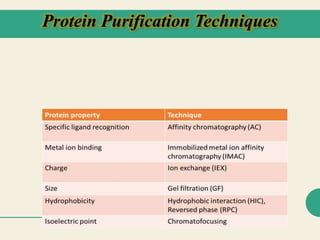
Protein Purification Techniques
 Chromatography - preparative purification of proteins
 Separation - according to differences between chemical, structural, &
functional properties of target protein and other substances in the sample
• Chromatography is the powerful method for detection and purification of biological
• substances.The principle of chromatographic separation is distribution or partition of
• separated molecules between two immiscible phases called mobile phase and stationary
• phase.Chromatographic methods are classified by different criteria including physical
• shape of stationary phase, nature of mobile phase and/or stationary phase, mechanism of
• separation or the other properties of the chromatographic systems.
• Column chromatography is the most popular method for
• purification of proteins.
Protein Purification Techniques
Scheme for Protein Purification
I. Sample preparation
II. Sample concentration and removal of contaminants
III. Separation of components of concentrated, partially purified sample
IV. Liquid chromatography (High Resolution), serves to eliminate contaminants
such as polymer
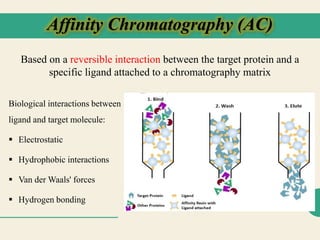
Affinity Chromatography (AC)
Biological interactions between
ligand and target molecule:
 Electrostatic
 Hydrophobic interactions
 Van der Waals' forces
 Hydrogen bonding
Based on a reversible interaction between the target protein and a
specific ligand attached to a chromatography matrix
Affinity Chromatography (AC) Cont…
Can be broadly divided into two method types:
I. Interaction of naturally occurring structure or sequence of
amino acids on the protein as the binding site
Example: binding of protein A to the Fc region of IgG
II. Interaction of proteins containing specific engineered amino
acid sequences on their surface with divalent metal ions e.g.,
Ni2+, Cu2+, Zn2+, Co2+ - IMAC
Example: Polyhistidine and glutathione s-transferase (GST) tags
Affinity Chromatography (AC) Cont…
Advantages:
 Absolute purification in a single step
 Purification based on biological function or individual
chemical structure.
 Used to separate active biomolecules from denatured or
functionally different forms
 Offers high selectivity, resolution, and capacity in most protein
purification schemes
Affinity Chromatography (AC) Cont…
Ion Exchange Chromatography (IEC)
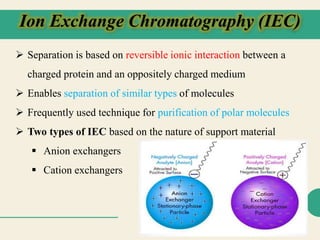
 Separation is based on reversible ionic interaction between a
charged protein and an oppositely charged medium
 Enables separation of similar types of molecules
 Frequently used technique for purification of polar molecules
 Two types of IEC based on the nature of support material
 Anion exchangers
 Cation exchangers
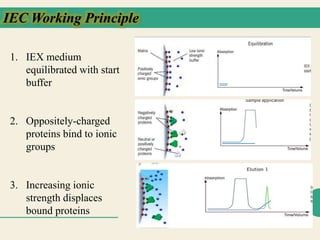
IEC Working Principle
1. IEX medium
equilibrated with start
buffer
2. Oppositely-charged
proteins bind to ionic
groups
3. Increasing ionic
strength displaces
bound proteins
4. Further increases in
ionic strength displace
more highly charged
proteins
5. Washing
Size Exclusion Chromatography (SEC)
 Separates proteins by molecular sizes.
 Best to conserve native structure and function of the purified
protein since wide varieties of buffers can be selected to obtain
the suitable condition for the protein.
 Stationary phase - porous hydrophilic gel beads e.g. agarose,
dextran, polyacrylamide, and chemical derivatives of these
substances.
Size Exclusion Chromatography (SEC)
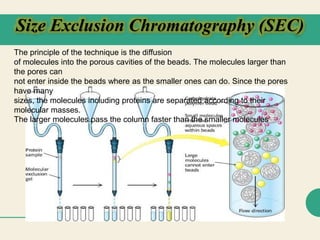
The principle of the technique is the diffusion
of molecules into the porous cavities of the beads. The molecules larger than
the pores can
not enter inside the beads where as the smaller ones can do. Since the pores
have many
sizes, the molecules including proteins are separated according to their
molecular masses.
The larger molecules pass the column faster than the smaller molecules
Chromatofocusing (CF)
 Form of gradient elution chromatography performed using ion
exchange resin column and an internally developed pH gradient.
 Separates proteins according to differences in their isoelectric
point (pI).
 Applications:
 Used as a polishing step for partially purified samples
 Resolve molecules with 0.02 pH units differences in pI
values
 Useful for separation of very similar substances
 Used for high resolution, analytical separations.
 Used as a complementary technique
Working Principle
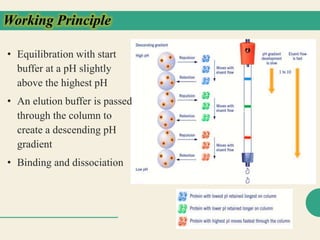
• Equilibration with start
buffer at a pH slightly
above the highest pH
• An elution buffer is passed
through the column to
create a descending pH
gradient
• Binding and dissociation
Fast Performance Liquid Chromatography
(FPLC)
 Form of medium-pressure chromatography - uses a pump to
control the speed at which the mobile phase passes through the
stationary phase.
 Introduced by PHARMACIA (Sweden)
 GE Healthcare’s ÄKTA systems provide
 ÄKTApilot, for process development and manufacturing.
 ÄKTAready and ÄKTAprocess, for larger-scale production.
 Bio-Rad Laboratories - NGC™ Chromatography System to suit
various applications
FPLC Working Principle
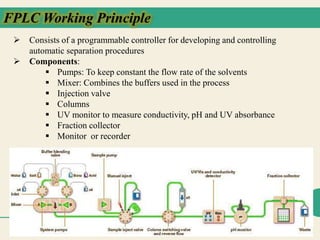
 Consists of a programmable controller for developing and controlling
automatic separation procedures
 Components:
 Pumps: To keep constant the flow rate of the solvents
 Mixer: Combines the buffers used in the process
 Injection valve
 Columns
 UV monitor to measure conductivity, pH and UV absorbance
 Fraction collector
 Monitor or recorder
High Throughput Protein Purification
 Necessary for target discovery and validation studies in drug development.
 Automated protein purification system:
 More controlled conditions and reproducible results
 Allows sensitive samples to be purified more efficiently
 Allows use of high-resolution media
 Allows automated collection of purified protein
 Uses software to create methods, monitor runs, and evaluate results
Examples of Automated Protein Purification
System
HisLink™ Protein Purification Systems by Promega:
 Purification of polyhistidine (His)-tagged proteins directly from culture
medium
 Useful in all general IMAC as well as in FPLC.
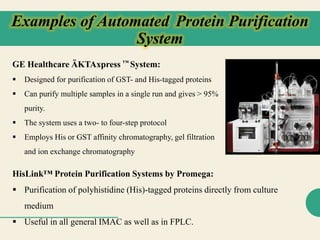
GE Healthcare ÄKTAxpress ™ System:
 Designed for purification of GST- and His-tagged proteins
 Can purify multiple samples in a single run and gives > 95%
purity.
 The system uses a two- to four-step protocol
 Employs His or GST affinity chromatography, gel filtration
and ion exchange chromatography
Examples of Automated Protein Purification System Cont..
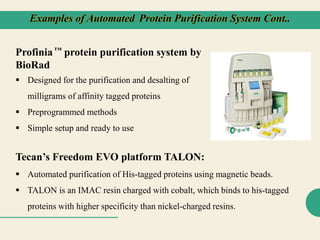
Profinia ™ protein purification system by
BioRad
 Designed for the purification and desalting of
milligrams of affinity tagged proteins
 Preprogrammed methods
 Simple setup and ready to use
Tecan’s Freedom EVO platform TALON:
 Automated purification of His-tagged proteins using magnetic beads.
 TALON is an IMAC resin charged with cobalt, which binds to his-tagged
proteins with higher specificity than nickel-charged resins.
Presentation1.pptx

Presentation1.pptx

  • 1.
  • 2.
    Protein Purification A seriesof processes by which a single protein type is isolated from a complex mixture such as a cell lysate Need to purify proteins:  Characterize function, structure and interactions  Identify the molecular basis of an activity  Drug development  Generate antibodies  Conduct binding assays
  • 3.
    Protein Purification Techniques Chromatography - preparative purification of proteins  Separation - according to differences between chemical, structural, & functional properties of target protein and other substances in the sample • Chromatography is the powerful method for detection and purification of biological • substances.The principle of chromatographic separation is distribution or partition of • separated molecules between two immiscible phases called mobile phase and stationary • phase.Chromatographic methods are classified by different criteria including physical • shape of stationary phase, nature of mobile phase and/or stationary phase, mechanism of • separation or the other properties of the chromatographic systems. • Column chromatography is the most popular method for • purification of proteins.
  • 4.
  • 5.
    Scheme for ProteinPurification I. Sample preparation II. Sample concentration and removal of contaminants III. Separation of components of concentrated, partially purified sample IV. Liquid chromatography (High Resolution), serves to eliminate contaminants such as polymer
  • 6.
    Affinity Chromatography (AC) Biologicalinteractions between ligand and target molecule:  Electrostatic  Hydrophobic interactions  Van der Waals' forces  Hydrogen bonding Based on a reversible interaction between the target protein and a specific ligand attached to a chromatography matrix
  • 7.
    Affinity Chromatography (AC)Cont… Can be broadly divided into two method types: I. Interaction of naturally occurring structure or sequence of amino acids on the protein as the binding site Example: binding of protein A to the Fc region of IgG II. Interaction of proteins containing specific engineered amino acid sequences on their surface with divalent metal ions e.g., Ni2+, Cu2+, Zn2+, Co2+ - IMAC Example: Polyhistidine and glutathione s-transferase (GST) tags
  • 8.
    Affinity Chromatography (AC)Cont… Advantages:  Absolute purification in a single step  Purification based on biological function or individual chemical structure.  Used to separate active biomolecules from denatured or functionally different forms  Offers high selectivity, resolution, and capacity in most protein purification schemes Affinity Chromatography (AC) Cont…
  • 9.
    Ion Exchange Chromatography(IEC)  Separation is based on reversible ionic interaction between a charged protein and an oppositely charged medium  Enables separation of similar types of molecules  Frequently used technique for purification of polar molecules  Two types of IEC based on the nature of support material  Anion exchangers  Cation exchangers
  • 10.
    IEC Working Principle 1.IEX medium equilibrated with start buffer 2. Oppositely-charged proteins bind to ionic groups 3. Increasing ionic strength displaces bound proteins
  • 11.
    4. Further increasesin ionic strength displace more highly charged proteins 5. Washing
  • 12.
    Size Exclusion Chromatography(SEC)  Separates proteins by molecular sizes.  Best to conserve native structure and function of the purified protein since wide varieties of buffers can be selected to obtain the suitable condition for the protein.  Stationary phase - porous hydrophilic gel beads e.g. agarose, dextran, polyacrylamide, and chemical derivatives of these substances.
  • 13.
    Size Exclusion Chromatography(SEC) The principle of the technique is the diffusion of molecules into the porous cavities of the beads. The molecules larger than the pores can not enter inside the beads where as the smaller ones can do. Since the pores have many sizes, the molecules including proteins are separated according to their molecular masses. The larger molecules pass the column faster than the smaller molecules
  • 14.
    Chromatofocusing (CF)  Formof gradient elution chromatography performed using ion exchange resin column and an internally developed pH gradient.  Separates proteins according to differences in their isoelectric point (pI).  Applications:  Used as a polishing step for partially purified samples  Resolve molecules with 0.02 pH units differences in pI values  Useful for separation of very similar substances  Used for high resolution, analytical separations.  Used as a complementary technique
  • 15.
    Working Principle • Equilibrationwith start buffer at a pH slightly above the highest pH • An elution buffer is passed through the column to create a descending pH gradient • Binding and dissociation
  • 16.
    Fast Performance LiquidChromatography (FPLC)  Form of medium-pressure chromatography - uses a pump to control the speed at which the mobile phase passes through the stationary phase.  Introduced by PHARMACIA (Sweden)  GE Healthcare’s ÄKTA systems provide  ÄKTApilot, for process development and manufacturing.  ÄKTAready and ÄKTAprocess, for larger-scale production.  Bio-Rad Laboratories - NGC™ Chromatography System to suit various applications
  • 17.
    FPLC Working Principle Consists of a programmable controller for developing and controlling automatic separation procedures  Components:  Pumps: To keep constant the flow rate of the solvents  Mixer: Combines the buffers used in the process  Injection valve  Columns  UV monitor to measure conductivity, pH and UV absorbance  Fraction collector  Monitor or recorder
  • 18.
    High Throughput ProteinPurification  Necessary for target discovery and validation studies in drug development.  Automated protein purification system:  More controlled conditions and reproducible results  Allows sensitive samples to be purified more efficiently  Allows use of high-resolution media  Allows automated collection of purified protein  Uses software to create methods, monitor runs, and evaluate results
  • 19.
    Examples of AutomatedProtein Purification System HisLink™ Protein Purification Systems by Promega:  Purification of polyhistidine (His)-tagged proteins directly from culture medium  Useful in all general IMAC as well as in FPLC. GE Healthcare ÄKTAxpress ™ System:  Designed for purification of GST- and His-tagged proteins  Can purify multiple samples in a single run and gives > 95% purity.  The system uses a two- to four-step protocol  Employs His or GST affinity chromatography, gel filtration and ion exchange chromatography
  • 20.
    Examples of AutomatedProtein Purification System Cont.. Profinia ™ protein purification system by BioRad  Designed for the purification and desalting of milligrams of affinity tagged proteins  Preprogrammed methods  Simple setup and ready to use Tecan’s Freedom EVO platform TALON:  Automated purification of His-tagged proteins using magnetic beads.  TALON is an IMAC resin charged with cobalt, which binds to his-tagged proteins with higher specificity than nickel-charged resins.

Editor's Notes

  • #4 The most common methods for preparative purification of proteins all involve chromatography. The method separate according to differences between the properties of the protein to be purified (the target protein) and the properties of other substances in the sample. Separation steps may exploit differences in chemical/structural/ functional properties between the target protein and other proteins in the crude mixture The principle of chromatographic separation is distribution or partition of separated molecules between two immiscible phases called mobile phase and stationary phase. No single procedure can be used to isolate every protein Exploit specific characteristics (structure or function) of the protein. Different steps should exploit a different characteristic Ensure method has little/no effect on function
  • #5 The most common methods for preparative purification of proteins all involve chromatography. The method separate according to differences between the properties of the protein to be purified (the target protein) and the properties of other substances in the sample. Separation steps may exploit differences in chemical/structural/ functional properties between the target protein and other proteins in the crude mixture The principle of chromatographic separation is distribution or partition of separated molecules between two immiscible phases called mobile phase and stationary phase. No single procedure can be used to isolate every protein Exploit specific characteristics (structure or function) of the protein. Different steps should exploit a different characteristic Ensure method has little/no effect on function
  • #6 Proteins purification varies from one purification step to multi- step of purifications Sample preparation is the starting point of the purification strategy (see Chapter 6). The purpose of sample preparation is to obtain a clarified extract of the source material. In the capture stage the objectives are to isolate, concentrate, and stabilize the target product. The product should be concentrated and transferred to an environment that will conserve potency/activity. At best, significant removal of critical contaminants can also be achieved. Ion exchange cgromatography During the intermediate purification stage, the key objective is to remove most of the bulk impurities, such as other proteins and nucleic acids, endotoxins, and viruses. If the capture step is efficient, the intermediate purification stage is often omitted in favor of one or more polishing steps. In the polishing stage, most impurities have already been removed. Now only trace amounts of impurities remain and possibly proteins closely related to the target protein. In the polishing stage, remaining impurities are removed and the target protein may be transferred to conditions suitable for use or storage. The objective is to achieve final purity. Size exclusion Ionexchange chromatography is usually the first chromatographic technique to be done for removal of unwanted proteins since the matrix is relatively cheaper and has higher binding capacity. Size-exclusion chromatography is usually operated after that. However the operation sequence can be reversed. One-step purification of protein from crude extract can be successful by using affinity chromatography (Fig. 7). Gel filtration chromatography or ion exchange chromatography is sometimes operated in accompany with affinity chromatography.
  • #7 Affinity purification involves 3 main steps: a. Incubation of a crude sample with the affinity support to allow the target molecule in the sample to bind to the immobilized ligand. b. Washing away non-bound sample components from the support. c. Elution (dissociation and recovery) of the target molecule from the immobilized ligand by altering the buffer conditions so that the binding interaction no longer occurs. Among all chromatographic techniques, affi nity chromatography plays a major role [ 16 ]. In fact, affi nity chromatography is the most specifi c and effective protein purifi cation technique, providing a rational basis for the purifi cation of target proteins. It exploits the principle of biomolecular recognition, that is, the ability of biologically active macromolecules to form specifi c and reversible complexes with affi nity ligands. The separation of molecules is based on binding affinity between macromolecules and macromolecules, or between macromolecules and low molecular mass ligands. The binding is specific for a certain molecule or a group of molecules. The matrix can be polyacrylamide, polystyrene, cross-linked dextrans and agarose etc.
  • #8 The interaction can be biospecific, for example, antibodies binding protein A or a receptor binding a hormone. It can also be nonbiospecific, for example, a protein binding dye substance or histidine-containing proteins binding metal ions (by immobilized metal ion affinity chromatography [IMAC],
  • #10 enables separation of similar types of molecules that would be difficult to separate by other techniques because the charge carried by the molecule of interest can be readily manipulated by changing buffer pH. Anion exchange columns contain a stationary phase with a positive charge that attracts negatively charged proteins. Cation exchange columns are the reverse, negatively charged beads which attract positively charged proteins This chromatographic technique conducts the separation according to magnitude of net electric charge of the proteins. There are two types: anion-exchange chromatography and cation-exchange chromatography. The material packed in the column is called ion exchanger which also have two types, anion and cation exchangers. Anion exchangers possess positively charged groups while cation exchangers have negatively charged groups. Cellulose, agarose, dextran and polystyrene are used for LPLC while polystyrene, polyethers and silica are strong enough for HPLC. The matrix is chemically modified to contain ionic groups which are weakly acidic, strong acidic, weakly basic, or strong basic.
  • #11 Oppositely-charged proteins bind to ionic groups of the IEX medium, becoming concentrated on the column. Uncharged proteins, or those with the same charge as the ionic groups, elute during or just after sample application. Increasing ionic strength (using a gradient) displaces bound proteins as ions in the buffer compete for binding sites . Elution of the target protein(s) is done by changing the pH in the column, which results in a change or neutralization of the charged functional groups of each protein. The separation is due to competition between proteins with different surface charges for oppositely charged groups on an ion exchanger adsorbent.
  • #12 Further increases in ionic strength displace proteins that are more highly charged (more tightly bound) Final high ionic strength wash removes any ionically bound proteins before re-equilibration
  • #13 used in the polishing steps of a purification scheme due to its ability to differentiate between different species of a protein. Often times, SEC is used as a faster and more reliable method of buffer exchange than dialysis, as it is compatible with more solvents and requires less buffer. A single solvent is used throughout the entire SEC procedure, and commercially available SEC stationary phases are compatible with most commonly used buffer components. Size-exclusion chromatography is the best to conserve native structure and function of the purified protein since wide varieties of buffers can be selected to obtain the suitable condition for the protein. The stationary phase of size-exclusion chromatography normally contains porous hydrophilic gel beads The principle of the technique is the diffusion of molecules into the porous cavities of the beads. The molecules larger than the pores can not enter inside the beads where as the smaller ones can do. Since the pores have many sizes, the molecules including proteins are separated according to their molecular masses. The larger molecules pass the column faster than the smaller molecules
  • #14 used in the polishing steps of a purification scheme due to its ability to differentiate between different species of a protein. Often times, SEC is used as a faster and more reliable method of buffer exchange than dialysis, as it is compatible with more solvents and requires less buffer. A single solvent is used throughout the entire SEC procedure, and commercially available SEC stationary phases are compatible with most commonly used buffer components. Size-exclusion chromatography is the best to conserve native structure and function of the purified protein since wide varieties of buffers can be selected to obtain the suitable condition for the protein. The stationary phase of size-exclusion chromatography normally contains porous hydrophilic gel beads The principle of the technique is the diffusion of molecules into the porous cavities of the beads. The molecules larger than the pores can not enter inside the beads where as the smaller ones can do. Since the pores have many sizes, the molecules including proteins are separated according to their molecular masses. The larger molecules pass the column faster than the smaller molecules
  • #15 biomolecule has a net negative charge at a pH above its isoelectric point A pH gradient is generated on the column as buffer and medium interact. The medium is a weak anion exchanger, and the buffer is a polyampholyte elution buffer containing a mixture of polymeric buffering species that buffers a broad pH range. Proteins with different pI values migrate at different rates down the column as the pH gradient develops, continually binding and dissociating while being focused into narrow bands and finally eluted.
  • #16 biomolecule has a net negative charge at a pH above its isoelectric point A pH gradient is generated on the column as buffer and medium interact. The medium is a weak anion exchanger, and the buffer is a polyampholyte elution buffer containing a mixture of polymeric buffering species that buffers a broad pH range. Proteins with different pI values migrate at different rates down the column as the pH gradient develops, continually binding and dissociating while being focused into narrow bands and finally eluted. the chromatofocusing medium is equilibrated with start buffer at a pH slightly above the highest pH required. An elution buffer (adjusted to the lowest pH required) is passed through the column and begins to titrate the amines on the medium and the proteins. As the buffer flows through the column, the pH is lowered and a moving, descending pH gradient is generated As the pH continues to decrease near the top of the column, any protein that drops below its pI becomes positively charged, is repelled by the positively-charged amine groups, and begins to migrate down the column with the elution buffer, travelling faster than the speed at which the pH gradient moves down the column. However, as the protein migrates down the column, the pH of the surroundings increases. When the protein reaches a zone in which the pH is above its pI, it becomes negatively charged and binds to the column again. The protein remains bound until the developing pH gradient reduces the local pH when, again, the protein drops below its pI, becomes positively charged, and begins to move down the column, catching up with the gradient. This process continues until the protein is eluted from the column at a pH near to its pI (when it has almost no net charge).
  • #17 automation of liquid chromatography and a reliable improvement of column chromatography. The FPLC instruments is used for separation of proteins (as amino acids) & their subsequent purification for future use. In other chromatographic analytical technique, the chance of denaturation is high because of their stainless steel made instruments which elevates the inner temperature and resulting denaturation of sample (protein) under investigation The introduction of chromatography systems, such as FPLCTM, improved this workflow by allowing predefined runs to be performed in a sequential manner. Further introduction of automated systems such as the A¨ KTATM family improved the workflow even further by allowing a fully automated experiment to be performed without operator assistance. However, these systems were designed for fairly large columns and high flow rates, which in turn required large sample volumes to be used.
  • #18 The procedure of FPLC depends on the type of chromatography that users want to perform. However, the basic procedure is the same. This system consists of a programmable controller for developing and controlling automatic separation procedures, 1.    In FPLC is essential to keep constant the flow rate of the solvents (buffers). This is set and control by pumps which conduce the solvents to the mixer. one or more pumps for liquid delivery, a mixer to ensure accurate and reproducible elution gradients, valves for sample injection and flow path control, Consists of a programmable controller for developing and controlling automatic separation procedures Components: Pumps: To keep constant the flow rate of the solvents Mixer combines the buffers used in the process and elutes a unique solution with different concentrations of the buffers. the sample is injected through the injection valve and then carried into the column by the flowing solvent from the mixer. Once in the column, the sample mixture separates as a result of different components adhering to or diffusing into the stationary phase.  The buffers are lead to the bottom of the column by the flow rate. On the other hand, the sample is separated in different components. This is resulted by the separation of components by the size, charge, affinity and solubility of the components of the sample. After this, the elution is carried to the UV monitor where the conductivity (salt concentration), pH and UV absorbance (proteins concentration) is measured.  Finally, the elution is collected by the fraction collector and the monitor  or recorder can show the data obtained.
  • #19 High-throughput protein purification is necessary for some applications, including target discovery and validation studies in drug development. Many companies are striving to meet this increasing need by developing automated platforms that allow researchers to walk away from the routine purification steps. A number of benefits can be derived from using an automated protein purification system.
  • #20 GE Healthcare ÄKTA™ System: Designed for protein purification ranges from micrograms to tens of grams of target protein. Covers all major chromatographic and cross flow filtration techniques, from the research laboratory to process development and manufacturing. UNICORN software. PrimeView™ software. Variants: ÄKTA™ start, AKTAprime plus, ÄKTApurifier, ÄKTAexplorer™ ÄKTApilot  Designed for the automated high-throughput purification of GST- and His-tagged proteins Gives > 95% purity. The system uses a two- to four-step protocol, depending on the types of column chromatography desired, and includes His or GST affinity chromatography, desalting or gel filtration and ion exchange chromatography. Following these protocols is an optional tag removal step. With a capacity of up to 50 mg of purified target protein, the ÄKTAxpress can purify 16 samples in 11 h using a two-step protocol, or 8 samples in 8 h using a four-step protocol.
  • #21 Purification of polyhistidine (His)-tagged or HQ-tagged proteins directly from culture medium containing bacterial cells expressing the tagged protein of interest. HisLink™ Protein Purification Resin is useful in all general immobilized metal affinity chromatography (IMAC) applications matrix as well as in low- to medium-pressure liquid chromatography systems.