
Different host vector systems for
recombinant cell cultivation
Utilizing Genetically Engineered
Organisms
INTRODUCTION
• A genetically modified organism (GMO), also
known as a transgenic organism, is any organism
whose genetic material has been altered
using genetic engineering techniques.
• Choice of host cell
• Details of the Construction of the vector
• Choice of promoter must all fit into a processing
strategy.
• How a product is to be recovered and purified.
HOW THE PRODUCT INFLUENCES
PROCESS DECISIONS
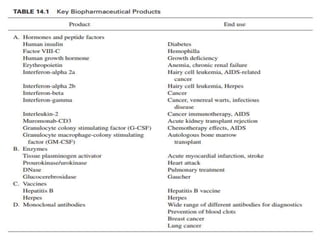
– Proteins
• (Proteins are large biomolecules, or macromolecules,
consisting of one or more long chains of amino
acid residues.)
– Nonproteins
• (Nonprotein products can be made by metabolically
engineering cells, inserting DNA-encoding enzymes that
generate new pathways or pathways with an enhanced
capacity to process the precursors to a desired
metabolite.)
Majority of Proteins
– Human Therapeutics
– Animal husbandry
– Food processing
– Industrial catalysts
Therapeutic Proteins
• Injectable – Clinical Efficiency of the product.
• Highly Pure.
• Posttranslational Processing sometimes
essential.
Challenges :
– Ensure product quality and safety.
– Process efficiency to reduce manufacturing cost.
– Need to produce highly purified material.
Animal Proteins/Hormones
• Purchased strictly on an economic basis.
• For example, the use of “bovine somatropin”
to increase milk production requires that the
increased value of the milk produced be
substantially greater than the cost of the
hormone and any increase in feed costs due to
increased milk production.
Food Proteins
• Product safety is important.
• Purity matters less than for injectable.
• Price is critical because alternative products
from natural sources may be available.
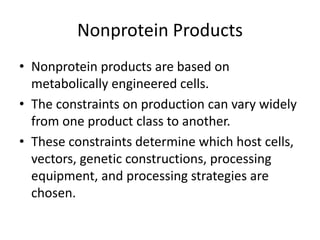
Nonprotein Products
• Nonprotein products are based on
metabolically engineered cells.
• The constraints on production can vary widely
from one product class to another.
• These constraints determine which host cells,
vectors, genetic constructions, processing
equipment, and processing strategies are
chosen.
GUIDELINES FOR CHOOSING
HOST–VECTOR SYSTEMS
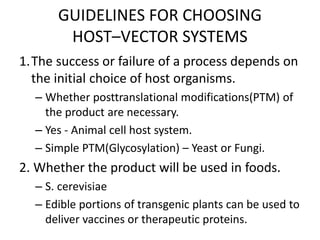
1.The success or failure of a process depends on
the initial choice of host organisms.
– Whether posttranslational modifications(PTM) of
the product are necessary.
– Yes - Animal cell host system.
– Simple PTM(Glycosylation) – Yeast or Fungi.
2. Whether the product will be used in foods.
– S. cerevisiae
– Edible portions of transgenic plants can be used to
deliver vaccines or therapeutic proteins.
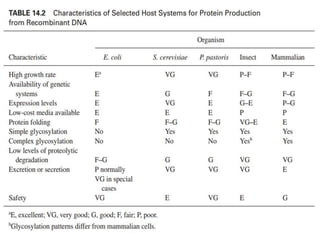
Escherichia coli
• If posttranslational modifications are
unnecessary.
• Broad knowledge(Physiology and genetics)
• E. coli will grow on simple and inexpensive
media.
• High growth rate + High cell concentration +
High expression level from specific vector
promoter = Extremely high volumetric
productivities.
E. coli to high cell densities
• Buildup of acetate and other metabolic by-
products -> Inhibit growth.
• Controlled feeding of glucose to prevent the
accumulation of large amounts of glucose in
the medium -> Prevents overflow metabolism
and the formation of acetate.
E.Coli : Not a Perfect Host
• Does not normally secrete proteins.
• When proteins are retained intracellularly and
produced at high levels, the amount of soluble
active protein present is usually limited due to
either proteolytic degradation or insolubilization
into inclusion bodies.
• Production of large amounts of foreign protein
may trigger a heat-shock response.
• Heat-shock response -> product degradation at a
rate nearly equal to the rate of production.
Limitations
• Many of the limitations on E. coli can be
overcome with protein secretion and
excretion.
• Secretion -> Translocation of a protein across
the inner membrane of E. coli.
• Excretion -> Release of the protein into the
extracellular compartment.
Gram-positive Bacteria
• Bacillus subtilis, is the best studied bacterial
alternative to E. coli.
• Gram positive -> No outer membrane -> Very
effective excreter of proteins.
• Amylases and proteases are produced
commercially using B. subtilis.
• B. subtilis is also much more difficult to
manipulate genetically than E. coli because of
a limited range of vectors and promoters.
Different host vector systems for recombinant cell cultivation By D Gnanasingh Arputhadas

Different host vector systems for recombinant cell cultivation By D Gnanasingh Arputhadas

  • 1.
    Different host vectorsystems for recombinant cell cultivation Utilizing Genetically Engineered Organisms
  • 2.
    INTRODUCTION • A geneticallymodified organism (GMO), also known as a transgenic organism, is any organism whose genetic material has been altered using genetic engineering techniques. • Choice of host cell • Details of the Construction of the vector • Choice of promoter must all fit into a processing strategy. • How a product is to be recovered and purified.
  • 3.
    HOW THE PRODUCTINFLUENCES PROCESS DECISIONS – Proteins • (Proteins are large biomolecules, or macromolecules, consisting of one or more long chains of amino acid residues.) – Nonproteins • (Nonprotein products can be made by metabolically engineering cells, inserting DNA-encoding enzymes that generate new pathways or pathways with an enhanced capacity to process the precursors to a desired metabolite.)
  • 4.
    Majority of Proteins –Human Therapeutics – Animal husbandry – Food processing – Industrial catalysts
  • 5.
    Therapeutic Proteins • Injectable– Clinical Efficiency of the product. • Highly Pure. • Posttranslational Processing sometimes essential. Challenges : – Ensure product quality and safety. – Process efficiency to reduce manufacturing cost. – Need to produce highly purified material.
  • 6.
    Animal Proteins/Hormones • Purchasedstrictly on an economic basis. • For example, the use of “bovine somatropin” to increase milk production requires that the increased value of the milk produced be substantially greater than the cost of the hormone and any increase in feed costs due to increased milk production.
  • 7.
    Food Proteins • Productsafety is important. • Purity matters less than for injectable. • Price is critical because alternative products from natural sources may be available.
  • 9.
    Nonprotein Products • Nonproteinproducts are based on metabolically engineered cells. • The constraints on production can vary widely from one product class to another. • These constraints determine which host cells, vectors, genetic constructions, processing equipment, and processing strategies are chosen.
  • 10.
    GUIDELINES FOR CHOOSING HOST–VECTORSYSTEMS 1.The success or failure of a process depends on the initial choice of host organisms. – Whether posttranslational modifications(PTM) of the product are necessary. – Yes - Animal cell host system. – Simple PTM(Glycosylation) – Yeast or Fungi. 2. Whether the product will be used in foods. – S. cerevisiae – Edible portions of transgenic plants can be used to deliver vaccines or therapeutic proteins.
  • 12.
    Escherichia coli • Ifposttranslational modifications are unnecessary. • Broad knowledge(Physiology and genetics) • E. coli will grow on simple and inexpensive media. • High growth rate + High cell concentration + High expression level from specific vector promoter = Extremely high volumetric productivities.
  • 13.
    E. coli tohigh cell densities • Buildup of acetate and other metabolic by- products -> Inhibit growth. • Controlled feeding of glucose to prevent the accumulation of large amounts of glucose in the medium -> Prevents overflow metabolism and the formation of acetate.
  • 14.
    E.Coli : Nota Perfect Host • Does not normally secrete proteins. • When proteins are retained intracellularly and produced at high levels, the amount of soluble active protein present is usually limited due to either proteolytic degradation or insolubilization into inclusion bodies. • Production of large amounts of foreign protein may trigger a heat-shock response. • Heat-shock response -> product degradation at a rate nearly equal to the rate of production.
  • 15.
    Limitations • Many ofthe limitations on E. coli can be overcome with protein secretion and excretion. • Secretion -> Translocation of a protein across the inner membrane of E. coli. • Excretion -> Release of the protein into the extracellular compartment.
  • 16.
    Gram-positive Bacteria • Bacillussubtilis, is the best studied bacterial alternative to E. coli. • Gram positive -> No outer membrane -> Very effective excreter of proteins. • Amylases and proteases are produced commercially using B. subtilis. • B. subtilis is also much more difficult to manipulate genetically than E. coli because of a limited range of vectors and promoters.