Mary K. Campbell
    Shawn O. Farrell
    http://academic.cengage.com/chemistry/campbell


       Chapter Five
 Protein Purification and
Characterization Techniques


 Paul D. Adams • University of Arkansas
Why purify a protein?

 • Characterize function, activity, structure

 • Use in assays

 • Raise antibodies

 • many other reasons ...
Guidelines for protein purification


• Define objectives
• Define properties of target protein and critical
  contaminants
• Minimize the number of steps
• Use a different technique at each step
• Develop analytical assays


  Adapted from: Protein Purification Handbook. Amersham Biosciences. 18-1132-29, Edition
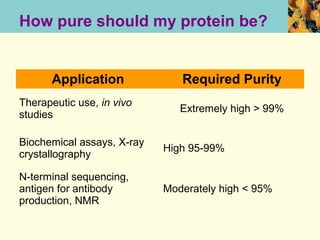
How pure should my protein be?


      Application              Required Purity
Therapeutic use, in vivo
                               Extremely high > 99%
studies

Biochemical assays, X-ray
                            High 95-99%
crystallography

N-terminal sequencing,
antigen for antibody        Moderately high < 95%
production, NMR
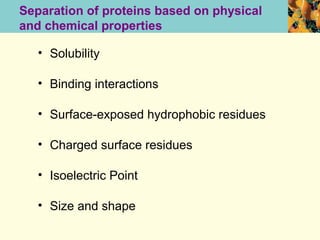
Separation of proteins based on physical
and chemical properties

   • Solubility

   • Binding interactions

   • Surface-exposed hydrophobic residues

   • Charged surface residues

   • Isoelectric Point

   • Size and shape
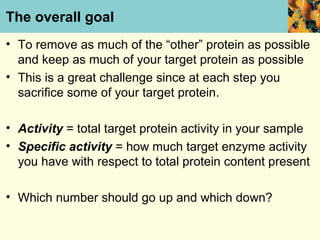
The overall goal
• To remove as much of the “other” protein as possible
  and keep as much of your target protein as possible
• This is a great challenge since at each step you
  sacrifice some of your target protein.

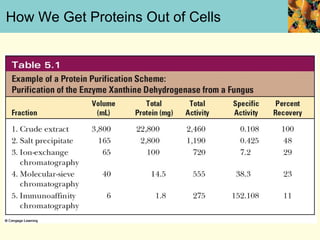
• Activity = total target protein activity in your sample
• Specific activity = how much target enzyme activity
  you have with respect to total protein content present

• Which number should go up and which down?
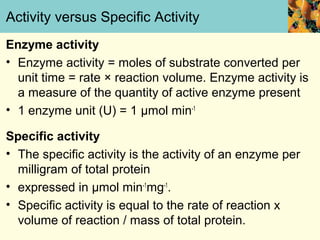
Activity versus Specific Activity
Enzyme activity
• Enzyme activity = moles of substrate converted per
  unit time = rate Ă— reaction volume. Enzyme activity is
  a measure of the quantity of active enzyme present
• 1 enzyme unit (U) = 1 μmol min-1

Specific activity
• The specific activity is the activity of an enzyme per
  milligram of total protein
• expressed in μmol min-1mg-1.
• Specific activity is equal to the rate of reaction x
  volume of reaction / mass of total protein.
How We Get Proteins Out of Cells
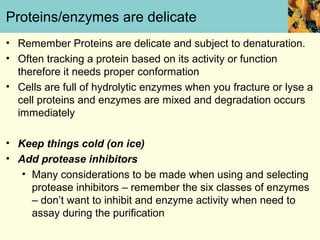
Proteins/enzymes are delicate
• Remember Proteins are delicate and subject to denaturation.
• Often tracking a protein based on its activity or function
  therefore it needs proper conformation
• Cells are full of hydrolytic enzymes when you fracture or lyse a
  cell proteins and enzymes are mixed and degradation occurs
  immediately

• Keep things cold (on ice)
• Add protease inhibitors
   • Many considerations to be made when using and selecting
     protease inhibitors – remember the six classes of enzymes
     – don’t want to inhibit and enzyme activity when need to
     assay during the purification
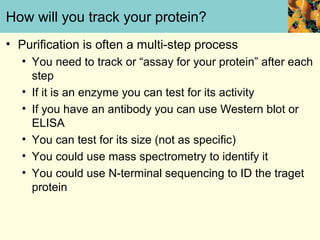
How will you track your protein?
• Purification is often a multi-step process
   • You need to track or “assay for your protein” after each
     step
   • If it is an enzyme you can test for its activity
   • If you have an antibody you can use Western blot or
     ELISA
   • You can test for its size (not as specific)
   • You could use mass spectrometry to identify it
   • You could use N-terminal sequencing to ID the traget
     protein
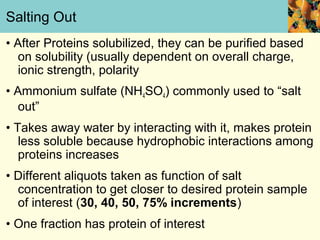
Salting Out
• After Proteins solubilized, they can be purified based
   on solubility (usually dependent on overall charge,
   ionic strength, polarity
• Ammonium sulfate (NH4SO4) commonly used to “salt
   out”
• Takes away water by interacting with it, makes protein
   less soluble because hydrophobic interactions among
   proteins increases
• Different aliquots taken as function of salt
  concentration to get closer to desired protein sample
  of interest (30, 40, 50, 75% increments)
• One fraction has protein of interest
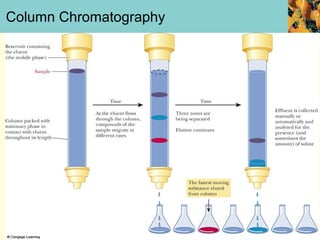
Column Chromatography
• Basis of Chromatography
   • Different compounds distribute themselves to a varying
     extent between different phases
• Interact/distribute themselves
• In different phases
• 2 phases:
  • Stationary: samples interacts with this phase
  • Mobile: Flows over the stationary phase and carries
  along with it the sample to be separated
Column Chromatography
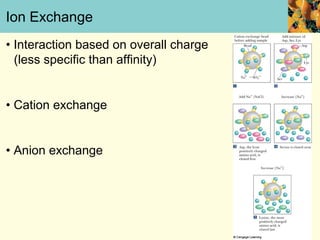
Ion Exchange
• Interaction based on overall charge
  (less specific than affinity)


• Cation exchange


• Anion exchange
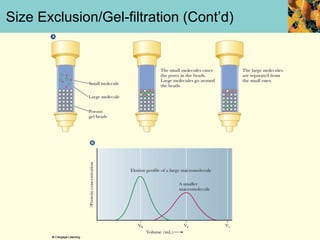
Size-Exclusion/Gel-Filtration
• Separates molecules based on size.
• Stationary phase composed of cross-linked gel
  particles.
• Extent of cross-linking can be controlled to determine
  pore size
• Smaller molecules enter the pores and are delayed in
  elution time. Larger molecules do not enter and elute
  from column before smaller ones.
Size Exclusion/Gel-filtration (Cont’d)
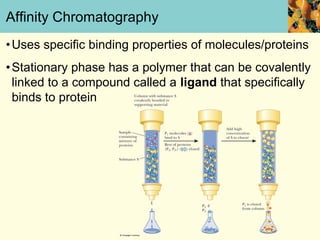
Affinity Chromatography
• Uses specific binding properties of molecules/proteins
• Stationary phase has a polymer that can be covalently
  linked to a compound called a ligand that specifically
  binds to protein
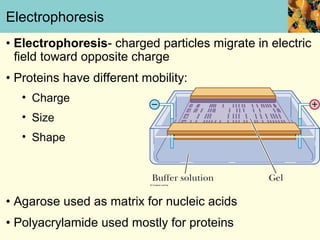
Electrophoresis
• Electrophoresis- charged particles migrate in electric
  field toward opposite charge
• Proteins have different mobility:
   • Charge
   • Size
   • Shape


• Agarose used as matrix for nucleic acids
• Polyacrylamide used mostly for proteins
Electrophoresis (Cont’d)
• Polyacrylamide has more resistance towards larger
   molecules than smaller


• Protein is treated with detergent (SDS) sodium
   dodecyl sulfate


• Smaller proteins move through faster (charge and
   shape usually similar)
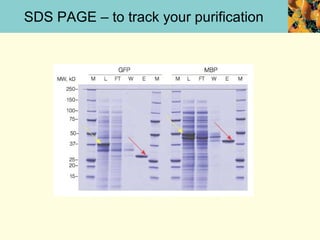
SDS PAGE – to track your purification
Isoelectric Focusing
• Isolectric focusing- based on differing isoelectric pts.
   (pI) of proteins
• Gel is prepared with pH gradient that parallels electric-
  field. What does this do?
  • Charge on the protein changes as it migrates.
  • When it gets to pI, has no charge and stops
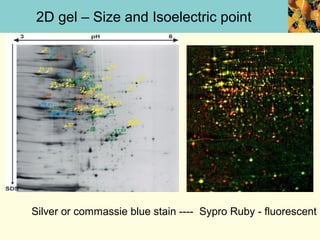
2D gel – Size and Isoelectric point


Silver or commassie blue stain ---- Sypro Ruby - fluorescent
Differential Centrifugation
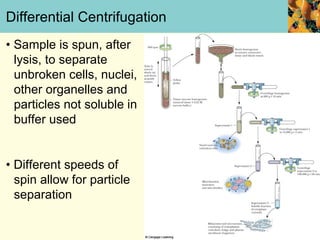
• Sample is spun, after
  lysis, to separate
  unbroken cells, nuclei,
  other organelles and
  particles not soluble in
  buffer used


• Different speeds of
  spin allow for particle
  separation

Protein purification chp-5-bioc-361-version-oct-2012

  • 1.
    Mary K. Campbell Shawn O. Farrell http://academic.cengage.com/chemistry/campbell Chapter Five Protein Purification and Characterization Techniques Paul D. Adams • University of Arkansas
  • 2.
    Why purify aprotein? • Characterize function, activity, structure • Use in assays • Raise antibodies • many other reasons ...
  • 3.
    Guidelines for proteinpurification • Define objectives • Define properties of target protein and critical contaminants • Minimize the number of steps • Use a different technique at each step • Develop analytical assays Adapted from: Protein Purification Handbook. Amersham Biosciences. 18-1132-29, Edition
  • 4.
    How pure shouldmy protein be? Application Required Purity Therapeutic use, in vivo Extremely high > 99% studies Biochemical assays, X-ray High 95-99% crystallography N-terminal sequencing, antigen for antibody Moderately high < 95% production, NMR
  • 5.
    Separation of proteinsbased on physical and chemical properties • Solubility • Binding interactions • Surface-exposed hydrophobic residues • Charged surface residues • Isoelectric Point • Size and shape
  • 6.
    The overall goal •To remove as much of the “other” protein as possible and keep as much of your target protein as possible • This is a great challenge since at each step you sacrifice some of your target protein. • Activity = total target protein activity in your sample • Specific activity = how much target enzyme activity you have with respect to total protein content present • Which number should go up and which down?
  • 7.
    Activity versus SpecificActivity Enzyme activity • Enzyme activity = moles of substrate converted per unit time = rate × reaction volume. Enzyme activity is a measure of the quantity of active enzyme present • 1 enzyme unit (U) = 1 μmol min-1 Specific activity • The specific activity is the activity of an enzyme per milligram of total protein • expressed in μmol min-1mg-1. • Specific activity is equal to the rate of reaction x volume of reaction / mass of total protein.
  • 8.
    How We GetProteins Out of Cells
  • 9.
    Proteins/enzymes are delicate •Remember Proteins are delicate and subject to denaturation. • Often tracking a protein based on its activity or function therefore it needs proper conformation • Cells are full of hydrolytic enzymes when you fracture or lyse a cell proteins and enzymes are mixed and degradation occurs immediately • Keep things cold (on ice) • Add protease inhibitors • Many considerations to be made when using and selecting protease inhibitors – remember the six classes of enzymes – don’t want to inhibit and enzyme activity when need to assay during the purification
  • 10.
    How will youtrack your protein? • Purification is often a multi-step process • You need to track or “assay for your protein” after each step • If it is an enzyme you can test for its activity • If you have an antibody you can use Western blot or ELISA • You can test for its size (not as specific) • You could use mass spectrometry to identify it • You could use N-terminal sequencing to ID the traget protein
  • 11.
    Salting Out • AfterProteins solubilized, they can be purified based on solubility (usually dependent on overall charge, ionic strength, polarity • Ammonium sulfate (NH4SO4) commonly used to “salt out” • Takes away water by interacting with it, makes protein less soluble because hydrophobic interactions among proteins increases • Different aliquots taken as function of salt concentration to get closer to desired protein sample of interest (30, 40, 50, 75% increments) • One fraction has protein of interest
  • 12.
    Column Chromatography • Basisof Chromatography • Different compounds distribute themselves to a varying extent between different phases • Interact/distribute themselves • In different phases • 2 phases: • Stationary: samples interacts with this phase • Mobile: Flows over the stationary phase and carries along with it the sample to be separated
  • 13.
  • 14.
    Ion Exchange • Interactionbased on overall charge (less specific than affinity) • Cation exchange • Anion exchange
  • 15.
    Size-Exclusion/Gel-Filtration • Separates moleculesbased on size. • Stationary phase composed of cross-linked gel particles. • Extent of cross-linking can be controlled to determine pore size • Smaller molecules enter the pores and are delayed in elution time. Larger molecules do not enter and elute from column before smaller ones.
  • 16.
  • 17.
    Affinity Chromatography • Usesspecific binding properties of molecules/proteins • Stationary phase has a polymer that can be covalently linked to a compound called a ligand that specifically binds to protein
  • 18.
    Electrophoresis • Electrophoresis- chargedparticles migrate in electric field toward opposite charge • Proteins have different mobility: • Charge • Size • Shape • Agarose used as matrix for nucleic acids • Polyacrylamide used mostly for proteins
  • 19.
    Electrophoresis (Cont’d) • Polyacrylamidehas more resistance towards larger molecules than smaller • Protein is treated with detergent (SDS) sodium dodecyl sulfate • Smaller proteins move through faster (charge and shape usually similar)
  • 20.
    SDS PAGE –to track your purification
  • 21.
    Isoelectric Focusing • Isolectricfocusing- based on differing isoelectric pts. (pI) of proteins • Gel is prepared with pH gradient that parallels electric- field. What does this do? • Charge on the protein changes as it migrates. • When it gets to pI, has no charge and stops
  • 22.
    2D gel –Size and Isoelectric point Silver or commassie blue stain ---- Sypro Ruby - fluorescent
  • 23.
    Differential Centrifugation • Sampleis spun, after lysis, to separate unbroken cells, nuclei, other organelles and particles not soluble in buffer used • Different speeds of spin allow for particle separation