Miss. Shingan Aarti vijaykumar
F.Y.M.Pharm (sem II)
Pharmaceutical chemistry
Roll No.- CH-106
Under guidance : Dr. S,B.Jadhav
 Introduction,
 Qualities of a Good Protecting Group in Organic Synthesis,
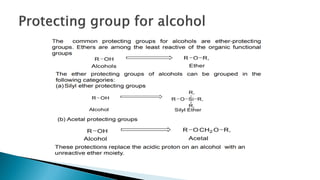
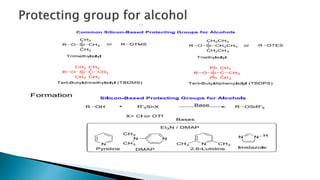
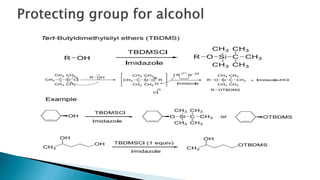
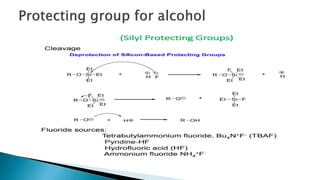
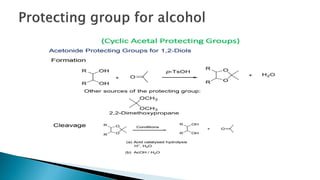
 Protecting groups for alcohol,
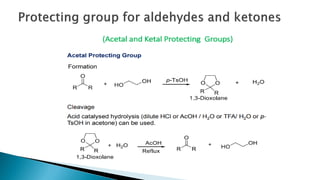
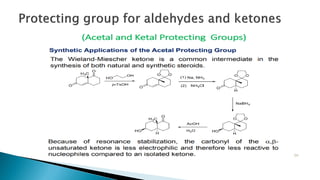
 Protecting groups for aldehydes and ketones,
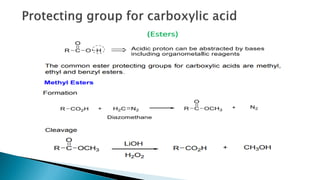
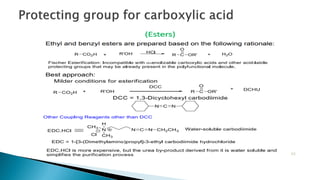
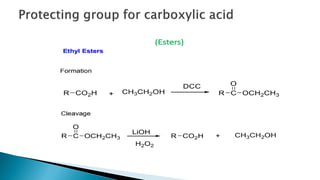
 Protecting groups for carboxylic acids,
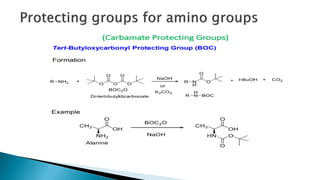
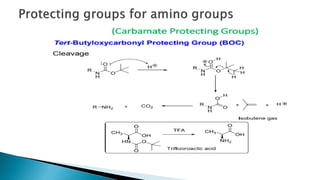
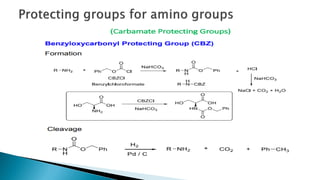
 Protecting groups for amino groups.
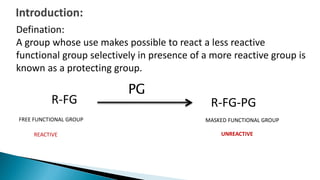
R-FG
FREE FUNCTIONAL GROUP
R-FG-PG
MASKED FUNCTIONAL GROUP
UNREACTIVEREACTIVE
PG
Defination:
A group whose use makes possible to react a less reactive
functional group selectively in presence of a more reactive group is
known as a protecting group.
 A protecting group (pg) is a molecular framework that is
introduced onto a specific functional group (fg) in a poly-
functional molecule to block its reactivity under reaction
conditions needed to make modifications elsewhere in the
molecule.
 A protecting group blokes the reactivity of a functional group by
converting it into a different group which is inert to the condition
of some reaction that is to be carried out as part of a synthetic
route.
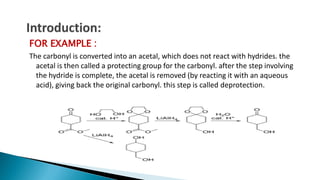
FOR EXAMPLE :
The carbonyl is converted into an acetal, which does not react with hydrides. the
acetal is then called a protecting group for the carbonyl. after the step involving
the hydride is complete, the acetal is removed (by reacting it with an aqueous
acid), giving back the original carbonyl. this step is called deprotection.
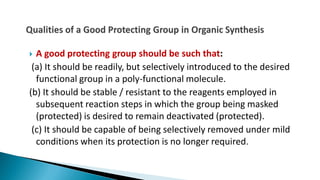
 A good protecting group should be such that:
(a) It should be readily, but selectively introduced to the desired
functional group in a poly-functional molecule.
(b) It should be stable / resistant to the reagents employed in
subsequent reaction steps in which the group being masked
(protected) is desired to remain deactivated (protected).
(c) It should be capable of being selectively removed under mild
conditions when its protection is no longer required.
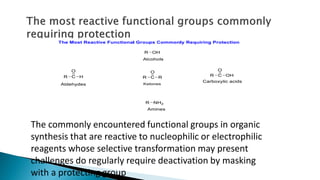
The commonly encountered functional groups in organic
synthesis that are reactive to nucleophilic or electrophilic
reagents whose selective transformation may present
challenges do regularly require deactivation by masking
with a protecting group
Reference :
1. Ferrier, R. J.; Collins, P. M. Monosaccharides, their Chemistry and their Roles in Natural
Products; Wiley: New York, 1994; Hanessian, S. Total Synthesis of Natural Products, the
Chiron Approach; Pergamon: Oxford, 1983; Inch, T. D. Tetrahedron 1984, 40, 3161;
Kochetkov, N. K.; Suiridov, A. F.; Ermolenko, M. S. Carbohydrates in the Synthesis of
Natural Compounds; Nauka: Moscow, 1984.
2. Hale, K. J. In Rodd’s Chemistry of Carbon Compounds; M. Sainsbury, Ed.; Elsevier:
Amsterdam, 1993; Vol 1E, F, G, 2nd Supplement, pp 315–436.
3. Mills, J. A. Adv. Carbohydr. Chem. 1955, 10, 1.
4. Darcy, R. J. Chem. Educ. 1994, 71, 1090–1091.
5. Hough, L.; Richardson, A. C. In Rodd’s Chemistry of Carbon Compounds, 2nd ed. IF;
Carbohydrate Chemistry; Coffey, S., Ed.; Elsevier: Amsterdam, 1967; pp 320–432.
6. Haworth, W. N.; Hirst, E. L. Chem. Ind. 1933, 52, 645; Ault, R. G.; Baird, D. K.; Carrington,
H. C.; Haworth W. N.; Herbert, R.; Hirst, E. L.; Percival, E. G. V.; Smith, F.; Stacey, M. J.
Chem. Soc. 1933, 1419–1423
Protecting group

Protecting group

  • 1.
    Miss. Shingan Aartivijaykumar F.Y.M.Pharm (sem II) Pharmaceutical chemistry Roll No.- CH-106 Under guidance : Dr. S,B.Jadhav
  • 2.
     Introduction,  Qualitiesof a Good Protecting Group in Organic Synthesis,  Protecting groups for alcohol,  Protecting groups for aldehydes and ketones,  Protecting groups for carboxylic acids,  Protecting groups for amino groups.
  • 3.
    R-FG FREE FUNCTIONAL GROUP R-FG-PG MASKEDFUNCTIONAL GROUP UNREACTIVEREACTIVE PG Defination: A group whose use makes possible to react a less reactive functional group selectively in presence of a more reactive group is known as a protecting group.
  • 4.
     A protectinggroup (pg) is a molecular framework that is introduced onto a specific functional group (fg) in a poly- functional molecule to block its reactivity under reaction conditions needed to make modifications elsewhere in the molecule.  A protecting group blokes the reactivity of a functional group by converting it into a different group which is inert to the condition of some reaction that is to be carried out as part of a synthetic route.
  • 5.
    FOR EXAMPLE : Thecarbonyl is converted into an acetal, which does not react with hydrides. the acetal is then called a protecting group for the carbonyl. after the step involving the hydride is complete, the acetal is removed (by reacting it with an aqueous acid), giving back the original carbonyl. this step is called deprotection.
  • 6.
     A goodprotecting group should be such that: (a) It should be readily, but selectively introduced to the desired functional group in a poly-functional molecule. (b) It should be stable / resistant to the reagents employed in subsequent reaction steps in which the group being masked (protected) is desired to remain deactivated (protected). (c) It should be capable of being selectively removed under mild conditions when its protection is no longer required.
  • 7.
    The commonly encounteredfunctional groups in organic synthesis that are reactive to nucleophilic or electrophilic reagents whose selective transformation may present challenges do regularly require deactivation by masking with a protecting group
  • 22.
    Reference : 1. Ferrier,R. J.; Collins, P. M. Monosaccharides, their Chemistry and their Roles in Natural Products; Wiley: New York, 1994; Hanessian, S. Total Synthesis of Natural Products, the Chiron Approach; Pergamon: Oxford, 1983; Inch, T. D. Tetrahedron 1984, 40, 3161; Kochetkov, N. K.; Suiridov, A. F.; Ermolenko, M. S. Carbohydrates in the Synthesis of Natural Compounds; Nauka: Moscow, 1984. 2. Hale, K. J. In Rodd’s Chemistry of Carbon Compounds; M. Sainsbury, Ed.; Elsevier: Amsterdam, 1993; Vol 1E, F, G, 2nd Supplement, pp 315–436. 3. Mills, J. A. Adv. Carbohydr. Chem. 1955, 10, 1. 4. Darcy, R. J. Chem. Educ. 1994, 71, 1090–1091. 5. Hough, L.; Richardson, A. C. In Rodd’s Chemistry of Carbon Compounds, 2nd ed. IF; Carbohydrate Chemistry; Coffey, S., Ed.; Elsevier: Amsterdam, 1967; pp 320–432. 6. Haworth, W. N.; Hirst, E. L. Chem. Ind. 1933, 52, 645; Ault, R. G.; Baird, D. K.; Carrington, H. C.; Haworth W. N.; Herbert, R.; Hirst, E. L.; Percival, E. G. V.; Smith, F.; Stacey, M. J. Chem. Soc. 1933, 1419–1423