PROTECTINGGROUPSIN
ORGANICSYNTHESIS
1
K.PRADEEP KUMAR. M.SC,APSET,(Ph.D)
H.O.D IN CHEMISTRY
IDEAL JUNIOR COLLEGE
KAKINADA.
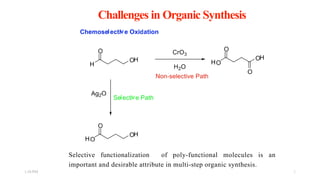
Challenges in Organic Synthesis
Selective functionalization of poly-functional molecules is an
important and desirable attribute in multi-step organic synthesis.
1:56 PM 2
1:56 PM

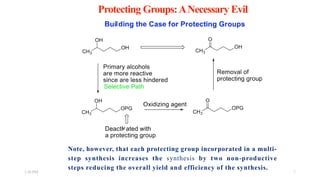
Protecting Groups:ANecessary Evil
Note, however, that each protecting group incorporated in a multi-
step synthesis increases the synthesis by two non-productive
steps reducing the overall yield and efficiency of the synthesis.

3
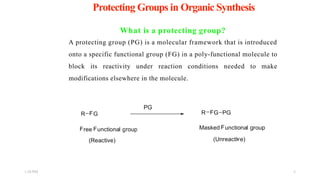
Protecting Groups in Organic Synthesis
What is a protecting group?
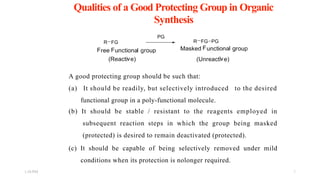
A protecting group (PG) is a molecular framework that is introduced
onto a specific functional group (FG) in a poly-functional molecule to
block its reactivity under reaction conditions needed to make
modifications elsewhere in the molecule.
1:56 PM 4
Qualities of a Good Protecting Group in Organic
Synthesis
A good protecting group should be such that:
(a) It should be readily, but selectively introduced to the desired
functional group in a poly-functional molecule.
(b) It should be stable / resistant to the reagents employed in
subsequent reaction steps in which the group being masked
(protected) is desired to remain deactivated (protected).
(c) It should be capable of being selectively removed under mild
conditions when its protection is nolonger required.
1:56 PM 5
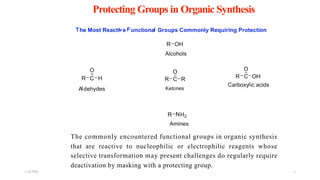
Protecting Groups in Organic Synthesis
The commonly encountered functional groups in organic synthesis
that are reactive to nucleophilic or electrophilic reagents whose
selective transformation may present challenges do regularly require
deactivation by masking with a protecting group.
1:56 PM 6
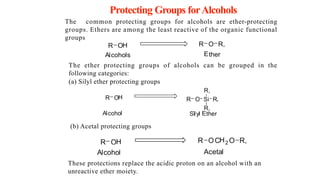
Protecting Groups forAlcohols
The common protecting groups for alcohols are ether-protecting
groups. Ethers are among the least reactive of the organic functional
groups
The ether protecting groups of alcohols can be grouped in the
following categories:
(a) Silyl ether protecting groups
(b) Acetal protecting groups
These protections replace the acidic proton on an alcohol with an
unreactive ether moiety.
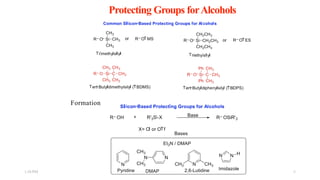
Protecting Groups forAlcohols
Formation
1:56 PM 8
Protecting Groups forAlcohols
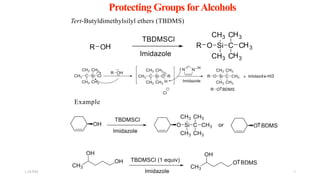
Tert-Butyldimethylsilyl ethers (TBDMS)
Example
1:56 PM 9
Protecting Groups forAlcohols
(Silyl Protecting Groups)
1:56 PM

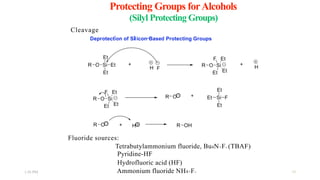
Cleavage
Fluoride sources:
Tetrabutylammonium fluoride, Bu4N+F- (TBAF)
Pyridine-HF
Hydrofluoric acid (HF)
Ammonium fluoride NH4+F-
 10
Protecting Groups forAlcohols
(Silyl Protecting Groups)
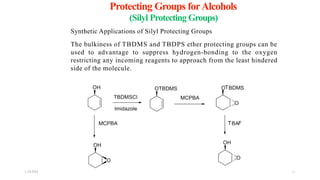
Synthetic Applications of Silyl Protecting Groups
The bulkiness of TBDMS and TBDPS ether protecting groups can be
used to advantage to suppress hydrogen-bonding to the oxygen
restricting any incoming reagents to approach from the least hindered
side of the molecule.
1:56 PM 11
Protecting Groups forAlcohols
(Silyl Protecting Groups)
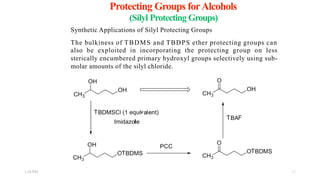
Synthetic Applications of Silyl Protecting Groups
The bulkiness of TBDMS and TBDPS ether protecting groups can
also be exploited in incorporating the protecting group on less
sterically encumbered primary hydroxyl groups selectively using sub-
molar amounts of the silyl chloride.
1:56 PM 12
Protecting Groups forAlcohols
(Benzyl ether Protecting Groups)
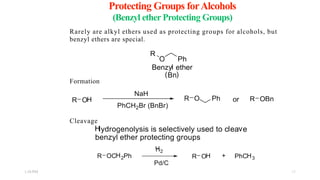
Rarely are alkyl ethers used as protecting groups for alcohols, but
benzyl ethers are special.
Formation
Cleavage
1:56 PM 15
Protecting Groups forAlcohols
(CyclicAcetal Protecting Groups)
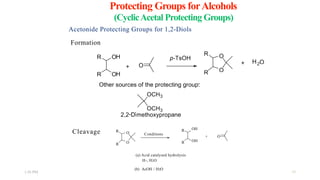
Acetonide Protecting Groups for 1,2-Diols
Formation
Cleavage
 R
R

O
O

Conditions

R
R

OH
OH

+
 O
1:56 PM

(a) Acid catalysed hydrolysis
H+, H2O
(b) AcOH / H2O

16
Protecting Groups forAlcohols
(Perspectives on their SyntheticApplications)
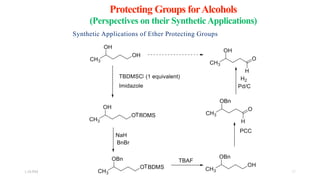
Synthetic Applications of Ether Protecting Groups
1:56 PM 17
Protecting Groups forAlcohols
(Perspectives on their SyntheticApplications)
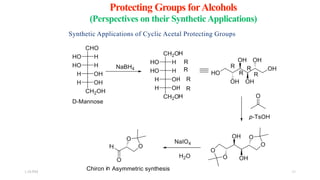
Synthetic Applications of Cyclic Acetal Protecting Groups
1:56 PM 18
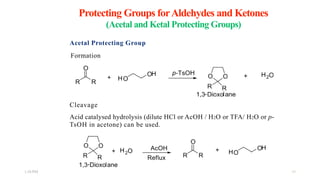
Protecting Groups forAldehydes and Ketones
(Acetal and Ketal Protecting Groups)
Acetal Protecting Group
Formation
Cleavage
Acid catalysed hydrolysis (dilute HCl or AcOH / H2O or TFA/ H2O or p-
TsOH in acetone) can be used.
1:56 PM 19
Protecting Groups forAldehydes &Ketones
1:56 PM

(Acetal and Ketal Protecting Groups)
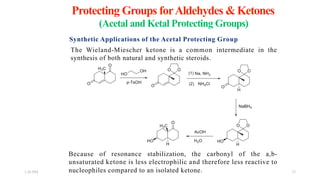
Synthetic Applications of the Acetal Protecting Group
The Wieland-Miescher ketone is a common intermediate in the
synthesis of both natural and synthetic steroids.
Because of resonance stabilization, the carbonyl of the a,b-
unsaturated ketone is less electrophilic and therefore less reactive to
nucleophiles compared to an isolated ketone.
 20
Protecting Groups for CarboxylicAcids
(Esters)
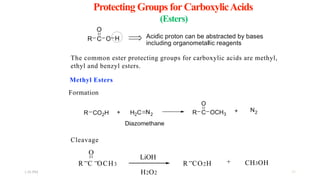
The common ester protecting groups for carboxylic acids are methyl,
ethyl and benzyl esters.
Methyl Esters
Formation
Cleavage
1:56 PM

O
R C OCH3

LiOH
H2O2

R CO2H
 +
 CH3OH

21
Protecting Groups for CarboxylicAcids
(Esters)
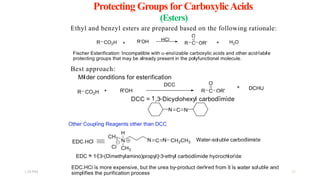
Ethyl and benzyl esters are prepared based on the following rationale:
Best approach:
1:56 PM 22
Protecting Groups for CarboxylicAcids
(Esters)
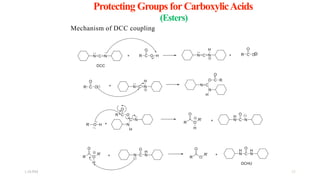
Mechanism of DCC coupling
1:56 PM 23
Protecting Groups for CarboxylicAcids
(Esters)
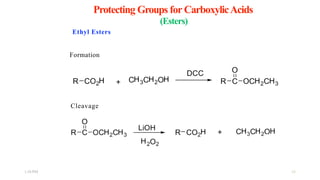
Ethyl Esters
Formation
Cleavage
1:56 PM 24
Protecting Groups for CarboxylicAcids
(Esters)
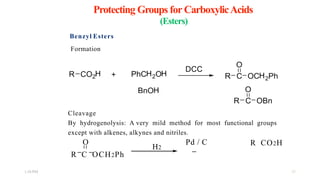
Benzyl Esters
Formation
Cleavage
By hydrogenolysis: A very mild method for most functional groups
except with alkenes, alkynes and nitriles.
O
R C OCH2Ph

H2
Pd / C
 R CO2H

1:56 PM 25
Protecting Groups forAmino Groups
(Carbamate Protecting Groups)
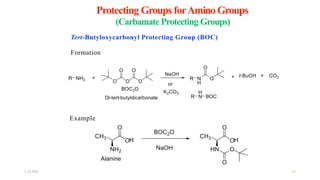
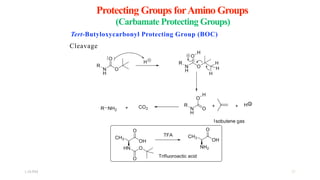
Tert-Butyloxycarbonyl Protecting Group (BOC)
Formation
Example
1:56 PM 26
Protecting Groups forAmino Groups
(Carbamate Protecting Groups)
Tert-Butyloxycarbonyl Protecting Group (BOC)
Cleavage
1:56 PM 27
Protecting Groups forAmino Groups
(Carbamate Protecting Groups)
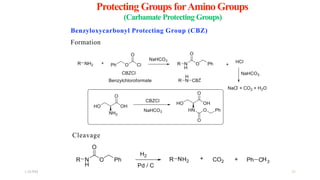
Benzyloxycarbonyl Protecting Group (CBZ)
Formation
Cleavage
1:56 PM 28
1:56 PM

Protecting Groups for CarboxylicAcids
(Ester Protecting Groups)
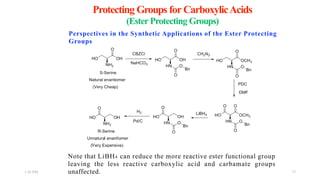
Perspectives in the Synthetic Applications of the Ester Protecting
Groups
Note that LiBH4 can reduce the more reactive ester functional group
leaving the less reactive carboxylic acid and carbamate groups
unaffected.
 29

protecting groups

  • 1.
  • 2.
    Challenges in OrganicSynthesis Selective functionalization of poly-functional molecules is an important and desirable attribute in multi-step organic synthesis. 1:56 PM 2
  • 3.
    1:56 PM
 Protecting Groups:ANecessaryEvil Note, however, that each protecting group incorporated in a multi- step synthesis increases the synthesis by two non-productive steps reducing the overall yield and efficiency of the synthesis.
 3
  • 4.
    Protecting Groups inOrganic Synthesis What is a protecting group? A protecting group (PG) is a molecular framework that is introduced onto a specific functional group (FG) in a poly-functional molecule to block its reactivity under reaction conditions needed to make modifications elsewhere in the molecule. 1:56 PM 4
  • 5.
    Qualities of aGood Protecting Group in Organic Synthesis A good protecting group should be such that: (a) It should be readily, but selectively introduced to the desired functional group in a poly-functional molecule. (b) It should be stable / resistant to the reagents employed in subsequent reaction steps in which the group being masked (protected) is desired to remain deactivated (protected). (c) It should be capable of being selectively removed under mild conditions when its protection is nolonger required. 1:56 PM 5
  • 6.
    Protecting Groups inOrganic Synthesis The commonly encountered functional groups in organic synthesis that are reactive to nucleophilic or electrophilic reagents whose selective transformation may present challenges do regularly require deactivation by masking with a protecting group. 1:56 PM 6
  • 7.
    Protecting Groups forAlcohols Thecommon protecting groups for alcohols are ether-protecting groups. Ethers are among the least reactive of the organic functional groups The ether protecting groups of alcohols can be grouped in the following categories: (a) Silyl ether protecting groups (b) Acetal protecting groups These protections replace the acidic proton on an alcohol with an unreactive ether moiety.
  • 8.
  • 9.
  • 10.
    Protecting Groups forAlcohols (SilylProtecting Groups) 1:56 PM
 Cleavage Fluoride sources: Tetrabutylammonium fluoride, Bu4N+F- (TBAF) Pyridine-HF Hydrofluoric acid (HF) Ammonium fluoride NH4+F-
 10
  • 11.
    Protecting Groups forAlcohols (SilylProtecting Groups) Synthetic Applications of Silyl Protecting Groups The bulkiness of TBDMS and TBDPS ether protecting groups can be used to advantage to suppress hydrogen-bonding to the oxygen restricting any incoming reagents to approach from the least hindered side of the molecule. 1:56 PM 11
  • 12.
    Protecting Groups forAlcohols (SilylProtecting Groups) Synthetic Applications of Silyl Protecting Groups The bulkiness of TBDMS and TBDPS ether protecting groups can also be exploited in incorporating the protecting group on less sterically encumbered primary hydroxyl groups selectively using sub- molar amounts of the silyl chloride. 1:56 PM 12
  • 13.
    Protecting Groups forAlcohols (Benzylether Protecting Groups) Rarely are alkyl ethers used as protecting groups for alcohols, but benzyl ethers are special. Formation Cleavage 1:56 PM 15
  • 14.
    Protecting Groups forAlcohols (CyclicAcetalProtecting Groups) Acetonide Protecting Groups for 1,2-Diols Formation Cleavage
 R R
 O O
 Conditions
 R R
 OH OH
 +
 O 1:56 PM
 (a) Acid catalysed hydrolysis H+, H2O (b) AcOH / H2O
 16
  • 15.
    Protecting Groups forAlcohols (Perspectiveson their SyntheticApplications) Synthetic Applications of Ether Protecting Groups 1:56 PM 17
  • 16.
    Protecting Groups forAlcohols (Perspectiveson their SyntheticApplications) Synthetic Applications of Cyclic Acetal Protecting Groups 1:56 PM 18
  • 17.
    Protecting Groups forAldehydesand Ketones (Acetal and Ketal Protecting Groups) Acetal Protecting Group Formation Cleavage Acid catalysed hydrolysis (dilute HCl or AcOH / H2O or TFA/ H2O or p- TsOH in acetone) can be used. 1:56 PM 19
  • 18.
    Protecting Groups forAldehydes&Ketones 1:56 PM
 (Acetal and Ketal Protecting Groups) Synthetic Applications of the Acetal Protecting Group The Wieland-Miescher ketone is a common intermediate in the synthesis of both natural and synthetic steroids. Because of resonance stabilization, the carbonyl of the a,b- unsaturated ketone is less electrophilic and therefore less reactive to nucleophiles compared to an isolated ketone.
 20
  • 19.
    Protecting Groups forCarboxylicAcids (Esters) The common ester protecting groups for carboxylic acids are methyl, ethyl and benzyl esters. Methyl Esters Formation Cleavage 1:56 PM
 O R C OCH3
 LiOH H2O2
 R CO2H
 +
 CH3OH
 21
  • 20.
    Protecting Groups forCarboxylicAcids (Esters) Ethyl and benzyl esters are prepared based on the following rationale: Best approach: 1:56 PM 22
  • 21.
    Protecting Groups forCarboxylicAcids (Esters) Mechanism of DCC coupling 1:56 PM 23
  • 22.
    Protecting Groups forCarboxylicAcids (Esters) Ethyl Esters Formation Cleavage 1:56 PM 24
  • 23.
    Protecting Groups forCarboxylicAcids (Esters) Benzyl Esters Formation Cleavage By hydrogenolysis: A very mild method for most functional groups except with alkenes, alkynes and nitriles. O R C OCH2Ph
 H2 Pd / C
 R CO2H
 1:56 PM 25
  • 24.
    Protecting Groups forAminoGroups (Carbamate Protecting Groups) Tert-Butyloxycarbonyl Protecting Group (BOC) Formation Example 1:56 PM 26
  • 25.
    Protecting Groups forAminoGroups (Carbamate Protecting Groups) Tert-Butyloxycarbonyl Protecting Group (BOC) Cleavage 1:56 PM 27
  • 26.
    Protecting Groups forAminoGroups (Carbamate Protecting Groups) Benzyloxycarbonyl Protecting Group (CBZ) Formation Cleavage 1:56 PM 28
  • 27.
    1:56 PM
 Protecting Groupsfor CarboxylicAcids (Ester Protecting Groups) Perspectives in the Synthetic Applications of the Ester Protecting Groups Note that LiBH4 can reduce the more reactive ester functional group leaving the less reactive carboxylic acid and carbamate groups unaffected.
 29