Hassan A. Al Balas, MD
Associate professor
Jordan University of Science and Technology
Irbid, Jordan
 Narrowing of the renal artery secondary to
heterogeneous group of diseases of different
pathophysiology and clinical features.
 The two most common underlying etiologies
are atherosclerotic renal artery stenosis(ARAS)
and fibromuscular dysplasia(FMD).
 Other less common etiology includes vasculitis
and neuro-cutaneous syndromes e.g.
neurofibromatosis.
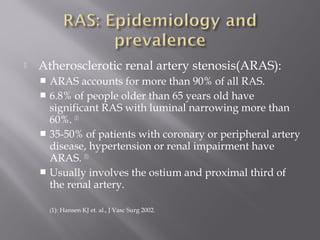
 Atherosclerotic renal artery stenosis(ARAS):
 ARAS accounts for more than 90% of all RAS.
 6.8% of people older than 65 years old have
significant RAS with luminal narrowing more than
60%. (1)
 35-50% of patients with coronary or peripheral artery
disease, hypertension or renal impairment have
ARAS. (1)
 Usually involves the ostium and proximal third of
the renal artery.
(1): Hansen KJ et. al., J Vasc Surg 2002.
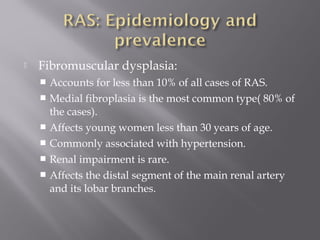
 Fibromuscular dysplasia:
 Accounts for less than 10% of all cases of RAS.
 Medial fibroplasia is the most common type( 80% of
the cases).
 Affects young women less than 30 years of age.
 Commonly associated with hypertension.
 Renal impairment is rare.
 Affects the distal segment of the main renal artery
and its lobar branches.
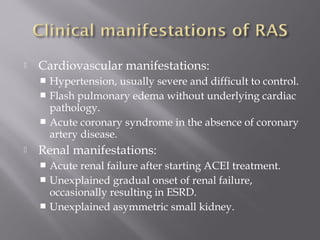
 Cardiovascular manifestations:
 Hypertension, usually severe and difficult to control.
 Flash pulmonary edema without underlying cardiac
pathology.
 Acute coronary syndrome in the absence of coronary
artery disease.
 Renal manifestations:
 Acute renal failure after starting ACEI treatment.
 Unexplained gradual onset of renal failure,
occasionally resulting in ESRD.
 Unexplained asymmetric small kidney.
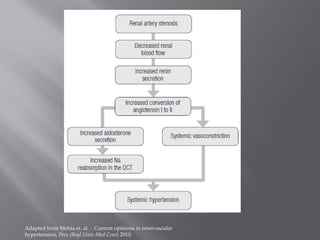
 Renovascular hypertension(RVH) is the
presence of systemic hypertension secondary to
stenostic or obstructive renal artery lesion.
 0.5-4% of hypertensive patients are secondary
to RVH. (1)
 The presence of RAS in patient with
hypertension does not mean RVH.
 Goldblatt et. al. pioneered work on dogs
helped to understand RVH in 1930s.
(1) Anderson GH Jr et.al., J Hypertens 1994.
Adapted from Mehta et. al. , Current opinions in renovascular
hypertension, Proc (Bayl Univ Med Cent) 2010.
 Ischemic nephropathy: reduction of GFR or loss of
renal parenchyma secondary to significant RAS.
 RAS is the third most common cause of ESRD,
accounting for about 5-14% of ESRD in patients
older than 50 years of age. (1)
 Complex process related to RAS results in impaired
renal function involving renal parenchymal fibrosis
secondary to activation of angiotensin II and
endothelin-I induced vasoconstriction.
(1) Mailloux LU et al., Am J Kidney Dis 24:622-629, 1994.
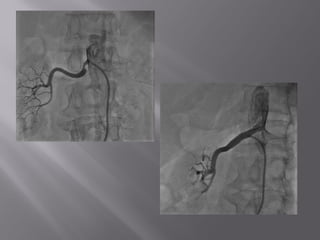
 In 1962, the first surgical renal
revascularization was successfully done.
 Andreas Gruntzig, in 1978, was the first to
perform renal artery balloon angioplasty.
 Several subsequent developments were
introduced since then to refine the technique
with the introduction of low profile system,
metallic and drug eluting stents.
 In hypertensive patient with ARAS, regarding the
revascularization technique, cure rate (normal BP,
no medication) is < 10%.(1)
 Several recent randomized studies questioned the
value of renal artery revascularization in patients
with ARAS.
 In patients with FMD, cure rate is > 80% with low
recurrence rate (patency > 90% after 10 years).
(1) Dworkin LD et. al.., Circulation. 2007 Jan 16.
 The aim of the study is to evaluate the added value of renal
artery stenting on renal function in patients with ARAS.
 Primary outcome was renal function and secondary
outcomes were blood pressure, time to major renal or
cardiovascular events and mortality.
 Multicenter randomized prospective trial performed in UK.
 806 patients were recruited from 57 hospitals, divided into
two groups: medical treatment vs. revascularization groups.
 Inclusion criteria was the uncertainty of the clinician
whether the patient will benefit from revascularization.
 Patients with RAS more than 60% were included.
 Median follow up for 34 months.
(1) AsATRAL investigators, N Engl J Med, 361 (2009).
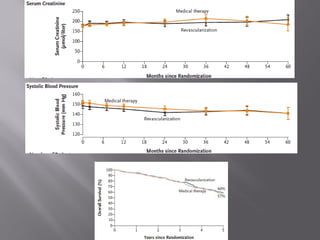
 End points results were:
 Renal function: Minor deterioration in both groups
without a difference.
 Blood pressure: Progressive decrease with no difference
between both groups.
 Renal events: Rate of progression into renal failure was
2% per year in both groups.
 Vascular events were similar in both groups.
 The study concluded that renal artery stenting has
added risk but no significant clinical benefits.
(1) AsATRAL investigators, N Engl J Med, 361 (2009).
 Aim of the study to test whether renal artery stenting
added to good medical treatment will improved
clinical outcome in patients with ARAS.
 947 patients with significant ARAS and either
hypertension on two or more medications or chronic
renal disease were prospectively assigned to either
medical therapy alone or medical therapy and renal
artery stenting.
 Patients were followed for adverse cardiovascular or
renal events (MI, stroke, CHF, renal insufficiency,
need for dialysis) or mortality related to these events.
(1) Cooper et. Al., N Engl J Med., 2014 Jan.
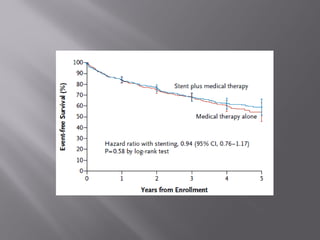
 Over median follow up period of 43 months,
there was no additional benefit from renal
artery revascularization over just medical
therapy.
 Systolic blood pressure was slightly lower in
the stent group compared to medical therapy
only group (-2.3mmHg, P=0.03).
 The average number of antihypertensive
medications between two groups was similar.
 Because of the recent publications and associated
critics, indications are being reshaped since last
ACCF/AHA last recommendation in 2005.
 The following are reasonable indications for renal
artery revascularization:
 Hypertensive patients with FMD.
 Progressive decline in GFR during treatment of
hypertension.
 Failure to achieve blood pressure control despite
adequate medical therapy.
 Recurrent flash pulmonary edema or CHF in the
absence of cardiac or coronary pathology.
 Meta analysis published in 2000 suggested the recurrence
rate of stenosis in renal artery after stenting at 17% at 6
months follow up. (1)
 Lederman et al in 2001 performed follow up angiogram in
patients with previous renal stent placement (2)
:
 Total number of patients are 300.
 In stent stenosis defined more than 50% stenosis.
 Risk of stenosis at 16 months average follow up was 21%.
 Restenosis rate is dependent on the renal vessel diameter
( 36% for vessel diameter < 4.5mm vs. 6.5% for vessel
diameter > 6mm). (2)
(1) Leertouwer TC, et al, Stent placement for renal arterial stenosis: where do we stand? A meta-
analysis, Radiology. 2000 Jul.
(2) Lederman, et al, Primary renal artery stenting: characteristics and outcomes after 363 procedures, Am Heart J 2001
Aug.
 GREAT trial (1)
:
 Prospective multicenter trial to evaluate stent patency in patients with ARAS.
 Patients were randomized between bare metallic stent(BMS) (52 patients) VS.
Serolimus eluting stent (SES) (53 patients).
 Stents sizes used were 5 and 6 mm in diameter.
 Angiogram follow up at 6 months and clinical follow up at 24 months.
 No significant difference in patency rate angiographically and clinically between
BMS (92.3%) and DES patients (98.1%).
 In-stent percent diameter stenosis, late lumen loss and the repeat revascularization
procedures were all lower in the SES group, although the difference was not
statistically significant.
 Possible indications for DES in renal artery stenosis includes:
 Small renal artery measuring less than 5mm in diameter.
 Intra-stent stenosis.
 RAS in patient with impaired kidney function to minimize recurrent contrast
exposure.
(1) Sirolimus-eluting versus bare-metal low-profile stent for renal artery treatment (GREAT trial): angiographic follow-up after 6 month and clinical
outcome up to 2 years. J Endovasc Ther
 Different meta analysis series showed that up
to 26% who underwent renal artery stenting
developed deterioration of renal function with
2.4% ended on dialysis.
 The post procedure renal function deterioration
is related to thromboembolic phenomena and
contrast nephropathy.
 Nonrandomized clinical trial suggested EPD
may be beneficial in minimizing renal function
deterioration after renal stenting.
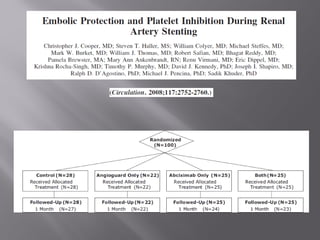
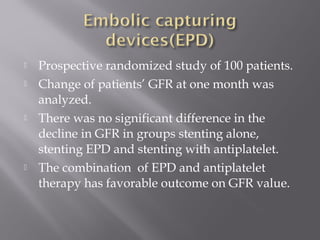
 Prospective randomized study of 100 patients.
 Change of patients’ GFR at one month was
analyzed.
 There was no significant difference in the
decline in GFR in groups stenting alone,
stenting EPD and stenting with antiplatelet.
 The combination of EPD and antiplatelet
therapy has favorable outcome on GFR value.
 Renal artery stenosis is fairly common
pathology especially in elderly population.
 Best therapeutic approach for significant RAS is
still being shaped by recent clinical trial.
 With the recent introduction of new effective
antihypertensive medications, good medical
treatment of renovascular disease may be as
effective as renal artery revascularization.
 Certain clinical features associated with RAS are
still valid indications for renal artery
revascularization.

Renal Artery Revascularization: where we are

  • 1.
    Hassan A. AlBalas, MD Associate professor Jordan University of Science and Technology Irbid, Jordan
  • 2.
     Narrowing ofthe renal artery secondary to heterogeneous group of diseases of different pathophysiology and clinical features.  The two most common underlying etiologies are atherosclerotic renal artery stenosis(ARAS) and fibromuscular dysplasia(FMD).  Other less common etiology includes vasculitis and neuro-cutaneous syndromes e.g. neurofibromatosis.
  • 3.
     Atherosclerotic renalartery stenosis(ARAS):  ARAS accounts for more than 90% of all RAS.  6.8% of people older than 65 years old have significant RAS with luminal narrowing more than 60%. (1)  35-50% of patients with coronary or peripheral artery disease, hypertension or renal impairment have ARAS. (1)  Usually involves the ostium and proximal third of the renal artery. (1): Hansen KJ et. al., J Vasc Surg 2002.
  • 4.
     Fibromuscular dysplasia: Accounts for less than 10% of all cases of RAS.  Medial fibroplasia is the most common type( 80% of the cases).  Affects young women less than 30 years of age.  Commonly associated with hypertension.  Renal impairment is rare.  Affects the distal segment of the main renal artery and its lobar branches.
  • 5.
     Cardiovascular manifestations: Hypertension, usually severe and difficult to control.  Flash pulmonary edema without underlying cardiac pathology.  Acute coronary syndrome in the absence of coronary artery disease.  Renal manifestations:  Acute renal failure after starting ACEI treatment.  Unexplained gradual onset of renal failure, occasionally resulting in ESRD.  Unexplained asymmetric small kidney.
  • 6.
     Renovascular hypertension(RVH)is the presence of systemic hypertension secondary to stenostic or obstructive renal artery lesion.  0.5-4% of hypertensive patients are secondary to RVH. (1)  The presence of RAS in patient with hypertension does not mean RVH.  Goldblatt et. al. pioneered work on dogs helped to understand RVH in 1930s. (1) Anderson GH Jr et.al., J Hypertens 1994.
  • 7.
    Adapted from Mehtaet. al. , Current opinions in renovascular hypertension, Proc (Bayl Univ Med Cent) 2010.
  • 8.
     Ischemic nephropathy:reduction of GFR or loss of renal parenchyma secondary to significant RAS.  RAS is the third most common cause of ESRD, accounting for about 5-14% of ESRD in patients older than 50 years of age. (1)  Complex process related to RAS results in impaired renal function involving renal parenchymal fibrosis secondary to activation of angiotensin II and endothelin-I induced vasoconstriction. (1) Mailloux LU et al., Am J Kidney Dis 24:622-629, 1994.
  • 9.
     In 1962,the first surgical renal revascularization was successfully done.  Andreas Gruntzig, in 1978, was the first to perform renal artery balloon angioplasty.  Several subsequent developments were introduced since then to refine the technique with the introduction of low profile system, metallic and drug eluting stents.
  • 11.
     In hypertensivepatient with ARAS, regarding the revascularization technique, cure rate (normal BP, no medication) is < 10%.(1)  Several recent randomized studies questioned the value of renal artery revascularization in patients with ARAS.  In patients with FMD, cure rate is > 80% with low recurrence rate (patency > 90% after 10 years). (1) Dworkin LD et. al.., Circulation. 2007 Jan 16.
  • 13.
     The aimof the study is to evaluate the added value of renal artery stenting on renal function in patients with ARAS.  Primary outcome was renal function and secondary outcomes were blood pressure, time to major renal or cardiovascular events and mortality.  Multicenter randomized prospective trial performed in UK.  806 patients were recruited from 57 hospitals, divided into two groups: medical treatment vs. revascularization groups.  Inclusion criteria was the uncertainty of the clinician whether the patient will benefit from revascularization.  Patients with RAS more than 60% were included.  Median follow up for 34 months. (1) AsATRAL investigators, N Engl J Med, 361 (2009).
  • 15.
     End pointsresults were:  Renal function: Minor deterioration in both groups without a difference.  Blood pressure: Progressive decrease with no difference between both groups.  Renal events: Rate of progression into renal failure was 2% per year in both groups.  Vascular events were similar in both groups.  The study concluded that renal artery stenting has added risk but no significant clinical benefits. (1) AsATRAL investigators, N Engl J Med, 361 (2009).
  • 17.
     Aim ofthe study to test whether renal artery stenting added to good medical treatment will improved clinical outcome in patients with ARAS.  947 patients with significant ARAS and either hypertension on two or more medications or chronic renal disease were prospectively assigned to either medical therapy alone or medical therapy and renal artery stenting.  Patients were followed for adverse cardiovascular or renal events (MI, stroke, CHF, renal insufficiency, need for dialysis) or mortality related to these events. (1) Cooper et. Al., N Engl J Med., 2014 Jan.
  • 19.
     Over medianfollow up period of 43 months, there was no additional benefit from renal artery revascularization over just medical therapy.  Systolic blood pressure was slightly lower in the stent group compared to medical therapy only group (-2.3mmHg, P=0.03).  The average number of antihypertensive medications between two groups was similar.
  • 20.
     Because ofthe recent publications and associated critics, indications are being reshaped since last ACCF/AHA last recommendation in 2005.  The following are reasonable indications for renal artery revascularization:  Hypertensive patients with FMD.  Progressive decline in GFR during treatment of hypertension.  Failure to achieve blood pressure control despite adequate medical therapy.  Recurrent flash pulmonary edema or CHF in the absence of cardiac or coronary pathology.
  • 21.
     Meta analysispublished in 2000 suggested the recurrence rate of stenosis in renal artery after stenting at 17% at 6 months follow up. (1)  Lederman et al in 2001 performed follow up angiogram in patients with previous renal stent placement (2) :  Total number of patients are 300.  In stent stenosis defined more than 50% stenosis.  Risk of stenosis at 16 months average follow up was 21%.  Restenosis rate is dependent on the renal vessel diameter ( 36% for vessel diameter < 4.5mm vs. 6.5% for vessel diameter > 6mm). (2) (1) Leertouwer TC, et al, Stent placement for renal arterial stenosis: where do we stand? A meta- analysis, Radiology. 2000 Jul. (2) Lederman, et al, Primary renal artery stenting: characteristics and outcomes after 363 procedures, Am Heart J 2001 Aug.
  • 22.
     GREAT trial(1) :  Prospective multicenter trial to evaluate stent patency in patients with ARAS.  Patients were randomized between bare metallic stent(BMS) (52 patients) VS. Serolimus eluting stent (SES) (53 patients).  Stents sizes used were 5 and 6 mm in diameter.  Angiogram follow up at 6 months and clinical follow up at 24 months.  No significant difference in patency rate angiographically and clinically between BMS (92.3%) and DES patients (98.1%).  In-stent percent diameter stenosis, late lumen loss and the repeat revascularization procedures were all lower in the SES group, although the difference was not statistically significant.  Possible indications for DES in renal artery stenosis includes:  Small renal artery measuring less than 5mm in diameter.  Intra-stent stenosis.  RAS in patient with impaired kidney function to minimize recurrent contrast exposure. (1) Sirolimus-eluting versus bare-metal low-profile stent for renal artery treatment (GREAT trial): angiographic follow-up after 6 month and clinical outcome up to 2 years. J Endovasc Ther
  • 23.
     Different metaanalysis series showed that up to 26% who underwent renal artery stenting developed deterioration of renal function with 2.4% ended on dialysis.  The post procedure renal function deterioration is related to thromboembolic phenomena and contrast nephropathy.  Nonrandomized clinical trial suggested EPD may be beneficial in minimizing renal function deterioration after renal stenting.
  • 25.
     Prospective randomizedstudy of 100 patients.  Change of patients’ GFR at one month was analyzed.  There was no significant difference in the decline in GFR in groups stenting alone, stenting EPD and stenting with antiplatelet.  The combination of EPD and antiplatelet therapy has favorable outcome on GFR value.
  • 26.
     Renal arterystenosis is fairly common pathology especially in elderly population.  Best therapeutic approach for significant RAS is still being shaped by recent clinical trial.  With the recent introduction of new effective antihypertensive medications, good medical treatment of renovascular disease may be as effective as renal artery revascularization.  Certain clinical features associated with RAS are still valid indications for renal artery revascularization.