UROLOGY II
The Bladder, Urethra & Prostate
Kishore S Rajan
Oman Medical College
Principles and Practice of Surgery by Garden
Table of Contents
• Urinary bladder
▫ Anatomy and trauma related injuries
• Urethra
▫ Anatomy and trauma related injuries
▫ Obstruction
• Prostrate
▫ Anatomy
▫ BPH
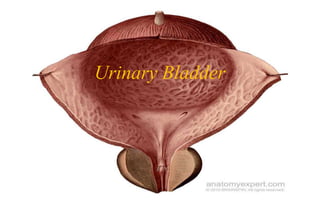
Urinary Bladder
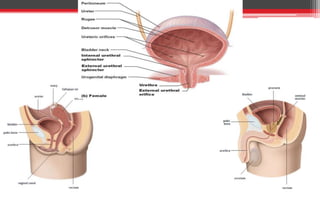
Anatomy
• The Bladder is a muscular reservoir that receives urine via the
ureters and expels it via the urethra.
• Children up to 4 years of age is lies predominantly in the
abdomen
• In Adults it is a pelvic organ
• The bladder is lined with specialized waterproof epithelium,
the urothelium (Transitional cell epithelium). It is thrown into
folds over most of the bladder except at the trigone where it is
smooth.
• Blood Supply: Superior and inferior vesicle arteries: branches
of internal iliac arteries.
• Venous drainage: vesicle venous drainage to internal iliac vein
Trauma To The Bladder
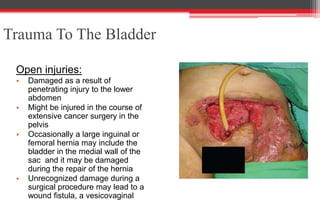
Open injuries:
• Damaged as a result of
penetrating injury to the lower
abdomen
• Might be injured in the course of
extensive cancer surgery in the
pelvis
• Occasionally a large inguinal or
femoral hernia may include the
bladder in the medial wall of the
sac and it may be damaged
during the repair of the hernia
• Unrecognized damage during a
surgical procedure may lead to a
wound fistula, a vesicovaginal
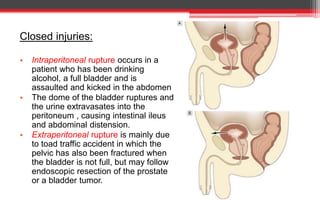
Closed injuries:
• Intraperitoneal rupture occurs in a
patient who has been drinking
alcohol, a full bladder and is
assaulted and kicked in the abdomen
• The dome of the bladder ruptures and
the urine extravasates into the
peritoneum , causing intestinal ileus
and abdominal distension.
• Extraperitoneal rupture is mainly due
to toad traffic accident in which the
pelvic has also been fractured when
the bladder is not full, but may follow
endoscopic resection of the prostate
or a bladder tumor.
Clinical Features
• The ileus and distension that occur with intraperitoneal rupture of
the bladder are often detected late because of the circumstances
surrounding the injury, but the patient will soon notice that he is
not passing urine and will seek advice.
• When the leak occurs during endoscopic procedure, the patient
later complains of suprapubic pain with lower abdominal
tenderness.
Investigations
• Generally the circumstances of bladder injury establish the
diagnosis.
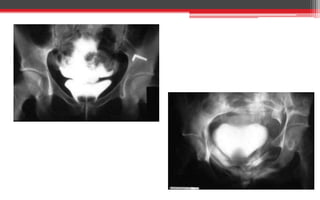
• If conformation of injury is required, water soluble contrast is
Management
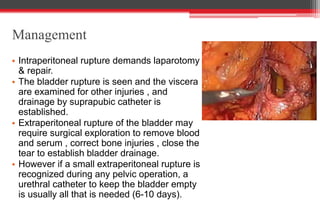
• Intraperitoneal rupture demands laparotomy
& repair.
• The bladder rupture is seen and the viscera
are examined for other injuries , and
drainage by suprapubic catheter is
established.
• Extraperitoneal rupture of the bladder may
require surgical exploration to remove blood
and serum , correct bone injuries , close the
tear to establish bladder drainage.
• However if a small extraperitoneal rupture is
recognized during any pelvic operation, a
urethral catheter to keep the bladder empty
is usually all that is needed (6-10 days).
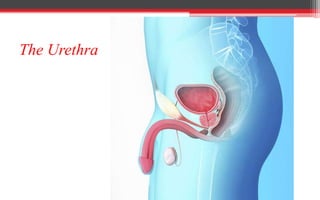
The Urethra
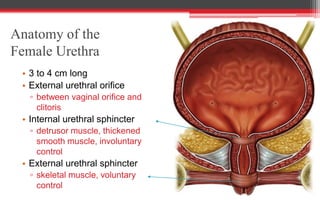
Anatomy of the
Female Urethra
• 3 to 4 cm long
• External urethral orifice
▫ between vaginal orifice and
clitoris
• Internal urethral sphincter
▫ detrusor muscle, thickened
smooth muscle, involuntary
control
• External urethral sphincter
▫ skeletal muscle, voluntary
control
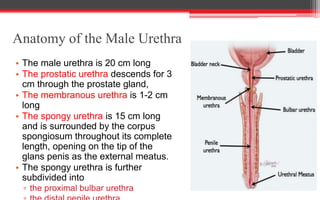
Anatomy of the Male Urethra
• The male urethra is 20 cm long
• The prostatic urethra descends for 3
cm through the prostate gland,
• The membranous urethra is 1-2 cm
long
• The spongy urethra is 15 cm long
and is surrounded by the corpus
spongiosum throughout its complete
length, opening on the tip of the
glans penis as the external meatus.
• The spongy urethra is further
subdivided into
▫ the proximal bulbar urethra
Trauma to the Urethra
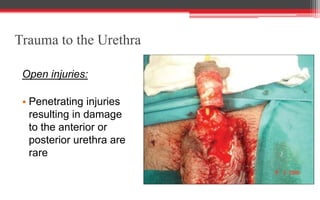
Open injuries:
• Penetrating injuries
resulting in damage
to the anterior or
posterior urethra are
rare
Closed Injuries
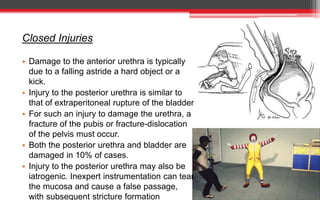
• Damage to the anterior urethra is typically
due to a falling astride a hard object or a
kick.
• Injury to the posterior urethra is similar to
that of extraperitoneal rupture of the bladder
• For such an injury to damage the urethra, a
fracture of the pubis or fracture-dislocation
of the pelvis must occur.
• Both the posterior urethra and bladder are
damaged in 10% of cases.
• Injury to the posterior urethra may also be
iatrogenic. Inexpert instrumentation can tear
the mucosa and cause a false passage,
with subsequent stricture formation
Clinical Features
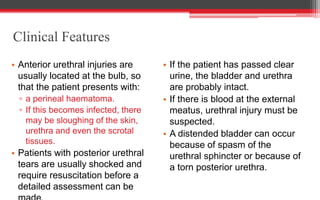
• Anterior urethral injuries are
usually located at the bulb, so
that the patient presents with:
▫ a perineal haematoma.
▫ If this becomes infected, there

may be sloughing of the skin,
urethra and even the scrotal
tissues.
• Patients with posterior urethral
tears are usually shocked and
require resuscitation before a
detailed assessment can be
• If the patient has passed clear
urine, the bladder and urethra
are probably intact.
• If there is blood at the external
meatus, urethral injury must be
suspected.
• A distended bladder can occur
because of spasm of the
urethral sphincter or because of
a torn posterior urethra.
Investigations
• If the physical signs suggest an anterior urethral injury and the
patient has passed clear urine, no further steps need be taken.
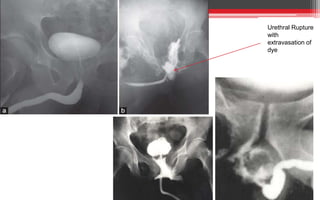
• If there is blood at the external meatus or the urine is blood-
stained, a urethrogram using water-soluble contrast material may
demonstrate the extravasation BUT may worsen the injury.
• A catheter should never be passed in the emergency room.
• If the patient passes clear urine, nothing further should be done.
• If the urine is blood-stained, retrograde urethrography may be
carried out.
Urethral Rupture
with
extravasation of
dye
Management
• All patients with an injury to the bulb of the urethra have a
perineal haematoma.
• A large haematoma may need to be drained if the urethra has
been lacerated.
• If the injury is only a contusion, this will resolve, but prophylactic
antibiotics are indicated.
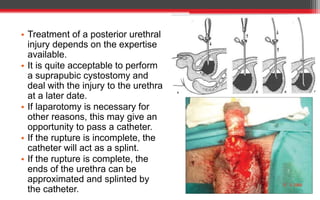
• Treatment of a posterior urethral
injury depends on the expertise
available.
• It is quite acceptable to perform
a suprapubic cystostomy and
deal with the injury to the urethra
at a later date.
• If laparotomy is necessary for
other reasons, this may give an
opportunity to pass a catheter.
• If the rupture is incomplete, the
catheter will act as a splint.
• If the rupture is complete, the
ends of the urethra can be
approximated and splinted by
the catheter.
Urethral Obstruction
Pathology
• Obstruction of the urethra;
• Congenital
• Stricture
• Malignancy
• Foreign bodies, including urinary stones.
• Change in pattern of micturition due to urethral narrowing may be
indistinguishable from that which occurs with BPH and bladder
neck obstruction diagnosis should be considered if there is a
history of urethral infection, instrumentation or trauma.
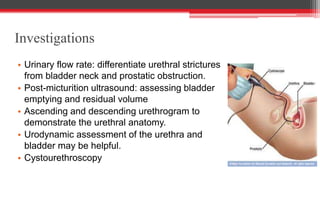
Investigations
• Urinary flow rate: differentiate urethral strictures
from bladder neck and prostatic obstruction.
• Post-micturition ultrasound: assessing bladder
emptying and residual volume
• Ascending and descending urethrogram to
demonstrate the urethral anatomy.
• Urodynamic assessment of the urethra and
bladder may be helpful.
• Cystourethroscopy
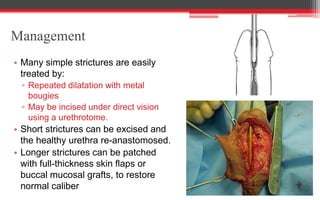
Management
• Many simple strictures are easily
treated by:
▫ Repeated dilatation with metal
bougies
▫ May be incised under direct vision
using a urethrotome.
• Short strictures can be excised and
the healthy urethra re-anastomosed.
• Longer strictures can be patched
with full-thickness skin flaps or
buccal mucosal grafts, to restore
normal caliber
The Prostate
Anatomy of the Prostrate
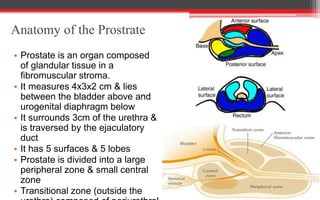
• Prostate is an organ composed
of glandular tissue in a
fibromuscular stroma.
• It measures 4x3x2 cm & lies
between the bladder above and
urogenital diaphragm below
• It surrounds 3cm of the urethra &
is traversed by the ejaculatory
duct
• It has 5 surfaces & 5 lobes
• Prostate is divided into a large
peripheral zone & small central
zone
• Transitional zone (outside the
Benign Prostatic Hyperplasia
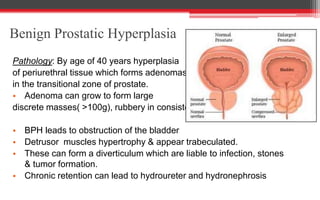
Pathology: By age of 40 years hyperplasia
of periurethral tissue which forms adenomas
in the transitional zone of prostate.
• Adenoma can grow to form large
discrete masses( >100g), rubbery in consistency
• BPH leads to obstruction of the bladder
• Detrusor muscles hypertrophy & appear trabeculated.
• These can form a diverticulum which are liable to infection, stones
& tumor formation.
• Chronic retention can lead to hydroureter and hydronephrosis
Clinical Features
• Most common: Frequency, nocturia, urgency, dysuria and poor
stream.
• Clinical features due to obstruction: Slow stream, hesitancy,
urgency and urge incontinence
• Straining may cause vessels at the bladder neck to bleed
• Chronic retention: Increasing frequency may deceive the patient
into believing that an adequate amount of urine is passed,
whereas the bladder has a small functional capacity and may be
almost full all of the time.
• Obstructive uraemia, drowsiness, anorexia and personality
changes.
Examination
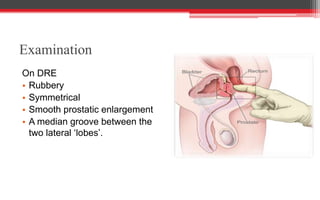
On DRE
• Rubbery
• Symmetrical
• Smooth prostatic enlargement
• A median groove between the
two lateral ‘lobes’.
Investigations
• A good history and
examination
• IPSS
• Blood
▫ Renal Function Test
▫ Hemoglobin
▫ Electrolytes
▫ Urine Culture
• PSA( prostatic specific
antigen)
▫ Normal value (0–4 ng/ml)
▫ Malignancy can occur with
normal PSA value
• Needle biopsy
▫ High suspicion patients
• Ultrasound
▫ Detect Bladder Diverticula
▫ Intravesicular Stones
▫ Measure Residual Urine Volume.
• Uroflowmetry
▫ Assist urine flow rate
Management
• Watchful waiting: for those who have mild to moderate
symptoms at presentation with no complications of BPH
and those not troubled severely by their symptoms. Self
help can help.
• Drug Therapy:
▫ Alpha-adrenoceptor antagonists : Prazosin, Doxazosin, Tamsulosin
 Watch for postural hypotension
▫ 5α-reductase inhibitors : Finasteride, Dulastride
 For patients with bulky prostates. 6mo for effect. Lowers the risk
of urinary retention
Surgical Management
Absolute Indications:
• Refractory Urinary
Retention
• Recurrent UTI
• Recurrent hematuria
• Bladder stones or
diverticula
• Upper urinary tract damage
leading to insufficiency.
Other indications:
• Sever symptoms score( >19)
• Failing medical treatment
• Not able to tolerate the side
effect of drug
• BPH complications
Open Prostatectomy
• Reserved for large adenomas (>100g) or patients with
intravesicular complications like bladder diverticulae or stones.
Approach includes:
• Transvesical (Freyer’s)
• Retropubic (Millin’s)
• Perineal (Young’s)
• Disadvantages:
▫ Longer hospital stay (7-10days)
▫ Damage to external sphincter causing incontinence.
Open Prostatectomy Video clip
Closed Prostatectomy
Transurethral resection of the Prostate (TURP)
• The prostate is removed piece by piece by electroresection using
a resectoscope
• Advantages :
▫ Short hospital stay (2-3 days)
▫ Precise removal of obstructing tissue
• Disadvantages:
▫ Prolonged resection can cause excessive absorption of irrigating
fluid & electrolyte imbalance (TURP syndrome)
▫ Injury to prostate sphincter
TURP video clip
Complications
• Retrograde ejaculation (65%)
• Erectile dysfunction (impotence) (5%)
• Risk of reoperation (15% 8-10 years after TURP)
• Severe sepsis (6%)
• Severe hematuria (3%)
Acute Retention
• This condition requires emergency admission to hospital to
relieve obstruction.
Management
• Conservative measures if history of obstruction. Aimed at
encouraging micturition, sedation, a warm bath
• A self-retaining Foley catheter (size 16 Fr) connected to closed
drain
• Suprapubic cystostomy
• Urine culture and if infection exists them start antibiotics.
• Catheter can be removed after 12hrs if history short
• Recurrence - TURP
Chronic Retention
• Determine whether the patient has any complication of
obstruction
• Uremia, hyperkalemia, dehydration, fluid and electrolyte
disturbance must be corrected
• The bladder is then catheterized and prostatectomy is carried out
• Relief of chronic obstruction is almost always followed by a
diuresis.
• Assess patient:
▫ Intake/output fluid charts
▫ Daily weight
▫ Blood pressure, both lying and standing
▫ Intravenous fluid replacement
Thank you

Urology surgery. Bladder, Urethra and Prostsate

  • 1.
    UROLOGY II The Bladder,Urethra & Prostate Kishore S Rajan Oman Medical College Principles and Practice of Surgery by Garden
  • 2.
    Table of Contents •Urinary bladder ▫ Anatomy and trauma related injuries • Urethra ▫ Anatomy and trauma related injuries ▫ Obstruction • Prostrate ▫ Anatomy ▫ BPH
  • 3.
  • 4.
    Anatomy • The Bladderis a muscular reservoir that receives urine via the ureters and expels it via the urethra. • Children up to 4 years of age is lies predominantly in the abdomen • In Adults it is a pelvic organ • The bladder is lined with specialized waterproof epithelium, the urothelium (Transitional cell epithelium). It is thrown into folds over most of the bladder except at the trigone where it is smooth. • Blood Supply: Superior and inferior vesicle arteries: branches of internal iliac arteries. • Venous drainage: vesicle venous drainage to internal iliac vein
  • 6.
    Trauma To TheBladder Open injuries: • Damaged as a result of penetrating injury to the lower abdomen • Might be injured in the course of extensive cancer surgery in the pelvis • Occasionally a large inguinal or femoral hernia may include the bladder in the medial wall of the sac and it may be damaged during the repair of the hernia • Unrecognized damage during a surgical procedure may lead to a wound fistula, a vesicovaginal
  • 7.
    Closed injuries: • Intraperitonealrupture occurs in a patient who has been drinking alcohol, a full bladder and is assaulted and kicked in the abdomen • The dome of the bladder ruptures and the urine extravasates into the peritoneum , causing intestinal ileus and abdominal distension. • Extraperitoneal rupture is mainly due to toad traffic accident in which the pelvic has also been fractured when the bladder is not full, but may follow endoscopic resection of the prostate or a bladder tumor.
  • 8.
    Clinical Features • Theileus and distension that occur with intraperitoneal rupture of the bladder are often detected late because of the circumstances surrounding the injury, but the patient will soon notice that he is not passing urine and will seek advice. • When the leak occurs during endoscopic procedure, the patient later complains of suprapubic pain with lower abdominal tenderness. Investigations • Generally the circumstances of bladder injury establish the diagnosis. • If conformation of injury is required, water soluble contrast is
  • 10.
    Management • Intraperitoneal rupturedemands laparotomy & repair. • The bladder rupture is seen and the viscera are examined for other injuries , and drainage by suprapubic catheter is established. • Extraperitoneal rupture of the bladder may require surgical exploration to remove blood and serum , correct bone injuries , close the tear to establish bladder drainage. • However if a small extraperitoneal rupture is recognized during any pelvic operation, a urethral catheter to keep the bladder empty is usually all that is needed (6-10 days).
  • 11.
  • 12.
    Anatomy of the FemaleUrethra • 3 to 4 cm long • External urethral orifice ▫ between vaginal orifice and clitoris • Internal urethral sphincter ▫ detrusor muscle, thickened smooth muscle, involuntary control • External urethral sphincter ▫ skeletal muscle, voluntary control
  • 13.
    Anatomy of theMale Urethra • The male urethra is 20 cm long • The prostatic urethra descends for 3 cm through the prostate gland, • The membranous urethra is 1-2 cm long • The spongy urethra is 15 cm long and is surrounded by the corpus spongiosum throughout its complete length, opening on the tip of the glans penis as the external meatus. • The spongy urethra is further subdivided into ▫ the proximal bulbar urethra
  • 14.
    Trauma to theUrethra Open injuries: • Penetrating injuries resulting in damage to the anterior or posterior urethra are rare
  • 15.
    Closed Injuries • Damageto the anterior urethra is typically due to a falling astride a hard object or a kick. • Injury to the posterior urethra is similar to that of extraperitoneal rupture of the bladder • For such an injury to damage the urethra, a fracture of the pubis or fracture-dislocation of the pelvis must occur. • Both the posterior urethra and bladder are damaged in 10% of cases. • Injury to the posterior urethra may also be iatrogenic. Inexpert instrumentation can tear the mucosa and cause a false passage, with subsequent stricture formation
  • 16.
    Clinical Features • Anteriorurethral injuries are usually located at the bulb, so that the patient presents with: ▫ a perineal haematoma. ▫ If this becomes infected, there may be sloughing of the skin, urethra and even the scrotal tissues. • Patients with posterior urethral tears are usually shocked and require resuscitation before a detailed assessment can be • If the patient has passed clear urine, the bladder and urethra are probably intact. • If there is blood at the external meatus, urethral injury must be suspected. • A distended bladder can occur because of spasm of the urethral sphincter or because of a torn posterior urethra.
  • 17.
    Investigations • If thephysical signs suggest an anterior urethral injury and the patient has passed clear urine, no further steps need be taken. • If there is blood at the external meatus or the urine is blood- stained, a urethrogram using water-soluble contrast material may demonstrate the extravasation BUT may worsen the injury. • A catheter should never be passed in the emergency room. • If the patient passes clear urine, nothing further should be done. • If the urine is blood-stained, retrograde urethrography may be carried out.
  • 18.
  • 19.
    Management • All patientswith an injury to the bulb of the urethra have a perineal haematoma. • A large haematoma may need to be drained if the urethra has been lacerated. • If the injury is only a contusion, this will resolve, but prophylactic antibiotics are indicated.
  • 20.
    • Treatment ofa posterior urethral injury depends on the expertise available. • It is quite acceptable to perform a suprapubic cystostomy and deal with the injury to the urethra at a later date. • If laparotomy is necessary for other reasons, this may give an opportunity to pass a catheter. • If the rupture is incomplete, the catheter will act as a splint. • If the rupture is complete, the ends of the urethra can be approximated and splinted by the catheter.
  • 21.
    Urethral Obstruction Pathology • Obstructionof the urethra; • Congenital • Stricture • Malignancy • Foreign bodies, including urinary stones. • Change in pattern of micturition due to urethral narrowing may be indistinguishable from that which occurs with BPH and bladder neck obstruction diagnosis should be considered if there is a history of urethral infection, instrumentation or trauma.
  • 22.
    Investigations • Urinary flowrate: differentiate urethral strictures from bladder neck and prostatic obstruction. • Post-micturition ultrasound: assessing bladder emptying and residual volume • Ascending and descending urethrogram to demonstrate the urethral anatomy. • Urodynamic assessment of the urethra and bladder may be helpful. • Cystourethroscopy
  • 23.
    Management • Many simplestrictures are easily treated by: ▫ Repeated dilatation with metal bougies ▫ May be incised under direct vision using a urethrotome. • Short strictures can be excised and the healthy urethra re-anastomosed. • Longer strictures can be patched with full-thickness skin flaps or buccal mucosal grafts, to restore normal caliber
  • 24.
  • 25.
    Anatomy of theProstrate • Prostate is an organ composed of glandular tissue in a fibromuscular stroma. • It measures 4x3x2 cm & lies between the bladder above and urogenital diaphragm below • It surrounds 3cm of the urethra & is traversed by the ejaculatory duct • It has 5 surfaces & 5 lobes • Prostate is divided into a large peripheral zone & small central zone • Transitional zone (outside the
  • 26.
    Benign Prostatic Hyperplasia Pathology:By age of 40 years hyperplasia of periurethral tissue which forms adenomas in the transitional zone of prostate. • Adenoma can grow to form large discrete masses( >100g), rubbery in consistency • BPH leads to obstruction of the bladder • Detrusor muscles hypertrophy & appear trabeculated. • These can form a diverticulum which are liable to infection, stones & tumor formation. • Chronic retention can lead to hydroureter and hydronephrosis
  • 27.
    Clinical Features • Mostcommon: Frequency, nocturia, urgency, dysuria and poor stream. • Clinical features due to obstruction: Slow stream, hesitancy, urgency and urge incontinence • Straining may cause vessels at the bladder neck to bleed • Chronic retention: Increasing frequency may deceive the patient into believing that an adequate amount of urine is passed, whereas the bladder has a small functional capacity and may be almost full all of the time. • Obstructive uraemia, drowsiness, anorexia and personality changes.
  • 28.
    Examination On DRE • Rubbery •Symmetrical • Smooth prostatic enlargement • A median groove between the two lateral ‘lobes’.
  • 29.
    Investigations • A goodhistory and examination • IPSS • Blood ▫ Renal Function Test ▫ Hemoglobin ▫ Electrolytes ▫ Urine Culture • PSA( prostatic specific antigen) ▫ Normal value (0–4 ng/ml) ▫ Malignancy can occur with normal PSA value • Needle biopsy ▫ High suspicion patients • Ultrasound ▫ Detect Bladder Diverticula ▫ Intravesicular Stones ▫ Measure Residual Urine Volume. • Uroflowmetry ▫ Assist urine flow rate
  • 30.
    Management • Watchful waiting:for those who have mild to moderate symptoms at presentation with no complications of BPH and those not troubled severely by their symptoms. Self help can help. • Drug Therapy: ▫ Alpha-adrenoceptor antagonists : Prazosin, Doxazosin, Tamsulosin  Watch for postural hypotension ▫ 5α-reductase inhibitors : Finasteride, Dulastride  For patients with bulky prostates. 6mo for effect. Lowers the risk of urinary retention
  • 31.
    Surgical Management Absolute Indications: •Refractory Urinary Retention • Recurrent UTI • Recurrent hematuria • Bladder stones or diverticula • Upper urinary tract damage leading to insufficiency. Other indications: • Sever symptoms score( >19) • Failing medical treatment • Not able to tolerate the side effect of drug • BPH complications
  • 32.
    Open Prostatectomy • Reservedfor large adenomas (>100g) or patients with intravesicular complications like bladder diverticulae or stones. Approach includes: • Transvesical (Freyer’s) • Retropubic (Millin’s) • Perineal (Young’s) • Disadvantages: ▫ Longer hospital stay (7-10days) ▫ Damage to external sphincter causing incontinence. Open Prostatectomy Video clip
  • 33.
    Closed Prostatectomy Transurethral resectionof the Prostate (TURP) • The prostate is removed piece by piece by electroresection using a resectoscope • Advantages : ▫ Short hospital stay (2-3 days) ▫ Precise removal of obstructing tissue • Disadvantages: ▫ Prolonged resection can cause excessive absorption of irrigating fluid & electrolyte imbalance (TURP syndrome) ▫ Injury to prostate sphincter TURP video clip
  • 34.
    Complications • Retrograde ejaculation(65%) • Erectile dysfunction (impotence) (5%) • Risk of reoperation (15% 8-10 years after TURP) • Severe sepsis (6%) • Severe hematuria (3%)
  • 35.
    Acute Retention • Thiscondition requires emergency admission to hospital to relieve obstruction. Management • Conservative measures if history of obstruction. Aimed at encouraging micturition, sedation, a warm bath • A self-retaining Foley catheter (size 16 Fr) connected to closed drain • Suprapubic cystostomy • Urine culture and if infection exists them start antibiotics. • Catheter can be removed after 12hrs if history short • Recurrence - TURP
  • 36.
    Chronic Retention • Determinewhether the patient has any complication of obstruction • Uremia, hyperkalemia, dehydration, fluid and electrolyte disturbance must be corrected • The bladder is then catheterized and prostatectomy is carried out • Relief of chronic obstruction is almost always followed by a diuresis. • Assess patient: ▫ Intake/output fluid charts ▫ Daily weight ▫ Blood pressure, both lying and standing ▫ Intravenous fluid replacement
  • 37.

Editor's Notes

  • #11 Conservative management for extraperitoneal rupture in the absence of other injuries.
  • #29 Asymmetry and a hard consistency will indicate a Malignant enlargement
  • #31 Alpha- Relax the smooth muscle: bladder neck prostatic Capsule useful in small prostates 5alpha reductase inhb- block the intraprostatic conversion of testosterone to Dihydrotestosterone shrinking of the prostate useful in large glands