Proptosis
Definition
Forward displacement of eyeball due to any
disease process within or adjacent to orbit as
consequences of rigid confines of orbital wall
Protruding eyeball may be displaced other
direction like medial, lateral, up or down
Pseudoproptosis;- protrusion doesn't originate
from a mass or inflammation or vascular disorder
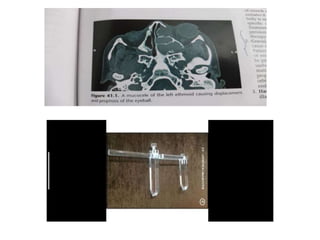
Clinically significant proptosis:- displacement
2mm greater than other measured by krahn or
hertal exophthalmometer
CAUSES:
• Neoplastic-
• Rhabdomyosarcoma
• Optic glioma
• Ca-metastatic, 2° from adjacent brain|tissue etc
• Vascular:-
• Venous varix, cavernous hemangioma,carotid cavernous fistula
• Inflammation &infection:-
• Idiopathic, orbital cellulitis or abscess, mucormycosis etc.
Children
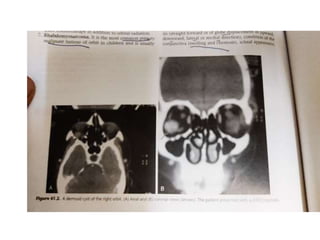
• Dermoid cyst
• Most common benign tumor
• Trapped ectoderm-suture lines during development
• Painless, progessive proptosis
• Ct show cyst with pressure effects
• Treat-surgical excision
Rhabdomyosarcoma
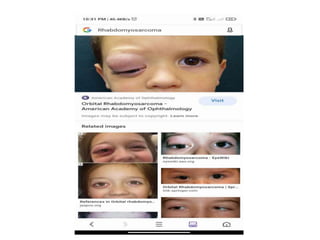
• Most common malignant tumor of orbit
• Painless but progressive can spread to adjoining
PNS
• Treatment: radiation and chemotherapy five yr
survival 90%
Cavernous
hemangioma
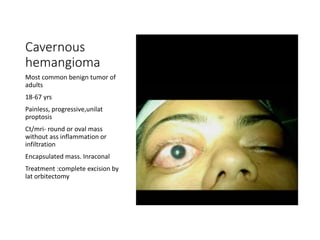
Most common benign tumor of
adults
18-67 yrs
Painless, progressive,unilat
proptosis
Ct/mri- round or oval mass
without ass inflammation or
infiltration
Encapsulated mass. Inraconal
Treatment :complete excision by
lat orbitectomy
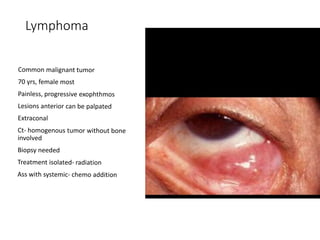
Lymphoma
Evaluation
• Detailed history
• Associated illness
• Pain
• Visual loss
• Physical exam- type of displacement,condition of conjunctiva,
ocular movement,vision
• Check of pulsating or change in postion
• Ct/mri
• Usg
• Fnac
• Systemuc exams
Management
• Biopsy needed
• Ant lesion- lid or conjunctival incision
• Excsional biopsy-dermoid, cavernous hemangioma etc
• Medical management with antibiotics-cellulitis
• Chemo- lymphoma, radiation-malginancy
• Surgery- debulking of lymphangioma
• Endoscopic orbital decompression- graves exophthalmos
• Lat orbitectomy-lesion of lacrimal glands or inraconal
• Transcranial- lesion at orbital apex or invaded intracraniay from orbit
•

Proptosis

  • 1.
  • 2.
    Definition Forward displacement ofeyeball due to any disease process within or adjacent to orbit as consequences of rigid confines of orbital wall Protruding eyeball may be displaced other direction like medial, lateral, up or down Pseudoproptosis;- protrusion doesn't originate from a mass or inflammation or vascular disorder Clinically significant proptosis:- displacement 2mm greater than other measured by krahn or hertal exophthalmometer
  • 3.
    CAUSES: • Neoplastic- • Rhabdomyosarcoma •Optic glioma • Ca-metastatic, 2° from adjacent brain|tissue etc • Vascular:- • Venous varix, cavernous hemangioma,carotid cavernous fistula • Inflammation &infection:- • Idiopathic, orbital cellulitis or abscess, mucormycosis etc.
  • 5.
    Children • Dermoid cyst •Most common benign tumor • Trapped ectoderm-suture lines during development • Painless, progessive proptosis • Ct show cyst with pressure effects • Treat-surgical excision
  • 7.
    Rhabdomyosarcoma • Most commonmalignant tumor of orbit • Painless but progressive can spread to adjoining PNS • Treatment: radiation and chemotherapy five yr survival 90%
  • 9.
    Cavernous hemangioma Most common benigntumor of adults 18-67 yrs Painless, progressive,unilat proptosis Ct/mri- round or oval mass without ass inflammation or infiltration Encapsulated mass. Inraconal Treatment :complete excision by lat orbitectomy
  • 10.
  • 11.
    Evaluation • Detailed history •Associated illness • Pain • Visual loss • Physical exam- type of displacement,condition of conjunctiva, ocular movement,vision • Check of pulsating or change in postion • Ct/mri • Usg • Fnac • Systemuc exams
  • 12.
    Management • Biopsy needed •Ant lesion- lid or conjunctival incision • Excsional biopsy-dermoid, cavernous hemangioma etc • Medical management with antibiotics-cellulitis • Chemo- lymphoma, radiation-malginancy • Surgery- debulking of lymphangioma • Endoscopic orbital decompression- graves exophthalmos • Lat orbitectomy-lesion of lacrimal glands or inraconal • Transcranial- lesion at orbital apex or invaded intracraniay from orbit •