Graphics Software
Graphics Software
   A graphics software is an intermediary
    between an application program & the
    graphics hardware. The output primitives
    & interaction devices that a graphics
    package supports can range from
    rudimentary to extremely rich.
There are two general classifications for
  graphics software:
 General Programming packages:
  provides an extensive set of graphics
  functions that can be used in a high-level
  programming language, such as C or
  FORTRAN. Basic functions in a general
  package include those for generating
  picture components (straight line, circle,
  polygon etc),setting color and intensity
  values, & applying transformations.
 Special-purpose applications packages:
Designed for nonprogrammers, so that users
  can generate displays without worrying
  about how graphics operations work.
  Example of such application packages are
  the artist’s painting programs and various
  business,medical and CAD systems.
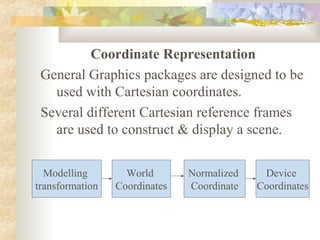
Coordinate Representation
 General Graphics packages are designed to be
   used with Cartesian coordinates.
 Several different Cartesian reference frames
   are used to construct & display a scene.


  Modelling        World       Normalized    Device
transformation   Coordinates   Coordinate   Coordinates
Graphics Functions
These packages provides users with a variety
  of functions for creating & manipulating
  pictures.
 Output primitives: basic building blocks.
 Attributes: properties of the output
  primitives.
 Geometric transformations: changing size,
  position & orientation.
   Modeling transformations: construct scene
    using object descriptions.
   Viewing transformations: are used to
    specify the view that is to be presented.
   Input Functions: used to control & process
    the data flow from the interactive devices
    such as mouse, tablet or joystick.
   Control operations: contains no. of
    housekeeping tasks such as clearing a
    display screen & initializing parameters.
Software Standards
      A standard graphics package such as
GKS(Graphical kernal system) & PHIGS
(Programmers Hierarchical Interactive
graphics system) implements a specification
designated as standard by an official national
or international standard bodies by ISO and
ANSI(American National Standard Institute).
   The main purpose of such standards is to
    promote portability of application
    programs & of programmers.
   Non-official standards are also developed,
    promoted & licensed by individual
    companies or by consortia of companies eg
    Adobe’s Post script & MIT’s X window
    system are two industry standards.
   GKS originally designed as a 2-D graphics
    packages, a 3-D GKS extension was
    subsequently developed.
   PHIGS is a extension of GKS having
    increased capabilities for object modeling,
    color specification, surface rendering etc.
   Extension of PHIGS called PHIGS+
    provide 3-D surface shading capabilities.
   GKS primitives:
There are basic four primitives:
(a) Polyline: used to draw lines.
       POLYLINE(n, X, Y)
  n = length of an array
  X & Y = array of x,y coordinate
(b) Polymarker: used to plot points.
      POLYMARKER(n, X, Y)
 n = number of data points
(c ) Fill Area: also used to draw line but it
   always connects the first and last points in
   the array.
           FILL AREA(n, X, Y)
(d) Text: used to print the “string” or “text”
   starting at the given coordinates.
             TEXT(x, y, “String”)
   GKS Segments: The segment command is
    the GKS method of developing complex
    objects. Any group of valid GKS code can
    be clustered together into a segment
    through the use of the CREATE
    SEGMENT (n) command. A segment
    listing is terminated with CLOSE
    SEGMENT command. For eg.
          CREATE SEGMENT (1)
           POLYLINE (5, X, Y)
            CLOSE SEGMENT
Graphics software

Graphics software

  • 1.
  • 2.
    Graphics Software  A graphics software is an intermediary between an application program & the graphics hardware. The output primitives & interaction devices that a graphics package supports can range from rudimentary to extremely rich.
  • 3.
    There are twogeneral classifications for graphics software:  General Programming packages: provides an extensive set of graphics functions that can be used in a high-level programming language, such as C or FORTRAN. Basic functions in a general package include those for generating picture components (straight line, circle, polygon etc),setting color and intensity values, & applying transformations.
  • 4.
     Special-purpose applicationspackages: Designed for nonprogrammers, so that users can generate displays without worrying about how graphics operations work. Example of such application packages are the artist’s painting programs and various business,medical and CAD systems.
  • 5.
    Coordinate Representation GeneralGraphics packages are designed to be used with Cartesian coordinates. Several different Cartesian reference frames are used to construct & display a scene. Modelling World Normalized Device transformation Coordinates Coordinate Coordinates
  • 6.
    Graphics Functions These packagesprovides users with a variety of functions for creating & manipulating pictures.  Output primitives: basic building blocks.  Attributes: properties of the output primitives.  Geometric transformations: changing size, position & orientation.
  • 7.
    Modeling transformations: construct scene using object descriptions.  Viewing transformations: are used to specify the view that is to be presented.  Input Functions: used to control & process the data flow from the interactive devices such as mouse, tablet or joystick.  Control operations: contains no. of housekeeping tasks such as clearing a display screen & initializing parameters.
  • 8.
    Software Standards A standard graphics package such as GKS(Graphical kernal system) & PHIGS (Programmers Hierarchical Interactive graphics system) implements a specification designated as standard by an official national or international standard bodies by ISO and ANSI(American National Standard Institute).
  • 9.
    The main purpose of such standards is to promote portability of application programs & of programmers.  Non-official standards are also developed, promoted & licensed by individual companies or by consortia of companies eg Adobe’s Post script & MIT’s X window system are two industry standards.
  • 10.
    GKS originally designed as a 2-D graphics packages, a 3-D GKS extension was subsequently developed.  PHIGS is a extension of GKS having increased capabilities for object modeling, color specification, surface rendering etc.  Extension of PHIGS called PHIGS+ provide 3-D surface shading capabilities.
  • 11.
    GKS primitives: There are basic four primitives: (a) Polyline: used to draw lines. POLYLINE(n, X, Y) n = length of an array X & Y = array of x,y coordinate (b) Polymarker: used to plot points. POLYMARKER(n, X, Y) n = number of data points
  • 12.
    (c ) FillArea: also used to draw line but it always connects the first and last points in the array. FILL AREA(n, X, Y) (d) Text: used to print the “string” or “text” starting at the given coordinates. TEXT(x, y, “String”)
  • 13.
    GKS Segments: The segment command is the GKS method of developing complex objects. Any group of valid GKS code can be clustered together into a segment through the use of the CREATE SEGMENT (n) command. A segment listing is terminated with CLOSE SEGMENT command. For eg. CREATE SEGMENT (1) POLYLINE (5, X, Y) CLOSE SEGMENT