







INTRODUCTION TO THE CURVES
COMPUTER GRAPHICS
UNIT V
-BY MS. ARTI GAVAS
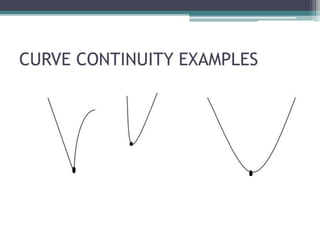
CURVE CONTINUITY
• A breakpoint is where two curve segments meet within a
piecewise curve.
• The continuity of a curve at a breakpoint describes how those
curves meet at the breakpoint.
• There are four possible types of continuity
• No continuity: curves do not meet at all.
• C0continuity : its a sharp point where they meet.
• C1 continuity: The curves have identical tangents at the
breakpoint and the curves join smoothly.
• Cn continuity: The curves have identical curvature at the
breakpoint and curvature continuity implies both tangential
and positional continuity.
CURVE CONTINUITY EXAMPLES
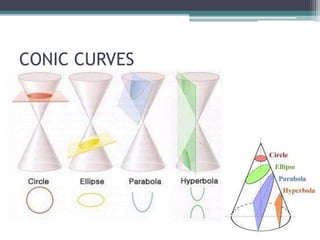
CONIC CURVES
CONIC CURVES CONTINUED…
• Both circles and ellipses are special cases of a
class of curves known as conics. Conics are
distinguished by second degree discriminating
functions of the form:
• The values of the constants, A, B, C, D, E, and F
determines the type of curve.
TYPES OF CURVES FROM CONIC
• Curves of this form arise frequently in physical
simulations.
• such as plotting the path of a projectile shot from a canon
under the influence of gravity (a parabola), or the near
collision of like charged particles (hyperbolas).
CONIC CURVES
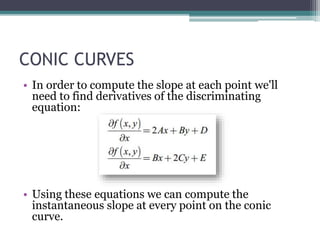
• In order to compute the slope at each point we'll
need to find derivatives of the discriminating
equation:
• Using these equations we can compute the
instantaneous slope at every point on the conic
curve.
PIECEWISE CURVE DESIGN
• The order of the curve determines the minimum number of control
points necessary to define the curve.
• We must have at least order control points to define a curve. To
make curves with more than order control points, you can join two
or more curve segments into a piecewise curve
PARAMETRIC CURVE DESIGN
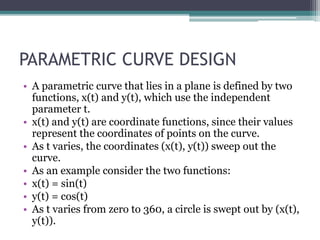
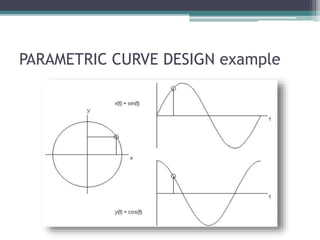
• A parametric curve that lies in a plane is defined by two
functions, x(t) and y(t), which use the independent
parameter t.
• x(t) and y(t) are coordinate functions, since their values
represent the coordinates of points on the curve.
• As t varies, the coordinates (x(t), y(t)) sweep out the
curve.
• As an example consider the two functions:
• x(t) = sin(t)
• y(t) = cos(t)
• As t varies from zero to 360, a circle is swept out by (x(t),
y(t)).
PARAMETRIC CURVE DESIGN example
SPLINE CURVE REPRESENTATION
• A spline curve is a mathematical representation for
which it is easy to build an interface that will allow a user
to design and control the shape of complex curves and
surfaces.
• The general approach is that the user enters a sequence
of points, and a curve is constructed whose shape closely
follows this sequence.
• The points are called control points. A curve that
actually passes through each control point is called an
interpolating curve.
• A curve that passes near to the control points but not
necessarily through them is called an approximating
curve.
SPLINE CURVE REPRESENTATION
BEZIER CURVES
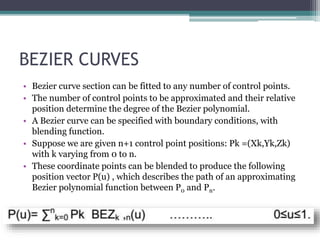
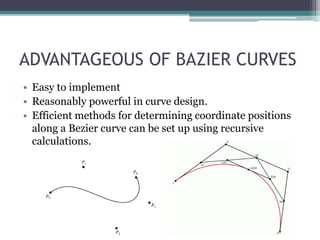
• Bezier curve section can be fitted to any number of control points.
• The number of control points to be approximated and their relative
position determine the degree of the Bezier polynomial.
• A Bezier curve can be specified with boundary conditions, with
blending function.
• Suppose we are given n+1 control point positions: Pk =(Xk,Yk,Zk)
with k varying from 0 to n.
• These coordinate points can be blended to produce the following
position vector P(u) , which describes the path of an approximating
Bezier polynomial function between P0 and Pn.
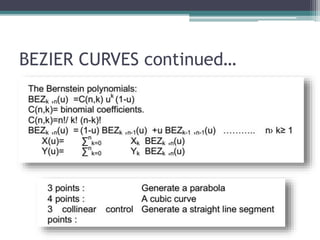
BEZIER CURVES continued…
ADVANTAGEOUS OF BAZIER CURVES
• Easy to implement
• Reasonably powerful in curve design.
• Efficient methods for determining coordinate positions
along a Bezier curve can be set up using recursive
calculations.
PROPERTIES OF BAZIER CURVES
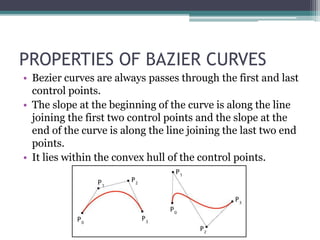
• Bezier curves are always passes through the first and last
control points.
• The slope at the beginning of the curve is along the line
joining the first two control points and the slope at the
end of the curve is along the line joining the last two end
points.
• It lies within the convex hull of the control points.
B-SPLINE CURVES
• B-splines are not used very often in 2D graphics software but
are used quite extensively in 3D modeling software.
• They have an advantage over Bezier curves in that they are
smoother and easier to control.
• B-splines consist entirely of smooth curves, but sharp corners
can be introduced by joining two spline curve segments.
• The continuous curve of a b-spline is defined by control
points.
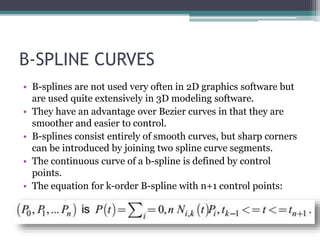
• The equation for k-order B-spline with n+1 control points:
B-SPLINE CURVES continued…
FRACTALS AND ITS APPLICATIONS
• Fractals can be seen as
mysterious expressions of beauty
representing exquisite
preordained shapes that mimic
the universe.
• Art and science will eventually be
seen to be as closely connected as
arms to the body.
• Both are vital elements of order
and its discovery. But when art is
seen as the ability to do, make,
apply, or portray in way that
withstands the test of time, its
connection with science becomes
clearer.
APPLICATIONS
• Nature
• Animations & movies
• Bacteria Cultures
• Biological systems

Introduction to the curves

  • 1.
    INTRODUCTION TO THECURVES COMPUTER GRAPHICS UNIT V -BY MS. ARTI GAVAS
  • 2.
    CURVE CONTINUITY • Abreakpoint is where two curve segments meet within a piecewise curve. • The continuity of a curve at a breakpoint describes how those curves meet at the breakpoint. • There are four possible types of continuity • No continuity: curves do not meet at all. • C0continuity : its a sharp point where they meet. • C1 continuity: The curves have identical tangents at the breakpoint and the curves join smoothly. • Cn continuity: The curves have identical curvature at the breakpoint and curvature continuity implies both tangential and positional continuity.
  • 3.
  • 4.
  • 5.
    CONIC CURVES CONTINUED… •Both circles and ellipses are special cases of a class of curves known as conics. Conics are distinguished by second degree discriminating functions of the form: • The values of the constants, A, B, C, D, E, and F determines the type of curve.
  • 6.
    TYPES OF CURVESFROM CONIC • Curves of this form arise frequently in physical simulations. • such as plotting the path of a projectile shot from a canon under the influence of gravity (a parabola), or the near collision of like charged particles (hyperbolas).
  • 7.
    CONIC CURVES • Inorder to compute the slope at each point we'll need to find derivatives of the discriminating equation: • Using these equations we can compute the instantaneous slope at every point on the conic curve.
  • 8.
    PIECEWISE CURVE DESIGN •The order of the curve determines the minimum number of control points necessary to define the curve. • We must have at least order control points to define a curve. To make curves with more than order control points, you can join two or more curve segments into a piecewise curve
  • 9.
    PARAMETRIC CURVE DESIGN •A parametric curve that lies in a plane is defined by two functions, x(t) and y(t), which use the independent parameter t. • x(t) and y(t) are coordinate functions, since their values represent the coordinates of points on the curve. • As t varies, the coordinates (x(t), y(t)) sweep out the curve. • As an example consider the two functions: • x(t) = sin(t) • y(t) = cos(t) • As t varies from zero to 360, a circle is swept out by (x(t), y(t)).
  • 10.
  • 11.
    SPLINE CURVE REPRESENTATION •A spline curve is a mathematical representation for which it is easy to build an interface that will allow a user to design and control the shape of complex curves and surfaces. • The general approach is that the user enters a sequence of points, and a curve is constructed whose shape closely follows this sequence. • The points are called control points. A curve that actually passes through each control point is called an interpolating curve. • A curve that passes near to the control points but not necessarily through them is called an approximating curve.
  • 12.
  • 13.
    BEZIER CURVES • Beziercurve section can be fitted to any number of control points. • The number of control points to be approximated and their relative position determine the degree of the Bezier polynomial. • A Bezier curve can be specified with boundary conditions, with blending function. • Suppose we are given n+1 control point positions: Pk =(Xk,Yk,Zk) with k varying from 0 to n. • These coordinate points can be blended to produce the following position vector P(u) , which describes the path of an approximating Bezier polynomial function between P0 and Pn.
  • 14.
  • 15.
    ADVANTAGEOUS OF BAZIERCURVES • Easy to implement • Reasonably powerful in curve design. • Efficient methods for determining coordinate positions along a Bezier curve can be set up using recursive calculations.
  • 16.
    PROPERTIES OF BAZIERCURVES • Bezier curves are always passes through the first and last control points. • The slope at the beginning of the curve is along the line joining the first two control points and the slope at the end of the curve is along the line joining the last two end points. • It lies within the convex hull of the control points.
  • 17.
    B-SPLINE CURVES • B-splinesare not used very often in 2D graphics software but are used quite extensively in 3D modeling software. • They have an advantage over Bezier curves in that they are smoother and easier to control. • B-splines consist entirely of smooth curves, but sharp corners can be introduced by joining two spline curve segments. • The continuous curve of a b-spline is defined by control points. • The equation for k-order B-spline with n+1 control points:
  • 18.
  • 19.
    FRACTALS AND ITSAPPLICATIONS • Fractals can be seen as mysterious expressions of beauty representing exquisite preordained shapes that mimic the universe. • Art and science will eventually be seen to be as closely connected as arms to the body. • Both are vital elements of order and its discovery. But when art is seen as the ability to do, make, apply, or portray in way that withstands the test of time, its connection with science becomes clearer.
  • 20.
    APPLICATIONS • Nature • Animations& movies • Bacteria Cultures • Biological systems