
Google Project Loon
LINCOLN CORNER IIUI
PRESENTED BY MAFAZ AHMED
Introduction
• Many of us think of the Internet as a global community. But two-thirds of the world’s population
does not yet have Internet access.
• Project Loon is a network of balloons traveling on the edge of space, designed to connect
people in rural and remote areas.
• The balloon is also considerably used to gather weather information such as atmospheric
pressure, temperature, humidity and wind speed.
History
 In 2001, Space Data Corporation, suggested an idea to widen the cellular coverage for the
rural areas in the united States. The idea was to have wireless transceivers carried on weather
balloons.
 In 2008, Google had considered contracting Space Data Corporation. Unofficial development
on the project began in 2011 under Google X( X corporation).
 The project was officially announced as a Google project on June 2013.
 A small group of Project Loon pioneers tested the technology in New Zealand.
 30 balloons, launched from New Zealand’s South Island
Technology
Project Loon balloons float in the stratosphere, twice as high
as airplanes
People connect to the balloon network using a special
Internet antenna attached to their building.
The signal bounces from balloon to balloon, then to the
global Internet back on Earth.
Stratosphere
Situated between 10 km and 60 km altitude on the edge of space.
Air pressure is 1% of that at sea level.
Thinner atmosphere offers less protection from the UV radiation and temperature caused by
the sun’s rays.
HOW LOON IS DESIGNED
ENVELOPE
SOLAR PANELS
EQUIPMENT
ENVELOPE
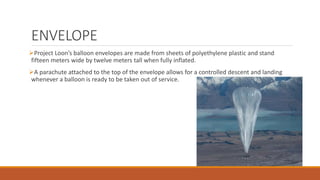
Project Loon’s balloon envelopes are made from sheets of polyethylene plastic and stand
fifteen meters wide by twelve meters tall when fully inflated.
A parachute attached to the top of the envelope allows for a controlled descent and landing
whenever a balloon is ready to be taken out of service.
SOLAR PANELS
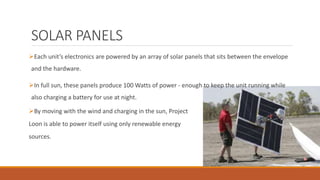
Each unit’s electronics are powered by an array of solar panels that sits between the envelope
and the hardware.
In full sun, these panels produce 100 Watts of power - enough to keep the unit running while
also charging a battery for use at night.
By moving with the wind and charging in the sun, Project
Loon is able to power itself using only renewable energy
sources.
EQUIPMENT
A small box containing the balloon’s electronic equipment.
This box contains circuit boards that control the system.
Radio antennas to communicate with other balloons and with Internet antennas on the ground.
And batteries to store solar power so the balloons can operate
during the night .
HOW LOON MOVES
Winds in the stratosphere are generally steady and slow-moving at between 5 and 20 mph.
Project Loon uses software algorithms to determine where its balloons need to go, then moves
each one into a layer of wind blowing in the right direction.
The balloons arranged to form one large communications network.
User Connectivity
Users of the service connect to the balloon network using a special Internet
antenna attached to their building.
HOW LOON CONNECTS
Each balloon can provide connectivity to a ground area about 80 km in diameter using a
wireless communications technology at speeds same to 3G.
Each balloon is equipped with a GPS for tracking its location.
Advantages
Easy to use.
Increasing Internet Speed.
Increasing Internet usage.
Use of Renewable Energy
Weather Surveillance
Disadvantages
Cost.
Maintenance.
Balloon can work for few week only.
Conclusion
Project Loon is an ambitious project and the world will highly benefit from it.
Project Loon, an initiative to help fill in those internet gaps through the use of networked
balloons.
The goal is to provide broadband-like internet for the two-thirds of the world that doesn’t have
access to a reliable internet connection by balloon.
The End

Project loon

  • 1.
    Google Project Loon LINCOLNCORNER IIUI PRESENTED BY MAFAZ AHMED
  • 2.
    Introduction • Many ofus think of the Internet as a global community. But two-thirds of the world’s population does not yet have Internet access. • Project Loon is a network of balloons traveling on the edge of space, designed to connect people in rural and remote areas. • The balloon is also considerably used to gather weather information such as atmospheric pressure, temperature, humidity and wind speed.
  • 3.
    History  In 2001,Space Data Corporation, suggested an idea to widen the cellular coverage for the rural areas in the united States. The idea was to have wireless transceivers carried on weather balloons.  In 2008, Google had considered contracting Space Data Corporation. Unofficial development on the project began in 2011 under Google X( X corporation).  The project was officially announced as a Google project on June 2013.  A small group of Project Loon pioneers tested the technology in New Zealand.  30 balloons, launched from New Zealand’s South Island
  • 4.
    Technology Project Loon balloonsfloat in the stratosphere, twice as high as airplanes People connect to the balloon network using a special Internet antenna attached to their building. The signal bounces from balloon to balloon, then to the global Internet back on Earth.
  • 5.
    Stratosphere Situated between 10km and 60 km altitude on the edge of space. Air pressure is 1% of that at sea level. Thinner atmosphere offers less protection from the UV radiation and temperature caused by the sun’s rays.
  • 6.
    HOW LOON ISDESIGNED ENVELOPE SOLAR PANELS EQUIPMENT
  • 7.
    ENVELOPE Project Loon’s balloonenvelopes are made from sheets of polyethylene plastic and stand fifteen meters wide by twelve meters tall when fully inflated. A parachute attached to the top of the envelope allows for a controlled descent and landing whenever a balloon is ready to be taken out of service.
  • 8.
    SOLAR PANELS Each unit’selectronics are powered by an array of solar panels that sits between the envelope and the hardware. In full sun, these panels produce 100 Watts of power - enough to keep the unit running while also charging a battery for use at night. By moving with the wind and charging in the sun, Project Loon is able to power itself using only renewable energy sources.
  • 9.
    EQUIPMENT A small boxcontaining the balloon’s electronic equipment. This box contains circuit boards that control the system. Radio antennas to communicate with other balloons and with Internet antennas on the ground. And batteries to store solar power so the balloons can operate during the night .
  • 10.
    HOW LOON MOVES Windsin the stratosphere are generally steady and slow-moving at between 5 and 20 mph. Project Loon uses software algorithms to determine where its balloons need to go, then moves each one into a layer of wind blowing in the right direction. The balloons arranged to form one large communications network.
  • 11.
    User Connectivity Users ofthe service connect to the balloon network using a special Internet antenna attached to their building.
  • 12.
    HOW LOON CONNECTS Eachballoon can provide connectivity to a ground area about 80 km in diameter using a wireless communications technology at speeds same to 3G. Each balloon is equipped with a GPS for tracking its location.
  • 13.
    Advantages Easy to use. IncreasingInternet Speed. Increasing Internet usage. Use of Renewable Energy Weather Surveillance
  • 14.
  • 15.
    Conclusion Project Loon isan ambitious project and the world will highly benefit from it. Project Loon, an initiative to help fill in those internet gaps through the use of networked balloons. The goal is to provide broadband-like internet for the two-thirds of the world that doesn’t have access to a reliable internet connection by balloon.
  • 16.