







WELCOME
PROJECT LOON
CONTENTS
 WHAT IS PROJECT LOON
 HISTORY
 THE TECHNOLOGY
 HOW LOON MOVES?
 HOW LOON IS DESIGNED
 HOW LOON CONNECTS?
 ADVANTAGES & DISADVANTAGES
 REFERENCES
“Two out of every three people on earth do not
have internet access”
WHAT IS PROJECT LOON?
 Project Loon is a network of balloons traveling on the edge of space, designed to connect
people in rural and remote areas.
 It is an initiative taken by Google to provide internet access all over the world.
 Sending balloons to Stratosphere to deliver internet globally
HISTORY
 In 2008,Google considered contracting Space Data Corp, but didn’t do so.
 In 2011, the unofficial development of the project began under Google X Labs.
 14 June 2013, Google announced this is an official project.
 16 June 2013, A pilot experiment happened in New Zealand and about 30 balloons were
launched.
THE PILOT TEST
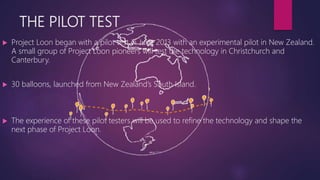
 Project Loon began with a pilot test in June 2013 with an experimental pilot in New Zealand.
A small group of Project Loon pioneers will test the technology in Christchurch and
Canterbury.
 30 balloons, launched from New Zealand’s South Island.
 The experience of these pilot testers will be used to refine the technology and shape the
next phase of Project Loon.
THE TECHNOLOGY
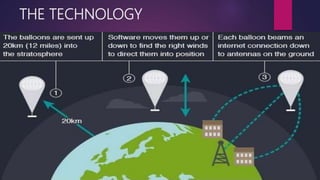
 The signal bounces from balloon to balloon, then to the global Internet back on Earth.
THE TECHNOLOGY
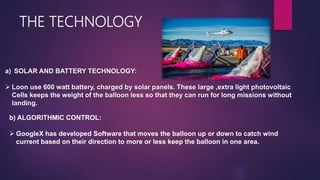
a) SOLAR AND BATTERY TECHNOLOGY:
 Loon use 600 watt battery, charged by solar panels. These large ,extra light photovoltaic
Cells keeps the weight of the balloon less so that they can run for long missions without
landing.
b) ALGORITHMIC CONTROL:
 GoogleX has developed Software that moves the balloon up or down to catch wind
current based on their direction to more or less keep the balloon in one area.
STRATOSPHERE
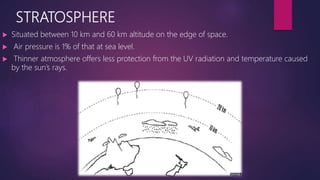
 Situated between 10 km and 60 km altitude on the edge of space.
 Air pressure is 1% of that at sea level.
 Thinner atmosphere offers less protection from the UV radiation and temperature caused
by the sun’s rays.
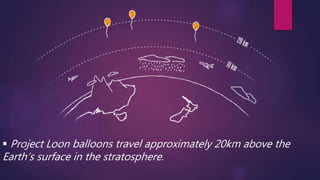
 Project Loon balloons travel approximately 20km above the
Earth’s surface in the stratosphere.
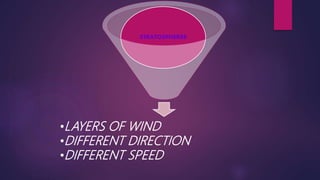
STRATOSPHERRE
•LAYERS OF WIND
•DIFFERENT DIRECTION
•DIFFERENT SPEED
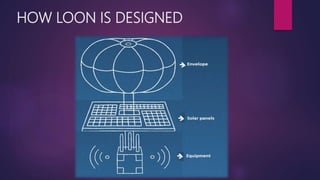
HOW LOON IS DESIGNED
ENVELOPE
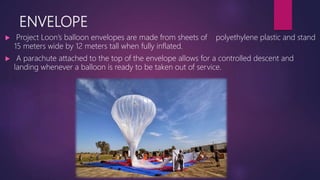
 Project Loon’s balloon envelopes are made from sheets of polyethylene plastic and stand
15 meters wide by 12 meters tall when fully inflated.
 A parachute attached to the top of the envelope allows for a controlled descent and
landing whenever a balloon is ready to be taken out of service.
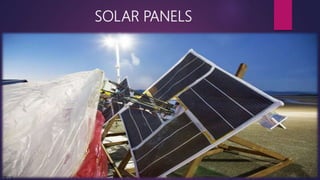
SOLAR PANELS
SOLAR PANELS
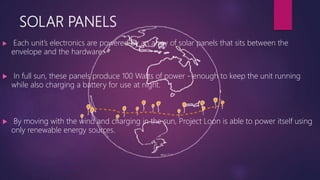
 Each unit’s electronics are powered by an array of solar panels that sits between the
envelope and the hardware.
 In full sun, these panels produce 100 Watts of power - enough to keep the unit running
while also charging a battery for use at night.
 By moving with the wind and charging in the sun, Project Loon is able to power itself using
only renewable energy sources.
.
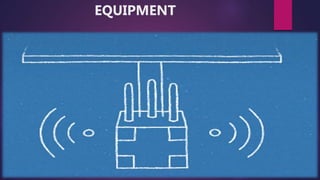
EQUIPMENT
EQUIPMENT
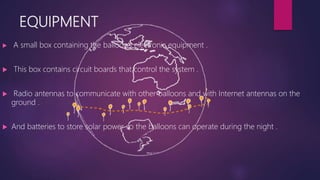
 A small box containing the balloon’s electronic equipment .
 This box contains circuit boards that control the system .
 Radio antennas to communicate with other balloons and with Internet antennas on the
ground .
 And batteries to store solar power so the balloons can operate during the night .
HOW LOON CONNECTS
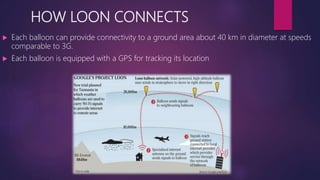
 Each balloon can provide connectivity to a ground area about 40 km in diameter at speeds
comparable to 3G.
 Each balloon is equipped with a GPS for tracking its location
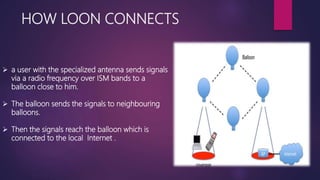
 a user with the specialized antenna sends signals
via a radio frequency over ISM bands to a
balloon close to him.
 The balloon sends the signals to neighbouring
balloons.
 Then the signals reach the balloon which is
connected to the local Internet .
HOW LOON CONNECTS
HOW LOON CONNECTS
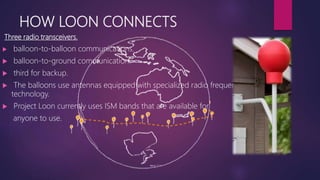
Three radio transceivers.
 balloon-to-balloon communications.
 balloon-to-ground communication.
 third for backup.
 The balloons use antennas equipped with specialized radio frequency
technology.
 Project Loon currently uses ISM bands that are available for
anyone to use.
ADVANTAGES
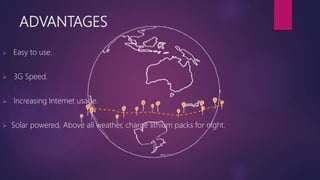
 Easy to use.
 3G Speed.
 Increasing Internet usage.
 Solar powered, Above all weather, charge lithium packs for night.
DISADVANTAGES
 Maintenance.
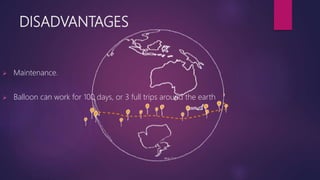
 Balloon can work for 100 days, or 3 full trips around the earth
References :
http://www.google.com/loon/
http://en.Wikipedia.org/wiki/proj
ectloon
http://www.youtube.com/googlel
oon
GOOGLE PORJECT LOON (Mohamed Vakif)

GOOGLE PORJECT LOON (Mohamed Vakif)

  • 1.
  • 2.
  • 4.
    CONTENTS  WHAT ISPROJECT LOON  HISTORY  THE TECHNOLOGY  HOW LOON MOVES?  HOW LOON IS DESIGNED  HOW LOON CONNECTS?  ADVANTAGES & DISADVANTAGES  REFERENCES
  • 5.
    “Two out ofevery three people on earth do not have internet access”
  • 6.
    WHAT IS PROJECTLOON?  Project Loon is a network of balloons traveling on the edge of space, designed to connect people in rural and remote areas.  It is an initiative taken by Google to provide internet access all over the world.  Sending balloons to Stratosphere to deliver internet globally
  • 8.
    HISTORY  In 2008,Googleconsidered contracting Space Data Corp, but didn’t do so.  In 2011, the unofficial development of the project began under Google X Labs.  14 June 2013, Google announced this is an official project.  16 June 2013, A pilot experiment happened in New Zealand and about 30 balloons were launched.
  • 9.
    THE PILOT TEST Project Loon began with a pilot test in June 2013 with an experimental pilot in New Zealand. A small group of Project Loon pioneers will test the technology in Christchurch and Canterbury.  30 balloons, launched from New Zealand’s South Island.  The experience of these pilot testers will be used to refine the technology and shape the next phase of Project Loon.
  • 10.
    THE TECHNOLOGY  Thesignal bounces from balloon to balloon, then to the global Internet back on Earth.
  • 11.
    THE TECHNOLOGY a) SOLARAND BATTERY TECHNOLOGY:  Loon use 600 watt battery, charged by solar panels. These large ,extra light photovoltaic Cells keeps the weight of the balloon less so that they can run for long missions without landing. b) ALGORITHMIC CONTROL:  GoogleX has developed Software that moves the balloon up or down to catch wind current based on their direction to more or less keep the balloon in one area.
  • 12.
    STRATOSPHERE  Situated between10 km and 60 km altitude on the edge of space.  Air pressure is 1% of that at sea level.  Thinner atmosphere offers less protection from the UV radiation and temperature caused by the sun’s rays.
  • 13.
     Project Loonballoons travel approximately 20km above the Earth’s surface in the stratosphere.
  • 14.
  • 15.
    HOW LOON ISDESIGNED
  • 16.
    ENVELOPE  Project Loon’sballoon envelopes are made from sheets of polyethylene plastic and stand 15 meters wide by 12 meters tall when fully inflated.  A parachute attached to the top of the envelope allows for a controlled descent and landing whenever a balloon is ready to be taken out of service.
  • 17.
  • 18.
    SOLAR PANELS  Eachunit’s electronics are powered by an array of solar panels that sits between the envelope and the hardware.  In full sun, these panels produce 100 Watts of power - enough to keep the unit running while also charging a battery for use at night.  By moving with the wind and charging in the sun, Project Loon is able to power itself using only renewable energy sources.
  • 19.
  • 20.
    EQUIPMENT  A smallbox containing the balloon’s electronic equipment .  This box contains circuit boards that control the system .  Radio antennas to communicate with other balloons and with Internet antennas on the ground .  And batteries to store solar power so the balloons can operate during the night .
  • 21.
    HOW LOON CONNECTS Each balloon can provide connectivity to a ground area about 40 km in diameter at speeds comparable to 3G.  Each balloon is equipped with a GPS for tracking its location
  • 22.
     a userwith the specialized antenna sends signals via a radio frequency over ISM bands to a balloon close to him.  The balloon sends the signals to neighbouring balloons.  Then the signals reach the balloon which is connected to the local Internet . HOW LOON CONNECTS
  • 23.
    HOW LOON CONNECTS Threeradio transceivers.  balloon-to-balloon communications.  balloon-to-ground communication.  third for backup.  The balloons use antennas equipped with specialized radio frequency technology.  Project Loon currently uses ISM bands that are available for anyone to use.
  • 24.
    ADVANTAGES  Easy touse.  3G Speed.  Increasing Internet usage.  Solar powered, Above all weather, charge lithium packs for night.
  • 25.
    DISADVANTAGES  Maintenance.  Ballooncan work for 100 days, or 3 full trips around the earth
  • 26.