Name : M.Anuhya
Regd no : 15501A0566
Dept : CSE
Sec : 2
Content
• The Loon technology
• How Loon flies?
• The Loon Design
• How Loon moves?
• How Loon connects?
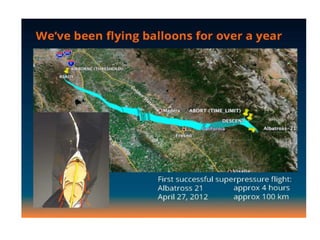
• The Pilot Test
• How it works?
• Breakthroughs of Technology
• Engineering Challenges
• Advantages
• Conclusion
PROJECT LOON
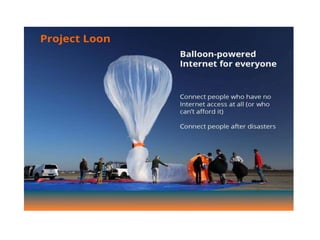
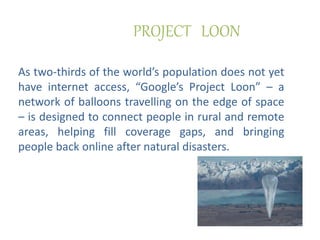
As two-thirds of the world’s population does not yet
have internet access, “Google’s Project Loon” – a
network of balloons travelling on the edge of space
– is designed to connect people in rural and remote
areas, helping fill coverage gaps, and bringing
people back online after natural disasters.
the loon technology
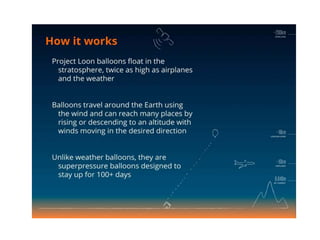
• Project Loon balloons float in the stratosphere, twice
as high as airplanes and the weather.
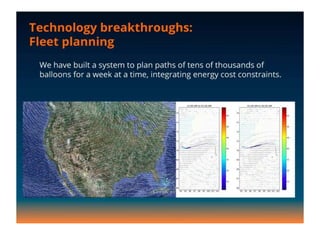
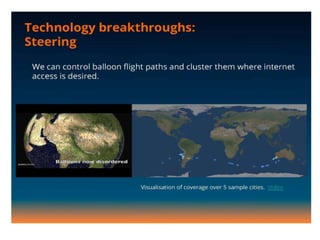
• They are carried around the Earth by winds and they
can be steered by rising or descending to an altitude
with winds moving in the desired direction.
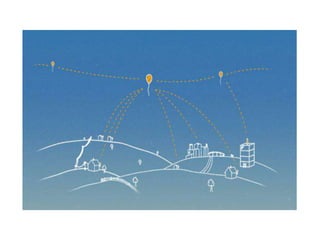
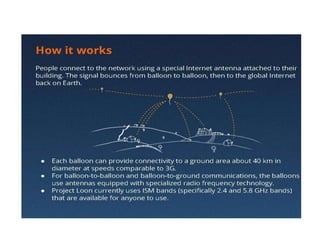
• People connect to the balloon network using a special
Internet antenna attached to their building.
• The signal bounces from balloon to balloon, then to
the global Internet back on Earth.
HOWLOONFLIES
NAVIGATINGWITH THE WIND
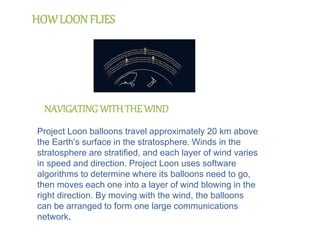
Project Loon balloons travel approximately 20 km above
the Earth’s surface in the stratosphere. Winds in the
stratosphere are stratified, and each layer of wind varies
in speed and direction. Project Loon uses software
algorithms to determine where its balloons need to go,
then moves each one into a layer of wind blowing in the
right direction. By moving with the wind, the balloons
can be arranged to form one large communications
network.
STRATOSPHERE
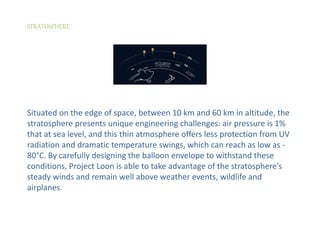
Situated on the edge of space, between 10 km and 60 km in altitude, the
stratosphere presents unique engineering challenges: air pressure is 1%
that at sea level, and this thin atmosphere offers less protection from UV
radiation and dramatic temperature swings, which can reach as low as -
80°C. By carefully designing the balloon envelope to withstand these
conditions, Project Loon is able to take advantage of the stratosphere’s
steady winds and remain well above weather events, wildlife and
airplanes.
loon design
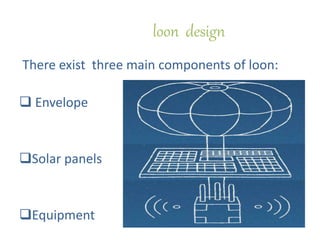
There exist three main components of loon:
 Envelope
Solar panels
Equipment
ENVELOPE
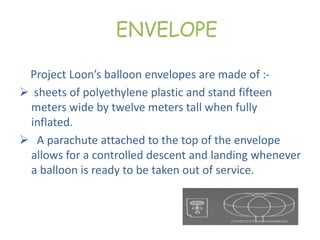
Project Loon’s balloon envelopes are made of :-
 sheets of polyethylene plastic and stand fifteen
meters wide by twelve meters tall when fully
inflated.
 A parachute attached to the top of the envelope
allows for a controlled descent and landing whenever
a balloon is ready to be taken out of service.
SOLAR PANELS
• Each unit’s electronics are powered by an
array of solar panels that sits between the
envelope and the hardware.
• In full sun, these panels produce 100 Watts of
power - enough to keep the unit running while
also charging a battery for use at night.
• By moving with the wind and charging in the
sun, Project Loon is able to power itself using
only renewable energy sources.
EQUIPMENT
A small box is used that contains the balloon’s
electronic equipment :-
• Circuit boards that control the system .
• Radio antennas to communicate with other
balloons and with Internet antennas on the
ground .
• And batteries to store solar power so the
balloons can operate during the night .
How loon moves ?
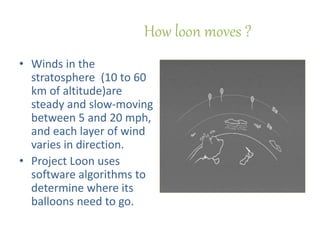
• Winds in the
stratosphere (10 to 60
km of altitude)are
steady and slow-moving
between 5 and 20 mph,
and each layer of wind
varies in direction.
• Project Loon uses
software algorithms to
determine where its
balloons need to go.
how loon connects ?
• Each balloon can provide connectivity to a
ground area about 40 km in diameter at
speeds comparable to 3G.
• Each balloon is equipped with a GPS for
tracking its location .
• The balloons use antennas equipped with
specialized radio frequency technology.
• Project Loon currently uses ISM bands that are
available for anyone to use.
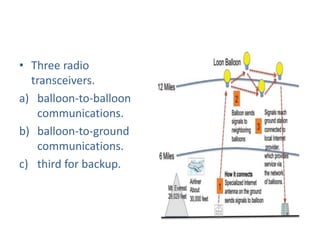
• Three radio
transceivers.
a) balloon-to-balloon
communications.
b) balloon-to-ground
communications.
c) third for backup.
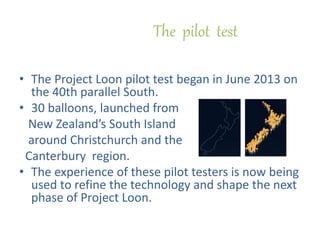
The pilot test
• The Project Loon pilot test began in June 2013 on
the 40th parallel South.
• 30 balloons, launched from
New Zealand’s South Island
around Christchurch and the
Canterbury region.
• The experience of these pilot testers is now being
used to refine the technology and shape the next
phase of Project Loon.
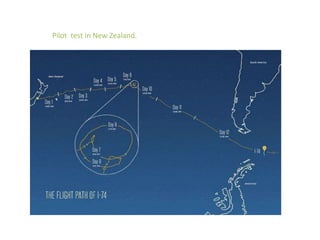
Pilot test in New Zealand.
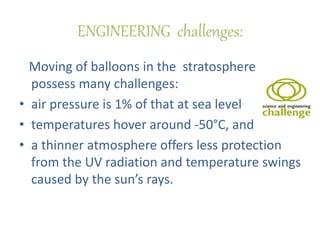
ENGINEERING challenges:
Moving of balloons in the stratosphere
possess many challenges:
• air pressure is 1% of that at sea level
• temperatures hover around -50°C, and
• a thinner atmosphere offers less protection
from the UV radiation and temperature swings
caused by the sun’s rays.
advantages
• This project will offer worldwide access to everyone
those who are as per now beyond the geographic
reach of internet.
• It provides connectivity at speeds comparable to 3G
for about area of 40 km in diameter.
• Wireless connection to the Web available for free to
every person in the world.
• It would offer a humanitarian communication system,
during emergencies in places where communications
link has broken up as in natural disasters.
• Although internet has become such a handy thing for people having
access to internet that they roam about with it in their pockets, but
this has been possible for those countries that can afford fibre optic
cables for connectivity and therefore the bitter truth remains that
nearly two-thirds of the world population do not yet have internet
access. The Google[X] team has therefore taken an initiative to bridge
this gap and make the world actually connected to one another by
introducing Google’s Project Loon.
• This project has come along a long way with successful Pilot Test and
also surpassing many environmental, engineering , political
challenges(relating to use of airspace and radio frequencies) and now
is seeking NASA’s intervention for its success worldwide.
• The project aims at : “Forget the Internet, soon there will be
OUTERNET”
• The success of this project would thereby make us talk about
Outernet , may be, in the next one year and we would put one step
forward in connecting the world into one by our technology.
conclusion
THANKS FOR YOUR KIND
ATTENTION !!!
google project loon ppt for seminar

google project loon ppt for seminar

  • 1.
    Name : M.Anuhya Regdno : 15501A0566 Dept : CSE Sec : 2
  • 2.
    Content • The Loontechnology • How Loon flies? • The Loon Design • How Loon moves? • How Loon connects? • The Pilot Test • How it works? • Breakthroughs of Technology • Engineering Challenges • Advantages • Conclusion
  • 4.
    PROJECT LOON As two-thirdsof the world’s population does not yet have internet access, “Google’s Project Loon” – a network of balloons travelling on the edge of space – is designed to connect people in rural and remote areas, helping fill coverage gaps, and bringing people back online after natural disasters.
  • 5.
    the loon technology •Project Loon balloons float in the stratosphere, twice as high as airplanes and the weather. • They are carried around the Earth by winds and they can be steered by rising or descending to an altitude with winds moving in the desired direction. • People connect to the balloon network using a special Internet antenna attached to their building. • The signal bounces from balloon to balloon, then to the global Internet back on Earth.
  • 7.
    HOWLOONFLIES NAVIGATINGWITH THE WIND ProjectLoon balloons travel approximately 20 km above the Earth’s surface in the stratosphere. Winds in the stratosphere are stratified, and each layer of wind varies in speed and direction. Project Loon uses software algorithms to determine where its balloons need to go, then moves each one into a layer of wind blowing in the right direction. By moving with the wind, the balloons can be arranged to form one large communications network.
  • 8.
    STRATOSPHERE Situated on theedge of space, between 10 km and 60 km in altitude, the stratosphere presents unique engineering challenges: air pressure is 1% that at sea level, and this thin atmosphere offers less protection from UV radiation and dramatic temperature swings, which can reach as low as - 80°C. By carefully designing the balloon envelope to withstand these conditions, Project Loon is able to take advantage of the stratosphere’s steady winds and remain well above weather events, wildlife and airplanes.
  • 9.
    loon design There existthree main components of loon:  Envelope Solar panels Equipment
  • 10.
    ENVELOPE Project Loon’s balloonenvelopes are made of :-  sheets of polyethylene plastic and stand fifteen meters wide by twelve meters tall when fully inflated.  A parachute attached to the top of the envelope allows for a controlled descent and landing whenever a balloon is ready to be taken out of service.
  • 11.
    SOLAR PANELS • Eachunit’s electronics are powered by an array of solar panels that sits between the envelope and the hardware. • In full sun, these panels produce 100 Watts of power - enough to keep the unit running while also charging a battery for use at night. • By moving with the wind and charging in the sun, Project Loon is able to power itself using only renewable energy sources.
  • 12.
    EQUIPMENT A small boxis used that contains the balloon’s electronic equipment :- • Circuit boards that control the system . • Radio antennas to communicate with other balloons and with Internet antennas on the ground . • And batteries to store solar power so the balloons can operate during the night .
  • 13.
    How loon moves? • Winds in the stratosphere (10 to 60 km of altitude)are steady and slow-moving between 5 and 20 mph, and each layer of wind varies in direction. • Project Loon uses software algorithms to determine where its balloons need to go.
  • 14.
    how loon connects? • Each balloon can provide connectivity to a ground area about 40 km in diameter at speeds comparable to 3G. • Each balloon is equipped with a GPS for tracking its location . • The balloons use antennas equipped with specialized radio frequency technology. • Project Loon currently uses ISM bands that are available for anyone to use.
  • 15.
    • Three radio transceivers. a)balloon-to-balloon communications. b) balloon-to-ground communications. c) third for backup.
  • 16.
    The pilot test •The Project Loon pilot test began in June 2013 on the 40th parallel South. • 30 balloons, launched from New Zealand’s South Island around Christchurch and the Canterbury region. • The experience of these pilot testers is now being used to refine the technology and shape the next phase of Project Loon.
  • 17.
    Pilot test inNew Zealand.
  • 23.
    ENGINEERING challenges: Moving ofballoons in the stratosphere possess many challenges: • air pressure is 1% of that at sea level • temperatures hover around -50°C, and • a thinner atmosphere offers less protection from the UV radiation and temperature swings caused by the sun’s rays.
  • 24.
    advantages • This projectwill offer worldwide access to everyone those who are as per now beyond the geographic reach of internet. • It provides connectivity at speeds comparable to 3G for about area of 40 km in diameter. • Wireless connection to the Web available for free to every person in the world. • It would offer a humanitarian communication system, during emergencies in places where communications link has broken up as in natural disasters.
  • 25.
    • Although internethas become such a handy thing for people having access to internet that they roam about with it in their pockets, but this has been possible for those countries that can afford fibre optic cables for connectivity and therefore the bitter truth remains that nearly two-thirds of the world population do not yet have internet access. The Google[X] team has therefore taken an initiative to bridge this gap and make the world actually connected to one another by introducing Google’s Project Loon. • This project has come along a long way with successful Pilot Test and also surpassing many environmental, engineering , political challenges(relating to use of airspace and radio frequencies) and now is seeking NASA’s intervention for its success worldwide. • The project aims at : “Forget the Internet, soon there will be OUTERNET” • The success of this project would thereby make us talk about Outernet , may be, in the next one year and we would put one step forward in connecting the world into one by our technology. conclusion
  • 26.
    THANKS FOR YOURKIND ATTENTION !!!