Project LOON
Index
• Introduction
• History
• Stratosphere
• Networks
• Loon Design
• Working
• Movement
• Engineering Challenges
• Advantages
• Dis-Advantages
• Conclusion
INTRODUCTION
• Project LOON Is a research and development project being
developed by X
• Formerly by Google X
• Mission for providing internet to rural and remote areas.
• Uses high altitude balloon placed in the stratosphere
• Create an aerial wireless network with up to 4G-LTE speeds
• It was named Project Loon, providing Internet access to the
remaining population unprecedented and “loony"
HISTORY
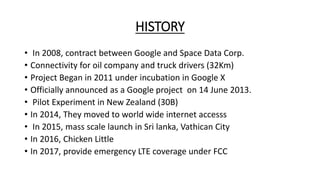
• In 2008, contract between Google and Space Data Corp.
• Connectivity for oil company and truck drivers (32Km)
• Project Began in 2011 under incubation in Google X
• Officially announced as a Google project on 14 June 2013.
• Pilot Experiment in New Zealand (30B)
• In 2014, They moved to world wide internet accesss
• In 2015, mass scale launch in Sri lanka, Vathican City
• In 2016, Chicken Little
• In 2017, provide emergency LTE coverage under FCC
Internet Users
Internet Users
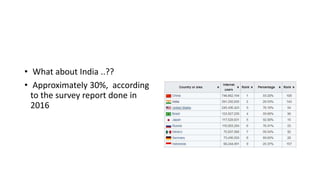
• What about India ..??
• Approximately 30%, according
to the survey report done in
2016
NETWORKS
Vertical Network
• Wireless Node attached to
balloon and Mobile-Pc
• Using IEEE 802.11b,g
• Maximum distance 600m
(2000ft)
• WLAN protocol
• IEEE 802.11j
• Provide Auto configuration
function
• using electro magnetic power
density- Finding neighbor
balloons
Mesh Network
LOON DESIGN
LOON consisting of mainly
 ENVELOPE
 SOLAR PANELS
 EQUIPMENT
ENVELOPE
• Inflammable part
• Made by polyethylene plastic
• Size: 15m wide &12m tall
• Longer lasting than weather
balloons. Stand in high pressure in
float altitude
• Gas releasing for taken out of
service.
• Parachute attached top of envelop
SOLAR PANELS
• Sits between Solar panel and
equipment
• Produce 100 watts of power
• Able to power itself using only
renewable energy sources
EQUIPMENT
• A type of electronic equipment
box carried by hot air balloon
• It consisting of
 Circuit board
 Radio Antenna
Batteries
WORKING
• Each balloon can provide connectivity to a ground area about 40 km
in diameter at speeds comparable to 4G.
• Each balloon is equipped with a GPS for tracking its location .
• The balloons use antennas equipped with specialized radio frequency
technology.
• Project Loon currently uses ISM bands that are available for anyone to
use.
• Using algorithms to determine where it needs to go
• Three radio transceivers.
a) balloon-to-balloon
communications.
b) balloon-to-ground
communications.
c) third for backup.
How loon moves
• 20km above earth surface
• Slow moving between 5&20mph
• Wind varies in direction and magnitude
• Algorithms
• Making a large communication networks
• There occur some engineering challenges too
•
Engineering challenges
Moving of balloons in the stratosphere possess many challenges:
• air pressure is 1% of that at sea level
• temperatures hover around -50°C, and
• a thinner atmosphere offers less protection from the UV radiation
and temperature swings caused by the sun’s rays.
LOON TECHNOLOGY
• Project Loon balloons float in the stratosphere, twice as high as
airplanes and the weather.
• They are carried around the Earth by winds and they can be steered
by rising or descending to an altitude with winds moving in the
desired direction.
• People connect to the balloon network using a special Internet
antenna attached to their building.
• The signal bounces from balloon to balloon, then to the global
Internet back on Earth.
Auto-Launching
• Autolaunchers are designed to launch Loon balloons safely and
reliably at scale.
• Huge side panels provide protection from the wind as the balloon is
filled and lifted into launch position, and then the crane is pointed
downwind to smoothly release the balloon up into the stratosphere.
• Each crane is capable of filling and launching a new balloon into the
Loon network every 30 minutes.
Navigating
• Project Loon balloons travel approximately 20 km above the Earth's
surface in the stratosphere, well above airplanes, wildlife, and
weather events.
• In the stratosphere winds are stratified, and each layer of wind varies
in speed and direction.
• To get balloons to where they need to go, Project Loon uses
predictive models of the winds and decision-making algorithms to
move each balloon up or down into a layer of wind blowing in the
right direction.
Connecting
• extended connectivity into rural and remote areas so that people
everywhere will be able to access the Internet directly from their
phones and other LTE-enabled devices.
• Wireless internet signal is transmitted up to the nearest balloon from
our telecommunications partner on the ground, relayed across the
balloon network, and then sent back down to people in rural and
remote areas.
Recovery
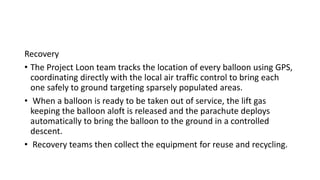
• The Project Loon team tracks the location of every balloon using GPS,
coordinating directly with the local air traffic control to bring each
one safely to ground targeting sparsely populated areas.
• When a balloon is ready to be taken out of service, the lift gas
keeping the balloon aloft is released and the parachute deploys
automatically to bring the balloon to the ground in a controlled
descent.
• Recovery teams then collect the equipment for reuse and recycling.
Advantages
• This project will offer worldwide access to everyone those who are as
per now beyond the geographic reach of internet.
• It provides connectivity at speeds comparable to 3G for about area
of 40 km in diameter.
• Use of Renewable Energy
• Collaboration between people across the globe
• It would offer a humanitarian communication system,
during emergencies in places where communications link has broken
up as in natural disasters.(military purpose & disaster recovery)
Disadvantages
• hardware failure
• internet privacy
• monopolistic tendency
Conclusion
•The project Aims @
forget the INTERNET,
soon there will be
OUTERNET
References
• https://x.company/loon/
• http://ranjaykrishna.com/blog/project-loon
• https://uk.norton.com/norton-blog/2015/10/is_google_project.html
• https://en.wikipedia.org/wiki/Project_Loon#Technology
• https://www.atmos-chem-phys.net/16/8581/2016/acp-16-8581-2016.pdf
Thanks

Project loon

  • 1.
  • 2.
    Index • Introduction • History •Stratosphere • Networks • Loon Design • Working • Movement • Engineering Challenges • Advantages • Dis-Advantages • Conclusion
  • 3.
    INTRODUCTION • Project LOONIs a research and development project being developed by X • Formerly by Google X • Mission for providing internet to rural and remote areas. • Uses high altitude balloon placed in the stratosphere • Create an aerial wireless network with up to 4G-LTE speeds • It was named Project Loon, providing Internet access to the remaining population unprecedented and “loony"
  • 4.
    HISTORY • In 2008,contract between Google and Space Data Corp. • Connectivity for oil company and truck drivers (32Km) • Project Began in 2011 under incubation in Google X • Officially announced as a Google project on 14 June 2013. • Pilot Experiment in New Zealand (30B) • In 2014, They moved to world wide internet accesss • In 2015, mass scale launch in Sri lanka, Vathican City • In 2016, Chicken Little • In 2017, provide emergency LTE coverage under FCC
  • 5.
  • 6.
  • 7.
    • What aboutIndia ..?? • Approximately 30%, according to the survey report done in 2016
  • 9.
    NETWORKS Vertical Network • WirelessNode attached to balloon and Mobile-Pc • Using IEEE 802.11b,g • Maximum distance 600m (2000ft) • WLAN protocol • IEEE 802.11j • Provide Auto configuration function • using electro magnetic power density- Finding neighbor balloons Mesh Network
  • 10.
    LOON DESIGN LOON consistingof mainly  ENVELOPE  SOLAR PANELS  EQUIPMENT
  • 11.
    ENVELOPE • Inflammable part •Made by polyethylene plastic • Size: 15m wide &12m tall • Longer lasting than weather balloons. Stand in high pressure in float altitude • Gas releasing for taken out of service. • Parachute attached top of envelop
  • 12.
    SOLAR PANELS • Sitsbetween Solar panel and equipment • Produce 100 watts of power • Able to power itself using only renewable energy sources
  • 13.
    EQUIPMENT • A typeof electronic equipment box carried by hot air balloon • It consisting of  Circuit board  Radio Antenna Batteries
  • 14.
    WORKING • Each ballooncan provide connectivity to a ground area about 40 km in diameter at speeds comparable to 4G. • Each balloon is equipped with a GPS for tracking its location . • The balloons use antennas equipped with specialized radio frequency technology. • Project Loon currently uses ISM bands that are available for anyone to use. • Using algorithms to determine where it needs to go
  • 15.
    • Three radiotransceivers. a) balloon-to-balloon communications. b) balloon-to-ground communications. c) third for backup.
  • 16.
    How loon moves •20km above earth surface • Slow moving between 5&20mph • Wind varies in direction and magnitude • Algorithms • Making a large communication networks • There occur some engineering challenges too •
  • 17.
    Engineering challenges Moving ofballoons in the stratosphere possess many challenges: • air pressure is 1% of that at sea level • temperatures hover around -50°C, and • a thinner atmosphere offers less protection from the UV radiation and temperature swings caused by the sun’s rays.
  • 18.
    LOON TECHNOLOGY • ProjectLoon balloons float in the stratosphere, twice as high as airplanes and the weather. • They are carried around the Earth by winds and they can be steered by rising or descending to an altitude with winds moving in the desired direction. • People connect to the balloon network using a special Internet antenna attached to their building. • The signal bounces from balloon to balloon, then to the global Internet back on Earth.
  • 19.
    Auto-Launching • Autolaunchers aredesigned to launch Loon balloons safely and reliably at scale. • Huge side panels provide protection from the wind as the balloon is filled and lifted into launch position, and then the crane is pointed downwind to smoothly release the balloon up into the stratosphere. • Each crane is capable of filling and launching a new balloon into the Loon network every 30 minutes.
  • 20.
    Navigating • Project Loonballoons travel approximately 20 km above the Earth's surface in the stratosphere, well above airplanes, wildlife, and weather events. • In the stratosphere winds are stratified, and each layer of wind varies in speed and direction. • To get balloons to where they need to go, Project Loon uses predictive models of the winds and decision-making algorithms to move each balloon up or down into a layer of wind blowing in the right direction.
  • 21.
    Connecting • extended connectivityinto rural and remote areas so that people everywhere will be able to access the Internet directly from their phones and other LTE-enabled devices. • Wireless internet signal is transmitted up to the nearest balloon from our telecommunications partner on the ground, relayed across the balloon network, and then sent back down to people in rural and remote areas.
  • 22.
    Recovery • The ProjectLoon team tracks the location of every balloon using GPS, coordinating directly with the local air traffic control to bring each one safely to ground targeting sparsely populated areas. • When a balloon is ready to be taken out of service, the lift gas keeping the balloon aloft is released and the parachute deploys automatically to bring the balloon to the ground in a controlled descent. • Recovery teams then collect the equipment for reuse and recycling.
  • 23.
    Advantages • This projectwill offer worldwide access to everyone those who are as per now beyond the geographic reach of internet. • It provides connectivity at speeds comparable to 3G for about area of 40 km in diameter. • Use of Renewable Energy • Collaboration between people across the globe • It would offer a humanitarian communication system, during emergencies in places where communications link has broken up as in natural disasters.(military purpose & disaster recovery)
  • 24.
    Disadvantages • hardware failure •internet privacy • monopolistic tendency
  • 25.
    Conclusion •The project Aims@ forget the INTERNET, soon there will be OUTERNET
  • 26.
    References • https://x.company/loon/ • http://ranjaykrishna.com/blog/project-loon •https://uk.norton.com/norton-blog/2015/10/is_google_project.html • https://en.wikipedia.org/wiki/Project_Loon#Technology • https://www.atmos-chem-phys.net/16/8581/2016/acp-16-8581-2016.pdf
  • 27.

Editor's Notes

  • #5 Sri lank 2nd vathican city 1st Chicken little : farmers connection in peru FCC :  Federal Communications Commission 4 Hurricane Maria. 
  • #12 Parachute: unxpctd failre, deploy automatic, handling direction too
  • #14 Radio antenna : communicating between ground anteena and neighbour anteena
  • #24 Refer http://ranjaykrishna.com/blog/project-loon Pros for the World Project Loon is clearly an asset to Google. However, it is also a convenience to the rest of the world. One of the most obvious avails of the project is the Availability of Information. Assuming all the mechanisms of the project are functioning as planned, every single person who has access to some device that has wifi access would be able to search for almost any form of media online. Farmers in remote corners of third world countries would be able to research and analyze multiple techniques that could increase their yield, a father would be able to stay in touch with his daughter no matter which township either one of them lived in, villagers across an country would be able to transparently examine the countries political scenario and vote appropriately. The second benefit is naturally Education. With millions of uneducated children all across the world, this program might be able to successfully provide schooling through online classes on topics ranging anywhere from disaster management to literary analysis. Even without any additional content, these new users would at the very least have access to existing online resources including W3School,  CodeAcademy and many others. Health and Medicine is another area that will be affected by Loon. With globally available data on disease outbreaks and medical breakthrough, the entire population will be able to adjust to epidemics or adopt new drugs or medications. Loon’s Use of Renewable Energy will greatly influence and inspire future projects as well. Creating an interplay between solar energy to keep the balloon functional while using wind energy to define its motor controls will help reduce the burden on coal, petroleum and other non-renewable energy sources. Finally, Collaboration between people across the globe will become much easier with the constant connectivity to the each other through the internet, allowing newer more complicated projects to arise. For example, NGO’s in Africa could clearly demonstrate to their investors from Canada precisely how they are implementing their communal goals.
  • #25 Concerns The main problem with launching any hardware project is the certainty of eventual hardware failure. In most cases, the hardware is usually accessible and can be fixed. However, for airplanes, rockets, satellites, and now Loon balloons, hardware failure is a huge problem as they can not be reached. If a Loon balloon fails, it can either remain up in the air floating, making it difficult to bring down or it might go down in unwanted areas. Both of these scenarios are a huge concern to the stability as well as the safety of people whose lives might be affected by unwanted balloon landings. Another concern over this project is internet privacy since it gives Google more power over a wider range of consumer behavior. This information can become a security issue if it is shared with Government agencies like the NSA. Finally, the last apprehension about this project is its monopolistic tendency. In the future, assuming no other company manages to initiate such a wide scale project, Google can utilize its monopoly over the internet by either charging money for Project Loon usage or even converge on favouritism by marketing Chromebooks and Android phones but limiting the accessibility of other company’s laptops and devices on the Loon web service.