GokarajuRangarajuInstituteofEngineeringand
Technology
ComputerScienceDepartment
Undertheguidanceof by
Dr.Ch.MallikarjunaRao G.Pranay
P.L.Shailaja 12241A0517
WHAT IS PROJECT LOON?
ProjectLoon isa network of balloons traveling onthe
edge of space,designed to connectpeople inrural and
remote areas.
THE PILOT TEST
 Project Loon starts in June2013 with an experimental pilot in New Zealand.
A small group of Project Loon pioneers will test the technology in
Christchurch and Canterbury.
 30 balloons, launched from New Zealand’s South Island.
 The experience of these pilot testers will be used to refine the technology
and shapethenext phaseof Project Loon.
The Technology
 ProjectLoonballoonsfloat inthestratosphere,twice ashighasairplanes and
the weather.
 Theyare carried aroundtheEarthby windsand theycanbe steered by
risingor descendingto an altitude with windsmovinginthedesired
direction.
 Peopleconnectto theballoon networkusing a specialInternetantenna
attached to their building.
 Thesignalbouncesfromballoon to balloon, then to theglobal Internetback
on Earth.
Stratosphere
• 7
 Situatedbetween10 kmand 60 kmaltitude ontheedge of
space.
 Air pressureis1% of that at sea level.
 Thinneratmosphereoffers lessprotection from theUVradiation
and temperature causedby the sun’srays.
HOW LOON MOVES
• 8
 Winds inthestratosphereare generally steady and slow-movingat
between5 and 20 mph,and each layer of wind variesin direction.
 ProjectLoonusessoftware algorithmsto determine whereitsballoons need
to go,thenmoveseachone intoa layer of wind blowing intheright
direction.
 Bymovingwith thewind,theballoons canbe arranged to form
onelarge communications network.
HOW LOONISDESIGNED
 ENVELOPE
 SOLAR PANELS
 EQUIPMENT
Component
 Solar panels
 Envelop
 Equipment Raval Sneh
ENVELOPE
 Project Loon’s balloon envelopes are made
from sheetsof polyethylene plastic and stand
fifteen meters wide by twelvemeterstall when
fully inflated.
 Aparachute attached to thetop of theenvelope
allows for a controlled descentand landing
whenever a balloon isready to be takenoutof
service.
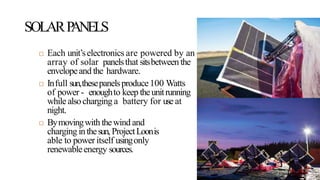
SOLARPANELS
 Each unit’selectronics are powered by an
array of solar panelsthat sitsbetween the
envelopeand the hardware.
 Infull sun,thesepanelsproduce100 Watts
of power - enoughto keep theunitrunning
while alsocharging a battery for use at
night.
 Bymovingwith thewind and
charging inthesun, ProjectLoonis
able to power itself usingonly
renewableenergy sources.
EQUIPMENT
 A small box containing the balloon’s electronic
equipment.
 This box containscircuitboards that controlthe
system .
 Radioantennasto communicatewith otherballoons
and with Internetantennasontheground .
 Andbatteries to storesolar power so theballoons
can operate during thenight .
HOW LOON CONNECTS
 Threeradio transceivers.
 balloon-to-balloon communications.
 balloon-to-ground communication.
 third for backup.
 The balloonsuse antennasequipped with specializedradio frequency
technology.
 ProjectLooncurrently usesISM bandsthat are available for anyoneto use.
 Eachballoon canprovide connectivityto a groundarea about 40 kmin
diameter at speedscomparableto 3G.
 Eachballoon isequipped witha GPSfor tracking its location
Advantages
 Easyto use.
 Speed.
 IncreasingInternet usage.
Disadvantages
 Cost.
 Maintenance.
 Ballooncanworkfor few week only.
Conclusion
Project Loon uses balloons to expand internet connection globally.
It helps to avoid expensive installation of fiber cable using special
antennas Like Beam, you broad band, etc…
Promotion of E-Business and E-Education.
Thank You
Project loon

Project loon

  • 1.
  • 3.
    WHAT IS PROJECTLOON? ProjectLoon isa network of balloons traveling onthe edge of space,designed to connectpeople inrural and remote areas.
  • 5.
    THE PILOT TEST Project Loon starts in June2013 with an experimental pilot in New Zealand. A small group of Project Loon pioneers will test the technology in Christchurch and Canterbury.  30 balloons, launched from New Zealand’s South Island.  The experience of these pilot testers will be used to refine the technology and shapethenext phaseof Project Loon.
  • 6.
    The Technology  ProjectLoonballoonsfloatinthestratosphere,twice ashighasairplanes and the weather.  Theyare carried aroundtheEarthby windsand theycanbe steered by risingor descendingto an altitude with windsmovinginthedesired direction.  Peopleconnectto theballoon networkusing a specialInternetantenna attached to their building.  Thesignalbouncesfromballoon to balloon, then to theglobal Internetback on Earth.
  • 7.
    Stratosphere • 7  Situatedbetween10kmand 60 kmaltitude ontheedge of space.  Air pressureis1% of that at sea level.  Thinneratmosphereoffers lessprotection from theUVradiation and temperature causedby the sun’srays.
  • 8.
    HOW LOON MOVES •8  Winds inthestratosphereare generally steady and slow-movingat between5 and 20 mph,and each layer of wind variesin direction.  ProjectLoonusessoftware algorithmsto determine whereitsballoons need to go,thenmoveseachone intoa layer of wind blowing intheright direction.  Bymovingwith thewind,theballoons canbe arranged to form onelarge communications network.
  • 10.
    HOW LOONISDESIGNED  ENVELOPE SOLAR PANELS  EQUIPMENT
  • 11.
    Component  Solar panels Envelop  Equipment Raval Sneh
  • 12.
    ENVELOPE  Project Loon’sballoon envelopes are made from sheetsof polyethylene plastic and stand fifteen meters wide by twelvemeterstall when fully inflated.  Aparachute attached to thetop of theenvelope allows for a controlled descentand landing whenever a balloon isready to be takenoutof service.
  • 13.
    SOLARPANELS  Each unit’selectronicsare powered by an array of solar panelsthat sitsbetween the envelopeand the hardware.  Infull sun,thesepanelsproduce100 Watts of power - enoughto keep theunitrunning while alsocharging a battery for use at night.  Bymovingwith thewind and charging inthesun, ProjectLoonis able to power itself usingonly renewableenergy sources.
  • 14.
    EQUIPMENT  A smallbox containing the balloon’s electronic equipment.  This box containscircuitboards that controlthe system .  Radioantennasto communicatewith otherballoons and with Internetantennasontheground .  Andbatteries to storesolar power so theballoons can operate during thenight .
  • 15.
    HOW LOON CONNECTS Threeradio transceivers.  balloon-to-balloon communications.  balloon-to-ground communication.  third for backup.  The balloonsuse antennasequipped with specializedradio frequency technology.  ProjectLooncurrently usesISM bandsthat are available for anyoneto use.  Eachballoon canprovide connectivityto a groundarea about 40 kmin diameter at speedscomparableto 3G.  Eachballoon isequipped witha GPSfor tracking its location
  • 18.
    Advantages  Easyto use. Speed.  IncreasingInternet usage.
  • 19.
    Disadvantages  Cost.  Maintenance. Ballooncanworkfor few week only.
  • 20.
    Conclusion Project Loon usesballoons to expand internet connection globally. It helps to avoid expensive installation of fiber cable using special antennas Like Beam, you broad band, etc… Promotion of E-Business and E-Education.
  • 21.