Presented By
Soujanya Katikala
Guided By
Prof. Peter Mcdonald
Contents
● Introduction
● History
● Loon Design
● How loon moves
● How it connects
● Pros and Cons
What is Project Loon ?
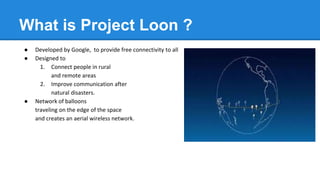
● Developed by Google, to provide free connectivity to all
● Designed to
1. Connect people in rural
and remote areas
2. Improve communication after
natural disasters.
● Network of balloons
traveling on the edge of the space
and creates an aerial wireless network.
History
● Initially everyone thought it as a prank by Google
● Unofficial development of the project began in 2011
● The project was officially announced as a Google project on 14 June 2013.
● Pilot Tests were conducted in 2013
Pilot Tests
● On 16 June 2013, A pilot experiment happened in New Zealand’s South Island.
● About 30 balloons were launched.
● After this initial trial, Google plans on sending up 300 balloons around the world at the 40th parallel
south that would provide coverage to New Zealand, Australia, Chile, and Argentina.
● In May-June 2014 Google tested in Brazil.
Balloon launching (launched in New Zealand)
How Loon Moves
● Project Loon balloons float in the stratosphere at an
altitude of about 20 km, twice as high as airplanes
and the weather.
● In the stratosphere, there are many layers of wind,
and each layer of wind varies in direction and speed.
● Loon balloons are directed by rising or descending
into a layer of wind blowing in the desired direction
of travel.
● Loon balloons designated to stay up for more
than 100 days.
● Each balloon is equipped with a GPS for tracking its location.
● Project Loon has complex software to determine
where its balloons need to go, then moves each one
into a layer of wind blowing in the right direction.
● By moving with the wind, the balloons can be arranged
to form one large communication network.
How Loon Moves
Why Stratosphere ?
Stratosphere:
● Situated on the edge of space, between 10km and 60 km
in altitude.
● Having steady winds below 20 mph.
● This sphere is great for solar panels because there
are no clouds to block the sun.
Loon Design
Main components in loon design:
● Envelope
● Solar Panels
● Electronics
Loon Design
Envelope
Solar Panels
Electronics
Balloon structure
● The inflatable part of the balloon is called envelope.
● Height : 12m
Width: 15m
Material: Polyethylene plastic
● The envelope is designed to handle exposure to UV rays,
dramatic temperature swings as low as -80°C.
ENVELOPE
12 m
15 m
ENVELOPE
● Balloons are super pressured and filled with helium gas.
● A well-made polyethylene plastic balloon envelope is critical for allowing a balloon to last around 100
days in the stratosphere.
● A parachute attached to the top of the envelope, used for bringing down the balloon safely.
● Each balloon’s solar panels provides power to its electronics.
● The solar array is made of flexible plastic laminate supported by
a light-weight aluminum frame.
● It uses high efficiency monocrystalline solar cells.
SOLAR PANELS
SOLAR PANELS
● The solar panels is mounted at a steep angle to effectively
captures sunlight.
● The panels produce approximately 100 Watts of power in full sun
for 4 hrs, that power is sufficient to keep Loon’s electronics
running 24 hrs a day.
● A small electronics box hangs underneath the inflated envelope.
● This box contains circuit boards, Linux-based computer, radio antenna, GPS, Sensors, and batteries.
1. Circuit boards that control the system.
2. Radio antenna on one balloon to communicate
with other balloons and with Internet antennas
on the ground.
1. GPS for tracking location.
2. Sensors to monitor and record weather conditions.
3. Lithium ion batteries to store solar power.
ELECTRONICS
How Loon Connects
● Each balloon has an radio antenna that provides connectivity to the ground and connects each balloon
to other balloon.
● There is a special antenna that is installed on the ground
to access the internet from balloon.
● Each balloon can provide signal connectivity to a ground area
about 40 km in diameter at speeds comparable to 3G(up to 10 Mbps).
● These antennas uses ISM bands of spectrum 2.4 GHz & 5.8 GHz.
ISM Bands
● ISM Bands: Industrial, Scientific and Medical (ISM) Radio Bands
o 2.4 & 5.8 Ghz bands
● These radio bands (portions of the radio spectrum) reserved internationally for industrial, scientific and
medical purposes other than telecommunications.
How Loon Connects
● There are two types of communications
1. balloon to balloon communication
2. balloon to ground communication.
● Mesh Network
o Balloons are connected in Mesh topology
o IEEE802.11s standard - defines how wireless devices form WLAN mesh network
● Loon’s protocol stack is not disclosed yet. As balloons following WLAN mesh architecture, supposedly
using IEEE802.11s.
How Loon Connects
Subscriber-to-ISP
20 km
10 km
ISP-to-Subscriber
● Internet Service Provider or Ground Network sends response back to Balloon network
● Data travels through the balloon network.
● Closest balloon to the Subscriber receives data and sends it back to the subscriber.
● Bring down Balloon
o A trigger mechanism on top would deflate it by releasing gas from the envelope
o Releases a parachute that brings the balloon down to the Earth in a controlled descent.
o GPS equipment tracks where the balloon is landing
o Google needs dedicated staff across the globe for balloon maintenance
Maintenance
● Google wants to build a network with no borders. Its biggest obstacle is not technology, Some countries
unwilling to give permission.
● In addition to permissions, Google should negotiate with countries to purchase or borrow specific radio
frequencies.
● There might be spying and security threat over data.
Challenges
Key People
● Rich DeVaul - Chief Technical Architect
● Mike Cassidy - Project Leader
● Cyrus Behroozi - Networking and Telecommunication Lead
Pros and Cons
Pros
● Easy to use and install antennas.
● Moderate internet speed for free
● Increases internet usage
● No extra ground infrastructure required
● Relatively cheaper equipment
Cons
● Maintenance
● Limited internet speed
● Balloons can work 100 days only.
Competing Ideas
● Facebook’s Drones
o more coverage area per drone.
o more internet speed.
o can stay up in the air for years ( ~5 yrs).
o expensive equipment.
o could do a lot of damage if it fails and fell out of the sky.
References
● Loon for all http://www.google.com/loon/
● Project Loon http://ipnsig.org/wp-content/uploads/2014/02/Project-Loon.pdf
● Origin’s of Project Loon http://www.ietf.org/mail-archive/web/gaia/current/msg00068.html
● Google Launches Balloons In The Hopes Of Extending Internet Service http://why.knovel.com/all-engineering-news/2545-google-launches-
balloons-in-the-hopes-of-extending-internet-service.html
● ISM BAND http://www.princeton.edu/~achaney/tmve/wiki100k/docs/ISM_band.html
● Google Project Loon - What is it? http://www.lifengadget.com/lifengadget/googles-project-loon/
● A Survey of Balloon Networking Applications and Technologies http://www.cse.wustl.edu/~jain/cse570-13/ftp/balloonn.pdf
● Project Loon https://www.youtube.com/user/ProjectLoon
● Project Loon: Google’s biggest obstacle isn’t technology. It’s politics http://gigaom.com/2013/06/21/project-loon-googles-biggest-obstacle-isnt-
technology-its-politics/
● How Google Will Use High-Flying Balloons to Deliver Internet to the Hinterlands
http://www.wired.com/2013/06/google_internet_balloons/all/google.com/loon#slideid-175682
● Google's balloons versus Facebook's drones: http://www.theverge.com/2014/3/7/5473692/facebook-drone-titan-aerospace-project-loon
Thank You

Project loon

  • 1.
  • 3.
    Contents ● Introduction ● History ●Loon Design ● How loon moves ● How it connects ● Pros and Cons
  • 4.
    What is ProjectLoon ? ● Developed by Google, to provide free connectivity to all ● Designed to 1. Connect people in rural and remote areas 2. Improve communication after natural disasters. ● Network of balloons traveling on the edge of the space and creates an aerial wireless network.
  • 5.
    History ● Initially everyonethought it as a prank by Google ● Unofficial development of the project began in 2011 ● The project was officially announced as a Google project on 14 June 2013. ● Pilot Tests were conducted in 2013
  • 6.
    Pilot Tests ● On16 June 2013, A pilot experiment happened in New Zealand’s South Island. ● About 30 balloons were launched. ● After this initial trial, Google plans on sending up 300 balloons around the world at the 40th parallel south that would provide coverage to New Zealand, Australia, Chile, and Argentina. ● In May-June 2014 Google tested in Brazil.
  • 7.
  • 8.
    How Loon Moves ●Project Loon balloons float in the stratosphere at an altitude of about 20 km, twice as high as airplanes and the weather. ● In the stratosphere, there are many layers of wind, and each layer of wind varies in direction and speed. ● Loon balloons are directed by rising or descending into a layer of wind blowing in the desired direction of travel. ● Loon balloons designated to stay up for more than 100 days.
  • 9.
    ● Each balloonis equipped with a GPS for tracking its location. ● Project Loon has complex software to determine where its balloons need to go, then moves each one into a layer of wind blowing in the right direction. ● By moving with the wind, the balloons can be arranged to form one large communication network. How Loon Moves
  • 10.
    Why Stratosphere ? Stratosphere: ●Situated on the edge of space, between 10km and 60 km in altitude. ● Having steady winds below 20 mph. ● This sphere is great for solar panels because there are no clouds to block the sun.
  • 11.
    Loon Design Main componentsin loon design: ● Envelope ● Solar Panels ● Electronics
  • 12.
  • 13.
  • 14.
    ● The inflatablepart of the balloon is called envelope. ● Height : 12m Width: 15m Material: Polyethylene plastic ● The envelope is designed to handle exposure to UV rays, dramatic temperature swings as low as -80°C. ENVELOPE 12 m 15 m
  • 15.
    ENVELOPE ● Balloons aresuper pressured and filled with helium gas. ● A well-made polyethylene plastic balloon envelope is critical for allowing a balloon to last around 100 days in the stratosphere. ● A parachute attached to the top of the envelope, used for bringing down the balloon safely.
  • 16.
    ● Each balloon’ssolar panels provides power to its electronics. ● The solar array is made of flexible plastic laminate supported by a light-weight aluminum frame. ● It uses high efficiency monocrystalline solar cells. SOLAR PANELS
  • 17.
    SOLAR PANELS ● Thesolar panels is mounted at a steep angle to effectively captures sunlight. ● The panels produce approximately 100 Watts of power in full sun for 4 hrs, that power is sufficient to keep Loon’s electronics running 24 hrs a day.
  • 18.
    ● A smallelectronics box hangs underneath the inflated envelope. ● This box contains circuit boards, Linux-based computer, radio antenna, GPS, Sensors, and batteries. 1. Circuit boards that control the system. 2. Radio antenna on one balloon to communicate with other balloons and with Internet antennas on the ground. 1. GPS for tracking location. 2. Sensors to monitor and record weather conditions. 3. Lithium ion batteries to store solar power. ELECTRONICS
  • 19.
    How Loon Connects ●Each balloon has an radio antenna that provides connectivity to the ground and connects each balloon to other balloon. ● There is a special antenna that is installed on the ground to access the internet from balloon. ● Each balloon can provide signal connectivity to a ground area about 40 km in diameter at speeds comparable to 3G(up to 10 Mbps). ● These antennas uses ISM bands of spectrum 2.4 GHz & 5.8 GHz.
  • 20.
    ISM Bands ● ISMBands: Industrial, Scientific and Medical (ISM) Radio Bands o 2.4 & 5.8 Ghz bands ● These radio bands (portions of the radio spectrum) reserved internationally for industrial, scientific and medical purposes other than telecommunications.
  • 21.
    How Loon Connects ●There are two types of communications 1. balloon to balloon communication 2. balloon to ground communication. ● Mesh Network o Balloons are connected in Mesh topology o IEEE802.11s standard - defines how wireless devices form WLAN mesh network ● Loon’s protocol stack is not disclosed yet. As balloons following WLAN mesh architecture, supposedly using IEEE802.11s.
  • 22.
  • 23.
  • 24.
    ISP-to-Subscriber ● Internet ServiceProvider or Ground Network sends response back to Balloon network ● Data travels through the balloon network. ● Closest balloon to the Subscriber receives data and sends it back to the subscriber.
  • 25.
    ● Bring downBalloon o A trigger mechanism on top would deflate it by releasing gas from the envelope o Releases a parachute that brings the balloon down to the Earth in a controlled descent. o GPS equipment tracks where the balloon is landing o Google needs dedicated staff across the globe for balloon maintenance Maintenance
  • 26.
    ● Google wantsto build a network with no borders. Its biggest obstacle is not technology, Some countries unwilling to give permission. ● In addition to permissions, Google should negotiate with countries to purchase or borrow specific radio frequencies. ● There might be spying and security threat over data. Challenges
  • 27.
    Key People ● RichDeVaul - Chief Technical Architect ● Mike Cassidy - Project Leader ● Cyrus Behroozi - Networking and Telecommunication Lead
  • 28.
    Pros and Cons Pros ●Easy to use and install antennas. ● Moderate internet speed for free ● Increases internet usage ● No extra ground infrastructure required ● Relatively cheaper equipment Cons ● Maintenance ● Limited internet speed ● Balloons can work 100 days only.
  • 29.
    Competing Ideas ● Facebook’sDrones o more coverage area per drone. o more internet speed. o can stay up in the air for years ( ~5 yrs). o expensive equipment. o could do a lot of damage if it fails and fell out of the sky.
  • 30.
    References ● Loon forall http://www.google.com/loon/ ● Project Loon http://ipnsig.org/wp-content/uploads/2014/02/Project-Loon.pdf ● Origin’s of Project Loon http://www.ietf.org/mail-archive/web/gaia/current/msg00068.html ● Google Launches Balloons In The Hopes Of Extending Internet Service http://why.knovel.com/all-engineering-news/2545-google-launches- balloons-in-the-hopes-of-extending-internet-service.html ● ISM BAND http://www.princeton.edu/~achaney/tmve/wiki100k/docs/ISM_band.html ● Google Project Loon - What is it? http://www.lifengadget.com/lifengadget/googles-project-loon/ ● A Survey of Balloon Networking Applications and Technologies http://www.cse.wustl.edu/~jain/cse570-13/ftp/balloonn.pdf ● Project Loon https://www.youtube.com/user/ProjectLoon ● Project Loon: Google’s biggest obstacle isn’t technology. It’s politics http://gigaom.com/2013/06/21/project-loon-googles-biggest-obstacle-isnt- technology-its-politics/ ● How Google Will Use High-Flying Balloons to Deliver Internet to the Hinterlands http://www.wired.com/2013/06/google_internet_balloons/all/google.com/loon#slideid-175682 ● Google's balloons versus Facebook's drones: http://www.theverge.com/2014/3/7/5473692/facebook-drone-titan-aerospace-project-loon
  • 31.