-By hArEee
SREE VIDYANIKETHAN INSTITUTE
OF MANAGEMENT
Presentation
on Googl’s project Loon
~ Narahari N Royal
2nd MCA
narahari.neeli@gmail.com
Contents:
Introduction
Abbreviations
History
Technology
How Loon Designed
How Loon Works/Moves
How Loon Connects
Maintenance
Challenges
Pros & Cons
 Reception and Reviews
Conclusion
Introduction :
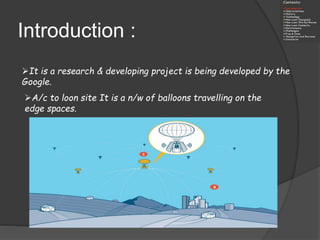
It is a research & developing project is being developed by the
Google.
A/c to loon site It is a n/w of balloons travelling on the
edge spaces.
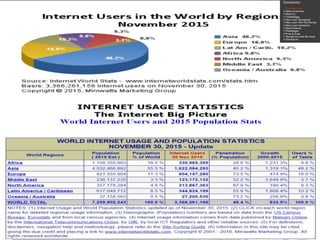
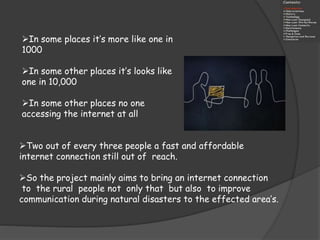
In some places it’s more like one in
1000
In some other places it’s looks like
one in 10,000
In some other places no one
accessing the internet at all
Two out of every three people a fast and affordable
internet connection still out of reach.
So the project mainly aims to bring an internet connection
to the rural people not only that but also to improve
communication during natural disasters to the effected area’s.
Key people
involved in this
project are
-Cyrus Behroozi
(networking &
telecommunication
lead.)
-Rich Devalue
(chief technical
architect),
Abbreviations:
NOAA - National Oceanic and Atmospheric
Administration
GPS - Global Positioning System
UV rays - Ultraviolet rays
IEEE - Electronics and Electrical Engineering
ISP - Internet Service Provider
History :
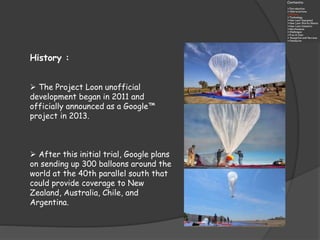
 The Project Loon unofficial
development began in 2011 and
officially announced as a Google™
project in 2013.
 After this initial trial, Google plans
on sending up 300 balloons around the
world at the 40th parallel south that
could provide coverage to New
Zealand, Australia, Chile, and
Argentina.
Technology :
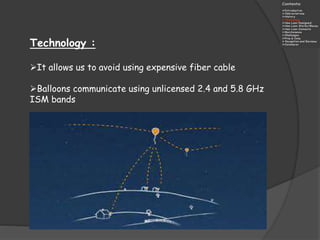
It allows us to avoid using expensive fiber cable
Balloons communicate using unlicensed 2.4 and 5.8 GHz
ISM bands
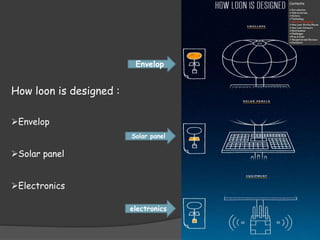
How loon is designed :
Envelop
Solar panel
Electronics
Envelop
Solar panel
electronics
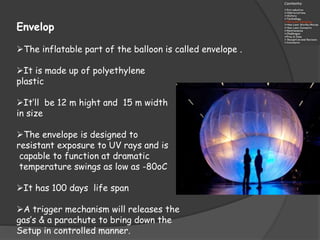
Envelop
The inflatable part of the balloon is called envelope .
It is made up of polyethylene
plastic
It‘ll be 12 m hight and 15 m width
in size
The envelope is designed to
resistant exposure to UV rays and is
capable to function at dramatic
temperature swings as low as -80oC
It has 100 days life span
A trigger mechanism will releases the
gas’s & a parachute to bring down the
Setup in controlled manner.
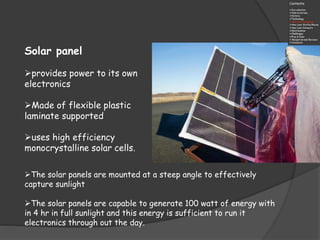
Solar panel
provides power to its own
electronics
Made of flexible plastic
laminate supported
uses high efficiency
monocrystalline solar cells.
The solar panels are mounted at a steep angle to effectively
capture sunlight
The solar panels are capable to generate 100 watt of energy with
in 4 hr in full sunlight and this energy is sufficient to run it
electronics through out the day.
Electronics:
A electronic box consist of circuit boards, Linux-based
computer, radio antenna, GPS, sensors, and batteries
Circuit boards to control the system
 Radio antenna for communication
 GPS for tracking location
 Sensors to monitor and record weather conditions
 Lithium ion batteries to store solar power
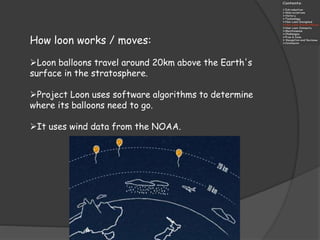
How loon works / moves:
Loon balloons travel around 20km above the Earth's
surface in the stratosphere.
Project Loon uses software algorithms to determine
where its balloons need to go.
It uses wind data from the NOAA.
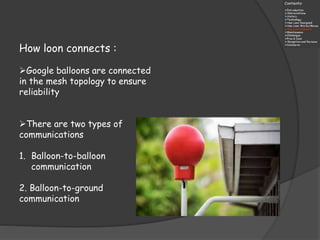
How loon connects :
Google balloons are connected
in the mesh topology to ensure
reliability
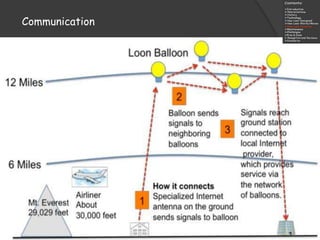
There are two types of
communications
1. Balloon-to-balloon
communication
2. Balloon-to-ground
communication
Communication
Pros:
will provide the Internet for free
equipment is relatively cheap.
Ground antennas are easy to use and install
No extra underground infrastructure is required
Cons:
limited internet speed.
Balloons can work 100 days only.
 the hardware failures cannot be reached at the intended
location.
 If a Loon balloon fails it’ll be a problem
Comment:
Bill Gates-
Gates said that loons can play a big
role in rural and remote areas of Africa
because Peoples are suffering from Disease
like Malaria so they can get help and Discuss
with Doctor by Internet.
Glitch -
20 kilometers up? Wow, they must
have one hell of a coverage footprint! Clearly
this solution isn't actually intended for
high-density populations...
Pushka Gib’an:-
I think it’s a wonderful idea ~ the internet its such an
amazing commodity – knowledge is power.
TulsaDavid:-
Nice thing is Google has just as much or more money to do
good, than those do who would thwart good…
Conclusion:
There is near about 75% comment is in the favor of project loons.
so far as I think it would be great Success of this Project in
Future. And we hope balloons could become an option for
connecting rural, remote, and underserved areas, and for helping
with communications after natural disasters.
It may be very helpful in the Areas of. . . .
Information
Education
Medicine
Collaboration
Thank’s for all
-hArEee
Project loon

Project loon

  • 1.
  • 2.
    SREE VIDYANIKETHAN INSTITUTE OFMANAGEMENT Presentation on Googl’s project Loon ~ Narahari N Royal 2nd MCA narahari.neeli@gmail.com
  • 3.
    Contents: Introduction Abbreviations History Technology How Loon Designed HowLoon Works/Moves How Loon Connects Maintenance Challenges Pros & Cons  Reception and Reviews Conclusion
  • 4.
    Introduction : It isa research & developing project is being developed by the Google. A/c to loon site It is a n/w of balloons travelling on the edge spaces.
  • 6.
    In some placesit’s more like one in 1000 In some other places it’s looks like one in 10,000 In some other places no one accessing the internet at all Two out of every three people a fast and affordable internet connection still out of reach. So the project mainly aims to bring an internet connection to the rural people not only that but also to improve communication during natural disasters to the effected area’s.
  • 7.
    Key people involved inthis project are -Cyrus Behroozi (networking & telecommunication lead.) -Rich Devalue (chief technical architect),
  • 8.
    Abbreviations: NOAA - NationalOceanic and Atmospheric Administration GPS - Global Positioning System UV rays - Ultraviolet rays IEEE - Electronics and Electrical Engineering ISP - Internet Service Provider
  • 9.
    History :  TheProject Loon unofficial development began in 2011 and officially announced as a Google™ project in 2013.  After this initial trial, Google plans on sending up 300 balloons around the world at the 40th parallel south that could provide coverage to New Zealand, Australia, Chile, and Argentina.
  • 10.
    Technology : It allowsus to avoid using expensive fiber cable Balloons communicate using unlicensed 2.4 and 5.8 GHz ISM bands
  • 11.
    How loon isdesigned : Envelop Solar panel Electronics Envelop Solar panel electronics
  • 12.
    Envelop The inflatable partof the balloon is called envelope . It is made up of polyethylene plastic It‘ll be 12 m hight and 15 m width in size The envelope is designed to resistant exposure to UV rays and is capable to function at dramatic temperature swings as low as -80oC It has 100 days life span A trigger mechanism will releases the gas’s & a parachute to bring down the Setup in controlled manner.
  • 13.
    Solar panel provides powerto its own electronics Made of flexible plastic laminate supported uses high efficiency monocrystalline solar cells. The solar panels are mounted at a steep angle to effectively capture sunlight The solar panels are capable to generate 100 watt of energy with in 4 hr in full sunlight and this energy is sufficient to run it electronics through out the day.
  • 14.
    Electronics: A electronic boxconsist of circuit boards, Linux-based computer, radio antenna, GPS, sensors, and batteries Circuit boards to control the system  Radio antenna for communication  GPS for tracking location  Sensors to monitor and record weather conditions  Lithium ion batteries to store solar power
  • 15.
    How loon works/ moves: Loon balloons travel around 20km above the Earth's surface in the stratosphere. Project Loon uses software algorithms to determine where its balloons need to go. It uses wind data from the NOAA.
  • 16.
    How loon connects: Google balloons are connected in the mesh topology to ensure reliability There are two types of communications 1. Balloon-to-balloon communication 2. Balloon-to-ground communication
  • 17.
  • 19.
    Pros: will provide theInternet for free equipment is relatively cheap. Ground antennas are easy to use and install No extra underground infrastructure is required Cons: limited internet speed. Balloons can work 100 days only.  the hardware failures cannot be reached at the intended location.  If a Loon balloon fails it’ll be a problem
  • 20.
    Comment: Bill Gates- Gates saidthat loons can play a big role in rural and remote areas of Africa because Peoples are suffering from Disease like Malaria so they can get help and Discuss with Doctor by Internet. Glitch - 20 kilometers up? Wow, they must have one hell of a coverage footprint! Clearly this solution isn't actually intended for high-density populations... Pushka Gib’an:- I think it’s a wonderful idea ~ the internet its such an amazing commodity – knowledge is power. TulsaDavid:- Nice thing is Google has just as much or more money to do good, than those do who would thwart good…
  • 21.
    Conclusion: There is nearabout 75% comment is in the favor of project loons. so far as I think it would be great Success of this Project in Future. And we hope balloons could become an option for connecting rural, remote, and underserved areas, and for helping with communications after natural disasters. It may be very helpful in the Areas of. . . . Information Education Medicine Collaboration
  • 22.