PROJECT LOON
- by Google
Presented by:
Manasa Bandari 15BSP0661
Nitish Bisht 15BSP0781
Rohit Sawant 15BSP1029
Shiney George 15BSP1917
Utkarsh Kadel 15BSP1395
What is Project Loon ?
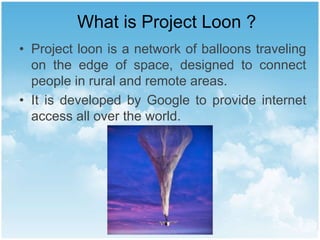
• Project loon is a network of balloons traveling
on the edge of space, designed to connect
people in rural and remote areas.
• It is developed by Google to provide internet
access all over the world.
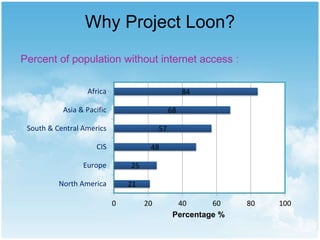
Why Project Loon?
21
25
48
57
68
84
0 20 40 60 80 100
North America
Europe
CIS
South & Central Americs
Asia & Pacific
Africa
Percentage %
Percent of population without internet access :
The Technology
• Project loon balloons float in the stratosphere, twice
as high as airplanes and weather.
• They are carried around the Earth by winds and
they can be steered by rising or descending to
altitude with winds moving in the desired direction.
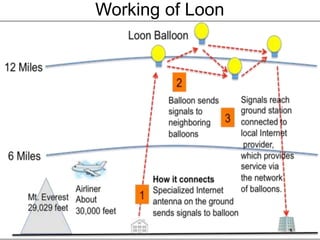
• People connect to the balloon network using a
special internet antenna attached to their building.
• The signal bounces from balloon to balloon , then
to the global internet back on Earth.
Design of Loon
• Envelops are made from sheets of polyethylene
plastic, and they measure fifteen meters wide by
twelve meters tall when fully inflated.
• Solar Panels are used to power the equipment's in
the balloon.
• Equipment's -Radio antennas to communicate with
other balloons and with Internet antennas on the
ground. And lithium ion batteries to store solar
power so the balloons can operate throughout the
night.
How Loon Connects
• Each balloon can provide connectivity to a ground areas
about 40 km in diameter at speeds comparable to 3G.
• Each balloon is equipped with a GPS for tracking its location.
• Three radio transceivers are:-
-Balloon-to-balloon communications.
-Balloon-to-ground communications.
-Third for back up.
• Project Loon currently uses ISM bands that are available for
anyone to use.
Working of Loon
Current Progress
• Project Loon began in June 2013 with an
experimental pilot in New Zealand, where a
small group of Project Loon pioneers tested
Loon technology
• The results of the pilot test, as well as
subsequent tests in New Zealand, California’s
Central Valley and in Northeast Brazil, are
being used to improve the technology in
preparation for the next stages of the project.
Advantages
• Easy to use.
• Internet Speed is good.
• Increasing the Internet Usage.
• Cost is low compared to satellites.
Disadvantages
• Maintenance is required periodically.
• Balloon can work for few weeks only (100
days).
Bibliography
• Prof. Raj Jain, “A Survey of Balloon Networking
Applications and Technologies”,
http://www.cse.wustl.edu/~jain/cse570-
13/ftp/balloonn.pdf
• http://www.google.com/loon/
• http://en.wikipedia.org/wiki/Projectloon
Thank You…!!!

Project loon of google

  • 1.
    PROJECT LOON - byGoogle Presented by: Manasa Bandari 15BSP0661 Nitish Bisht 15BSP0781 Rohit Sawant 15BSP1029 Shiney George 15BSP1917 Utkarsh Kadel 15BSP1395
  • 2.
    What is ProjectLoon ? • Project loon is a network of balloons traveling on the edge of space, designed to connect people in rural and remote areas. • It is developed by Google to provide internet access all over the world.
  • 3.
    Why Project Loon? 21 25 48 57 68 84 020 40 60 80 100 North America Europe CIS South & Central Americs Asia & Pacific Africa Percentage % Percent of population without internet access :
  • 4.
    The Technology • Projectloon balloons float in the stratosphere, twice as high as airplanes and weather. • They are carried around the Earth by winds and they can be steered by rising or descending to altitude with winds moving in the desired direction. • People connect to the balloon network using a special internet antenna attached to their building. • The signal bounces from balloon to balloon , then to the global internet back on Earth.
  • 5.
    Design of Loon •Envelops are made from sheets of polyethylene plastic, and they measure fifteen meters wide by twelve meters tall when fully inflated. • Solar Panels are used to power the equipment's in the balloon. • Equipment's -Radio antennas to communicate with other balloons and with Internet antennas on the ground. And lithium ion batteries to store solar power so the balloons can operate throughout the night.
  • 6.
    How Loon Connects •Each balloon can provide connectivity to a ground areas about 40 km in diameter at speeds comparable to 3G. • Each balloon is equipped with a GPS for tracking its location. • Three radio transceivers are:- -Balloon-to-balloon communications. -Balloon-to-ground communications. -Third for back up. • Project Loon currently uses ISM bands that are available for anyone to use.
  • 7.
  • 8.
    Current Progress • ProjectLoon began in June 2013 with an experimental pilot in New Zealand, where a small group of Project Loon pioneers tested Loon technology • The results of the pilot test, as well as subsequent tests in New Zealand, California’s Central Valley and in Northeast Brazil, are being used to improve the technology in preparation for the next stages of the project.
  • 9.
    Advantages • Easy touse. • Internet Speed is good. • Increasing the Internet Usage. • Cost is low compared to satellites. Disadvantages • Maintenance is required periodically. • Balloon can work for few weeks only (100 days).
  • 10.
    Bibliography • Prof. RajJain, “A Survey of Balloon Networking Applications and Technologies”, http://www.cse.wustl.edu/~jain/cse570- 13/ftp/balloonn.pdf • http://www.google.com/loon/ • http://en.wikipedia.org/wiki/Projectloon
  • 11.