BALOON POWERED INTERNET FOR ALL 
Seminar by, 
Rosche Raymond, 
S7 EC, 
12. 
Guided by, 
Mr. Vijay Moni Varghese, 
Assistant Professor, 
Dept. of ECE, BJI
WHAT IS PROJECT LOON? 
Many of us think of the Internet as a global 
community. But two-thirds of the world’s population 
does not yet have Internet access. Project Loon is a 
network of balloons traveling on the edge of space, 
designed to connect people in rural and remote 
areas, help fill coverage gaps, and bring people back 
online after disasters.
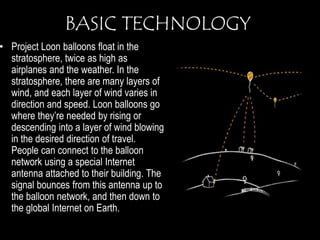
BASIC TECHNOLOGY 
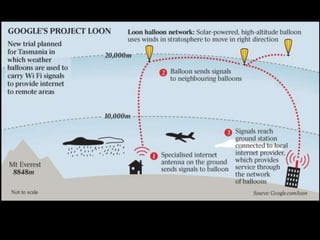
• Project Loon balloons float in the 
stratosphere, twice as high as 
airplanes and the weather. In the 
stratosphere, there are many layers of 
wind, and each layer of wind varies in 
direction and speed. Loon balloons go 
where they’re needed by rising or 
descending into a layer of wind blowing 
in the desired direction of travel. 
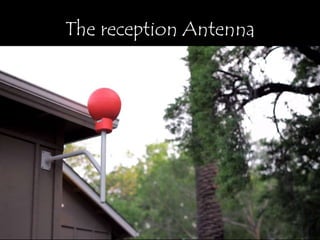
People can connect to the balloon 
network using a special Internet 
antenna attached to their building. The 
signal bounces from this antenna up to 
the balloon network, and then down to 
the global Internet on Earth.
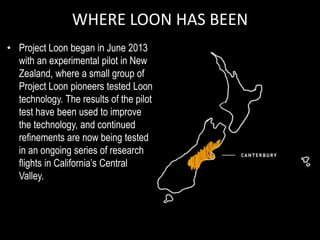
WHERE LOON HAS BEEN 
• Project Loon began in June 2013 
with an experimental pilot in New 
Zealand, where a small group of 
Project Loon pioneers tested Loon 
technology. The results of the pilot 
test have been used to improve 
the technology, and continued 
refinements are now being tested 
in an ongoing series of research 
flights in California’s Central 
Valley.
HOW LOON FLIES 
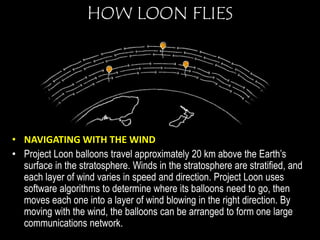
• NAVIGATING WITH THE WIND 
• Project Loon balloons travel approximately 20 km above the Earth’s 
surface in the stratosphere. Winds in the stratosphere are stratified, and 
each layer of wind varies in speed and direction. Project Loon uses 
software algorithms to determine where its balloons need to go, then 
moves each one into a layer of wind blowing in the right direction. By 
moving with the wind, the balloons can be arranged to form one large 
communications network.
HOW LOON FLIES 
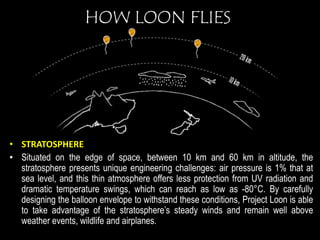
• STRATOSPHERE 
• Situated on the edge of space, between 10 km and 60 km in altitude, the 
stratosphere presents unique engineering challenges: air pressure is 1% that at 
sea level, and this thin atmosphere offers less protection from UV radiation and 
dramatic temperature swings, which can reach as low as -80°C. By carefully 
designing the balloon envelope to withstand these conditions, Project Loon is able 
to take advantage of the stratosphere’s steady winds and remain well above 
weather events, wildlife and airplanes.
HOW LOON IS DESIGNED 
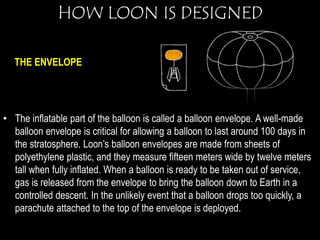
THE ENVELOPE 
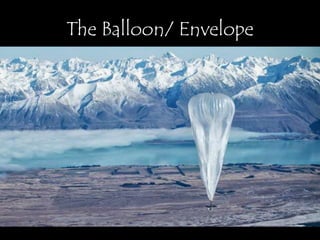
• The inflatable part of the balloon is called a balloon envelope. A well-made 
balloon envelope is critical for allowing a balloon to last around 100 days in 
the stratosphere. Loon’s balloon envelopes are made from sheets of 
polyethylene plastic, and they measure fifteen meters wide by twelve meters 
tall when fully inflated. When a balloon is ready to be taken out of service, 
gas is released from the envelope to bring the balloon down to Earth in a 
controlled descent. In the unlikely event that a balloon drops too quickly, a 
parachute attached to the top of the envelope is deployed.
The Balloon/ Envelope
SOLAR PANELS 
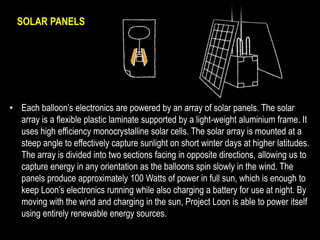
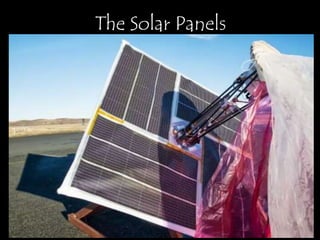
• Each balloon’s electronics are powered by an array of solar panels. The solar 
array is a flexible plastic laminate supported by a light-weight aluminium frame. It 
uses high efficiency monocrystalline solar cells. The solar array is mounted at a 
steep angle to effectively capture sunlight on short winter days at higher latitudes. 
The array is divided into two sections facing in opposite directions, allowing us to 
capture energy in any orientation as the balloons spin slowly in the wind. The 
panels produce approximately 100 Watts of power in full sun, which is enough to 
keep Loon’s electronics running while also charging a battery for use at night. By 
moving with the wind and charging in the sun, Project Loon is able to power itself 
using entirely renewable energy sources.
The Solar Panels
ELECTRONICS 
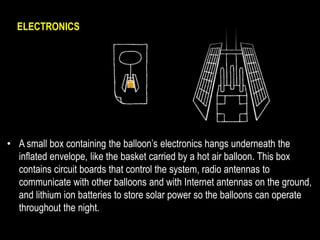
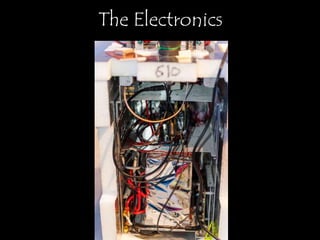
• A small box containing the balloon’s electronics hangs underneath the 
inflated envelope, like the basket carried by a hot air balloon. This box 
contains circuit boards that control the system, radio antennas to 
communicate with other balloons and with Internet antennas on the ground, 
and lithium ion batteries to store solar power so the balloons can operate 
throughout the night.
The Electronics
HOW LOON CONNECTS 
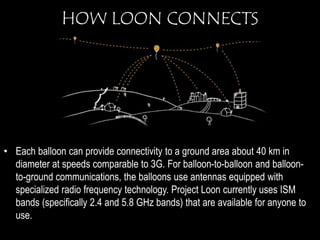
• Each balloon can provide connectivity to a ground area about 40 km in 
diameter at speeds comparable to 3G. For balloon-to-balloon and balloon-to- 
ground communications, the balloons use antennas equipped with 
specialized radio frequency technology. Project Loon currently uses ISM 
bands (specifically 2.4 and 5.8 GHz bands) that are available for anyone to 
use.
The reception Antenna
WHERE LOON IS GOING 
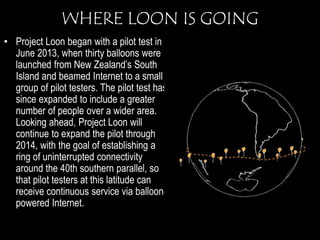
• Project Loon began with a pilot test in 
June 2013, when thirty balloons were 
launched from New Zealand’s South 
Island and beamed Internet to a small 
group of pilot testers. The pilot test has 
since expanded to include a greater 
number of people over a wider area. 
Looking ahead, Project Loon will 
continue to expand the pilot through 
2014, with the goal of establishing a 
ring of uninterrupted connectivity 
around the 40th southern parallel, so 
that pilot testers at this latitude can 
receive continuous service via balloon-powered 
Internet.
Conclusion 
• The main aim of Googles’ LOON FOR ALL project is to provide 
cheap efficient Internet access to the remote areas of the world 
where Internet facilities are at a minimum due to the high cost of 
Underlying Optic fibre cables to get connected to the internet. 
• By this lots of Homes, schools, local business enterprises and all can 
be connected to the worldwide network and can join hands in the 
growing up and development process. 
• This project can not only used to transmit and receive internet datas, 
but can also used in the weather field and can also used to collect 
information about the area on which they are transmitting or receiving 
on.
REFERENCES 
Googles official site for their Project 
google.com/loon 
Wikipedia 
en.wikipedia.org/wiki/Project_Loon
THANK YOU
HavE a NiCe DAy

Project loon

  • 1.
    BALOON POWERED INTERNETFOR ALL Seminar by, Rosche Raymond, S7 EC, 12. Guided by, Mr. Vijay Moni Varghese, Assistant Professor, Dept. of ECE, BJI
  • 2.
    WHAT IS PROJECTLOON? Many of us think of the Internet as a global community. But two-thirds of the world’s population does not yet have Internet access. Project Loon is a network of balloons traveling on the edge of space, designed to connect people in rural and remote areas, help fill coverage gaps, and bring people back online after disasters.
  • 3.
    BASIC TECHNOLOGY •Project Loon balloons float in the stratosphere, twice as high as airplanes and the weather. In the stratosphere, there are many layers of wind, and each layer of wind varies in direction and speed. Loon balloons go where they’re needed by rising or descending into a layer of wind blowing in the desired direction of travel. People can connect to the balloon network using a special Internet antenna attached to their building. The signal bounces from this antenna up to the balloon network, and then down to the global Internet on Earth.
  • 5.
    WHERE LOON HASBEEN • Project Loon began in June 2013 with an experimental pilot in New Zealand, where a small group of Project Loon pioneers tested Loon technology. The results of the pilot test have been used to improve the technology, and continued refinements are now being tested in an ongoing series of research flights in California’s Central Valley.
  • 6.
    HOW LOON FLIES • NAVIGATING WITH THE WIND • Project Loon balloons travel approximately 20 km above the Earth’s surface in the stratosphere. Winds in the stratosphere are stratified, and each layer of wind varies in speed and direction. Project Loon uses software algorithms to determine where its balloons need to go, then moves each one into a layer of wind blowing in the right direction. By moving with the wind, the balloons can be arranged to form one large communications network.
  • 7.
    HOW LOON FLIES • STRATOSPHERE • Situated on the edge of space, between 10 km and 60 km in altitude, the stratosphere presents unique engineering challenges: air pressure is 1% that at sea level, and this thin atmosphere offers less protection from UV radiation and dramatic temperature swings, which can reach as low as -80°C. By carefully designing the balloon envelope to withstand these conditions, Project Loon is able to take advantage of the stratosphere’s steady winds and remain well above weather events, wildlife and airplanes.
  • 8.
    HOW LOON ISDESIGNED THE ENVELOPE • The inflatable part of the balloon is called a balloon envelope. A well-made balloon envelope is critical for allowing a balloon to last around 100 days in the stratosphere. Loon’s balloon envelopes are made from sheets of polyethylene plastic, and they measure fifteen meters wide by twelve meters tall when fully inflated. When a balloon is ready to be taken out of service, gas is released from the envelope to bring the balloon down to Earth in a controlled descent. In the unlikely event that a balloon drops too quickly, a parachute attached to the top of the envelope is deployed.
  • 9.
  • 10.
    SOLAR PANELS •Each balloon’s electronics are powered by an array of solar panels. The solar array is a flexible plastic laminate supported by a light-weight aluminium frame. It uses high efficiency monocrystalline solar cells. The solar array is mounted at a steep angle to effectively capture sunlight on short winter days at higher latitudes. The array is divided into two sections facing in opposite directions, allowing us to capture energy in any orientation as the balloons spin slowly in the wind. The panels produce approximately 100 Watts of power in full sun, which is enough to keep Loon’s electronics running while also charging a battery for use at night. By moving with the wind and charging in the sun, Project Loon is able to power itself using entirely renewable energy sources.
  • 11.
  • 12.
    ELECTRONICS • Asmall box containing the balloon’s electronics hangs underneath the inflated envelope, like the basket carried by a hot air balloon. This box contains circuit boards that control the system, radio antennas to communicate with other balloons and with Internet antennas on the ground, and lithium ion batteries to store solar power so the balloons can operate throughout the night.
  • 13.
  • 14.
    HOW LOON CONNECTS • Each balloon can provide connectivity to a ground area about 40 km in diameter at speeds comparable to 3G. For balloon-to-balloon and balloon-to- ground communications, the balloons use antennas equipped with specialized radio frequency technology. Project Loon currently uses ISM bands (specifically 2.4 and 5.8 GHz bands) that are available for anyone to use.
  • 15.
  • 16.
    WHERE LOON ISGOING • Project Loon began with a pilot test in June 2013, when thirty balloons were launched from New Zealand’s South Island and beamed Internet to a small group of pilot testers. The pilot test has since expanded to include a greater number of people over a wider area. Looking ahead, Project Loon will continue to expand the pilot through 2014, with the goal of establishing a ring of uninterrupted connectivity around the 40th southern parallel, so that pilot testers at this latitude can receive continuous service via balloon-powered Internet.
  • 17.
    Conclusion • Themain aim of Googles’ LOON FOR ALL project is to provide cheap efficient Internet access to the remote areas of the world where Internet facilities are at a minimum due to the high cost of Underlying Optic fibre cables to get connected to the internet. • By this lots of Homes, schools, local business enterprises and all can be connected to the worldwide network and can join hands in the growing up and development process. • This project can not only used to transmit and receive internet datas, but can also used in the weather field and can also used to collect information about the area on which they are transmitting or receiving on.
  • 18.
    REFERENCES Googles officialsite for their Project google.com/loon Wikipedia en.wikipedia.org/wiki/Project_Loon
  • 19.
  • 20.