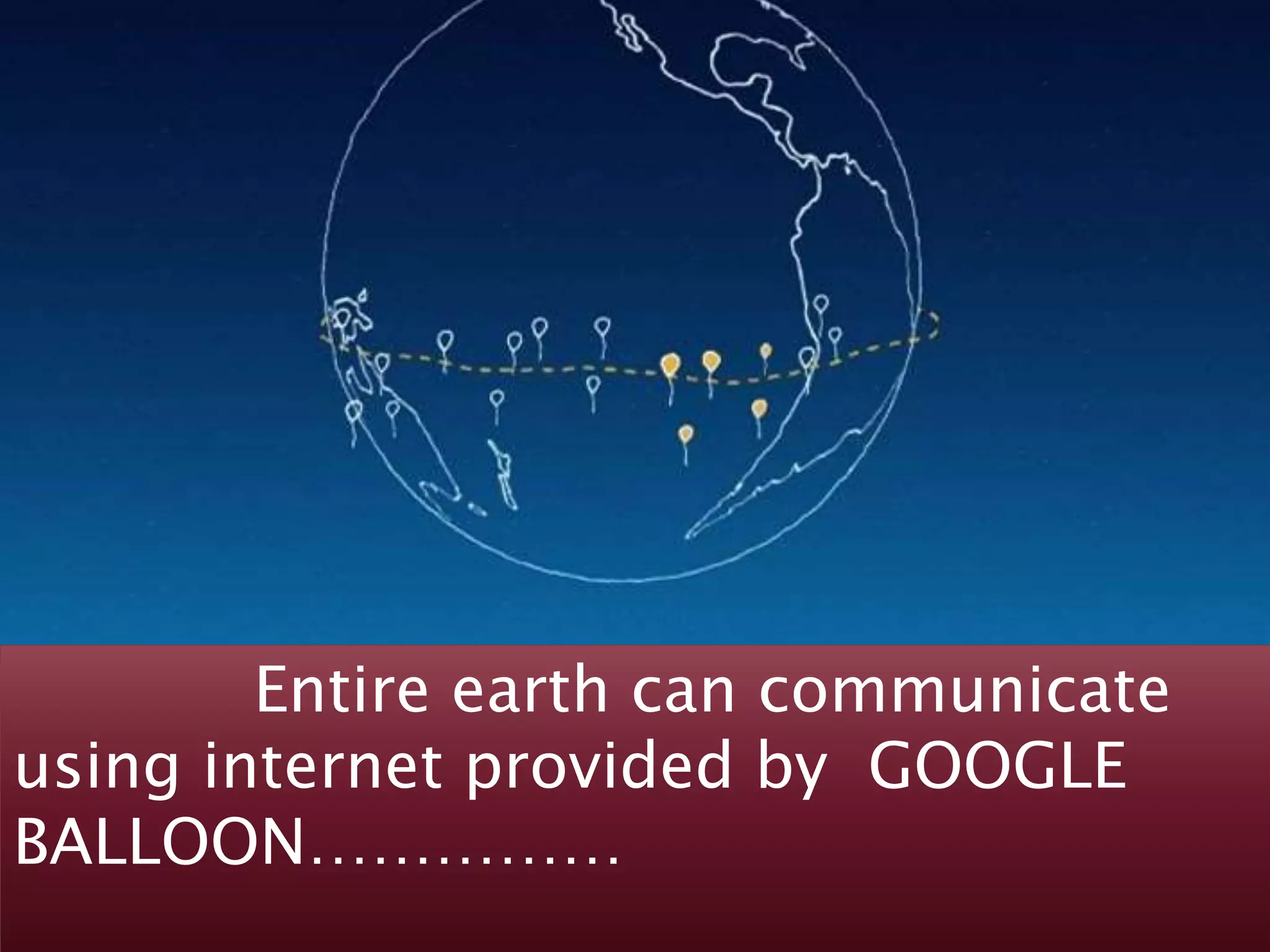
Entire earth can communicate 
using internet provided by GOOGLE 
BALLOON……………
BALLOON 
Presented by- 
Himani Gupta 
Priyanka Gupta
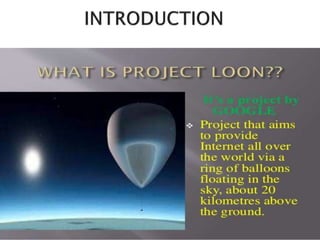
 INTRODUCTION 
 PILOT TEST 
 TECHNOLOGY 
 LOON MOVES 
 LOON DESIGN 
 LOON CONNECTS 
 ISM BANDS 
 ADVANTAGE 
 DISADVANTAGE 
 CONCLUSION
Why Project Loon ? 
Many of us think of 
the internet as the 
global community . 
But two_third of the 
world ‘ s population 
does not yet have the 
internet access .
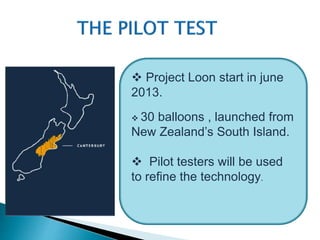
 Project Loon start in june 
2013. 
 30 balloons , launched from 
New Zealand’s South Island. 
 Pilot testers will be used 
to refine the technology.
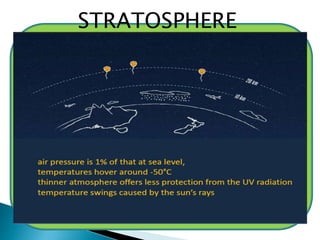
Project Loon balloons float in the stratosphere as twice as 
high as airplanes and the weather. 
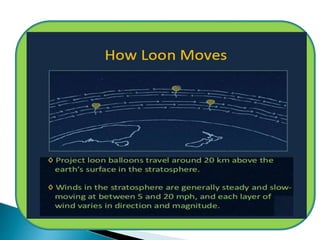
They are carried around the Earth by winds and they can be 
steered by rising or descending to an altitude with winds 
moving in the desired direction. 
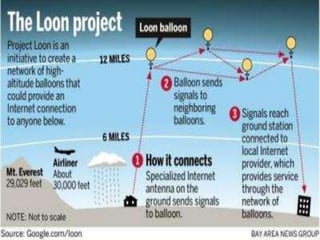
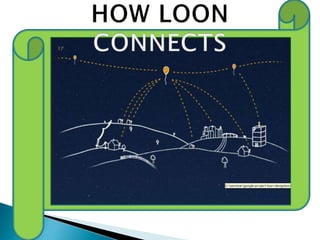
People connect to the balloon network using a special internet 
antenna attached to their building. 
The signal bounces from balloons to balloons then to the 
global internet back on earth.
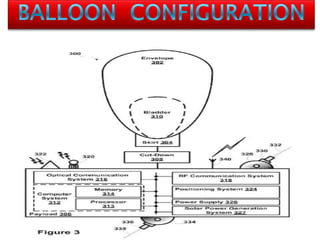
STRATOSPHERE
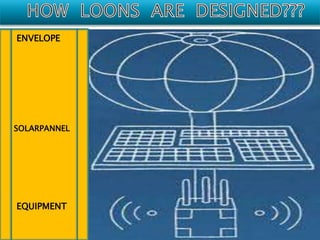
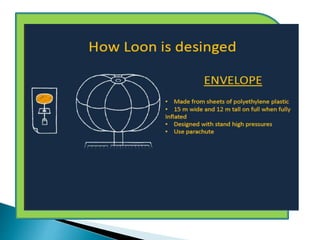
ENVELOPE 
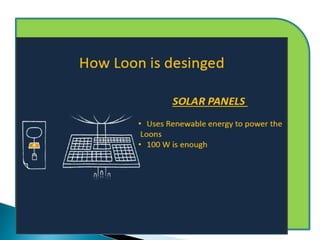
SOLARPANNEL 
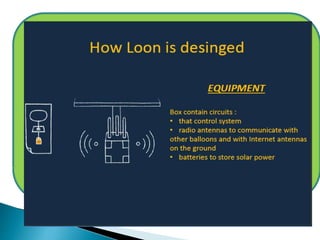
EQUIPMENT
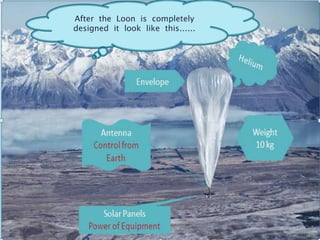
After the Loon is completely 
designed it look like this……
 Each balloon is equipped with a GPS 
for tracking its location . 
 Each balloon can provide 
connectivity to a ground area about 40 
km in diameter at speeds comparable 
to 3G.
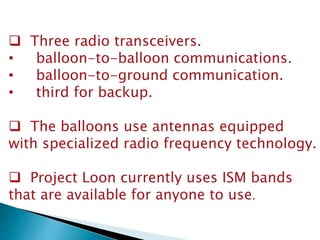
 Three radio transceivers. 
• balloon-to-balloon communications. 
• balloon-to-ground communication. 
• third for backup. 
 The balloons use antennas equipped 
with specialized radio frequency technology. 
 Project Loon currently uses ISM bands 
that are available for anyone to use.
 The industrial, scientific and medical (ISM) 
radio bands . 
 Radio bands reserved internationally for 
the use of radio frequency (RF) energy for 
industrial, scientific and medical purposes 
other than communications.
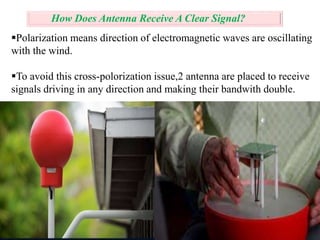
How Does Antenna Receive A Clear Signal? 
Polarization means direction of electromagnetic waves are oscillating 
with the wind. 
To avoid this cross-polorization issue,2 antenna are placed to receive 
signals driving in any direction and making their bandwith double.
ADVANTAGES 
• Lower cost 
• Availability of information 
• Education and health 
• Use of Renewable Energy 
• Weather Surveillance
DISADVANTAGES 
• Hardware Failure 
• Internet privacy 
• Not a Replacement of Satellite Communication 
• Cost 
• Maintenance
GOOGLE BALLOON
GOOGLE BALLOON
GOOGLE BALLOON

GOOGLE BALLOON

  • 1.
    Entire earth cancommunicate using internet provided by GOOGLE BALLOON……………
  • 2.
    BALLOON Presented by- Himani Gupta Priyanka Gupta
  • 3.
     INTRODUCTION PILOT TEST  TECHNOLOGY  LOON MOVES  LOON DESIGN  LOON CONNECTS  ISM BANDS  ADVANTAGE  DISADVANTAGE  CONCLUSION
  • 5.
    Why Project Loon? Many of us think of the internet as the global community . But two_third of the world ‘ s population does not yet have the internet access .
  • 6.
     Project Loonstart in june 2013.  30 balloons , launched from New Zealand’s South Island.  Pilot testers will be used to refine the technology.
  • 7.
    Project Loon balloonsfloat in the stratosphere as twice as high as airplanes and the weather. They are carried around the Earth by winds and they can be steered by rising or descending to an altitude with winds moving in the desired direction. People connect to the balloon network using a special internet antenna attached to their building. The signal bounces from balloons to balloons then to the global internet back on earth.
  • 9.
  • 11.
  • 15.
    After the Loonis completely designed it look like this……
  • 16.
     Each balloonis equipped with a GPS for tracking its location .  Each balloon can provide connectivity to a ground area about 40 km in diameter at speeds comparable to 3G.
  • 18.
     Three radiotransceivers. • balloon-to-balloon communications. • balloon-to-ground communication. • third for backup.  The balloons use antennas equipped with specialized radio frequency technology.  Project Loon currently uses ISM bands that are available for anyone to use.
  • 20.
     The industrial,scientific and medical (ISM) radio bands .  Radio bands reserved internationally for the use of radio frequency (RF) energy for industrial, scientific and medical purposes other than communications.
  • 21.
    How Does AntennaReceive A Clear Signal? Polarization means direction of electromagnetic waves are oscillating with the wind. To avoid this cross-polorization issue,2 antenna are placed to receive signals driving in any direction and making their bandwith double.
  • 22.
    ADVANTAGES • Lowercost • Availability of information • Education and health • Use of Renewable Energy • Weather Surveillance
  • 23.
    DISADVANTAGES • HardwareFailure • Internet privacy • Not a Replacement of Satellite Communication • Cost • Maintenance