By
Krishnajith S S
R Gopi Sankar
1. Introduction:
2. Global Internet Usage
3. What Is Google Project Loon?
4. Where’s the Loon?
5. Stratosphere
6. Why Stratosphere?
7. How Do Project Loon Move In Stratosphere?
8. How Is Loon Designed?
• Envelope
• Solar Panels
• Electronic Equipments
9. How Loon Connects?
10. Reception of Loon services
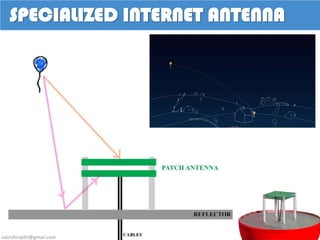
11. Specialized Internet antenna
12. Ism Bands?
13. How Will The Balloons Descend?
14. Conclusion
sskrishnajith@gmail.com
‘Project Loon’ is a development project by Google to provide
Internet access with an affordable rate worldwide.
2/3 of the world population does not yet have Internet access.
REASON: Scarcity of intensive capital necessary for Internet
infrastructure.
Easier for a service provider to recover the equipment cost in areas
of high population density.
Even though there are more than 1 billion smart phone subscribers
in the world, the majority of them still don’t have data access due
to the costly data plan in many countries.
sskrishnajith@gmail.com
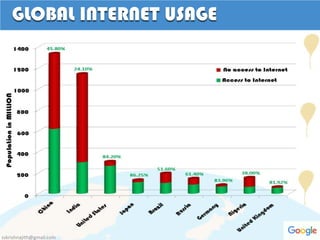
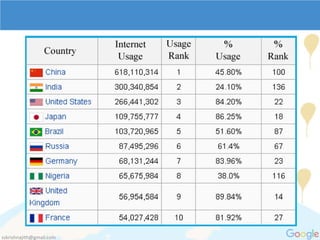
GLOBAL INTERNET USAGE
sskrishnajith@gmail.com
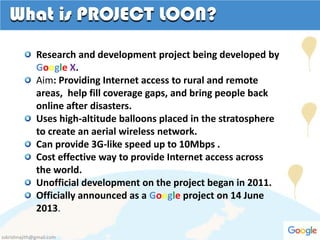
What is PROJECT LOON?
Research and development project being developed by
Google X.
Aim: Providing Internet access to rural and remote
areas, help fill coverage gaps, and bring people back
online after disasters.
Uses high-altitude balloons placed in the stratosphere
to create an aerial wireless network.
Can provide 3G-like speed up to 10Mbps .
Cost effective way to provide Internet access across
the world.
Unofficial development on the project began in 2011.
Officially announced as a Google project on 14 June
2013.
sskrishnajith@gmail.com
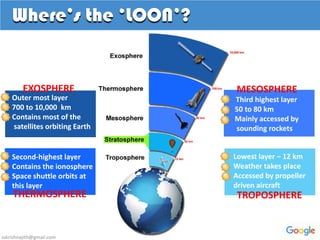
Where’s the ‘LOON’?
Outer most layer
700 to 10,000 km
Contains most of the
satellites orbiting Earth
EXOSPHERE
Second-highest layer
Contains the ionosphere
Space shuttle orbits at
this layer
THERMOSPHERE
Third highest layer
50 to 80 km
Mainly accessed by
sounding rockets
MESOSPHERE
Lowest layer – 12 km
Weather takes place
Accessed by propeller
driven aircraft
TROPOSPHERE
sskrishnajith@gmail.com
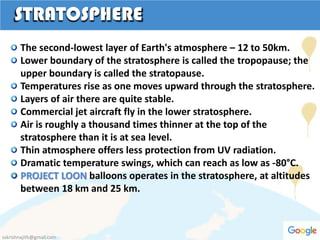
STRATOSPHERE
The second-lowest layer of Earth's atmosphere – 12 to 50km.
Lower boundary of the stratosphere is called the tropopause; the
upper boundary is called the stratopause.
Temperatures rise as one moves upward through the stratosphere.
Layers of air there are quite stable.
Commercial jet aircraft fly in the lower stratosphere.
Air is roughly a thousand times thinner at the top of the
stratosphere than it is at sea level.
Thin atmosphere offers less protection from UV radiation.
Dramatic temperature swings, which can reach as low as -80°C.
PROJECT LOON balloons operates in the stratosphere, at altitudes
between 18 km and 25 km.
sskrishnajith@gmail.com
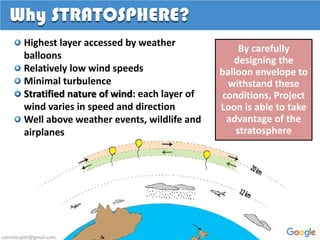
Why STRATOSPHERE?
Highest layer accessed by weather
balloons
Relatively low wind speeds
Minimal turbulence
Stratified nature of wind: each layer of
wind varies in speed and direction
Well above weather events, wildlife and
airplanes
By carefully
designing the
balloon envelope to
withstand these
conditions, Project
Loon is able to take
advantage of the
stratosphere
sskrishnajith@gmail.com
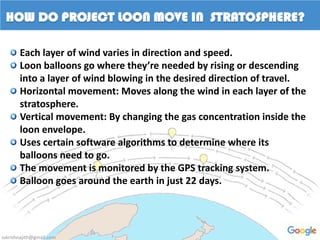
HOW DO PROJECT LOON MOVE IN STRATOSPHERE?
Each layer of wind varies in direction and speed.
Loon balloons go where they’re needed by rising or descending
into a layer of wind blowing in the desired direction of travel.
Horizontal movement: Moves along the wind in each layer of the
stratosphere.
Vertical movement: By changing the gas concentration inside the
loon envelope.
Uses certain software algorithms to determine where its
balloons need to go.
The movement is monitored by the GPS tracking system.
Balloon goes around the earth in just 22 days.
sskrishnajith@gmail.com
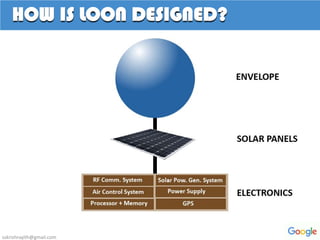
HOW IS LOON DESIGNED?
sskrishnajith@gmail.com
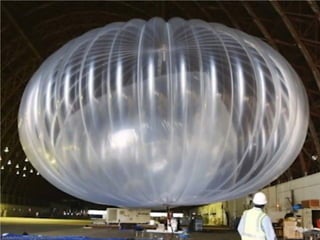
Inflatable part of the balloon
Made from sheets of polyethylene
plastic[0.076 mm thick]
It strongly keeps from stretching
& popping at even high altitude
Measure 15m wide by 12m tall
when fully inflated
Inside envelope, there is another
chamber, called bladder
A parachute attached to the top of
the envelope
ENVELOPE
sskrishnajith@gmail.com
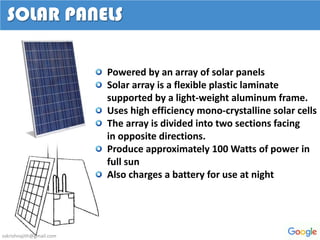
Powered by an array of solar panels
Solar array is a flexible plastic laminate
supported by a light-weight aluminum frame.
Uses high efficiency mono-crystalline solar cells
The array is divided into two sections facing
in opposite directions.
Produce approximately 100 Watts of power in
full sun
Also charges a battery for use at night
SOLAR PANELS
sskrishnajith@gmail.com
ELECTRONICS
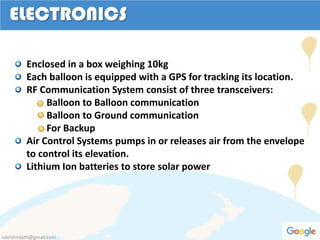
Enclosed in a box weighing 10kg
Each balloon is equipped with a GPS for tracking its location.
RF Communication System consist of three transceivers:
Balloon to Balloon communication
Balloon to Ground communication
For Backup
Air Control Systems pumps in or releases air from the envelope
to control its elevation.
Lithium Ion batteries to store solar power
sskrishnajith@gmail.com
HOW LOON CONNECTS?
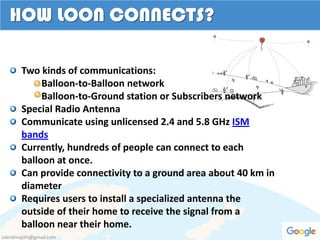
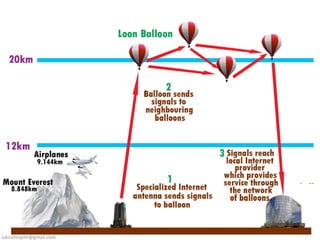
Two kinds of communications:
Balloon-to-Balloon network
Balloon-to-Ground station or Subscribers network
Special Radio Antenna
Communicate using unlicensed 2.4 and 5.8 GHz ISM
bands
Currently, hundreds of people can connect to each
balloon at once.
Can provide connectivity to a ground area about 40 km in
diameter
Requires users to install a specialized antenna the
outside of their home to receive the signal from a
balloon near their home.
sskrishnajith@gmail.com
RECEPTION OF LOON SERVICES
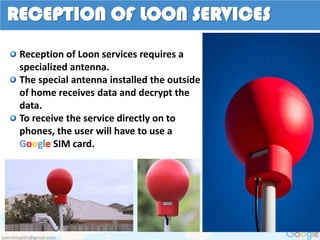
Reception of Loon services requires a
specialized antenna.
The special antenna installed the outside
of home receives data and decrypt the
data.
To receive the service directly on to
phones, the user will have to use a
Google SIM card.
sskrishnajith@gmail.com
SPECIALIZED INTERNET ANTENNA
sskrishnajith@gmail.com
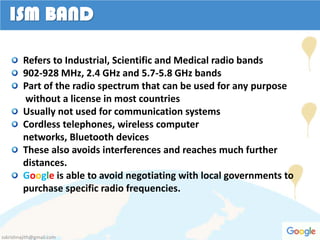
ISM BAND
Refers to Industrial, Scientific and Medical radio bands
902-928 MHz, 2.4 GHz and 5.7-5.8 GHz bands
Part of the radio spectrum that can be used for any purpose
without a license in most countries
Usually not used for communication systems
Cordless telephones, wireless computer
networks, Bluetooth devices
These also avoids interferences and reaches much further
distances.
Google is able to avoid negotiating with local governments to
purchase specific radio frequencies.
sskrishnajith@gmail.com
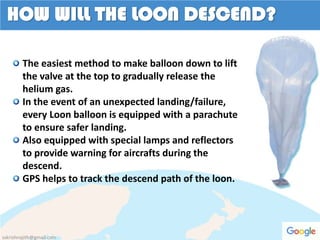
HOW WILL THE LOON DESCEND?
The easiest method to make balloon down to lift
the valve at the top to gradually release the
helium gas.
In the event of an unexpected landing/failure,
every Loon balloon is equipped with a parachute
to ensure safer landing.
Also equipped with special lamps and reflectors
to provide warning for aircrafts during the
descend.
GPS helps to track the descend path of the loon.
sskrishnajith@gmail.com
ADVANTAGES
Provide Internet to rural &
disaster hit areas
Cheaper data rates
Cheaper infrastructure
Faster & Efficient connection
Secure data
DISADVANTAGES
Shorter life
Requires continuous
monitoring
CONCLUSION
Google has successfully tested Project Loon in New Zealand and
Brazil.
The Project Loon will be implemented as a commercial project
in 2016.
sskrishnajith@gmail.com

Project loon

  • 1.
  • 2.
    1. Introduction: 2. GlobalInternet Usage 3. What Is Google Project Loon? 4. Where’s the Loon? 5. Stratosphere 6. Why Stratosphere? 7. How Do Project Loon Move In Stratosphere? 8. How Is Loon Designed? • Envelope • Solar Panels • Electronic Equipments 9. How Loon Connects? 10. Reception of Loon services 11. Specialized Internet antenna 12. Ism Bands? 13. How Will The Balloons Descend? 14. Conclusion sskrishnajith@gmail.com
  • 3.
    ‘Project Loon’ isa development project by Google to provide Internet access with an affordable rate worldwide. 2/3 of the world population does not yet have Internet access. REASON: Scarcity of intensive capital necessary for Internet infrastructure. Easier for a service provider to recover the equipment cost in areas of high population density. Even though there are more than 1 billion smart phone subscribers in the world, the majority of them still don’t have data access due to the costly data plan in many countries. sskrishnajith@gmail.com
  • 4.
  • 5.
  • 6.
    What is PROJECTLOON? Research and development project being developed by Google X. Aim: Providing Internet access to rural and remote areas, help fill coverage gaps, and bring people back online after disasters. Uses high-altitude balloons placed in the stratosphere to create an aerial wireless network. Can provide 3G-like speed up to 10Mbps . Cost effective way to provide Internet access across the world. Unofficial development on the project began in 2011. Officially announced as a Google project on 14 June 2013. sskrishnajith@gmail.com
  • 7.
    Where’s the ‘LOON’? Outermost layer 700 to 10,000 km Contains most of the satellites orbiting Earth EXOSPHERE Second-highest layer Contains the ionosphere Space shuttle orbits at this layer THERMOSPHERE Third highest layer 50 to 80 km Mainly accessed by sounding rockets MESOSPHERE Lowest layer – 12 km Weather takes place Accessed by propeller driven aircraft TROPOSPHERE sskrishnajith@gmail.com
  • 8.
    STRATOSPHERE The second-lowest layerof Earth's atmosphere – 12 to 50km. Lower boundary of the stratosphere is called the tropopause; the upper boundary is called the stratopause. Temperatures rise as one moves upward through the stratosphere. Layers of air there are quite stable. Commercial jet aircraft fly in the lower stratosphere. Air is roughly a thousand times thinner at the top of the stratosphere than it is at sea level. Thin atmosphere offers less protection from UV radiation. Dramatic temperature swings, which can reach as low as -80°C. PROJECT LOON balloons operates in the stratosphere, at altitudes between 18 km and 25 km. sskrishnajith@gmail.com
  • 9.
    Why STRATOSPHERE? Highest layeraccessed by weather balloons Relatively low wind speeds Minimal turbulence Stratified nature of wind: each layer of wind varies in speed and direction Well above weather events, wildlife and airplanes By carefully designing the balloon envelope to withstand these conditions, Project Loon is able to take advantage of the stratosphere sskrishnajith@gmail.com
  • 10.
    HOW DO PROJECTLOON MOVE IN STRATOSPHERE? Each layer of wind varies in direction and speed. Loon balloons go where they’re needed by rising or descending into a layer of wind blowing in the desired direction of travel. Horizontal movement: Moves along the wind in each layer of the stratosphere. Vertical movement: By changing the gas concentration inside the loon envelope. Uses certain software algorithms to determine where its balloons need to go. The movement is monitored by the GPS tracking system. Balloon goes around the earth in just 22 days. sskrishnajith@gmail.com
  • 11.
    HOW IS LOONDESIGNED? sskrishnajith@gmail.com
  • 12.
    Inflatable part ofthe balloon Made from sheets of polyethylene plastic[0.076 mm thick] It strongly keeps from stretching & popping at even high altitude Measure 15m wide by 12m tall when fully inflated Inside envelope, there is another chamber, called bladder A parachute attached to the top of the envelope ENVELOPE sskrishnajith@gmail.com
  • 13.
  • 14.
    Powered by anarray of solar panels Solar array is a flexible plastic laminate supported by a light-weight aluminum frame. Uses high efficiency mono-crystalline solar cells The array is divided into two sections facing in opposite directions. Produce approximately 100 Watts of power in full sun Also charges a battery for use at night SOLAR PANELS sskrishnajith@gmail.com
  • 15.
    ELECTRONICS Enclosed in abox weighing 10kg Each balloon is equipped with a GPS for tracking its location. RF Communication System consist of three transceivers: Balloon to Balloon communication Balloon to Ground communication For Backup Air Control Systems pumps in or releases air from the envelope to control its elevation. Lithium Ion batteries to store solar power sskrishnajith@gmail.com
  • 16.
    HOW LOON CONNECTS? Twokinds of communications: Balloon-to-Balloon network Balloon-to-Ground station or Subscribers network Special Radio Antenna Communicate using unlicensed 2.4 and 5.8 GHz ISM bands Currently, hundreds of people can connect to each balloon at once. Can provide connectivity to a ground area about 40 km in diameter Requires users to install a specialized antenna the outside of their home to receive the signal from a balloon near their home. sskrishnajith@gmail.com
  • 17.
  • 18.
    RECEPTION OF LOONSERVICES Reception of Loon services requires a specialized antenna. The special antenna installed the outside of home receives data and decrypt the data. To receive the service directly on to phones, the user will have to use a Google SIM card. sskrishnajith@gmail.com
  • 19.
  • 20.
    ISM BAND Refers toIndustrial, Scientific and Medical radio bands 902-928 MHz, 2.4 GHz and 5.7-5.8 GHz bands Part of the radio spectrum that can be used for any purpose without a license in most countries Usually not used for communication systems Cordless telephones, wireless computer networks, Bluetooth devices These also avoids interferences and reaches much further distances. Google is able to avoid negotiating with local governments to purchase specific radio frequencies. sskrishnajith@gmail.com
  • 21.
    HOW WILL THELOON DESCEND? The easiest method to make balloon down to lift the valve at the top to gradually release the helium gas. In the event of an unexpected landing/failure, every Loon balloon is equipped with a parachute to ensure safer landing. Also equipped with special lamps and reflectors to provide warning for aircrafts during the descend. GPS helps to track the descend path of the loon. sskrishnajith@gmail.com
  • 22.
    ADVANTAGES Provide Internet torural & disaster hit areas Cheaper data rates Cheaper infrastructure Faster & Efficient connection Secure data DISADVANTAGES Shorter life Requires continuous monitoring CONCLUSION Google has successfully tested Project Loon in New Zealand and Brazil. The Project Loon will be implemented as a commercial project in 2016. sskrishnajith@gmail.com