Raval Sneh
MCA -3
Dept. of Computer Science
1
WHAT IS PROJECT LOON?
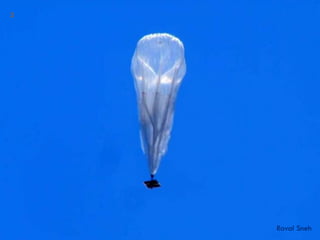
 Project Loon is a network of balloons
traveling on the edge of space, designed to
connect people in rural and remote areas.
Raval Sneh
2
Raval Sneh
3
THE PILOT TEST
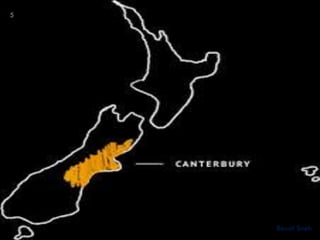
 Project Loon starts in June 2013 with an experimental pilot in
New Zealand. A small group of Project Loon pioneers will test
the technology in Christchurch and Canterbury.
 30 balloons, launched from New Zealand’s South Island.
 The experience of these pilot testers will be used to refine the
technology and shape the next phase of Project Loon.
Raval Sneh
4
Raval Sneh
5
THE TECHNOLOGY
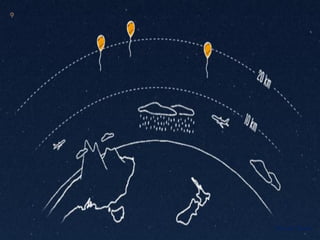
 Project Loon balloons float in the stratosphere, twice
as high as airplanes and the weather.
 They are carried around the Earth by winds and
they can be steered by rising or descending to an
altitude with winds moving in the desired direction.
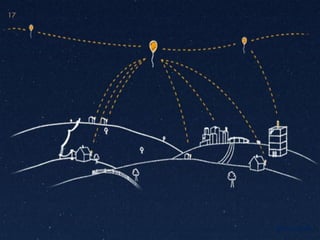
 People connect to the balloon network using a
special Internet antenna attached to their building.
 The signal bounces from balloon to balloon, then to
the global Internet back on Earth.
Raval Sneh
6
Stratosphere
 Situated between 10 km and 60 km altitude
on the edge of space.
 Air pressure is 1% of that at sea level.
 Thinner atmosphere offers less protection from
the UV radiation and temperature caused by
the sun’s rays.
Raval Sneh
7
HOW LOON MOVES
 Winds in the stratosphere are generally steady and
slow-moving at between 5 and 20 mph, and each
layer of wind varies in direction.
 Project Loon uses software algorithms to determine
where its balloons need to go, then moves each one
into a layer of wind blowing in the right direction.
 By moving with the wind, the balloons can be
arranged to form one large communications
network.
Raval Sneh
8
Raval Sneh
9
HOW LOON IS DESIGNED
 ENVELOPE
 SOLAR PANELS
 EQUIPMENT
Raval Sneh
10
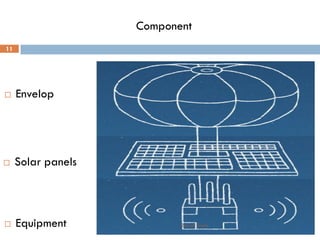
Component
 Solar panels
 Envelop
 Equipment Raval Sneh
11
ENVELOPE
 Project Loon’s balloon envelopes are made from
sheets of polyethylene plastic and stand fifteen meters
wide by twelve meters tall when fully inflated.
 A parachute attached to the top of the envelope
allows for a controlled descent and landing whenever
a balloon is ready to be taken out of service.
Raval Sneh
12
SOLAR PANELS
 Each unit’s electronics are powered by an array of solar
panels that sits between the envelope and the
hardware.
 In full sun, these panels produce 100 Watts of power -
enough to keep the unit running while also charging a
battery for use at night.
 By moving with the wind and charging in the sun,
Project Loon is able to power itself using only
renewable energy sources.
Raval Sneh
13
EQUIPMENT
 A small box containing the balloon’s electronic
equipment .
 This box contains circuit boards that control the system .
 Radio antennas to communicate with other balloons and
with Internet antennas on the ground .
 And batteries to store solar power so the balloons can
operate during the night .
Raval Sneh
14
HOW LOON CONNECTS
 Each balloon can provide connectivity to a
ground area about 40 km in diameter at
speeds comparable to 3G.
 Each balloon is equipped with a GPS for
tracking its location
Raval Sneh
15
HOW LOON CONNECTS
 Three radio transceivers.
 balloon-to-balloon communications.
 balloon-to-ground communication.
 third for backup.
 The balloons use antennas equipped with
specialized radio frequency technology.
 Project Loon currently uses ISM bands that are
available for anyone to use. Raval Sneh
16
Raval Sneh
17
ISM BANDS
 The industrial, scientific and medical (ISM) radio
bands .
 Radio bands reserved internationally for the use
of radio frequency (RF) energy for industrial,
scientific and medical purposes other than
communications.
Raval Sneh
18
Advantages
 Easy to use.
 Speed.
 Increasing Internet usage.
Raval Sneh
19
Disadvantages
 Cost.
 Maintenance.
 Balloon can work for few week only.
Raval Sneh
20
Raval Sneh
21
Bibliography
 http://www.google.com/loon/
 http://en.wikipedia.org/wiki/Projectloon
 http://www.youtube.com/googleloon
Raval Sneh
22
Raval Sneh
23
Raval Sneh
24
Thank You….

Project loon

  • 1.
    Raval Sneh MCA -3 Dept.of Computer Science 1
  • 2.
    WHAT IS PROJECTLOON?  Project Loon is a network of balloons traveling on the edge of space, designed to connect people in rural and remote areas. Raval Sneh 2
  • 3.
  • 4.
    THE PILOT TEST Project Loon starts in June 2013 with an experimental pilot in New Zealand. A small group of Project Loon pioneers will test the technology in Christchurch and Canterbury.  30 balloons, launched from New Zealand’s South Island.  The experience of these pilot testers will be used to refine the technology and shape the next phase of Project Loon. Raval Sneh 4
  • 5.
  • 6.
    THE TECHNOLOGY  ProjectLoon balloons float in the stratosphere, twice as high as airplanes and the weather.  They are carried around the Earth by winds and they can be steered by rising or descending to an altitude with winds moving in the desired direction.  People connect to the balloon network using a special Internet antenna attached to their building.  The signal bounces from balloon to balloon, then to the global Internet back on Earth. Raval Sneh 6
  • 7.
    Stratosphere  Situated between10 km and 60 km altitude on the edge of space.  Air pressure is 1% of that at sea level.  Thinner atmosphere offers less protection from the UV radiation and temperature caused by the sun’s rays. Raval Sneh 7
  • 8.
    HOW LOON MOVES Winds in the stratosphere are generally steady and slow-moving at between 5 and 20 mph, and each layer of wind varies in direction.  Project Loon uses software algorithms to determine where its balloons need to go, then moves each one into a layer of wind blowing in the right direction.  By moving with the wind, the balloons can be arranged to form one large communications network. Raval Sneh 8
  • 9.
  • 10.
    HOW LOON ISDESIGNED  ENVELOPE  SOLAR PANELS  EQUIPMENT Raval Sneh 10
  • 11.
    Component  Solar panels Envelop  Equipment Raval Sneh 11
  • 12.
    ENVELOPE  Project Loon’sballoon envelopes are made from sheets of polyethylene plastic and stand fifteen meters wide by twelve meters tall when fully inflated.  A parachute attached to the top of the envelope allows for a controlled descent and landing whenever a balloon is ready to be taken out of service. Raval Sneh 12
  • 13.
    SOLAR PANELS  Eachunit’s electronics are powered by an array of solar panels that sits between the envelope and the hardware.  In full sun, these panels produce 100 Watts of power - enough to keep the unit running while also charging a battery for use at night.  By moving with the wind and charging in the sun, Project Loon is able to power itself using only renewable energy sources. Raval Sneh 13
  • 14.
    EQUIPMENT  A smallbox containing the balloon’s electronic equipment .  This box contains circuit boards that control the system .  Radio antennas to communicate with other balloons and with Internet antennas on the ground .  And batteries to store solar power so the balloons can operate during the night . Raval Sneh 14
  • 15.
    HOW LOON CONNECTS Each balloon can provide connectivity to a ground area about 40 km in diameter at speeds comparable to 3G.  Each balloon is equipped with a GPS for tracking its location Raval Sneh 15
  • 16.
    HOW LOON CONNECTS Three radio transceivers.  balloon-to-balloon communications.  balloon-to-ground communication.  third for backup.  The balloons use antennas equipped with specialized radio frequency technology.  Project Loon currently uses ISM bands that are available for anyone to use. Raval Sneh 16
  • 17.
  • 18.
    ISM BANDS  Theindustrial, scientific and medical (ISM) radio bands .  Radio bands reserved internationally for the use of radio frequency (RF) energy for industrial, scientific and medical purposes other than communications. Raval Sneh 18
  • 19.
    Advantages  Easy touse.  Speed.  Increasing Internet usage. Raval Sneh 19
  • 20.
    Disadvantages  Cost.  Maintenance. Balloon can work for few week only. Raval Sneh 20
  • 21.
  • 22.
  • 23.
  • 24.