Google’s
Project Loon
Presented By :-
Rahul Das
CSE 4th Year
09215002712
Guided by :-
Mr. Sushil Kumar
Asst. Professor
Dept. of Computer Science
Introduction
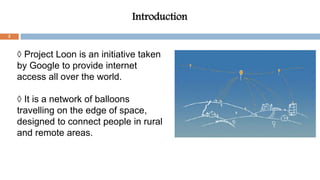
◊ Project Loon is an initiative taken
by Google to provide internet
access all over the world.
◊ It is a network of balloons
travelling on the edge of space,
designed to connect people in rural
and remote areas.
2
The Technology
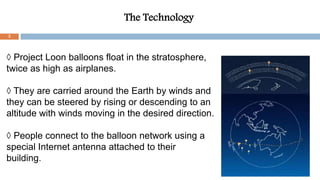
◊ Project Loon balloons float in the stratosphere,
twice as high as airplanes.
◊ They are carried around the Earth by winds and
they can be steered by rising or descending to an
altitude with winds moving in the desired direction.
◊ People connect to the balloon network using a
special Internet antenna attached to their
building.
3
History of Project Loon
4
◊ In 2008, Google considered contracting Space Data Corp, but didn't do so.
◊ In 2011, the unofficial development of the project began under Google X
Labs
◊ On 14 June 2013, Google announced this as an official project.
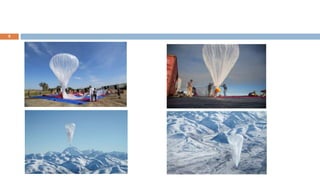
◊ On 16 June 2013, A pilot experiment happened in New Zealand and about
30 balloons were launched.
5
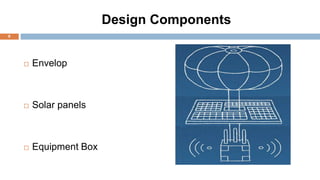
Design Components
 Envelop
 Solar panels
 Equipment Box
6
Envelope
7
 Material : Polyethylene Sheets
 Height : 40 feet
 Width : 50 feet
Solar Panel
8
 Each unit’s electronics are powered by an array of solar panels
that sits between the envelope and the hardware.
 In full sun, these panels produce 100 Watts of power - enough
to keep the unit running while also charging a battery for use at
night.
 This way Loon is able to power itself using only renewable
energy sources.
Equipments
9
 A box contains circuit boards that control the system .
 Radio antennas to communicate with other balloons and with
Internet antennas on the ground.
 Batteries are used to store solar power so the balloons can
operate during the night.
How Loon Moves ?
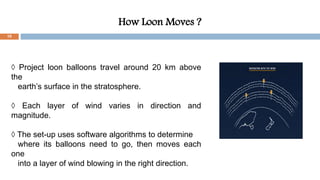
◊ Project loon balloons travel around 20 km above
the
earth’s surface in the stratosphere.
◊ Each layer of wind varies in direction and
magnitude.
◊ The set-up uses software algorithms to determine
where its balloons need to go, then moves each
one
into a layer of wind blowing in the right direction.
10
How Loon Connects ?
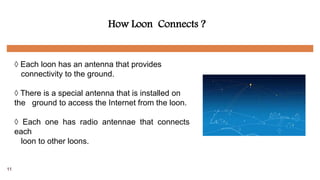
◊ Each loon has an antenna that provides
connectivity to the ground.
◊ There is a special antenna that is installed on
the ground to access the Internet from the loon.
◊ Each one has radio antennae that connects
each
loon to other loons.
11
Advantages
◊ Easy to use
◊ Speed comparable to 3G
◊ Use of Renewable Energy
13
Disadvantages
◊ Cost
◊ Maintenance is difficult
◊ Balloon can work for few weeks only
13
Applications
14
 It can improve communication during any disaster to affected
regions.
 Internet will be available at all places, even in Sahara Desert
 It can improve Internet usage in developing countries in region
such as Africa and Southeast Asia that can’t afford
underground fiber cable for providing internet connectivity.
Latest Trends
15
 Sri Lanka’s officials signed an agreement with Google to launch
the helium-filled, high-tech balloons over the country, making it
the first country in the world to have universal Internet
coverage.
 Google is gearing up to test 20 high-altitude balloons in north
Australia.
Conclusion
In this century, Google's new invention Project Loon provides a very valuable help
to poor people by accessing the internet facility.
With this, almost all people may get the ability to know the world of internet and
utilize this facility to overcome the barriers.
Project Loon is still in its development stage. If this is successful, this technology
can replace the currently existing networks.
16
References
 http://www.google.com/loon
 http://en.wikipedia.org/wiki/Projectloon
 https://plus.google.com/+ProjectLoon/photos/photo/58965199
0410874
 http://www.slideshare.net/google-internet-balloons
17
18
Any Queries?
ALPHABET'S(GOOGLE) Project Loon

ALPHABET'S(GOOGLE) Project Loon

  • 1.
    Google’s Project Loon Presented By:- Rahul Das CSE 4th Year 09215002712 Guided by :- Mr. Sushil Kumar Asst. Professor Dept. of Computer Science
  • 2.
    Introduction ◊ Project Loonis an initiative taken by Google to provide internet access all over the world. ◊ It is a network of balloons travelling on the edge of space, designed to connect people in rural and remote areas. 2
  • 3.
    The Technology ◊ ProjectLoon balloons float in the stratosphere, twice as high as airplanes. ◊ They are carried around the Earth by winds and they can be steered by rising or descending to an altitude with winds moving in the desired direction. ◊ People connect to the balloon network using a special Internet antenna attached to their building. 3
  • 4.
    History of ProjectLoon 4 ◊ In 2008, Google considered contracting Space Data Corp, but didn't do so. ◊ In 2011, the unofficial development of the project began under Google X Labs ◊ On 14 June 2013, Google announced this as an official project. ◊ On 16 June 2013, A pilot experiment happened in New Zealand and about 30 balloons were launched.
  • 5.
  • 6.
    Design Components  Envelop Solar panels  Equipment Box 6
  • 7.
    Envelope 7  Material :Polyethylene Sheets  Height : 40 feet  Width : 50 feet
  • 8.
    Solar Panel 8  Eachunit’s electronics are powered by an array of solar panels that sits between the envelope and the hardware.  In full sun, these panels produce 100 Watts of power - enough to keep the unit running while also charging a battery for use at night.  This way Loon is able to power itself using only renewable energy sources.
  • 9.
    Equipments 9  A boxcontains circuit boards that control the system .  Radio antennas to communicate with other balloons and with Internet antennas on the ground.  Batteries are used to store solar power so the balloons can operate during the night.
  • 10.
    How Loon Moves? ◊ Project loon balloons travel around 20 km above the earth’s surface in the stratosphere. ◊ Each layer of wind varies in direction and magnitude. ◊ The set-up uses software algorithms to determine where its balloons need to go, then moves each one into a layer of wind blowing in the right direction. 10
  • 11.
    How Loon Connects? ◊ Each loon has an antenna that provides connectivity to the ground. ◊ There is a special antenna that is installed on the ground to access the Internet from the loon. ◊ Each one has radio antennae that connects each loon to other loons. 11
  • 12.
    Advantages ◊ Easy touse ◊ Speed comparable to 3G ◊ Use of Renewable Energy
  • 13.
    13 Disadvantages ◊ Cost ◊ Maintenanceis difficult ◊ Balloon can work for few weeks only 13
  • 14.
    Applications 14  It canimprove communication during any disaster to affected regions.  Internet will be available at all places, even in Sahara Desert  It can improve Internet usage in developing countries in region such as Africa and Southeast Asia that can’t afford underground fiber cable for providing internet connectivity.
  • 15.
    Latest Trends 15  SriLanka’s officials signed an agreement with Google to launch the helium-filled, high-tech balloons over the country, making it the first country in the world to have universal Internet coverage.  Google is gearing up to test 20 high-altitude balloons in north Australia.
  • 16.
    Conclusion In this century,Google's new invention Project Loon provides a very valuable help to poor people by accessing the internet facility. With this, almost all people may get the ability to know the world of internet and utilize this facility to overcome the barriers. Project Loon is still in its development stage. If this is successful, this technology can replace the currently existing networks. 16
  • 17.
    References  http://www.google.com/loon  http://en.wikipedia.org/wiki/Projectloon https://plus.google.com/+ProjectLoon/photos/photo/58965199 0410874  http://www.slideshare.net/google-internet-balloons 17
  • 18.