BRANCHING
PROGRAMMING
SUBMITTED BY:
KANWARJEET KAUR NANGLI
M. ED SEMESTER IV
EDUCATION DEPARTMENT, GURU NANAK DEV
UNIVERSITY, AMRITSAR.
BRANCHING PROGRAMMING:
• In 1954, Norman Crowder, a psychologist with united state air
force was asked to investigate the training of aircraft
maintenance men. The technicians were being taught to
“trouble shoot” or repair faults, in a bomber navigation
system. And there lies the origin of branching programming.
EDUCATIONAL PERSPECTIVE OF BRANCHING
PROGRAMMING:
• After exposure to the programmed material, the student
has to discriminate a correct answer from the given
multiple- choice questions. This process is within the
learner. The major rationale fir the word “intrinsic” is that
the student’s response is controlled by himself internally.
PRINCIPLES OF BRANCHING PROGRAMME:
PRINCIPLE OF EXPOSION.
{Ex. The learner should perceive the whole phenomena exposed to him}.
PRINCIPLE OF DIAGNOSIS.
{Ex. It refers to identifying the weakness of learner.}
 PRINCIPLE OF REMEDIATION.
{Ex. Diagnosis provides the b asis for remediation or remedial
instructions.}
STRUCTURE OF BRANCHING PROGRAMME
FRAME:
• In this strategy, content is not presented in small steps but whole unit
or concept is presented.
• The size of step may be a paragraph or two or whole page.
• The learner perceives the whole concept and tries to comprehend.
• He has to follow the sequence pages.
• Therefore, branching programming text is know as SCRAMBLED
TEXT.
FEATURES OF BRANCHING
PROGRAMME:
• Material in a frame is larger; much information is presented at each
step. A step may consist of two or more paragraphs and sometimes
a full page.
• Learner has freedom to choose his own path of action according to
the background of the subject matter. The learner controls the
exact sequence that he will follow.
• Student is more alert and concentrates on the subject.
• The programmer has ample opportunity to exploit the literary
DEVELOPING BRANCHING PROGRAMMED
MATERIAL FOR TEACHING SOCIAL SCIENCE
OF CBSE CLASS IX:
• In this study we converted the chapter “ Natural Vegetation and
Wildlife” from social science subject of CBSE class IX. The chapter
was taught on the principles of branching instructions. A part of
the chapter converted into framework is shown as follow:
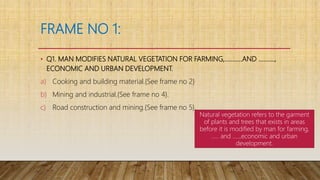
FRAME NO 1:
• Q1. MAN MODIFIES NATURAL VEGETATION FOR FARMING,………..AND ……….,
ECONOMIC AND URBAN DEVELOPMENT.
a) Cooking and building material.{See frame no 2}
b) Mining and industrial.{See frame no 4}.
c) Road construction and mining.{See frame no 5}.
Natural vegetation refers to the garment
of plants and trees that exists in areas
before it is modified by man for farming,
….. and …..,economic and urban
development.
FRAME NO 2:
• Q4{a}. Your answer is incorrect. Return to frame no 4 and read the passage given in the frame
carefully.
• Q3{a}. Your answer is correct now. Go to the next question.
• Q1{a}.Your answer is incorrect. Return to frame no 1 and read the passage given in the frame carefully.
• Q6{b}. Your answer is incorrect. Return to frame no 4 and read the passage given in the frame
carefully.
• QUESTION NO 2. Tree forests covers ……….Of the earth’s surface.
• {A} 2.9% {FRAME NO 7}
• {B} 9.4% {FRAME NO 5}
• {C} 16.3% {FRAME NO 6}.
Forests refers to as a wood or woods, is an
area with a high density of trees. Tree forests
covers …..% of the earth’s surface.
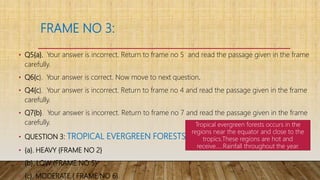
FRAME NO 3:
• Q5{a}. Your answer is incorrect. Return to frame no 5 and read the passage given in the frame
carefully.
• Q6{c}. Your answer is correct. Now move to next question.
• Q4{c}. Your answer is incorrect. Return to frame no 4 and read the passage given in the frame
carefully.
• Q7{b}. Your answer is incorrect. Return to frame no 7 and read the passage given in the frame
carefully.
• QUESTION 3: TROPICAL EVERGREEN FORESTS RECEIVE………RAINFALL.
• {a}. HEAVY {FRAME NO 2}
• {b}. LOW {FRAME NO 5}
• {c}. MODERATE { FRAME NO 6}.
Tropical evergreen forests occurs in the
regions near the equator and close to the
tropics.These regions are hot and
receive…..Rainfall throughout the year.
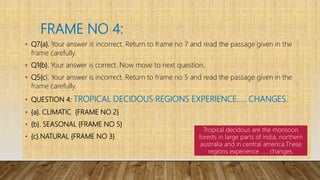
FRAME NO 4:
• Q7{a}. Your answer is incorrect. Return to frame no 7 and read the passage given in the
frame carefully.
• Q1{b}. Your answer is correct. Now move to next question.
• Q5{c}. Your answer is incorrect. Return to frame no 5 and read the passage given in the
frame carefully.
• QUESTION 4: TROPICAL DECIDOUS REGIONS EXPERIENCE….. CHANGES.
• {a}. CLIMATIC {FRAME NO 2}
• {b}. SEASONAL {FRAME NO 5}
• {c}.NATURAL {FRAME NO 3}
Tropical decidous are the monsoon
forests in large parts of india, northern
australia and in central america.These
regions experience ….. changes.
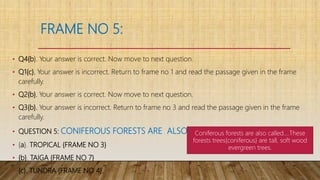
FRAME NO 5:
• Q4{b}. Your answer is correct. Now move to next question.
• Q1{c}. Your answer is incorrect. Return to frame no 1 and read the passage given in the frame
carefully.
• Q2{b}. Your answer is correct. Now move to next question.
• Q3{b}. Your answer is incorrect. Return to frame no 3 and read the passage given in the frame
carefully.
• QUESTION 5: CONIFEROUS FORESTS ARE ALSO CALLED AS……….
• {a}. TROPICAL {FRAME NO 3}
• {b}. TAIGA {FRAME NO 7}
• {c}. TUNDRA {FRAME NO 4}.
Coniferous forests are also called….These
forests trees{coniferous} are tall, soft wood
evergreen trees.
FRAME NO 6:
• Q2{c}. Your answer is incorrect. Return to frame no 2 and read the passage given in the frame
carefully.
• Q7{c}. Your answer is correct. Now move to next question.
• Q3{c}. Your answer is incorrect. Return to frame no 3 and read the passage given in the frame
carefully.
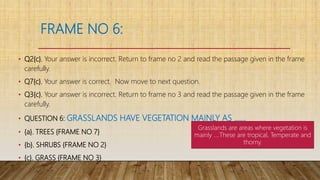
• QUESTION 6: GRASSLANDS HAVE VEGETATION MAINLY AS ……
• {a}. TREES {FRAME NO 7}
• {b}. SHRUBS {FRAME NO 2}
• {c}. GRASS {FRAME NO 3}
Grasslands are areas where vegetation is
mainly ….These are tropical, Temperate and
thorny.
FRAME NO 7:
• Q6 {a}. Your answer is incorrect. Return to frame no 6 and read the passage given in the
frame carefully.
• Q5{b}. Your answer is correct. Now move to next question.
• Q2{a}. Your answer is incorrect. Return to frame no 2 and read the passage given in the
frame carefully.
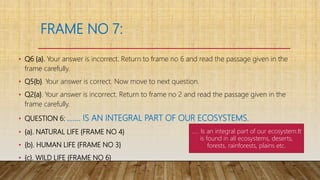
• QUESTION 6: ……. IS AN INTEGRAL PART OF OUR ECOSYSTEMS.
• {a}. NATURAL LIFE {FRAME NO 4}
• {b}. HUMAN LIFE {FRAME NO 3}
• {c}. WILD LIFE {FRAME NO 6}
….. Is an integral part of our ecosystem.It
is found in all ecosystems, deserts,
forests, rainforests, plains etc.
MERITS OF BRANCHING PROGRAMMING:
 Teaching.
Diagnosis.
Remediation.
Reinforcement
It is based on the principles of problem solving.It generates approximate
situation of learning.
Scrambled text- book operates as tutorial strategy.
The focus of scrambled text is to provide remedial instruction and teaching.
DEMERITS OF BRANCHING
PROGRAMMING:
The learner may guess the correct response without understanding the subject
matter of the frame.
Infinite branching cannot be provided. It cannot cater to the needs of the
individuals. It is very difficult to find out the total number of branches for each
individual.
Cost of preparation is high, audio-visual equipment is costly.
The programme needs revision after every two years which is very costly affair.
Programme are the product of programmer’s imagination and it is he who
decides diagnostic questions and level of content.
Branching programming with frames

Branching programming with frames

  • 1.
    BRANCHING PROGRAMMING SUBMITTED BY: KANWARJEET KAURNANGLI M. ED SEMESTER IV EDUCATION DEPARTMENT, GURU NANAK DEV UNIVERSITY, AMRITSAR.
  • 2.
    BRANCHING PROGRAMMING: • In1954, Norman Crowder, a psychologist with united state air force was asked to investigate the training of aircraft maintenance men. The technicians were being taught to “trouble shoot” or repair faults, in a bomber navigation system. And there lies the origin of branching programming.
  • 3.
    EDUCATIONAL PERSPECTIVE OFBRANCHING PROGRAMMING: • After exposure to the programmed material, the student has to discriminate a correct answer from the given multiple- choice questions. This process is within the learner. The major rationale fir the word “intrinsic” is that the student’s response is controlled by himself internally.
  • 4.
    PRINCIPLES OF BRANCHINGPROGRAMME: PRINCIPLE OF EXPOSION. {Ex. The learner should perceive the whole phenomena exposed to him}. PRINCIPLE OF DIAGNOSIS. {Ex. It refers to identifying the weakness of learner.}  PRINCIPLE OF REMEDIATION. {Ex. Diagnosis provides the b asis for remediation or remedial instructions.}
  • 5.
    STRUCTURE OF BRANCHINGPROGRAMME FRAME: • In this strategy, content is not presented in small steps but whole unit or concept is presented. • The size of step may be a paragraph or two or whole page. • The learner perceives the whole concept and tries to comprehend. • He has to follow the sequence pages. • Therefore, branching programming text is know as SCRAMBLED TEXT.
  • 6.
    FEATURES OF BRANCHING PROGRAMME: •Material in a frame is larger; much information is presented at each step. A step may consist of two or more paragraphs and sometimes a full page. • Learner has freedom to choose his own path of action according to the background of the subject matter. The learner controls the exact sequence that he will follow. • Student is more alert and concentrates on the subject. • The programmer has ample opportunity to exploit the literary
  • 7.
    DEVELOPING BRANCHING PROGRAMMED MATERIALFOR TEACHING SOCIAL SCIENCE OF CBSE CLASS IX: • In this study we converted the chapter “ Natural Vegetation and Wildlife” from social science subject of CBSE class IX. The chapter was taught on the principles of branching instructions. A part of the chapter converted into framework is shown as follow:
  • 8.
    FRAME NO 1: •Q1. MAN MODIFIES NATURAL VEGETATION FOR FARMING,………..AND ………., ECONOMIC AND URBAN DEVELOPMENT. a) Cooking and building material.{See frame no 2} b) Mining and industrial.{See frame no 4}. c) Road construction and mining.{See frame no 5}. Natural vegetation refers to the garment of plants and trees that exists in areas before it is modified by man for farming, ….. and …..,economic and urban development.
  • 9.
    FRAME NO 2: •Q4{a}. Your answer is incorrect. Return to frame no 4 and read the passage given in the frame carefully. • Q3{a}. Your answer is correct now. Go to the next question. • Q1{a}.Your answer is incorrect. Return to frame no 1 and read the passage given in the frame carefully. • Q6{b}. Your answer is incorrect. Return to frame no 4 and read the passage given in the frame carefully. • QUESTION NO 2. Tree forests covers ……….Of the earth’s surface. • {A} 2.9% {FRAME NO 7} • {B} 9.4% {FRAME NO 5} • {C} 16.3% {FRAME NO 6}. Forests refers to as a wood or woods, is an area with a high density of trees. Tree forests covers …..% of the earth’s surface.
  • 10.
    FRAME NO 3: •Q5{a}. Your answer is incorrect. Return to frame no 5 and read the passage given in the frame carefully. • Q6{c}. Your answer is correct. Now move to next question. • Q4{c}. Your answer is incorrect. Return to frame no 4 and read the passage given in the frame carefully. • Q7{b}. Your answer is incorrect. Return to frame no 7 and read the passage given in the frame carefully. • QUESTION 3: TROPICAL EVERGREEN FORESTS RECEIVE………RAINFALL. • {a}. HEAVY {FRAME NO 2} • {b}. LOW {FRAME NO 5} • {c}. MODERATE { FRAME NO 6}. Tropical evergreen forests occurs in the regions near the equator and close to the tropics.These regions are hot and receive…..Rainfall throughout the year.
  • 11.
    FRAME NO 4: •Q7{a}. Your answer is incorrect. Return to frame no 7 and read the passage given in the frame carefully. • Q1{b}. Your answer is correct. Now move to next question. • Q5{c}. Your answer is incorrect. Return to frame no 5 and read the passage given in the frame carefully. • QUESTION 4: TROPICAL DECIDOUS REGIONS EXPERIENCE….. CHANGES. • {a}. CLIMATIC {FRAME NO 2} • {b}. SEASONAL {FRAME NO 5} • {c}.NATURAL {FRAME NO 3} Tropical decidous are the monsoon forests in large parts of india, northern australia and in central america.These regions experience ….. changes.
  • 12.
    FRAME NO 5: •Q4{b}. Your answer is correct. Now move to next question. • Q1{c}. Your answer is incorrect. Return to frame no 1 and read the passage given in the frame carefully. • Q2{b}. Your answer is correct. Now move to next question. • Q3{b}. Your answer is incorrect. Return to frame no 3 and read the passage given in the frame carefully. • QUESTION 5: CONIFEROUS FORESTS ARE ALSO CALLED AS………. • {a}. TROPICAL {FRAME NO 3} • {b}. TAIGA {FRAME NO 7} • {c}. TUNDRA {FRAME NO 4}. Coniferous forests are also called….These forests trees{coniferous} are tall, soft wood evergreen trees.
  • 13.
    FRAME NO 6: •Q2{c}. Your answer is incorrect. Return to frame no 2 and read the passage given in the frame carefully. • Q7{c}. Your answer is correct. Now move to next question. • Q3{c}. Your answer is incorrect. Return to frame no 3 and read the passage given in the frame carefully. • QUESTION 6: GRASSLANDS HAVE VEGETATION MAINLY AS …… • {a}. TREES {FRAME NO 7} • {b}. SHRUBS {FRAME NO 2} • {c}. GRASS {FRAME NO 3} Grasslands are areas where vegetation is mainly ….These are tropical, Temperate and thorny.
  • 14.
    FRAME NO 7: •Q6 {a}. Your answer is incorrect. Return to frame no 6 and read the passage given in the frame carefully. • Q5{b}. Your answer is correct. Now move to next question. • Q2{a}. Your answer is incorrect. Return to frame no 2 and read the passage given in the frame carefully. • QUESTION 6: ……. IS AN INTEGRAL PART OF OUR ECOSYSTEMS. • {a}. NATURAL LIFE {FRAME NO 4} • {b}. HUMAN LIFE {FRAME NO 3} • {c}. WILD LIFE {FRAME NO 6} ….. Is an integral part of our ecosystem.It is found in all ecosystems, deserts, forests, rainforests, plains etc.
  • 15.
    MERITS OF BRANCHINGPROGRAMMING:  Teaching. Diagnosis. Remediation. Reinforcement It is based on the principles of problem solving.It generates approximate situation of learning. Scrambled text- book operates as tutorial strategy. The focus of scrambled text is to provide remedial instruction and teaching.
  • 16.
    DEMERITS OF BRANCHING PROGRAMMING: Thelearner may guess the correct response without understanding the subject matter of the frame. Infinite branching cannot be provided. It cannot cater to the needs of the individuals. It is very difficult to find out the total number of branches for each individual. Cost of preparation is high, audio-visual equipment is costly. The programme needs revision after every two years which is very costly affair. Programme are the product of programmer’s imagination and it is he who decides diagnostic questions and level of content.