Submitted To :
Dr. Vandana Aggarwal
Submitted By :
Sonam Sharma(16MSP1092)
Jyoti (16MSP1094)
Coined from principle of Operant Learning or Conditioning
First started ‘programmed learning’ in 1943 by B.F. Skinner and his
companions.
B.F. Skinner published a paper entitled ‘Science of Learning and art of
Teaching’.
 “Programmed instruction is the process of arranging the material to be
learned into a series of sequential steps that is from known to unknown.”
------ Smith and Moore
 “Programmed learning is a method of designing a reproducible sequence of
instructional events to produce a measurable and consistent effect on
behavior of each and every acceptable students.”
------ Susan Markle
 Principle of Small Steps
 Principle of Active Response
 Principle of Immediate Reinforcement
 Principle of Self –Pacing
 Principle of Self Evaluation
 To help the students for learning by doing.
 To provide the situation to learn at his/her own speed.
 To help the students to learn without the presence of teacher.
 To present the mater in a logical manner.
 To study himself.
 To evaluate himself.
 To compare his/her answer with the key .
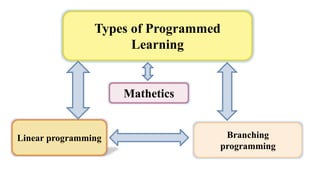
Types of Programmed
Learning
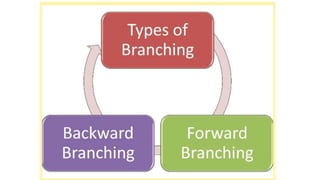
Linear programming Branching
programming
Mathetics
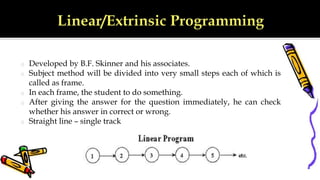
o Developed by B.F. Skinner and his associates.
o Subject method will be divided into very small steps each of which is
called as frame.
o In each frame, the student to do something.
o After giving the answer for the question immediately, he can check
whether his answer in correct or wrong.
o Straight line – single track
 Linear Arrangement
 Small Steps
 Controlled Responses
 Active Responding
 Immediate Feedback
 Prompting
 Self- Pacing
 Simple Mechanism
 Minimum error
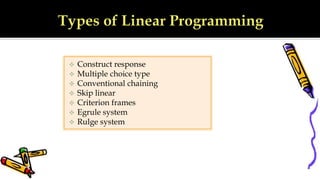
 Construct response
 Multiple choice type
 Conventional chaining
 Skip linear
 Criterion frames
 Egrule system
 Rulge system
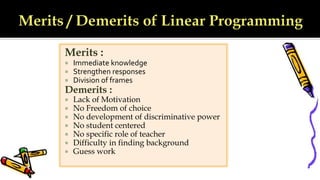
Merits :
 Immediate knowledge
 Strengthen responses
 Division of frames
Demerits :
 Lack of Motivation
 No Freedom of choice
 No development of discriminative power
 No student centered
 No specific role of teacher
 Difficulty in finding background
 Guess work
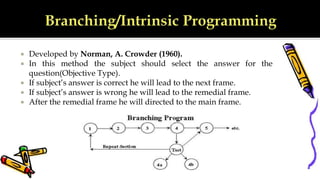
 Developed by Norman, A. Crowder (1960).
 In this method the subject should select the answer for the
question(Objective Type).
 If subject’s answer is correct he will lead to the next frame.
 If subject’s answer is wrong he will lead to the remedial frame.
 After the remedial frame he will directed to the main frame.
 Based on traditional tutorial method
 Larger frame
 Multiple choice questions
 Alertness of learners
 Easier to develop frames
 Teaching and instruction
 Psychological and social motivation
 Meaningful units
 No hinderance by errors
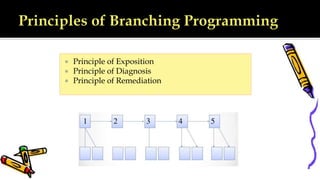
 Principle of Exposition
 Principle of Diagnosis
 Principle of Remediation
Merits :
 Individualised instruction
 Larger frames
 Alertness of learning
 Development of creativity
 Programmed text & motivation
Demerits :
 Guessing
 Difficulty in multiple choice questions
 Difficulty in arranging the Branching Programme
 Not Suitable for small children
 Costly
 No suitable feedback
 Programmer’s imagination
 Developed by Thomas F. Gilbert.
 “Mathetics is defined as a systematic application of
reinforcement theory to the analysis and construction of
complex repertoires which represent the mastery in subject
matter.”
 Based on connectives theory of learning.
 Reverse chaining approach.
 Mastery step
 Motivation
 Reverse chaining
 Stimulus & response
 Prompting
 Prescription
¤ Principle of Chaining
¤ Principle of Discrimination
¤ Principle of Generalization
Merits :
 More meaningful and valid.
 Easy and significant.
 Wide range of applicability.
 Complete training system
Demerits :
 Main emphasis is on mastery of the content rather than
changes in behavior of the learner.
 Retrogressive chaining of stimuli.
 Difficult to develop retrogressive learning package.
Programmed learning

Programmed learning

  • 1.
    Submitted To : Dr.Vandana Aggarwal Submitted By : Sonam Sharma(16MSP1092) Jyoti (16MSP1094)
  • 2.
    Coined from principleof Operant Learning or Conditioning First started ‘programmed learning’ in 1943 by B.F. Skinner and his companions. B.F. Skinner published a paper entitled ‘Science of Learning and art of Teaching’.
  • 3.
     “Programmed instructionis the process of arranging the material to be learned into a series of sequential steps that is from known to unknown.” ------ Smith and Moore  “Programmed learning is a method of designing a reproducible sequence of instructional events to produce a measurable and consistent effect on behavior of each and every acceptable students.” ------ Susan Markle
  • 4.
     Principle ofSmall Steps  Principle of Active Response  Principle of Immediate Reinforcement  Principle of Self –Pacing  Principle of Self Evaluation
  • 5.
     To helpthe students for learning by doing.  To provide the situation to learn at his/her own speed.  To help the students to learn without the presence of teacher.  To present the mater in a logical manner.  To study himself.  To evaluate himself.  To compare his/her answer with the key .
  • 6.
    Types of Programmed Learning Linearprogramming Branching programming Mathetics
  • 7.
    o Developed byB.F. Skinner and his associates. o Subject method will be divided into very small steps each of which is called as frame. o In each frame, the student to do something. o After giving the answer for the question immediately, he can check whether his answer in correct or wrong. o Straight line – single track
  • 8.
     Linear Arrangement Small Steps  Controlled Responses  Active Responding  Immediate Feedback  Prompting  Self- Pacing  Simple Mechanism  Minimum error
  • 9.
     Construct response Multiple choice type  Conventional chaining  Skip linear  Criterion frames  Egrule system  Rulge system
  • 10.
    Merits :  Immediateknowledge  Strengthen responses  Division of frames Demerits :  Lack of Motivation  No Freedom of choice  No development of discriminative power  No student centered  No specific role of teacher  Difficulty in finding background  Guess work
  • 11.
     Developed byNorman, A. Crowder (1960).  In this method the subject should select the answer for the question(Objective Type).  If subject’s answer is correct he will lead to the next frame.  If subject’s answer is wrong he will lead to the remedial frame.  After the remedial frame he will directed to the main frame.
  • 13.
     Based ontraditional tutorial method  Larger frame  Multiple choice questions  Alertness of learners  Easier to develop frames  Teaching and instruction  Psychological and social motivation  Meaningful units  No hinderance by errors
  • 14.
     Principle ofExposition  Principle of Diagnosis  Principle of Remediation
  • 15.
    Merits :  Individualisedinstruction  Larger frames  Alertness of learning  Development of creativity  Programmed text & motivation Demerits :  Guessing  Difficulty in multiple choice questions  Difficulty in arranging the Branching Programme  Not Suitable for small children  Costly  No suitable feedback  Programmer’s imagination
  • 16.
     Developed byThomas F. Gilbert.  “Mathetics is defined as a systematic application of reinforcement theory to the analysis and construction of complex repertoires which represent the mastery in subject matter.”  Based on connectives theory of learning.  Reverse chaining approach.
  • 17.
     Mastery step Motivation  Reverse chaining  Stimulus & response  Prompting  Prescription
  • 18.
    ¤ Principle ofChaining ¤ Principle of Discrimination ¤ Principle of Generalization
  • 19.
    Merits :  Moremeaningful and valid.  Easy and significant.  Wide range of applicability.  Complete training system Demerits :  Main emphasis is on mastery of the content rather than changes in behavior of the learner.  Retrogressive chaining of stimuli.  Difficult to develop retrogressive learning package.