PRODUCTION
MANAGEMENT
BY
Vikas kumar
(2813856)
B.Tech (final year)
OVERVIEW
 Definition of production
 Definition of production mangement
 Objectives of production mangent
 Plant location and plant layout
 Work measurement
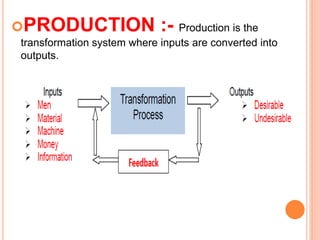
PRODUCTION :- Production is the
transformation system where inputs are converted into
outputs.
PRODUCTION MANAGEMENT
According to f.s buffa “ production management deal
with decision making related to production so that
the resulting goods or services is produced
according to specification, in the amount and by the
schedule demanded and at minimum cost.
OBJECTIVES OF PRODUCTION MANGEMENT
Ultimate objectives
Intermediate objectives
Ultimate objectives:-
I. To produce quality product
II. Production at minimum possible
cost.
III. Right quantity
IV. Manufacturing schedule or right time.
Intermediate objectives:-
I. Optimum use of material.
II. Machinery and equipment.
III. Manufacturing services.
IV. Manpower
PLANT LOCATION
 According to kimball and kimball “ the most
advantages location is that at which the cost of
gathering material and fabricating it plus the cost of
distributing the finished product to the customer will
be the minimum.
IDEAL PLANT LOCATION
 Ideal location is that which ensure the optimum
result in relation to cost.
 And shubin said, “ideal plant location is one that
permits the lowest unit cost in the production and
distribution of there product or service.”
FACTOR AFFECTING LOCATION
 Primary factor
I. Supply of raw material.
II. Proximity to market
III. Availability of labour
IV. Transport facilities.
V. Supply of power , fuel and water
VI. Finance or money or capital.
 Secondary factor
I. Natural factor or suitability of climate.
II. Political factor.
III. Government or state aid and subsidies
IV. Personal and historical factor
V. momentum of early start
VI. Suitability of decentralization
VII. Other factor
PLANT LAYOUT
 The plant layout is the way in which the equipment is
physically arranged in the factory.
Ideal plant layout
According to F.G Moore “a good layout is one which
allows material rapidaly and directly for processing . This
reduce the transport handling, clerical and other cost
down per unit, space requirements are minimized and
reduces idle machine and man time.”
ColorEntrance from finishing TFO
section
Dalal
m/c no.2
Dalal
m/c no.
10
m/c
no.26
TO
Fong's
m/c
no.34
Fong's
m/c
no.70
PUNCHING DISPENSER WET LAB DRY Execu Maintance Toilet
ROOM ROOM LAB -tive Room
dyeing
Examining
area
exit
RMT office HOD office
CCM Passing
section
STORE
RF
dryer
RF
dryer
COLOR KITCHEN
CHEMICAL STORE
Finishing
Department
Sampling section1-3kg
Fong's 9
TO
Fong's 1
Ugolini 1
Ugolini 17
GBBD
m/c 2 ,3
Ugolini 1
Dalal
SPDM
11,12
Ugolin 27
to 30
Ugolini
m/c no.14
To
Ugolini
m/c no.26
Dalal
SPDM
m/c no.
12
Berta
Hydro
BERTA
SHIFT OFFICE
Emerge
-ncy
Exit
Std.
room
Dalal 11
Fong's
43,44,45,
46
Dalal
12,13,14,
15
Dalal 13
SPDM
Fong's
35,36,37
,38,39
Ugolini
64,65,66
Ugolini
49,50,51,
52
Ugolini
60,61,62,
63
Ugolini
67,68
Fong's 16
Fong's 18
Dalal
20,21,22,
23,24,25
Fong's
machine
no. 40,
69,
59,
57,
53,
54
THIES 55
Fong's 56
Fong's 58
Dye-
ing
Man
-ager
FACTOR AFFECTING THE PLANT LAYOUT
 Managerial polices and decisions
 Nature of plant location
 Type of machine
 Type of manufacturing process
 Nature of product
 Method of production
 Minimum movements
 Arrangement of material handling equipments
 Continuance
 Availability of facilities
 Future expansion
 Availability of total floor area
 balance
 Flexibility
WORK MEASUREMENT
 Measurement is the determination of the amount of
time required for performing a unit of work.
 As per encyclopedia of business and finance,
“work measurement is the careful analysis of task,
its size, the method used in performance , and its
efficiency.”
OBJECTIVE OF WORK MEASUREMENT
1. To analysis the operation with a view that the
improvement is to be done on existing
methods(Process). It minimizes the human effort.
2. To fix the standard of perfortmance
3. To reduce the idle time
4. To establish and standardize the condition for an
efficient operation
5. to access the plant capacity accurately for controlling
man, machine and labour utilization.
6. To determined the man and machine assignment.
7. To improve the operative efficiency
8. To determined the time standard to be used as a basis
for wages payment to the direct labour.
9. To assist in method study by comparison of times for
alternative method.
10.To assist in the organization of labour by enabling a
daily comparison to be made b/w actual time and target
time.
ESSENTIALS OF WORK MEASUREMENT
1. For setting standard
a. compering the efficiency of alternative method and
determined the best method.
b. knowing the no. of machine an operator can run
c. Balance the work of member of team.
2. Time standard
a. Evaluating proposed method in advance of actual
production
b. Planning and schedule of production
c. Ploant and labour requirement
3. Computation of wages and incentives schemes
a. Labour cost control
b. Standard cost
c. Capital budgeting and budgetary control
4. Estimation for tenders setting price and delivery
promises.
a. labour performance.
b. Machine utilization standard.
PRODUCTION CONTROL
 Activities involved in handling materials parts,
assemblies, and subassemblies, from their raw or
initial stage to the finished product stage in an
organized and efficient manner. It may also include
activates such as planning, scheduling, routing,
dispatching, storage, etc.
 In the words of kimball and kimball:-
“the planing of industrial operation involves four
consideration, namely, what work shall be done,
How the work shall be done,and lastly, when the work
shall be done.”
OBJECTIVES OF PRODUCTION CONTROL
 Determines the sequence of operation for
continuous production.
 Planning plant capacity for future production
programmes.
 Issuing co-ordinated work schedules to concerned
persons.
 Maintain sufficient inventories to support continuous
flow production.
 Evaluation performance of workshops.
 Maintain the production schedules to insure the
delivery at time.
IMPORTANCE OF PRODUCTION CONTROL
1. For increasing production:- main purpose of
production control is to arrange inputs. production
control programme minimize idleness of men and
machine. It thus help in raising industry output.
2. For co-ordinating plant activity:- in planning
production is carried out no of process and thus
activites are synchronized for smooth working.
ELEMENTS OF PRODUCTION CONTROL
 Planning
 Routing
 Scheduling
 Dispatching
 Follow-up and expediting
 Inspection.
PLANNING
 It is the first element of production planning and
control. Planning is deciding in advance what is to
be done in future. An organizational set up is
created to prepare plans and policies. Various
charts, manuals and production budgets are also
prepared. Planning provides a sound base for
control. A separate department is set up for this
work.
ROUTING
Routing is determining the exact path which will be
followed in production. It is the selection of the path
from where each unit have to pass before reaching
the final stage. The stages from which goods are to
pass are decided in this process.
In the words of ALFORD and BEATY –
“Routing is the specification of the flow sequence of
operations and processes to be followed in
producing a particular manufacturing lot.”
SCHEDULING
Scheduling is the determining of time and date when
each operation is to be commenced or completed.
The time and date of manufacturing each
component is fixed in such a way that assembling
for final product is not delayed in any way.
In the words of KIMBALL and KIMBALL –
“The determination of the time that should be
required to perform each operation and also the
time necessary to perform the entire series, as
routed, making allowances for all factors
concerned.”
DISPATCHING
Dispatching refers to the process of actually ordering
the work to be done. It involves putting the plan into
effect by issuing orders. It is concerned with starting
the process and operation on the basis of route
sheets and schedule charts.
In the words of JOHN A. SHUBIN –
“Dispatches put production in effect by releasing
and guiding manufacturing order in the sequence
previously determined by route sheets and
schedules.”
FLOW-UP AND EXPEDITING
Follow up or expediting is that branch of production
control procedure which regulates the progress of
materials and part through the production process.”
Follow up Procedure –
Progress may be assessed with the help of routine
reports or communication with operating
departments. The follow up procedure is used for
expediting and checking the progress.
INSPECTION
Inspection is the process of ensuring whether the
products manufactured are of requisite quality or
not.
Inspection is undertaken both of products and
inputs. It is carried on at various levels of
production process so that pre-determined
standards of quality are achieved.
Inspection ensures the maintenance of pre-
determined quality of products.
THANK YOU

Production management

  • 1.
  • 2.
    OVERVIEW  Definition ofproduction  Definition of production mangement  Objectives of production mangent  Plant location and plant layout  Work measurement
  • 3.
    PRODUCTION :- Productionis the transformation system where inputs are converted into outputs.
  • 4.
    PRODUCTION MANAGEMENT According tof.s buffa “ production management deal with decision making related to production so that the resulting goods or services is produced according to specification, in the amount and by the schedule demanded and at minimum cost.
  • 5.
    OBJECTIVES OF PRODUCTIONMANGEMENT Ultimate objectives Intermediate objectives Ultimate objectives:- I. To produce quality product II. Production at minimum possible cost. III. Right quantity IV. Manufacturing schedule or right time.
  • 6.
    Intermediate objectives:- I. Optimumuse of material. II. Machinery and equipment. III. Manufacturing services. IV. Manpower
  • 7.
    PLANT LOCATION  Accordingto kimball and kimball “ the most advantages location is that at which the cost of gathering material and fabricating it plus the cost of distributing the finished product to the customer will be the minimum.
  • 8.
    IDEAL PLANT LOCATION Ideal location is that which ensure the optimum result in relation to cost.  And shubin said, “ideal plant location is one that permits the lowest unit cost in the production and distribution of there product or service.”
  • 9.
    FACTOR AFFECTING LOCATION Primary factor I. Supply of raw material. II. Proximity to market III. Availability of labour IV. Transport facilities. V. Supply of power , fuel and water VI. Finance or money or capital.
  • 10.
     Secondary factor I.Natural factor or suitability of climate. II. Political factor. III. Government or state aid and subsidies IV. Personal and historical factor V. momentum of early start VI. Suitability of decentralization VII. Other factor
  • 11.
    PLANT LAYOUT  Theplant layout is the way in which the equipment is physically arranged in the factory. Ideal plant layout According to F.G Moore “a good layout is one which allows material rapidaly and directly for processing . This reduce the transport handling, clerical and other cost down per unit, space requirements are minimized and reduces idle machine and man time.”
  • 12.
    ColorEntrance from finishingTFO section Dalal m/c no.2 Dalal m/c no. 10 m/c no.26 TO Fong's m/c no.34 Fong's m/c no.70 PUNCHING DISPENSER WET LAB DRY Execu Maintance Toilet ROOM ROOM LAB -tive Room dyeing Examining area exit RMT office HOD office CCM Passing section STORE RF dryer RF dryer COLOR KITCHEN CHEMICAL STORE Finishing Department Sampling section1-3kg Fong's 9 TO Fong's 1 Ugolini 1 Ugolini 17 GBBD m/c 2 ,3 Ugolini 1 Dalal SPDM 11,12 Ugolin 27 to 30 Ugolini m/c no.14 To Ugolini m/c no.26 Dalal SPDM m/c no. 12 Berta Hydro BERTA SHIFT OFFICE Emerge -ncy Exit Std. room Dalal 11 Fong's 43,44,45, 46 Dalal 12,13,14, 15 Dalal 13 SPDM Fong's 35,36,37 ,38,39 Ugolini 64,65,66 Ugolini 49,50,51, 52 Ugolini 60,61,62, 63 Ugolini 67,68 Fong's 16 Fong's 18 Dalal 20,21,22, 23,24,25 Fong's machine no. 40, 69, 59, 57, 53, 54 THIES 55 Fong's 56 Fong's 58 Dye- ing Man -ager
  • 13.
    FACTOR AFFECTING THEPLANT LAYOUT  Managerial polices and decisions  Nature of plant location  Type of machine  Type of manufacturing process  Nature of product  Method of production  Minimum movements  Arrangement of material handling equipments  Continuance  Availability of facilities  Future expansion  Availability of total floor area  balance  Flexibility
  • 14.
    WORK MEASUREMENT  Measurementis the determination of the amount of time required for performing a unit of work.  As per encyclopedia of business and finance, “work measurement is the careful analysis of task, its size, the method used in performance , and its efficiency.”
  • 15.
    OBJECTIVE OF WORKMEASUREMENT 1. To analysis the operation with a view that the improvement is to be done on existing methods(Process). It minimizes the human effort. 2. To fix the standard of perfortmance 3. To reduce the idle time 4. To establish and standardize the condition for an efficient operation
  • 16.
    5. to accessthe plant capacity accurately for controlling man, machine and labour utilization. 6. To determined the man and machine assignment. 7. To improve the operative efficiency 8. To determined the time standard to be used as a basis for wages payment to the direct labour. 9. To assist in method study by comparison of times for alternative method. 10.To assist in the organization of labour by enabling a daily comparison to be made b/w actual time and target time.
  • 17.
    ESSENTIALS OF WORKMEASUREMENT 1. For setting standard a. compering the efficiency of alternative method and determined the best method. b. knowing the no. of machine an operator can run c. Balance the work of member of team. 2. Time standard a. Evaluating proposed method in advance of actual production b. Planning and schedule of production c. Ploant and labour requirement
  • 18.
    3. Computation ofwages and incentives schemes a. Labour cost control b. Standard cost c. Capital budgeting and budgetary control 4. Estimation for tenders setting price and delivery promises. a. labour performance. b. Machine utilization standard.
  • 19.
    PRODUCTION CONTROL  Activitiesinvolved in handling materials parts, assemblies, and subassemblies, from their raw or initial stage to the finished product stage in an organized and efficient manner. It may also include activates such as planning, scheduling, routing, dispatching, storage, etc.  In the words of kimball and kimball:- “the planing of industrial operation involves four consideration, namely, what work shall be done, How the work shall be done,and lastly, when the work shall be done.”
  • 20.
    OBJECTIVES OF PRODUCTIONCONTROL  Determines the sequence of operation for continuous production.  Planning plant capacity for future production programmes.  Issuing co-ordinated work schedules to concerned persons.  Maintain sufficient inventories to support continuous flow production.  Evaluation performance of workshops.  Maintain the production schedules to insure the delivery at time.
  • 21.
    IMPORTANCE OF PRODUCTIONCONTROL 1. For increasing production:- main purpose of production control is to arrange inputs. production control programme minimize idleness of men and machine. It thus help in raising industry output. 2. For co-ordinating plant activity:- in planning production is carried out no of process and thus activites are synchronized for smooth working.
  • 22.
    ELEMENTS OF PRODUCTIONCONTROL  Planning  Routing  Scheduling  Dispatching  Follow-up and expediting  Inspection.
  • 23.
    PLANNING  It isthe first element of production planning and control. Planning is deciding in advance what is to be done in future. An organizational set up is created to prepare plans and policies. Various charts, manuals and production budgets are also prepared. Planning provides a sound base for control. A separate department is set up for this work.
  • 24.
    ROUTING Routing is determiningthe exact path which will be followed in production. It is the selection of the path from where each unit have to pass before reaching the final stage. The stages from which goods are to pass are decided in this process. In the words of ALFORD and BEATY – “Routing is the specification of the flow sequence of operations and processes to be followed in producing a particular manufacturing lot.”
  • 25.
    SCHEDULING Scheduling is thedetermining of time and date when each operation is to be commenced or completed. The time and date of manufacturing each component is fixed in such a way that assembling for final product is not delayed in any way. In the words of KIMBALL and KIMBALL – “The determination of the time that should be required to perform each operation and also the time necessary to perform the entire series, as routed, making allowances for all factors concerned.”
  • 26.
    DISPATCHING Dispatching refers tothe process of actually ordering the work to be done. It involves putting the plan into effect by issuing orders. It is concerned with starting the process and operation on the basis of route sheets and schedule charts. In the words of JOHN A. SHUBIN – “Dispatches put production in effect by releasing and guiding manufacturing order in the sequence previously determined by route sheets and schedules.”
  • 27.
    FLOW-UP AND EXPEDITING Followup or expediting is that branch of production control procedure which regulates the progress of materials and part through the production process.” Follow up Procedure – Progress may be assessed with the help of routine reports or communication with operating departments. The follow up procedure is used for expediting and checking the progress.
  • 28.
    INSPECTION Inspection is theprocess of ensuring whether the products manufactured are of requisite quality or not. Inspection is undertaken both of products and inputs. It is carried on at various levels of production process so that pre-determined standards of quality are achieved. Inspection ensures the maintenance of pre- determined quality of products.
  • 29.