Production and Operations
      Management
       Introduction


                            1
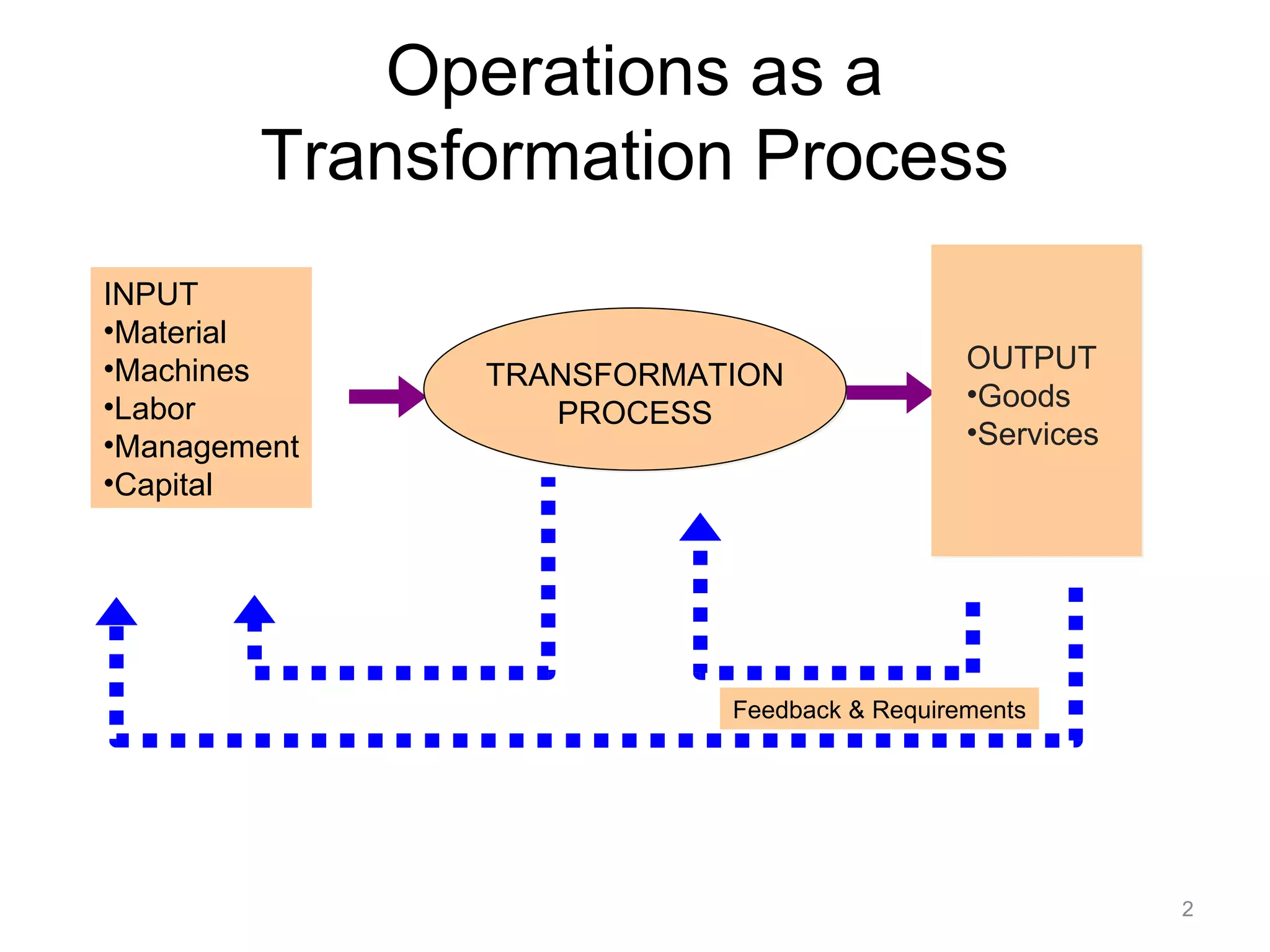
Operations as a
        Transformation Process
INPUT
•Material
•Machines                                  OUTPUT
              TRANSFORMATION
•Labor                                     •Goods
                 PROCESS
•Management                                •Services
•Capital


                         Feedback & Requirements


                                                       2
Production management is concerned with the
  manufacturing of goods:
     Examples of goods:
                 cars
                 books
                 chairs
                 computers
                 houses
                 etc.

                                              3
Examples of services:
                retailing/food
                banking
                education
                health care
                utilities
                insurance
                government agencies
                etc.
                                      4
OPERATIONS MANAGEMENT QUESTIONS

1. How many items will be demanded next
  month?

2. How many items should be produced next
  month?

3. How many workers are needed to satisfy the
  proposed production level?
                                                5
OPERATIONS MANAGEMENT QUESTIONS
4. If a plant is built, how should the activities be
  scheduled so that the project is completed on
  time, within budget, and with acceptable
  quality?

5. How is the quality of our output measured
  and how is it improved?

6. If sodas are needed, how many should be
  ordered?
                                                   6
Introduction

• Production means application of processes
  (technology) to the raw material to add the use
  and economic values to arrive at the desired
  product by the best method without sacrificing
  the desired quality.
• Production is of 3 major ways
• Production by Disintegration -separating the
  contents, the desired products are produced.
  For example …………..
                                                    7
• Production by Integration- in this type of
  production various components of the product
  are assembled together to form the desired
  product. Eg……….
• Production by Service- here the chemical and
  mechanical properties are improved without
  any physical change. Eg……… heat treatment
  of metals
• Generally speaking, production is the use of
  any process or procedure designed to
  transform a set of input elements, which have
  use value and economic value.
                                                  8
Management

•   Do it yourself;
•   Ask your neighbor …………..
•   What is management?
•   What are the activities involved in
    management?


                                          9
Operations- An overview
• Operations management is the conversion of
  inputs into outputs, using physical resources so
  as to provide the desired utility to the customer
  while meeting the other organizational
  objectives of effectiveness, efficiency and
  adaptability.


                                                 10
A product

• Many of us know of a product from the
  consumers orientation. It is better for us to deal
  with different angles, because it will be helpful
  for us to understand the subject of production and
  operations manegement.
• To a consumer; the product is a combination of
  or optimal mix of utilities. This is because every
  consumer expects some use or uses from the
  product. For example soap can be identified by
  cleanliness of body, freshness, fragrance or health
  etc

                                                    11
• To a production manager; a product is the
  combination of various surfaces and processes
  (operations). This is because the production
  manager is solely responsible for producing
  the product. He has to think of the various
  surfaces by which the product is made of so
  that he can plan for processes by which a
  particular surface can be made.
• To a financial manager; a product is a mix of
  various cost elements as he is responsible for
  the profitability of the product.
                                               12
• To a personnel/Human resource manager; a
  product is a mix of various skills as he is the
  person who selects and trains the personnel to
  meet the demand of the skill to produce the
  product.
• In general a product is a bundle of tangible and
  intangible attributes which along with the
  service is meant to satisfy the customer wants.


                                                 13
Importance of operations management
• Efficient production management will give
  benefits to the various sections of society. That
  is the stakeholders
 Consumer benefits from increased
  productivity, increased use value in the
  product. Products are available to him/her at a
  right place, at right price, at right time, in
  desired quantity and of desired quality.


                                                  14
Importance of operations mgt con….
 Investors; they get increased security for their
  investments, adequate market returns and
  creditability and good image in the society.
 Employee gets adequate wages, job security,
  improved working conditions and increased
  personal and job satisfaction.
 Suppliers will get confidence in management
  and their bills can be realized without any
  delay.
 Community enjoys benefits from economic            15
and social stability.
 The nation will achieve prospects and security
  because of increased productivity and healthy
  industrial atmosphere.


                                               16
Functions of production mgt department
• The functions of the production department
  depend on the size of the firm. As such there
  may be no guidelines to specify the function
  of production dept but the following are some
  of the functions which are looked after by the
  production department
 Materials: the selection of materials for the
  product, production manager must have
  sound knowledge of materials and their
  properties so that he can select appropriate
  materials for his product.
                                               17
Functions of production mgt cont…
 Methods: Finding the best method for the
  process, to search for the methods that suit the
  available resources, identifying the sequence
  of processes for manufacture of the product.
 Machines and equipment: selection of suitable
  machinery for the process desired, designing
  the maintenance policy and design of lay out
  of machines are taken care of by the
  production department.
 Estimating: To fix the production targets and
  delivery dates and to keep the production costs
  a
                                                 18
at minimum, production department does a
  thorough of production times and costs.
 Loading and scheduling; the production
  management department has to draw a time
  table for various activities specifying when to
  start and when to finish the process required.
 Routing, this is concerned with fixing the flow
  lines for various raw materials, components
  etc from stores to the packing of finished
  products so that all the concerned know what
  exactly is happening on the shop floor.
                                                19
 Despatching; the activities of the shop floor
  follow given instructions which are given by
  the production department.
 Expediting or follow up; it is the responsibility
  of the production department to know
  whether activities are being carried out as per
  plans or not. Expediting helps to evaluate the
  plans
 Inspection; this is generally done during
  production, but a separate quality control
  department does quality inspection which is
  not normally under prodn department.            20
 Evaluation; the production department must
  evaluate itself and its contribution in fulfilling
  the corporate objectives and departmental
  objectives. This is necessary for setting future
  standards.


                                                       21

Production and operations management

  • 1.
    Production and Operations Management Introduction 1
  • 2.
    Operations as a Transformation Process INPUT •Material •Machines OUTPUT TRANSFORMATION •Labor •Goods PROCESS •Management •Services •Capital Feedback & Requirements 2
  • 3.
    Production management isconcerned with the manufacturing of goods: Examples of goods: cars books chairs computers houses etc. 3
  • 4.
    Examples of services: retailing/food banking education health care utilities insurance government agencies etc. 4
  • 5.
    OPERATIONS MANAGEMENT QUESTIONS 1.How many items will be demanded next month? 2. How many items should be produced next month? 3. How many workers are needed to satisfy the proposed production level? 5
  • 6.
    OPERATIONS MANAGEMENT QUESTIONS 4.If a plant is built, how should the activities be scheduled so that the project is completed on time, within budget, and with acceptable quality? 5. How is the quality of our output measured and how is it improved? 6. If sodas are needed, how many should be ordered? 6
  • 7.
    Introduction • Production meansapplication of processes (technology) to the raw material to add the use and economic values to arrive at the desired product by the best method without sacrificing the desired quality. • Production is of 3 major ways • Production by Disintegration -separating the contents, the desired products are produced. For example ………….. 7
  • 8.
    • Production byIntegration- in this type of production various components of the product are assembled together to form the desired product. Eg………. • Production by Service- here the chemical and mechanical properties are improved without any physical change. Eg……… heat treatment of metals • Generally speaking, production is the use of any process or procedure designed to transform a set of input elements, which have use value and economic value. 8
  • 9.
    Management • Do it yourself; • Ask your neighbor ………….. • What is management? • What are the activities involved in management? 9
  • 10.
    Operations- An overview •Operations management is the conversion of inputs into outputs, using physical resources so as to provide the desired utility to the customer while meeting the other organizational objectives of effectiveness, efficiency and adaptability. 10
  • 11.
    A product • Manyof us know of a product from the consumers orientation. It is better for us to deal with different angles, because it will be helpful for us to understand the subject of production and operations manegement. • To a consumer; the product is a combination of or optimal mix of utilities. This is because every consumer expects some use or uses from the product. For example soap can be identified by cleanliness of body, freshness, fragrance or health etc 11
  • 12.
    • To aproduction manager; a product is the combination of various surfaces and processes (operations). This is because the production manager is solely responsible for producing the product. He has to think of the various surfaces by which the product is made of so that he can plan for processes by which a particular surface can be made. • To a financial manager; a product is a mix of various cost elements as he is responsible for the profitability of the product. 12
  • 13.
    • To apersonnel/Human resource manager; a product is a mix of various skills as he is the person who selects and trains the personnel to meet the demand of the skill to produce the product. • In general a product is a bundle of tangible and intangible attributes which along with the service is meant to satisfy the customer wants. 13
  • 14.
    Importance of operationsmanagement • Efficient production management will give benefits to the various sections of society. That is the stakeholders  Consumer benefits from increased productivity, increased use value in the product. Products are available to him/her at a right place, at right price, at right time, in desired quantity and of desired quality. 14
  • 15.
    Importance of operationsmgt con….  Investors; they get increased security for their investments, adequate market returns and creditability and good image in the society.  Employee gets adequate wages, job security, improved working conditions and increased personal and job satisfaction.  Suppliers will get confidence in management and their bills can be realized without any delay.  Community enjoys benefits from economic 15
  • 16.
    and social stability. The nation will achieve prospects and security because of increased productivity and healthy industrial atmosphere. 16
  • 17.
    Functions of productionmgt department • The functions of the production department depend on the size of the firm. As such there may be no guidelines to specify the function of production dept but the following are some of the functions which are looked after by the production department  Materials: the selection of materials for the product, production manager must have sound knowledge of materials and their properties so that he can select appropriate materials for his product. 17
  • 18.
    Functions of productionmgt cont…  Methods: Finding the best method for the process, to search for the methods that suit the available resources, identifying the sequence of processes for manufacture of the product.  Machines and equipment: selection of suitable machinery for the process desired, designing the maintenance policy and design of lay out of machines are taken care of by the production department.  Estimating: To fix the production targets and delivery dates and to keep the production costs a 18
  • 19.
    at minimum, productiondepartment does a thorough of production times and costs.  Loading and scheduling; the production management department has to draw a time table for various activities specifying when to start and when to finish the process required.  Routing, this is concerned with fixing the flow lines for various raw materials, components etc from stores to the packing of finished products so that all the concerned know what exactly is happening on the shop floor. 19
  • 20.
     Despatching; theactivities of the shop floor follow given instructions which are given by the production department.  Expediting or follow up; it is the responsibility of the production department to know whether activities are being carried out as per plans or not. Expediting helps to evaluate the plans  Inspection; this is generally done during production, but a separate quality control department does quality inspection which is not normally under prodn department. 20
  • 21.
     Evaluation; theproduction department must evaluate itself and its contribution in fulfilling the corporate objectives and departmental objectives. This is necessary for setting future standards. 21

Editor's Notes