MANAGEMENT
INTRODUCTION
 It is defined as planning , implementation and
control of industrial production process to ensure
smooth and efficient operation. production
management techniques are used in both
manufacturing and service industries.
 Simply, production management is a process of
planning, organizing, directing and controlling
the activities of the production function.
CONCEPT OF PRODUCTION
 Production is defined as “the step-by-step
conversion of one form of material into another
form through chemical or mechanical process to
create or enhance the utility of the product to the
user.”
 Thus production is a value addition process. At each
stage of processing, there will be value addition.
 Edwood Buffa defines production as ‘a process by
which goods and services are created’.
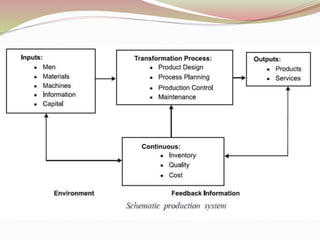
PRODUCTION SYSTEM
 The production system of an organization is that part,
which produces products of an organization.
 It is that activity whereby Resources, flowing within a
defined system, are combined & transformed in a
controlled manner to add value in accordance with
the policies communicated by management.
Characteristics Of Production System
 1. Production is an organized activity, so every
production system has an objective.
 2. The system transforms the various Inputs to useful
Outputs.
 3. It doesn’t operate in Isolation from the other
organization system.
 4. There exists a feedback about the activities,
which is essential to control and improve system
performance.
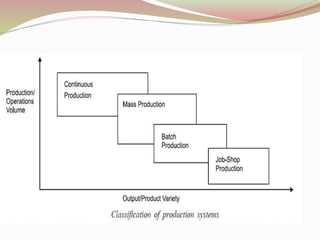
CLASSIFICATION
 Production systems can be classified as:
1. Job Shop Production
2. Batch Production
3. Mass Production
4. Continuous Production
JOB SHOP PRODUCTION
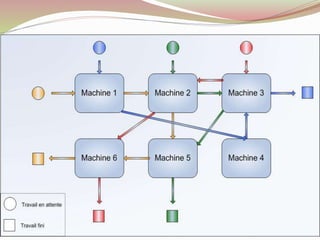
 Job shop production are characterised by
manufacturing of one or few quantity of products
designed and produced as per the specification of
customers within prefixed time and cost.
 The distinguishing feature of this is low volume &
high variety of products.
 A job shop comprises of general purpose machines
arranged into different departments.
 Each job demands unique technological
requirements, demands processing on machines in a
certain sequence.
Characteristics
 1. High variety of products and low volume.
 2. Use of general purpose machines and facilities.
 3. Highly skilled operators who can take up each job
as a challenge because of uniqueness.
 4. Large inventory of materials, tools, parts.
 5. Detailed planning is essential for sequencing the
requirements of each product, capacities for each
work centre and order priorities.
ADVANTAGES
 1. Because of general purpose machines and facilities
variety of products can be produced.
 2. Operators will become more skilled & competent,
as each job gives them learning opportunities.
 3. Full potential of operators can be utilised.
 4. Opportunity exists for creative methods &
Innovative ideas.
LIMITATIONS
 1. Higher cost due to frequent set up changes.
 2. Higher level of inventory at all levels and hence
higher inventory cost.
 3. Production planning is complicated.
 4. Larger space requirements.
BATCH PRODUCTION
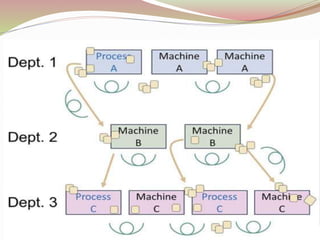
 Batch production is defined “as a form of
manufacturing in which the job passes through
the functional departments in lots or batches and
each lot may have a different routing.”
 It is characterised by the manufacture of limited
number of products produced at regular intervals
and stocked awaiting sales.
CHARACTERISTICS
 1. There is shorter production runs.
 2. Plant and machinery are flexible.
 3. Manufacturing lead time & cost are lower as
compared to job shop production.
ADVANTAGES
 1. Better utilisation of plant and machinery.
 2. Promotes functional specialisation.
 3. Cost per unit is lower as compared to job shop
production.
 4. Lower investment in plant and machinery.
 5. Flexibility to accommodate and process number of
products.
 6. Job satisfaction exists for operators.
LIMITATIONS
 1. Material handling is complex because of irregular
and longer flows.
 2. Production planning and control is complex.
 3. Work in process inventory is higher compared to
continuous production.
 4. Higher set up costs due to frequent changes in set
up.
MASS PRODUCTION
 ‘ Manufacture of discrete parts or assemblies
using a continuous process are called mass
production ’.
 This production system is justified by very large
volume of production.
 The machines are arranged in a line or product
layout. Product and process standardisation exists
and all outputs follow the same path.
CHARACTERISTICS
1. Standardisation of product and process sequence.
2. Large volume of products.
3. Shorter cycle time of production.
4. Lower in process inventory.
5. Perfectly balanced production lines.
6. Production planning and control is easy.
7. Material handling can be completely automatic.
ADVANTAGES
 1. Higher rate of production with reduced cycle time.
 2. Higher capacity utilisation due to line balancing.
 3. Less skilled operators are required.
 4. Low process inventory.
 5. Manufacturing cost per unit is low.
LIMITATIONS
 1. Breakdown of one machine will stop an entire
production line.
 2. Line layout needs major change with the changes
in the product design.
 3. High investment in production facilities.
 4. The cycle time is determined by the slowest
operation.
CONTINUOUS PRODUCTION
 Production facilities are arranged as per the sequence
of production operations from the first operations
to the finished product.
 The items are made to flow through the sequence of
operations through material handling devices such as
conveyors, transfer devices, etc.
CHARACTERISTICS
 1. Dedicated plant and equipment with zero
flexibility.
 2. Material handling is fully automated.
 3. Process follows a predetermined sequence of
operations.
 4. Component materials can’t be readily Identified
with final product.
 5. Planning and scheduling is a routine action.
ADVANTAGES
 1. Standardisation of product and process sequence.
 2. Higher rate of production with reduced cycle time.
 3. Higher capacity utilisation due to line balancing.
 4. Manpower is not required for material handling as it
is completely automatic.
 5. Person with limited skills can be used on the
production line.
 6. Unit cost is lower due to high volume of
production.
LIMITATIONS
 1. Process number of products doesn’t exist.
 2. Very high investment for setting flow lines.
 3. Product differentiation is limited.
OBJECTIVES OF PRODUCTION MANAGEMENT
 The objective of the production management is ‘to
produce goods services of right quality and
quantity at the right time and right
manufacturing cost’.
RIGHT QUALITY:
The quality of product is established based upon the
customers needs. The right quality is not necessarily
best quality. It is determined by the cost of the
product and the technical characteristics as suited to
the specific requirements.i.e.
 2. RIGHT QUANTITY
The manufacturing organization should produce
the products in right number. If they are produced
in excess of demand the capital will block up in the
form of inventory and if the quantity is produced in
short of demand, leads to shortage of products.
 3. RIGHT TIME
Timeliness of delivery is one of the important
parameter to judge the effectiveness of production
department. So, the production department has to make
the optimal utilization of input resources to achieve its
objective.
 4. RIGHT MANUFACTURING COST
Manufacturing costs are established before the
product is actually manufactured.
 All attempts should be made to produce the
products at pre-established cost, so as to reduce
the variation between actual and the standard
(pre-established) cost.
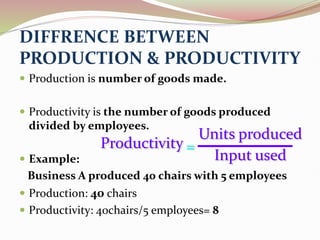
DIFFRENCE BETWEEN
PRODUCTION & PRODUCTIVITY
 Production is number of goods made.
 Productivity is the number of goods produced
divided by employees.
 Example:
Business A produced 40 chairs with 5 employees
 Production: 40 chairs
 Productivity: 40chairs/5 employees= 8
Productivity
Units produced
Input used
=
SCOPE OF PRODUCTION MANAGEMENT
 Production management concern with the
conversion of inputs into outputs, using
physical resources, so as to provide the desired
utilities to the customer while meeting the
other organizational objectives of effectiveness,
efficiency and adoptability.
 It distinguishes itself from other functions such as
personnel, marketing, finance, etc., by its primary
concern for ‘conversion by using physical
resources.’
 Following are the activities which are listed under
production management functions:
 1. Location of facilities
 2. Plant layouts
 3. Product design
 4. Process design
 5. Production and planning control
 6. Quality control
 7. Materials management
 8. Maintenance management.
LOCATION OF FACILITIES
 Location of facilities for operations is a long-term
capacity decision which involves a long term
commitment about the geographically static factors
that affect a business organization. It is an important
strategic level decision-making for an organization.
 The selection of location is a key-decision as large
investment is made in building plant and machinery.
 An improper location of plant may lead to waste of all
the investments made in plant and machinery
equipments.
 Hence, location of plant should be based on the
company’s expansion plan and policy, diversification
plan for the products, changing sources of raw
materials and many other factors.
 The purpose of the location study is to find the
optimal location that will results in the greatest
advantage to the organization.
PLANT LAYOUT
 Plant layout refers to the physical arrangement of
facilities. It is the configuration of departments,work
centres and equipment in the conversion process.
 The overall objective of the plant layout is to design a
physical arrangement that meets the required output
quality and quantity most economically.
OBJECTIVES OF PLANT LAYOUT
1. Integrate the production centres
2. Reduce material handling
3. Effective utilization of available space
4. Worker convenience and job satisfaction
5. Flexibility
6. Quick disposal of work
7. Smooth flow of operation
8. Avoids industrial accidents
PRODUCT DESIGN
 Product design deals with conversion of ideas into
reality. Every business organization have to design,
develop and introduce new products as a survival and
growth strategy.
 Developing the new products and launching them in
the market is the biggest challenge faced by the
organizations.
 The entire process of need identification to physical
manufactures of product involves three functions:
marketing, product development, manufacturing.
 Product development translates the needs of
customers given by marketing into technical
specifications and designing the various features into
the product to these specifications.
 Manufacturing has the responsibility of selecting the
processes by which the product can be manufactured.
 Product design and developmentprovides link
between marketing, customer needs and expectations
and the activities required to manufacture the
product.
PROCESS DESIGN
 Process design is a macroscopic decision-making of an
overall process route for converting the raw material
into finished goods.
 These decisions encompass the selection of a process,
choice of technology, process flow analysis and layout
of the facilities.
 Hence, the important decisions in process design are
to analyzed the workflow for converting raw material
into finished product and to select the workstation for
each included in the workflow.
PRODUCTION PLANNING AND
CONTROL
 The principle of production planning and control lies
in the statement ‘First Plan Your Work and then Work
on Your Plan’.
 Main functions of production planning and control
includes planning, routing, scheduling, dispatching
and follow-up.
 Planning is deciding in advance what to do,
how to do it, when to do it and who is to do it.
 Routing may be defined as the selection of
path which each part of the product will
follow,which being transformed from raw
material to finished products. Routing
determines the most advantageous path to be
followed.
 Scheduling may be defined as‘the fixation of time
and date for each operation’ as well as it
determines the sequence of operations to be
followed.
 Dispatching is concerned with the starting the
processes. It gives necessary authority so as to
start a particular work, which has already been
planned under ‘Routing’ and ‘Scheduling’.
 The function of follow-up is to report daily the
progress of work in each shop in a prescribed
proforma and to investigate the causes of
deviations from the planned performance.
MATERIALS MANAGEMENT
 Materials management is that aspect of management
function which is primarily concerned with the
acquisition, control and use of materials needed and
flow of goods and services connected with the
production process having some predetermined
objectives in view.
 The main objectives of materials management are:
 1. To minimize material cost.
 2.To purchase, receive, transport and store materials
efficiently and to reduce the related cost.
 3. To cut down costs through simplification,
standardization, value analysis, import substitution,
etc.
 4. To trace new sources of supply and to develop
cordial relations with them in order to ensure
continuous supply at reasonable rates.
 5. To reduce investment tied in the inventories for use
in other productive purposes and to develop high
inventory turnover ratios.
MAINTENANCE MANAGEMENT
 In modern industry, equipment and machinery are a
very important part of the total productive effort.
Therefore, their idleness or downtime becomes are
very expensive. Hence, it is very important that the
plant machinery should be properly maintained.
 The main objectives of maintenance management are:
 1. To achieve minimum breakdown and to keep the
plant in good working condition at the lowest possible
cost.
 2. To keep the machines and other facilities in such a
condition that permits them to be used at their
optimal capacity without interruption.
 3. To ensure the availability of the machines, buildings
and services required by other sections of the factory
for the performance of their functions at optimal
return on investment.
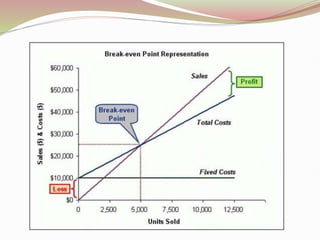
BREAK EVEN ANALYSIS
 Break even analysis is the study of cost-volume-profit
relationship
 Break even point is the point where the gains equal the
losses
 The point defines when an investment will generate a
positive return
 The point where sales or revenues equal expenses
 The point where total costs equal total revenues
 There is no profit made or loss incurred at the break even
point
 It is the lower limit of the profit when prices are set and
margins are determined
 Also known as “point of zero profit”
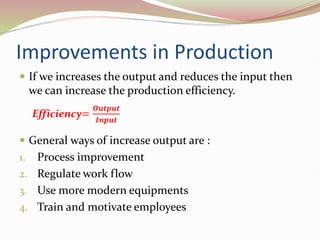
Improvements in Production
 If we increases the output and reduces the input then
we can increase the production efficiency.
 General ways of increase output are :
1. Process improvement
2. Regulate work flow
3. Use more modern equipments
4. Train and motivate employees
Efficiency=
𝑶𝒖𝒕𝒑𝒖𝒕
𝑰𝒏𝒑𝒖𝒕
 General ways of decreases input are:
1. Improve quality
2. Minimize waste
3. Reduce the cost of labour
4. Reduce cost of supply
THANK YOU

production management techniques engg.pptx

  • 1.
  • 3.
    INTRODUCTION  It isdefined as planning , implementation and control of industrial production process to ensure smooth and efficient operation. production management techniques are used in both manufacturing and service industries.  Simply, production management is a process of planning, organizing, directing and controlling the activities of the production function.
  • 4.
    CONCEPT OF PRODUCTION Production is defined as “the step-by-step conversion of one form of material into another form through chemical or mechanical process to create or enhance the utility of the product to the user.”  Thus production is a value addition process. At each stage of processing, there will be value addition.  Edwood Buffa defines production as ‘a process by which goods and services are created’.
  • 5.
    PRODUCTION SYSTEM  Theproduction system of an organization is that part, which produces products of an organization.  It is that activity whereby Resources, flowing within a defined system, are combined & transformed in a controlled manner to add value in accordance with the policies communicated by management.
  • 7.
    Characteristics Of ProductionSystem  1. Production is an organized activity, so every production system has an objective.  2. The system transforms the various Inputs to useful Outputs.  3. It doesn’t operate in Isolation from the other organization system.  4. There exists a feedback about the activities, which is essential to control and improve system performance.
  • 8.
    CLASSIFICATION  Production systemscan be classified as: 1. Job Shop Production 2. Batch Production 3. Mass Production 4. Continuous Production
  • 10.
    JOB SHOP PRODUCTION Job shop production are characterised by manufacturing of one or few quantity of products designed and produced as per the specification of customers within prefixed time and cost.  The distinguishing feature of this is low volume & high variety of products.  A job shop comprises of general purpose machines arranged into different departments.  Each job demands unique technological requirements, demands processing on machines in a certain sequence.
  • 11.
    Characteristics  1. Highvariety of products and low volume.  2. Use of general purpose machines and facilities.  3. Highly skilled operators who can take up each job as a challenge because of uniqueness.  4. Large inventory of materials, tools, parts.  5. Detailed planning is essential for sequencing the requirements of each product, capacities for each work centre and order priorities.
  • 12.
    ADVANTAGES  1. Becauseof general purpose machines and facilities variety of products can be produced.  2. Operators will become more skilled & competent, as each job gives them learning opportunities.  3. Full potential of operators can be utilised.  4. Opportunity exists for creative methods & Innovative ideas.
  • 13.
    LIMITATIONS  1. Highercost due to frequent set up changes.  2. Higher level of inventory at all levels and hence higher inventory cost.  3. Production planning is complicated.  4. Larger space requirements.
  • 14.
    BATCH PRODUCTION  Batchproduction is defined “as a form of manufacturing in which the job passes through the functional departments in lots or batches and each lot may have a different routing.”  It is characterised by the manufacture of limited number of products produced at regular intervals and stocked awaiting sales.
  • 16.
    CHARACTERISTICS  1. Thereis shorter production runs.  2. Plant and machinery are flexible.  3. Manufacturing lead time & cost are lower as compared to job shop production.
  • 17.
    ADVANTAGES  1. Betterutilisation of plant and machinery.  2. Promotes functional specialisation.  3. Cost per unit is lower as compared to job shop production.  4. Lower investment in plant and machinery.  5. Flexibility to accommodate and process number of products.  6. Job satisfaction exists for operators.
  • 18.
    LIMITATIONS  1. Materialhandling is complex because of irregular and longer flows.  2. Production planning and control is complex.  3. Work in process inventory is higher compared to continuous production.  4. Higher set up costs due to frequent changes in set up.
  • 19.
    MASS PRODUCTION  ‘Manufacture of discrete parts or assemblies using a continuous process are called mass production ’.  This production system is justified by very large volume of production.  The machines are arranged in a line or product layout. Product and process standardisation exists and all outputs follow the same path.
  • 20.
    CHARACTERISTICS 1. Standardisation ofproduct and process sequence. 2. Large volume of products. 3. Shorter cycle time of production. 4. Lower in process inventory. 5. Perfectly balanced production lines. 6. Production planning and control is easy. 7. Material handling can be completely automatic.
  • 21.
    ADVANTAGES  1. Higherrate of production with reduced cycle time.  2. Higher capacity utilisation due to line balancing.  3. Less skilled operators are required.  4. Low process inventory.  5. Manufacturing cost per unit is low.
  • 22.
    LIMITATIONS  1. Breakdownof one machine will stop an entire production line.  2. Line layout needs major change with the changes in the product design.  3. High investment in production facilities.  4. The cycle time is determined by the slowest operation.
  • 23.
    CONTINUOUS PRODUCTION  Productionfacilities are arranged as per the sequence of production operations from the first operations to the finished product.  The items are made to flow through the sequence of operations through material handling devices such as conveyors, transfer devices, etc.
  • 25.
    CHARACTERISTICS  1. Dedicatedplant and equipment with zero flexibility.  2. Material handling is fully automated.  3. Process follows a predetermined sequence of operations.  4. Component materials can’t be readily Identified with final product.  5. Planning and scheduling is a routine action.
  • 26.
    ADVANTAGES  1. Standardisationof product and process sequence.  2. Higher rate of production with reduced cycle time.  3. Higher capacity utilisation due to line balancing.  4. Manpower is not required for material handling as it is completely automatic.  5. Person with limited skills can be used on the production line.  6. Unit cost is lower due to high volume of production.
  • 27.
    LIMITATIONS  1. Processnumber of products doesn’t exist.  2. Very high investment for setting flow lines.  3. Product differentiation is limited.
  • 28.
    OBJECTIVES OF PRODUCTIONMANAGEMENT  The objective of the production management is ‘to produce goods services of right quality and quantity at the right time and right manufacturing cost’. RIGHT QUALITY: The quality of product is established based upon the customers needs. The right quality is not necessarily best quality. It is determined by the cost of the product and the technical characteristics as suited to the specific requirements.i.e.
  • 29.
     2. RIGHTQUANTITY The manufacturing organization should produce the products in right number. If they are produced in excess of demand the capital will block up in the form of inventory and if the quantity is produced in short of demand, leads to shortage of products.  3. RIGHT TIME Timeliness of delivery is one of the important parameter to judge the effectiveness of production department. So, the production department has to make the optimal utilization of input resources to achieve its objective.
  • 30.
     4. RIGHTMANUFACTURING COST Manufacturing costs are established before the product is actually manufactured.  All attempts should be made to produce the products at pre-established cost, so as to reduce the variation between actual and the standard (pre-established) cost.
  • 31.
    DIFFRENCE BETWEEN PRODUCTION &PRODUCTIVITY  Production is number of goods made.  Productivity is the number of goods produced divided by employees.  Example: Business A produced 40 chairs with 5 employees  Production: 40 chairs  Productivity: 40chairs/5 employees= 8 Productivity Units produced Input used =
  • 32.
    SCOPE OF PRODUCTIONMANAGEMENT  Production management concern with the conversion of inputs into outputs, using physical resources, so as to provide the desired utilities to the customer while meeting the other organizational objectives of effectiveness, efficiency and adoptability.  It distinguishes itself from other functions such as personnel, marketing, finance, etc., by its primary concern for ‘conversion by using physical resources.’
  • 33.
     Following arethe activities which are listed under production management functions:  1. Location of facilities  2. Plant layouts  3. Product design  4. Process design  5. Production and planning control  6. Quality control  7. Materials management  8. Maintenance management.
  • 34.
    LOCATION OF FACILITIES Location of facilities for operations is a long-term capacity decision which involves a long term commitment about the geographically static factors that affect a business organization. It is an important strategic level decision-making for an organization.  The selection of location is a key-decision as large investment is made in building plant and machinery.
  • 35.
     An improperlocation of plant may lead to waste of all the investments made in plant and machinery equipments.  Hence, location of plant should be based on the company’s expansion plan and policy, diversification plan for the products, changing sources of raw materials and many other factors.  The purpose of the location study is to find the optimal location that will results in the greatest advantage to the organization.
  • 36.
    PLANT LAYOUT  Plantlayout refers to the physical arrangement of facilities. It is the configuration of departments,work centres and equipment in the conversion process.  The overall objective of the plant layout is to design a physical arrangement that meets the required output quality and quantity most economically.
  • 37.
    OBJECTIVES OF PLANTLAYOUT 1. Integrate the production centres 2. Reduce material handling 3. Effective utilization of available space 4. Worker convenience and job satisfaction 5. Flexibility 6. Quick disposal of work 7. Smooth flow of operation 8. Avoids industrial accidents
  • 38.
    PRODUCT DESIGN  Productdesign deals with conversion of ideas into reality. Every business organization have to design, develop and introduce new products as a survival and growth strategy.  Developing the new products and launching them in the market is the biggest challenge faced by the organizations.  The entire process of need identification to physical manufactures of product involves three functions: marketing, product development, manufacturing.
  • 39.
     Product developmenttranslates the needs of customers given by marketing into technical specifications and designing the various features into the product to these specifications.  Manufacturing has the responsibility of selecting the processes by which the product can be manufactured.  Product design and developmentprovides link between marketing, customer needs and expectations and the activities required to manufacture the product.
  • 40.
    PROCESS DESIGN  Processdesign is a macroscopic decision-making of an overall process route for converting the raw material into finished goods.  These decisions encompass the selection of a process, choice of technology, process flow analysis and layout of the facilities.  Hence, the important decisions in process design are to analyzed the workflow for converting raw material into finished product and to select the workstation for each included in the workflow.
  • 41.
    PRODUCTION PLANNING AND CONTROL The principle of production planning and control lies in the statement ‘First Plan Your Work and then Work on Your Plan’.  Main functions of production planning and control includes planning, routing, scheduling, dispatching and follow-up.
  • 42.
     Planning isdeciding in advance what to do, how to do it, when to do it and who is to do it.  Routing may be defined as the selection of path which each part of the product will follow,which being transformed from raw material to finished products. Routing determines the most advantageous path to be followed.  Scheduling may be defined as‘the fixation of time and date for each operation’ as well as it determines the sequence of operations to be followed.
  • 43.
     Dispatching isconcerned with the starting the processes. It gives necessary authority so as to start a particular work, which has already been planned under ‘Routing’ and ‘Scheduling’.  The function of follow-up is to report daily the progress of work in each shop in a prescribed proforma and to investigate the causes of deviations from the planned performance.
  • 44.
    MATERIALS MANAGEMENT  Materialsmanagement is that aspect of management function which is primarily concerned with the acquisition, control and use of materials needed and flow of goods and services connected with the production process having some predetermined objectives in view.
  • 45.
     The mainobjectives of materials management are:  1. To minimize material cost.  2.To purchase, receive, transport and store materials efficiently and to reduce the related cost.  3. To cut down costs through simplification, standardization, value analysis, import substitution, etc.  4. To trace new sources of supply and to develop cordial relations with them in order to ensure continuous supply at reasonable rates.  5. To reduce investment tied in the inventories for use in other productive purposes and to develop high inventory turnover ratios.
  • 46.
    MAINTENANCE MANAGEMENT  Inmodern industry, equipment and machinery are a very important part of the total productive effort. Therefore, their idleness or downtime becomes are very expensive. Hence, it is very important that the plant machinery should be properly maintained.
  • 47.
     The mainobjectives of maintenance management are:  1. To achieve minimum breakdown and to keep the plant in good working condition at the lowest possible cost.  2. To keep the machines and other facilities in such a condition that permits them to be used at their optimal capacity without interruption.  3. To ensure the availability of the machines, buildings and services required by other sections of the factory for the performance of their functions at optimal return on investment.
  • 48.
    BREAK EVEN ANALYSIS Break even analysis is the study of cost-volume-profit relationship  Break even point is the point where the gains equal the losses  The point defines when an investment will generate a positive return  The point where sales or revenues equal expenses  The point where total costs equal total revenues  There is no profit made or loss incurred at the break even point  It is the lower limit of the profit when prices are set and margins are determined  Also known as “point of zero profit”
  • 50.
    Improvements in Production If we increases the output and reduces the input then we can increase the production efficiency.  General ways of increase output are : 1. Process improvement 2. Regulate work flow 3. Use more modern equipments 4. Train and motivate employees Efficiency= 𝑶𝒖𝒕𝒑𝒖𝒕 𝑰𝒏𝒑𝒖𝒕
  • 51.
     General waysof decreases input are: 1. Improve quality 2. Minimize waste 3. Reduce the cost of labour 4. Reduce cost of supply
  • 52.