
PRODUCTION MANAGEMENT 
1
Introduction to Production Management 
2
3 
Overview 
 Introduction 
 Historical Milestones in OM 
 Factors Affecting OM Today 
 Different Ways of Studying OM 
 Wrap-Up: What World-Class Producers Do
4 
Introduction 
 Operations management is the management of an 
organization’s productive resources or its production 
system. 
 A production system takes inputs and converts them 
into outputs. 
 The conversion process is the predominant activity of 
a production system. 
 The primary concern of an operations manager is the 
activities of the conversion process.
5 
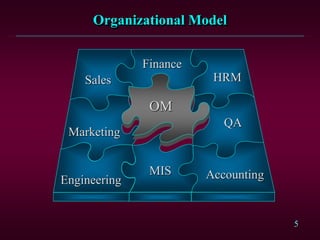
Organizational Model 
Marketing 
MIS 
Engineering 
HRM 
QA 
Accounting 
Sales 
Finance 
OM
6 
Historical Milestones in OM 
 The Industrial Revolution 
 Post-Civil War Period 
 Scientific Management 
 Human Relations and Behaviorism 
 Operations Research 
 The Service Revolution
7 
The Industrial Revolution 
 The industrial revolution developed in England in the 
1700s. 
 The steam engine, invented by James Watt in 1764, 
largely replaced human and water power for factories. 
 Adam Smith’s The Wealth of Nations in 1776 touted 
the economic benefits of the specialization of labor. 
 Thus the late-1700s factories had not only machine 
power but also ways of planning and controlling the 
tasks of workers.
8 
The Industrial Revolution 
 The industrial revolution spread from England to 
other European countries and to the United Sates. 
 In 1790 an American, Eli Whitney, developed the 
concept of interchangeable parts. 
 The first great industry in the US was the textile 
industry. 
 In the 1800s the development of the gasoline engine 
and electricity further advanced the revolution. 
 By the mid-1800s, the old cottage system of 
production had been replaced by the factory system. 
 . . . more
9 
Post-Civil War Period 
 During the post-Civil War period great expansion of 
production capacity occurred. 
 By post-Civil War the following developments set the 
stage for the great production explosion of the 20th 
century: 
 increased capital and production capacity 
 the expanded urban workforce 
 new Western US markets 
 an effective national transportation system
10 
Scientific Management 
 Frederick Taylor is known as the father of scientific 
management. His shop system employed these steps: 
 Each worker’s skill, strength, and learning ability 
were determined. 
 Stopwatch studies were conducted to precisely set 
standard output per worker on each task. 
 Material specifications, work methods, and routing 
sequences were used to organize the shop. 
 Supervisors were carefully selected and trained. 
 Incentive pay systems were initiated.
11 
Scientific Management 
 In the 1920s, Ford Motor Company’s operation 
embodied the key elements of scientific management: 
 standardized product designs 
 mass production 
 low manufacturing costs 
 mechanized assembly lines 
 specialization of labor 
 interchangeable parts
12 
Human Relations and Behavioralism 
 In the 1927-1932 period, researchers in the 
Hawthorne Studies realized that human factors were 
affecting production. 
 Researchers and managers alike were recognizing 
that psychological and sociological factors affected 
production. 
 From the work of behavioralists came a gradual 
change in the way managers thought about and 
treated workers.
13 
Operations Research 
 During World War II, enormous quantities of 
resources (personnel, supplies, equipment, …) had to 
be deployed. 
 Military operations research (OR) teams were formed 
to deal with the complexity of the deployment. 
 After the war, operations researchers found their way 
back to universities, industry, government, and 
consulting firms. 
 OR helps operations managers make decisions when 
problems are complex and wrong decisions are 
costly.
14 
The Service Revolution 
 The creation of services organizations accelerated 
sharply after World War II. 
 Today, more than two-thirds of the US workforce is 
employed in services. 
 About two-thirds of the US GDP is from services. 
 There is a huge trade surplus in services. 
 Investment per office worker now exceeds the 
investment per factory worker. 
 Thus there is a growing need for service operations 
management.
15 
The Computer Revolution 
 Explosive growth of computer and communication 
technologies 
 Easy access to information and the availability of 
more information 
 Advances in software applications such as Enterprise 
Resource Planning (ERP) software 
 Widespread use of email 
 More and more firms becoming involved in E-Business 
using the Internet 
 Result: faster, better decisions over greater distances
16 
Today's Factors Affecting OM 
 Global Competition 
 Quality, Customer Service, and Cost Challenges 
 Rapid Expansion of Advanced Technologies 
 Continued Growth of the Service Sector 
 Scarcity of Operations Resources 
 Social-Responsibility Issues
17 
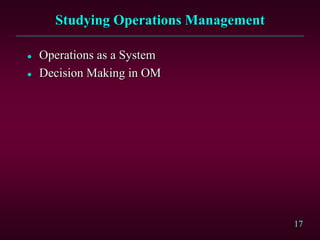
Studying Operations Management 
 Operations as a System 
 Decision Making in OM
18 
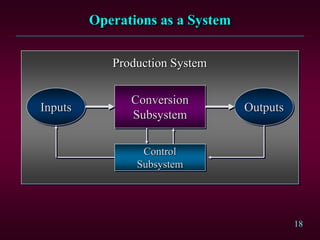
Operations as a System 
Production System 
Conversion 
Subsystem 
Inputs Outputs 
Control 
Subsystem
19 
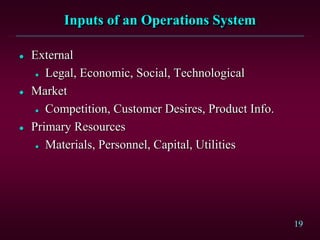
Inputs of an Operations System 
 External 
 Legal, Economic, Social, Technological 
 Market 
 Competition, Customer Desires, Product Info. 
 Primary Resources 
 Materials, Personnel, Capital, Utilities
20 
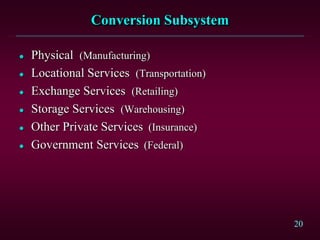
Conversion Subsystem 
 Physical (Manufacturing) 
 Locational Services (Transportation) 
 Exchange Services (Retailing) 
 Storage Services (Warehousing) 
 Other Private Services (Insurance) 
 Government Services (Federal)
21 
Outputs of an Operations System 
 Direct 
 Products 
 Services 
 Indirect 
 Waste 
 Pollution 
 Technological Advances
22 
Production as an Organization Function 
 US companies cannot compete with marketing, 
finance, accounting, and engineering alone. 
 We focus on OM as we think of global 
competitiveness, because that is where the vast 
majority of a firm’s workers, capital assets, and 
expenses reside. 
 To succeed, a firm must have a strong operations 
function teaming with the other organization 
functions.
23 
Decision Making in OM 
 Strategic Decisions 
 Operating Decisions 
 Control Decisions
24 
Strategic Decisions 
 These decisions are of strategic importance and have 
long-term significance for the organization. 
 Examples include deciding: 
 the design for a new product’s production process 
 where to locate a new factory 
 whether to launch a new-product development plan
25 
Operating Decisions 
 These decisions are necessary if the ongoing 
production of goods and services is to satisfy market 
demands and provide profits. 
 Examples include deciding: 
 how much finished-goods inventory to carry 
 the amount of overtime to use next week 
 the details for purchasing raw material next month
26 
Control Decisions 
 These decisions concern the day-to-day activities of 
workers, quality of products and services, production 
and overhead costs, and machine maintenance. 
 Examples include deciding: 
 labor cost standards for a new product 
 frequency of preventive maintenance 
 new quality control acceptance criteria
27 
What Controls the Operations System? 
 Information about the outputs, the conversions, and 
the inputs is fed back to management. 
 This information is matched with management’s 
expectations 
 When there is a difference, management must take 
corrective action to maintain control of the system
28 
Wrap-Up: World Class Practice 
 OM important in any organization 
 Global competition forces rapid evolution of OM 
 Decision based framework focus of course 
 Strategic, Operating, and Control
29 
End of Chapter 1

Production management

  • 1.
  • 2.
  • 3.
    3 Overview Introduction  Historical Milestones in OM  Factors Affecting OM Today  Different Ways of Studying OM  Wrap-Up: What World-Class Producers Do
  • 4.
    4 Introduction Operations management is the management of an organization’s productive resources or its production system.  A production system takes inputs and converts them into outputs.  The conversion process is the predominant activity of a production system.  The primary concern of an operations manager is the activities of the conversion process.
  • 5.
    5 Organizational Model Marketing MIS Engineering HRM QA Accounting Sales Finance OM
  • 6.
    6 Historical Milestonesin OM  The Industrial Revolution  Post-Civil War Period  Scientific Management  Human Relations and Behaviorism  Operations Research  The Service Revolution
  • 7.
    7 The IndustrialRevolution  The industrial revolution developed in England in the 1700s.  The steam engine, invented by James Watt in 1764, largely replaced human and water power for factories.  Adam Smith’s The Wealth of Nations in 1776 touted the economic benefits of the specialization of labor.  Thus the late-1700s factories had not only machine power but also ways of planning and controlling the tasks of workers.
  • 8.
    8 The IndustrialRevolution  The industrial revolution spread from England to other European countries and to the United Sates.  In 1790 an American, Eli Whitney, developed the concept of interchangeable parts.  The first great industry in the US was the textile industry.  In the 1800s the development of the gasoline engine and electricity further advanced the revolution.  By the mid-1800s, the old cottage system of production had been replaced by the factory system.  . . . more
  • 9.
    9 Post-Civil WarPeriod  During the post-Civil War period great expansion of production capacity occurred.  By post-Civil War the following developments set the stage for the great production explosion of the 20th century:  increased capital and production capacity  the expanded urban workforce  new Western US markets  an effective national transportation system
  • 10.
    10 Scientific Management  Frederick Taylor is known as the father of scientific management. His shop system employed these steps:  Each worker’s skill, strength, and learning ability were determined.  Stopwatch studies were conducted to precisely set standard output per worker on each task.  Material specifications, work methods, and routing sequences were used to organize the shop.  Supervisors were carefully selected and trained.  Incentive pay systems were initiated.
  • 11.
    11 Scientific Management  In the 1920s, Ford Motor Company’s operation embodied the key elements of scientific management:  standardized product designs  mass production  low manufacturing costs  mechanized assembly lines  specialization of labor  interchangeable parts
  • 12.
    12 Human Relationsand Behavioralism  In the 1927-1932 period, researchers in the Hawthorne Studies realized that human factors were affecting production.  Researchers and managers alike were recognizing that psychological and sociological factors affected production.  From the work of behavioralists came a gradual change in the way managers thought about and treated workers.
  • 13.
    13 Operations Research  During World War II, enormous quantities of resources (personnel, supplies, equipment, …) had to be deployed.  Military operations research (OR) teams were formed to deal with the complexity of the deployment.  After the war, operations researchers found their way back to universities, industry, government, and consulting firms.  OR helps operations managers make decisions when problems are complex and wrong decisions are costly.
  • 14.
    14 The ServiceRevolution  The creation of services organizations accelerated sharply after World War II.  Today, more than two-thirds of the US workforce is employed in services.  About two-thirds of the US GDP is from services.  There is a huge trade surplus in services.  Investment per office worker now exceeds the investment per factory worker.  Thus there is a growing need for service operations management.
  • 15.
    15 The ComputerRevolution  Explosive growth of computer and communication technologies  Easy access to information and the availability of more information  Advances in software applications such as Enterprise Resource Planning (ERP) software  Widespread use of email  More and more firms becoming involved in E-Business using the Internet  Result: faster, better decisions over greater distances
  • 16.
    16 Today's FactorsAffecting OM  Global Competition  Quality, Customer Service, and Cost Challenges  Rapid Expansion of Advanced Technologies  Continued Growth of the Service Sector  Scarcity of Operations Resources  Social-Responsibility Issues
  • 17.
    17 Studying OperationsManagement  Operations as a System  Decision Making in OM
  • 18.
    18 Operations asa System Production System Conversion Subsystem Inputs Outputs Control Subsystem
  • 19.
    19 Inputs ofan Operations System  External  Legal, Economic, Social, Technological  Market  Competition, Customer Desires, Product Info.  Primary Resources  Materials, Personnel, Capital, Utilities
  • 20.
    20 Conversion Subsystem  Physical (Manufacturing)  Locational Services (Transportation)  Exchange Services (Retailing)  Storage Services (Warehousing)  Other Private Services (Insurance)  Government Services (Federal)
  • 21.
    21 Outputs ofan Operations System  Direct  Products  Services  Indirect  Waste  Pollution  Technological Advances
  • 22.
    22 Production asan Organization Function  US companies cannot compete with marketing, finance, accounting, and engineering alone.  We focus on OM as we think of global competitiveness, because that is where the vast majority of a firm’s workers, capital assets, and expenses reside.  To succeed, a firm must have a strong operations function teaming with the other organization functions.
  • 23.
    23 Decision Makingin OM  Strategic Decisions  Operating Decisions  Control Decisions
  • 24.
    24 Strategic Decisions  These decisions are of strategic importance and have long-term significance for the organization.  Examples include deciding:  the design for a new product’s production process  where to locate a new factory  whether to launch a new-product development plan
  • 25.
    25 Operating Decisions  These decisions are necessary if the ongoing production of goods and services is to satisfy market demands and provide profits.  Examples include deciding:  how much finished-goods inventory to carry  the amount of overtime to use next week  the details for purchasing raw material next month
  • 26.
    26 Control Decisions  These decisions concern the day-to-day activities of workers, quality of products and services, production and overhead costs, and machine maintenance.  Examples include deciding:  labor cost standards for a new product  frequency of preventive maintenance  new quality control acceptance criteria
  • 27.
    27 What Controlsthe Operations System?  Information about the outputs, the conversions, and the inputs is fed back to management.  This information is matched with management’s expectations  When there is a difference, management must take corrective action to maintain control of the system
  • 28.
    28 Wrap-Up: WorldClass Practice  OM important in any organization  Global competition forces rapid evolution of OM  Decision based framework focus of course  Strategic, Operating, and Control
  • 29.
    29 End ofChapter 1