PAPER PRESENTATION ON
 NON VERBAL COMUNICATION


                           1
Non Verbal
Communication

                2
Verbal       Nonverbal
Communicatio Communication
      n
Thewords we   Bodily  actions and
   use          vocal qualities that
                typically accompany
                a verbal message


                                       3
IMPORTANCE OF NON-VERBAL
COMMUNICATION

♦ only 7% of a message’s effect is carried by
 words ; listeners receive the other 93% through
 non -verbal means - Communication
 researcher Mehrabian

 ♦Over 65 percent of the social meaning of the
 messages we send to others are communicated
 non-verbally.


                                                  4
“What you are speaks
so loudly that I cannot
 hear what you say”

   -Ralph Waldo Emerson


                          5
Characteristics of Nonverbal
Communication

 Intentional   or unintentional
 Ambiguous

 Primary

 Continuous

 Multichanneled

                                   6
Functions of Nonverbal
Communication
To   provide information
To   regulate interaction
To   express or hide emotion and affect
To   present an image
To   express power and control

                                           7
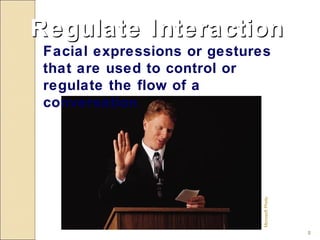
Regulate Interaction
 Facial expressions or gestures
 that are used to control or
 regulate the flow of a
 conversation


                              Microsoft Photo
                                                8
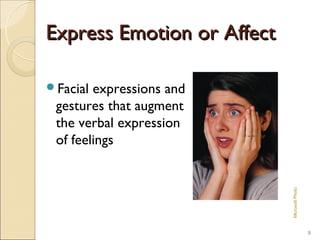
Express Emotion or Affect

Facial expressions and
 gestures that augment
 the verbal expression
 of feelings


                            Microsoft Photo
                                              9
Types of Nonverbal
Communication
   Kinesics
   Paralanguage
   Vocal interferences
   Spatial Usage                     tthiing
                                     y h ng
   Self-presentation        E v e rry p t
                             E ve e pt
     cues                       e xc e
                                 e xc s!
                                 worrd s !
                             e wo d
                          tth e
                            h

                                                10
Kinesics

Eye   Contact
Facial   expressions
Emoticons
Gesture
Posture
Touch

                        11
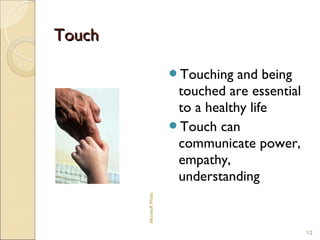
Touch

                          Touching   and being
                           touched are essential
                           to a healthy life
                          Touch can
                           communicate power,
                           empathy,
                           understanding
        Microsoft Photo


                                                   12
Paralanguage
 Pitch
 Volume
 Rate
 Quality
 Intonation


               13
Vocal Interferences
 Extraneous   sounds or words
  that interrupt fluent speech
  ◦ “uh,” “um”
  ◦ “you know,” “like”
 Place    markers
 Filler


                                 14
Spatial Usage
Proxemics
  ◦ Intimate distance
  ◦ Personal distance
  ◦ Social distance
  ◦ Public Distance
Territory


                        15
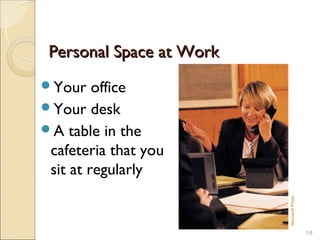
Personal Space at Work
Your    office
Your desk
A table in the
 cafeteria that you
 sit at regularly


                          Microsoft Photo
                                            16
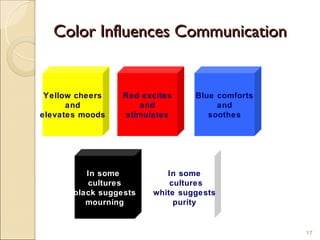
Color Influences Communication


 Yellow cheers    Red excites    Blue comforts
      and              and            and
elevates moods     stimulates       soothes


          In some          In some
          cultures          cultures
       black suggests   white suggests
          mourning           purity


                                                 17
Self-Presentation Cues
 Physical    Appearance

 Time   (Chronemics)

 Olfactory   Communication


                              18
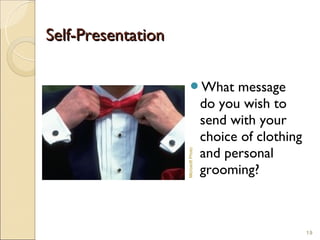
Self-Presentation

                       What                message
                                      do you wish to
                                      send with your
                                      choice of clothing
                                      and personal

                    Microsoft Photo
                                      grooming?


                                                           19
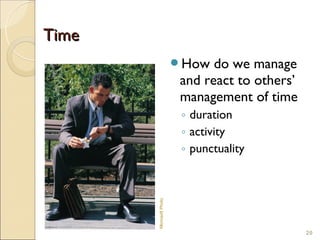
Time
                         How  do we manage
                         and react to others’
                         management of time
                          ◦ duration
                          ◦ activity
                          ◦ punctuality
       Microsoft Photo


                                                20
Cultural and Gender Variations


Kinesics
Paralanguage
Proxemics  and Territory
Olfactory Communication


                                 21
Nonverbal
Vary from culture to
Signals
culture


                       Microsoft Photo
                                         22
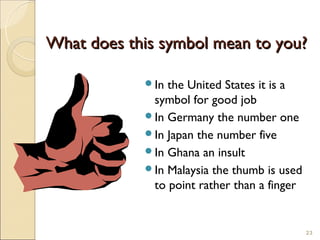
What does this symbol mean to you?

            In the United States it is a
             symbol for good job
            In Germany the number one
            In Japan the number five
            In Ghana an insult
            In Malaysia the thumb is used
             to point rather than a finger


                                             23
Improving Nonverbal Communication
Skills
•When sending messages
 • Be conscious of nonverbal behavior
 • Be purposeful in use of nonverbals
 • Make sure nonverbals are not distracting
 • Match verbal and nonverbal communication
 • Adapt to the situation


                                          24
Improving Nonverbal Communication
Skills
•When receiving messages
  • Don’t automatically assume
  • Consider gender, culture and individual
  differences
  • Pay attention to all aspects of nonverbal
  communication
  • Use perception checking

                                                25
Teachers should be aware of nonverbal behavior for
three major reasons:
An  awareness of nonverbal behavior will
 allow you to become better receivers of
 students' messages.
You will become a better sender of
 signals that reinforce learning.
This mode of communication increases
 the degree of the perceived psychological
 closeness between teacher and student.


                                                     26
Creating a climate that facilitates
learning and retention demands
     good nonverbal skills.


       THANK YOU

                                      27

Ppt non verbal communication

  • 1.
    PAPER PRESENTATION ON NON VERBAL COMUNICATION 1
  • 2.
  • 3.
    Verbal Nonverbal Communicatio Communication n Thewords we Bodily actions and use vocal qualities that typically accompany a verbal message 3
  • 4.
    IMPORTANCE OF NON-VERBAL COMMUNICATION ♦only 7% of a message’s effect is carried by words ; listeners receive the other 93% through non -verbal means - Communication researcher Mehrabian  ♦Over 65 percent of the social meaning of the messages we send to others are communicated non-verbally. 4
  • 5.
    “What you arespeaks so loudly that I cannot hear what you say” -Ralph Waldo Emerson 5
  • 6.
    Characteristics of Nonverbal Communication Intentional or unintentional Ambiguous Primary Continuous Multichanneled 6
  • 7.
    Functions of Nonverbal Communication To provide information To regulate interaction To express or hide emotion and affect To present an image To express power and control 7
  • 8.
    Regulate Interaction Facialexpressions or gestures that are used to control or regulate the flow of a conversation Microsoft Photo 8
  • 9.
    Express Emotion orAffect Facial expressions and gestures that augment the verbal expression of feelings Microsoft Photo 9
  • 10.
    Types of Nonverbal Communication  Kinesics  Paralanguage  Vocal interferences  Spatial Usage tthiing y h ng  Self-presentation E v e rry p t E ve e pt cues e xc e e xc s! worrd s ! e wo d tth e h 10
  • 11.
    Kinesics Eye Contact Facial expressions Emoticons Gesture Posture Touch 11
  • 12.
    Touch Touching and being touched are essential to a healthy life Touch can communicate power, empathy, understanding Microsoft Photo 12
  • 13.
    Paralanguage Pitch Volume Rate Quality Intonation 13
  • 14.
    Vocal Interferences Extraneous sounds or words that interrupt fluent speech ◦ “uh,” “um” ◦ “you know,” “like” Place markers Filler 14
  • 15.
    Spatial Usage Proxemics ◦ Intimate distance ◦ Personal distance ◦ Social distance ◦ Public Distance Territory 15
  • 16.
    Personal Space atWork Your office Your desk A table in the cafeteria that you sit at regularly Microsoft Photo 16
  • 17.
    Color Influences Communication Yellow cheers Red excites Blue comforts and and and elevates moods stimulates soothes In some In some cultures cultures black suggests white suggests mourning purity 17
  • 18.
    Self-Presentation Cues Physical Appearance Time (Chronemics) Olfactory Communication 18
  • 19.
    Self-Presentation What message do you wish to send with your choice of clothing and personal Microsoft Photo grooming? 19
  • 20.
    Time How do we manage and react to others’ management of time ◦ duration ◦ activity ◦ punctuality Microsoft Photo 20
  • 21.
    Cultural and GenderVariations Kinesics Paralanguage Proxemics and Territory Olfactory Communication 21
  • 22.
    Nonverbal Vary from cultureto Signals culture Microsoft Photo 22
  • 23.
    What does thissymbol mean to you? In the United States it is a symbol for good job In Germany the number one In Japan the number five In Ghana an insult In Malaysia the thumb is used to point rather than a finger 23
  • 24.
    Improving Nonverbal Communication Skills •Whensending messages • Be conscious of nonverbal behavior • Be purposeful in use of nonverbals • Make sure nonverbals are not distracting • Match verbal and nonverbal communication • Adapt to the situation 24
  • 25.
    Improving Nonverbal Communication Skills •Whenreceiving messages • Don’t automatically assume • Consider gender, culture and individual differences • Pay attention to all aspects of nonverbal communication • Use perception checking 25
  • 26.
    Teachers should beaware of nonverbal behavior for three major reasons: An awareness of nonverbal behavior will allow you to become better receivers of students' messages. You will become a better sender of signals that reinforce learning. This mode of communication increases the degree of the perceived psychological closeness between teacher and student. 26
  • 27.
    Creating a climatethat facilitates learning and retention demands good nonverbal skills. THANK YOU 27

Editor's Notes