Marketing Information System & Marketing Research www.profmanishparihar.blogspot.com
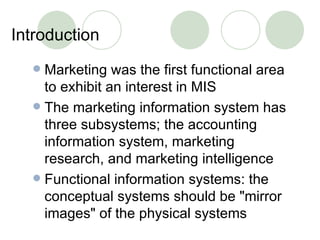
Introduction Marketing was the first functional area to exhibit an interest in MIS The marketing information system has three subsystems; the accounting information system, marketing research, and marketing intelligence Functional information systems: the conceptual systems should be "mirror images" of the physical systems
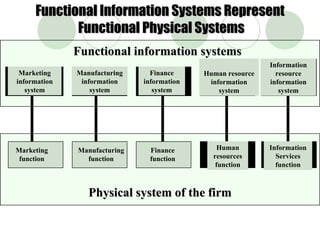
Functional information systems Marketing information system Manufacturing information system Finance information system Human resource information system Marketing function Manufacturing function Finance function Human resources function Physical system of the firm Functional Information Systems Represent Functional Physical Systems Information resource information system Information Services function
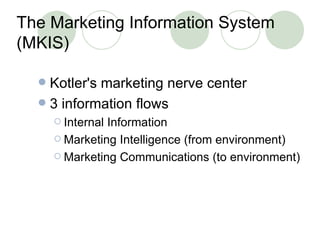
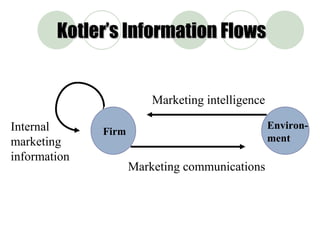
The Marketing Information System (MKIS) Kotler's marketing nerve center 3 information flows Internal Information Marketing Intelligence (from environment) Marketing Communications (to environment)
Firm Environ- ment Marketing intelligence Marketing communications Internal marketing information Kotler’s Information Flows
Marketing Information System (MKIS) Definition A computer-based system that works in conjunction with other functional information  systems to support the firm's management in solving problems that relate to marketing the firm's products.
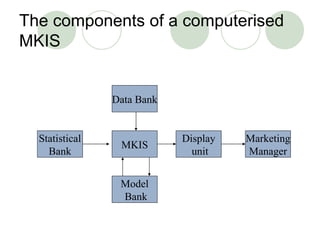
The components of a computerised MKIS Model Bank Data Bank Statistical Bank MKIS Display unit Marketing Manager
The components of a computerised MKIS Data bank - raw data e.g historical sales data, secondary data Statistical bank -  programmes to carry-out sales forecasts, spending projections A model bank - stores marketing models e.g Ansoff’s matrix, Boston Matrix Display unit - VDU and keyboard
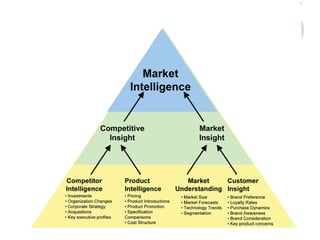
Marketing Intelligence Marketing Intelligence  ( MI ) is the information relevant to a company’s markets, gathered and analyzed specifically for the purpose of accurate and confident decision-making in determining market opportunity, market penetration strategy, and market development metrics.  - wikipedia
 
Marketing Research ‘ the systematic gathering, recording and analysing of data about problems relating to the marketing of goods and services’ American Marketing Association
The Marketing Research Process Set objectives Define research Problem Assess the value of the research Construct a research proposal Specify data collection method Specify techniques of measurement Select the sample Data collection Analysis of results Present in a final report
Terminology of Marketing Research Primary data - collected firsthand Secondary data - already exists, desk research Quantitative research - statistical basis Qualitative research - subjective and personal sampling - studying part of a ‘population’ to learn about the whole
Marketing Research Techniques Interviews face-to-face telephone postal questionnaire Attitude measurement cognitive component (know/believe about an act/object) affective component (feel about an act/object) conative component (behave towards an object or act)
Group discussion and focus group Postal research questionnaires Diary panels - sources of continuous data In-home scanning - hand-held light pen to scan barcodes Telephone research Observation home audit direct observation In-store testing
www.profmanishparihar.blogspot.cm Sources:  www.marketingteacher.com

Marketing information system

  • 1.
    Marketing Information System& Marketing Research www.profmanishparihar.blogspot.com
  • 2.
    Introduction Marketing wasthe first functional area to exhibit an interest in MIS The marketing information system has three subsystems; the accounting information system, marketing research, and marketing intelligence Functional information systems: the conceptual systems should be "mirror images" of the physical systems
  • 3.
    Functional information systemsMarketing information system Manufacturing information system Finance information system Human resource information system Marketing function Manufacturing function Finance function Human resources function Physical system of the firm Functional Information Systems Represent Functional Physical Systems Information resource information system Information Services function
  • 4.
    The Marketing InformationSystem (MKIS) Kotler's marketing nerve center 3 information flows Internal Information Marketing Intelligence (from environment) Marketing Communications (to environment)
  • 5.
    Firm Environ- mentMarketing intelligence Marketing communications Internal marketing information Kotler’s Information Flows
  • 6.
    Marketing Information System(MKIS) Definition A computer-based system that works in conjunction with other functional information systems to support the firm's management in solving problems that relate to marketing the firm's products.
  • 7.
    The components ofa computerised MKIS Model Bank Data Bank Statistical Bank MKIS Display unit Marketing Manager
  • 8.
    The components ofa computerised MKIS Data bank - raw data e.g historical sales data, secondary data Statistical bank - programmes to carry-out sales forecasts, spending projections A model bank - stores marketing models e.g Ansoff’s matrix, Boston Matrix Display unit - VDU and keyboard
  • 9.
    Marketing Intelligence MarketingIntelligence ( MI ) is the information relevant to a company’s markets, gathered and analyzed specifically for the purpose of accurate and confident decision-making in determining market opportunity, market penetration strategy, and market development metrics. - wikipedia
  • 10.
  • 11.
    Marketing Research ‘the systematic gathering, recording and analysing of data about problems relating to the marketing of goods and services’ American Marketing Association
  • 12.
    The Marketing ResearchProcess Set objectives Define research Problem Assess the value of the research Construct a research proposal Specify data collection method Specify techniques of measurement Select the sample Data collection Analysis of results Present in a final report
  • 13.
    Terminology of MarketingResearch Primary data - collected firsthand Secondary data - already exists, desk research Quantitative research - statistical basis Qualitative research - subjective and personal sampling - studying part of a ‘population’ to learn about the whole
  • 14.
    Marketing Research TechniquesInterviews face-to-face telephone postal questionnaire Attitude measurement cognitive component (know/believe about an act/object) affective component (feel about an act/object) conative component (behave towards an object or act)
  • 15.
    Group discussion andfocus group Postal research questionnaires Diary panels - sources of continuous data In-home scanning - hand-held light pen to scan barcodes Telephone research Observation home audit direct observation In-store testing
  • 16.

Editor's Notes