DESIGNING SCHOOL
CURRICULUM APPROACHES
Desired Learning Outcomes
> Describe the different approaches to school
curriculum
> Explain by examples how the approaches clarify
the definition of curriculum
> Reflect on how the three approaches interrelate
to each other
THREE WAYS OF APPROACHING A
CURRICULUM
Curriculum can be approached or seen in three ways. It
can be defined as a content, a process or an outcome. If you
examine the definitions provided by the experts in the field,
there are three ways of approaching a curriculum. First, is to
approach it as content or a body of knowledge to be transmitted.
Second, is to approach it as a product or the learning outcomes
desired of learners. Third, is tp approach it as a process or what
actually happens in the classroom when the curriculum is
practiced.
It is quite for traditionalists to equate a curriculum to a
topic outline, subject matter, or concepts to be included in the
syllabus or a books. For example, a primary school mathematics
curriculum consists of topics on addition, multiplication,
subtraction, division, distance, weight and many more. Another
example is in secondary school science that involves the study
of biological science, physical science, environmental science
and earth science.
1. Curriculum as a content or body of
knowledge
There are four ways of presenting the
content in the curriculum.
THESE ARE.
1. Topical Approach, where much content is based on knowledge,
and experiences are included;
2. Concept Approach, with fewer topics in clusters around major
and sub-concepts and their interaction, with relatedness
emphasized;
3. Thematic Approach as a combination of concepts that
developed conceptual structures, and
4. Modular Approach that leads to complete units of instruction.
There are some suggested criteria in the
selection of knowledge or subject matter.
(Scheffer, 1970 in Bilbao, et al 2015)
1. Significance
Content should contribute to ideas, concepts, principles and
generalization that should attain the overall purpose of the
curriculum. It is significant if content becomes the means of
developing cognitive, affective or psychomotor skills of the
learner. As education is a way of preserving culture, content will
be significant when this is address the cultural context of the
learners.
2. Validity
The authenticity of the subject matter
forms its validity. Knowledge beomes obselete
with the fast changing times. Thu there is a
need for validity check and verification at a
regular interval, because content which may be
valid in its original form may not continue to be
valid in the current times.
3. Utility
Usefulness of the content in the
curriculum is relative to the learners who are
going to use these. Utility can be relative to
time. It may have been useful in the past, but
may not be useful now or in the future.
Questions like: Will i use this in my future job?
Will it add meaning to my life as a lifelong
learner? Or will the subject matter be useful in
solving current concerns?
4. Learnability
The complexity of the content should be
within the range of experience of the learners.
This is based on the psychological principles of
learning. Appropriate organization of content
standards and sequencing of contents are two
basic principles that would influence
learnability.
5. Feasebility
Can be subject content be learned within the
time allowed, resources available, expertise of the
teaches and the nature of the learners? Are there
contents of learning which can be learned beyond
the formal teaching-learning engagement? Are
there opportunities provided to be learn these?
6. Interest
Will the learners take interest in the content?
Why? Are the contents meaningful? What
value will the contents have in the present and
future life of the learners? Interest is one of the
driving forces for students to learn better?
Guide in the selection of the content
in the Curriculum
1. Commonly used in daily life
2. Appropriate to the maturity levels and abilities of the learners
3. Valuable in meeting the needs and competencies of the future
career
4. Related to other subject fields or diciplines for
complementations and integration.
5. Important in the transfer of learning to other diciplines
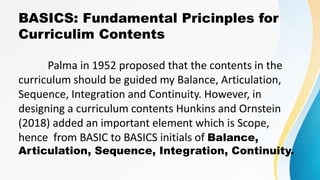
BASICS: Fundamental Pricinples for
Curriculim Contents
Palma in 1952 proposed that the contents in the
curriculum should be guided my Balance, Articulation,
Sequence, Integration and Continuity. However, in
designing a curriculum contents Hunkins and Ornstein
(2018) added an important element which is Scope,
hence from BASIC to BASICS initials of Balance,
Articulation, Sequence, Integration, Continuity.
BALANCE
Content should be fairly distributed in
deph and breadth. This will guarantee that
significant contents should be covered to avoid
too much or too little of the contents needed
with in the time allocation.
ARTICULATION
As the content complexity progress with the educational
levels, vertically or horizontally, across the same dicipline smooth
connections or bridging should be provided. This will assure no
gaps or overlaps in the content. Seamlessness in the content is
desired and can be assured if there is articulation in the
curriculum. Thus, there 15 a need off team among writers and
implementers of curriculum.
SEQUENCE
The logical arrangement of the content refers to
sequence or order. This can be done vertically for
deepening the content pr horizontally for broadening the
same content. In both ways, the pattern usually is from
easy to complex, what is known to the unknown, what is
current something in the future.
INTEGRATION
The content in the curriculum does not stand alone
or in isolation. It has some ways of relatedness or
connectedness in to other content. Contents should be
infused in other diciplines whenever possible. This will
provide a wholistic or unified view of curriculum instead
of segmentation. Contents which can be integrated to
other deciplines acquire in a higher prenuim than we
isolated.
CONTINUITY
Content when viewed as a curriculum should
continuously flow as it was before, to where it is now,and
where it will be in the future. Content may not be in the
same form and substance as seen in the past since
changes and development in curriculum occur. Constant
repetition, reinforcement and enhancement of content
are all elements of continuity.
SCOPE
The breadth and depth of the curriculum content
are vital in a curriculum, scope consists of all the contents,
topics, learninh experiences comprising the curriculum.
The scope shall consider the cognitive level, affective
domain and psychomotor skills in identifying the
contents. Other factors will be considered but caution is
given to overloading of contents. “More contents is not
always better.”
2. CURRICULUM AS A PROCESS
We have seen that the curriculum can be approached as
content. on the other hand, it can also be approached as a
process. Here, curriculum is not seen as a physical thing or a
noun, but as a verb or an action. It is the interaction among the
teachers, students and content. As a process, curriculum
happens in the classroom as the questions asked by the teacher
and the learning activities engaged in by the students. It is an
active process with emphasis on the context in which the
processes occur. Used in analogy of the recipe in a cookbook, a
recipe is the content while the ways of cooking is the process.
SOME OF THE ANSWERS WILL BE:
1. Problem based.
2. Hands-on, Minds-on
3. Cooperative Learning
4. Blended Curriculum
5. On-Line
6. Case-based and many more.
When Curriculum is approached as a PROCESS,
guiding principles are presented.
1. Curriculum process in the form of teaching method or
strategies are means to achieve the end.
2. There is no single best process or method. Its effectiveness will
depend on the desired learning outcomes, the learners, support
materials and the teacher.
3. Curriculum process should stimulate the learners desire to
develop the cognitive, affective, psychomotor domains in each
individual.
4. In the choice of methods, learning and teaching styles
should be considered.
5. Every method or process should result to learning
outcomes which can be described as cognitive, affective
and psychomotor.
6. Flexibility in the ude of the process or methods should
be considered. An effective process will always result to
learning outcomes.
7. Both teaching and learning are the two important
processes in the implementation of the curriculum.
3. CURRICULUM AS A PRODUCT
Besides viewing curriculum as content that is
to be transmitted, or process that gives action using
the content, it has also been viewed as a product. In
other words, product is what the students to
achieve as learning outcomes.
Curriculum as a product
The product from the curriculum is a student equiped with the
knowledge, skills and values to function effectively and effeciently. The
real purpose of education is to bring about significant changes in students’
pattern of behavior. It is importanr that any statement of objectives or
intended outcomes of the school should be a statement of changes to take
place in the students. Central to the approach is the formulation of
behavioral objective stated as intended learning outcomes or desired
products so that content and teaching methods may be organized and the
results evaluated. Products of learning are operationalized as
knowledge,skills, and values.
CURRICULUM AS A PRODUCT
Curriculum product is expressed in the form of outcomes
which are reffered to as the achieved learning outcomes. There
may be several desired learning outcomes, but if the process is
not successful, then no learning outcomes will be achieved.
These learned or achieved learning outcomes are demonstrated
by the person who has meaningful experiences in the curriculum.
All of these are result of planning, content and processes in the
curriculum.

DESIGNING SCHOOL CURRICULUM APPROACHES.pptx

  • 1.
  • 2.
    Desired Learning Outcomes >Describe the different approaches to school curriculum > Explain by examples how the approaches clarify the definition of curriculum > Reflect on how the three approaches interrelate to each other
  • 3.
    THREE WAYS OFAPPROACHING A CURRICULUM Curriculum can be approached or seen in three ways. It can be defined as a content, a process or an outcome. If you examine the definitions provided by the experts in the field, there are three ways of approaching a curriculum. First, is to approach it as content or a body of knowledge to be transmitted. Second, is to approach it as a product or the learning outcomes desired of learners. Third, is tp approach it as a process or what actually happens in the classroom when the curriculum is practiced.
  • 4.
    It is quitefor traditionalists to equate a curriculum to a topic outline, subject matter, or concepts to be included in the syllabus or a books. For example, a primary school mathematics curriculum consists of topics on addition, multiplication, subtraction, division, distance, weight and many more. Another example is in secondary school science that involves the study of biological science, physical science, environmental science and earth science. 1. Curriculum as a content or body of knowledge
  • 5.
    There are fourways of presenting the content in the curriculum. THESE ARE. 1. Topical Approach, where much content is based on knowledge, and experiences are included; 2. Concept Approach, with fewer topics in clusters around major and sub-concepts and their interaction, with relatedness emphasized; 3. Thematic Approach as a combination of concepts that developed conceptual structures, and 4. Modular Approach that leads to complete units of instruction.
  • 6.
    There are somesuggested criteria in the selection of knowledge or subject matter. (Scheffer, 1970 in Bilbao, et al 2015) 1. Significance Content should contribute to ideas, concepts, principles and generalization that should attain the overall purpose of the curriculum. It is significant if content becomes the means of developing cognitive, affective or psychomotor skills of the learner. As education is a way of preserving culture, content will be significant when this is address the cultural context of the learners.
  • 7.
    2. Validity The authenticityof the subject matter forms its validity. Knowledge beomes obselete with the fast changing times. Thu there is a need for validity check and verification at a regular interval, because content which may be valid in its original form may not continue to be valid in the current times.
  • 8.
    3. Utility Usefulness ofthe content in the curriculum is relative to the learners who are going to use these. Utility can be relative to time. It may have been useful in the past, but may not be useful now or in the future. Questions like: Will i use this in my future job? Will it add meaning to my life as a lifelong learner? Or will the subject matter be useful in solving current concerns?
  • 9.
    4. Learnability The complexityof the content should be within the range of experience of the learners. This is based on the psychological principles of learning. Appropriate organization of content standards and sequencing of contents are two basic principles that would influence learnability.
  • 10.
    5. Feasebility Can besubject content be learned within the time allowed, resources available, expertise of the teaches and the nature of the learners? Are there contents of learning which can be learned beyond the formal teaching-learning engagement? Are there opportunities provided to be learn these?
  • 11.
    6. Interest Will thelearners take interest in the content? Why? Are the contents meaningful? What value will the contents have in the present and future life of the learners? Interest is one of the driving forces for students to learn better?
  • 12.
    Guide in theselection of the content in the Curriculum 1. Commonly used in daily life 2. Appropriate to the maturity levels and abilities of the learners 3. Valuable in meeting the needs and competencies of the future career 4. Related to other subject fields or diciplines for complementations and integration. 5. Important in the transfer of learning to other diciplines
  • 13.
    BASICS: Fundamental Pricinplesfor Curriculim Contents Palma in 1952 proposed that the contents in the curriculum should be guided my Balance, Articulation, Sequence, Integration and Continuity. However, in designing a curriculum contents Hunkins and Ornstein (2018) added an important element which is Scope, hence from BASIC to BASICS initials of Balance, Articulation, Sequence, Integration, Continuity.
  • 14.
    BALANCE Content should befairly distributed in deph and breadth. This will guarantee that significant contents should be covered to avoid too much or too little of the contents needed with in the time allocation.
  • 15.
    ARTICULATION As the contentcomplexity progress with the educational levels, vertically or horizontally, across the same dicipline smooth connections or bridging should be provided. This will assure no gaps or overlaps in the content. Seamlessness in the content is desired and can be assured if there is articulation in the curriculum. Thus, there 15 a need off team among writers and implementers of curriculum.
  • 16.
    SEQUENCE The logical arrangementof the content refers to sequence or order. This can be done vertically for deepening the content pr horizontally for broadening the same content. In both ways, the pattern usually is from easy to complex, what is known to the unknown, what is current something in the future.
  • 17.
    INTEGRATION The content inthe curriculum does not stand alone or in isolation. It has some ways of relatedness or connectedness in to other content. Contents should be infused in other diciplines whenever possible. This will provide a wholistic or unified view of curriculum instead of segmentation. Contents which can be integrated to other deciplines acquire in a higher prenuim than we isolated.
  • 18.
    CONTINUITY Content when viewedas a curriculum should continuously flow as it was before, to where it is now,and where it will be in the future. Content may not be in the same form and substance as seen in the past since changes and development in curriculum occur. Constant repetition, reinforcement and enhancement of content are all elements of continuity.
  • 19.
    SCOPE The breadth anddepth of the curriculum content are vital in a curriculum, scope consists of all the contents, topics, learninh experiences comprising the curriculum. The scope shall consider the cognitive level, affective domain and psychomotor skills in identifying the contents. Other factors will be considered but caution is given to overloading of contents. “More contents is not always better.”
  • 20.
    2. CURRICULUM ASA PROCESS We have seen that the curriculum can be approached as content. on the other hand, it can also be approached as a process. Here, curriculum is not seen as a physical thing or a noun, but as a verb or an action. It is the interaction among the teachers, students and content. As a process, curriculum happens in the classroom as the questions asked by the teacher and the learning activities engaged in by the students. It is an active process with emphasis on the context in which the processes occur. Used in analogy of the recipe in a cookbook, a recipe is the content while the ways of cooking is the process.
  • 21.
    SOME OF THEANSWERS WILL BE: 1. Problem based. 2. Hands-on, Minds-on 3. Cooperative Learning 4. Blended Curriculum 5. On-Line 6. Case-based and many more.
  • 22.
    When Curriculum isapproached as a PROCESS, guiding principles are presented. 1. Curriculum process in the form of teaching method or strategies are means to achieve the end. 2. There is no single best process or method. Its effectiveness will depend on the desired learning outcomes, the learners, support materials and the teacher. 3. Curriculum process should stimulate the learners desire to develop the cognitive, affective, psychomotor domains in each individual.
  • 23.
    4. In thechoice of methods, learning and teaching styles should be considered. 5. Every method or process should result to learning outcomes which can be described as cognitive, affective and psychomotor. 6. Flexibility in the ude of the process or methods should be considered. An effective process will always result to learning outcomes. 7. Both teaching and learning are the two important processes in the implementation of the curriculum.
  • 24.
    3. CURRICULUM ASA PRODUCT Besides viewing curriculum as content that is to be transmitted, or process that gives action using the content, it has also been viewed as a product. In other words, product is what the students to achieve as learning outcomes.
  • 25.
    Curriculum as aproduct The product from the curriculum is a student equiped with the knowledge, skills and values to function effectively and effeciently. The real purpose of education is to bring about significant changes in students’ pattern of behavior. It is importanr that any statement of objectives or intended outcomes of the school should be a statement of changes to take place in the students. Central to the approach is the formulation of behavioral objective stated as intended learning outcomes or desired products so that content and teaching methods may be organized and the results evaluated. Products of learning are operationalized as knowledge,skills, and values.
  • 26.
    CURRICULUM AS APRODUCT Curriculum product is expressed in the form of outcomes which are reffered to as the achieved learning outcomes. There may be several desired learning outcomes, but if the process is not successful, then no learning outcomes will be achieved. These learned or achieved learning outcomes are demonstrated by the person who has meaningful experiences in the curriculum. All of these are result of planning, content and processes in the curriculum.