Models of Curriculum Evaluation and
Application in Educational
Technology
Koledafe Olawale Sunday
Centre for Open and Distance Learning
University of Ilorin, Nigeria
Kolawole Rasaq Omodolapo
Busari Taibat Tolani
Department of Educational Technology
University of Ilorin, Nigeria
What is Curriculum?
Curriculum can be defined as the planned and guided
learning experiences and intended learning outcomes,
formulated through the systematic reconstruction of
knowledge and experiences, under the auspices of the
school, for the learners’ continuous and willful growth
in personal social competence (Tanner & Tanner, 1975)
Smith (2000) four main contexts in
curriculum definition:
as a body of knowledge that is to be transmitted,
as an attempt to achieve certain ends in students’
product,
as a process
as a praxis.
Curriculum Definition (Cont’d)
EbertII, Ebert, & Bentley (2013) defines curriculum to
be the means and materials with which students will
interact for the purpose of achieving identified
educational outcomes.
Evaluation: What is it?
Evaluation is a systematic and objective assessment of
an ongoing or completed project, programme or
policy, its design, implementation and results with the
aim of determining its relevance and fulfilment of
objectives, efficiency, effectiveness, impact and
sustainability (United Nations Office on Drugs and
Crime, n.d.).
Evaluation: What is it?
“Evaluation is the systematic process of collecting and
analyzing data in order to determine whether and to
what degree objectives have been achieved”
(Boulmetis & Dutwin, 2005, p. 4)
Curriculum Evaluation
Curriculum evaluation is an attempt to toss light on
two questions:
Do planned courses, programs, activities, and learning
opportunities as developed and organized actually
produce desired results?
How can the curriculum offerings best be improved?
(Hussain, Dogar, Azeem, & Shakoor, 2011)
What is a Model
Models are liken to myths and metaphors which helps
us make senses of our world. A model offers its user a
means of comprehending an otherwise
incomprehensible problem (Instructional Design
Central, 2012).
What is a Model
Theory explains the process and philosophical
foundation of a matter and also sought to find answer
to the question “why?”
Models describes a process and the underpinning
conceptual framework of a matter, and also sought
answers to the question “How?” (Rathy, n.d).
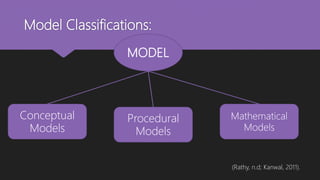
Model Classifications:
Conceptual
Models
Procedural
Models
Mathematical
Models
(Rathy, n.d; Kanwal, 2011).
MODEL
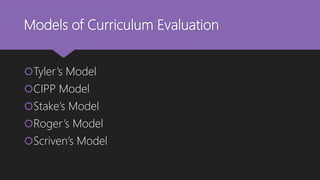
Models of Curriculum Evaluation
Tyler’s Model
CIPP Model
Stake’s Model
Roger’s Model
Scriven’s Model
Tyler’s Model of Curriculum Evaluation
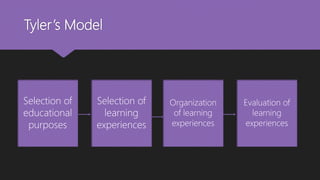
Propounded by Ralph Tyler in 1949.
One of the earliest curriculum experts.
Tyler’s model is also referred to as “the goal
attainment model of curriculum evaluation”
Tyler’s Model (Cont’d)
Tyler’s model emphasize more on goals
formulation through a
detailed analysis of feedback from the
students, society and subject matter.
The model measures the extent to which the
educational goals of a program have been attained
(Singla & Gupta, n.d).
Tyler’s Model (Cont’d)
Tyler model proceeds from the broader view of a
concept and narrow it down to the specific.
For instance, it examine the needs of the society and
then narrow it to stating the specific objectives to be
achieved in order meet the societal need. It is however
said to be deductive in nature (Oliva & Gordon, 2012).|
Tyler’s Rationale
What educational purpose should the school seek to
attain (i.e. educational aims, goals and objectives)?
What educational experiences (learning experiences)
can be provided that are likely to bring about the
attainment of the set purpose?
Tyler Rationale (Cont’d)
How can these educational experiences be effectively
organized (organization of learning experiences)?
How can we determine whether these purposes are
being attained (evauation)? (Omoniyi, 2009)
Tyler’s Model
Selection of
educational
purposes
Selection of
learning
experiences
Organization
of learning
experiences
Evaluation of
learning
experiences
Tyler’s Model: Short Comings
Linear Framework
Leaves evaluation towards the tail end of the
framework
CIPP Model of Curriculum Evaluation
Propounded in 1971
The CIPP model came as a consensus of the Phi-Delta
Committee that was chaired by Daniel Stufflebeam in
1971. CIPP focused more on decision making at each
stages of the curriculum processes.
CIPP Model of Curriculum Evaluation
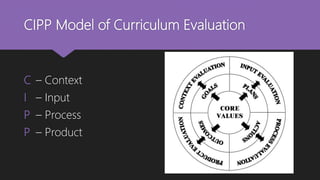
C – Context
I – Input
P – Process
P – Product
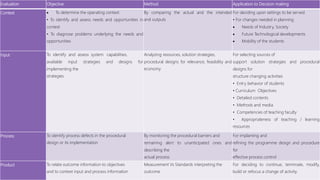
Evaluation Objective Method Application to Decision making
Context  To determine the operating context
• To identify and assess needs and opportunities in
context
• To diagnose problems underlying the needs and
opportunities
By comparing the actual and the intended
and outputs
For deciding upon settings to be served
• For changes needed in planning
 Needs of Industry, Society
 Future Technological developments
 Mobility of the students
Input To identify and assess system capabilities,
available input strategies and designs for
implementing the
strategies
Analyzing resources, solution strategies,
procedural designs for relevance, feasibility and
economy
For selecting sources of
support solution strategies and procedural
designs for
structure changing activities
• Entry behavior of students
• Curriculum Objectives
• Detailed contents
• Methods and media
• Competencies of teaching faculty
• Appropriateness of teaching / learning
resources
Process To identify process defects in the procedural
design or its implementation
By monitoring the procedural barriers and
remaining alert to unanticipated ones and
describing the
actual process
For implanting and
refining the programme design and procedure
for
effective process control
Product To relate outcome information to objectives
and to context input and process information
Measurement Vs Standards interpreting the
outcome
For deciding to continue, terminate, modify,
build or refocus a change of activity.
CIPP: Short Coming
However, despite several promises of excellence and
potential in moving in the region of formative and
summative evaluation CIPP model, is too concerned
with how the process is supposed to be rather than
the reality on ground (Pradinata, 2012).
Stake’s Countenance Model
o Propounded in 1969 by Robert E. Stake.
It examine the basis of the education programme such
as the background philosophy and purpose for which
the programme was developed. These intents refer to
the goals and plans of the practitioners, such as the
curricula and education programme planners, teachers
and students.
Stake’s Countenance Model: Antecedent
Antecedent - Antecedent is any condition existing
prior to teaching and learning which may relate to
outcome.
Students’ interests or prior learning
Learning Environment in the Institution
Traditions and Values of the Institution (Rathy, n.d)
Stake’s Countenance Model: Transaction
Transaction - Transactions are the countless
encounters of students with teacher, student with
student, author with reader, parent with counsellor.
Interactions that occur between:
Stake’s Countenance Model: Transaction
(Forms of Transactions in Teaching & Learning)
Teachers
Students
Students
Students
Students
Curricular
Materials
Students
Educational
Environments
Stake’s Countenance Model: Outcome
Outcome - Outcome include measurements of the
impact of instruction on learners and others. The
outcome is an integral impact of curriculum
implementation on students, teachers, administrators
and community. Outcome can either be immediate or
long range (Rathy, n.d).
Stake’s Countenance Model: Ups & Downs
The high point of Stake's model lies in the manner in
which intents and actions are defined, observed and
evaluated, together with standards and judgements
rather than actual educational goals. (Woods, 1988;
Ling, et al., n.d.). nonetheless, Rathy (n.d) faults the
model for “stairng up conflicts” and also tends to
ignore the “causes”
Application to Educational Technology
Educational Technology is a study and ethical practice
of facilitating learning and improving performance by
creating, using and managing appropriate
technological processes and resources.
Application to Educational Technology
What educational purpose should the school seek to
attain? (i.e. educational aims, goals and objectives)- This
question can serve as a guild to the instructional
developer, by preempting him of what the expected
learning outcome should be. He can however work with
this as a blueprint. As media is designed not as an end to
itself but rather as mean to achieve the expected learning
outcomes.
Application to Educational Technology
What educational experiences (learning experiences)
can be provided that are likely to bring about the
attainment of the set purpose?- This can be applied in
the context of educational technology as preparing
the learning environment to cause an interaction that
will facilitate learning.
Application to Educational Technology
How can these educational experiences be effectively
organized (organization of learning experiences)?- One
thing is to create a technology for facilitating learning,
another is to ensure that the technology actually facilitate
learning. The term “using and managing” in the definition
stressed on the fact that the created technology should be
properly organized and managed.
Application to Educational Technology
How can we determine whether these purposes are
being attained (evaluation)?- Evaluation is key in the
field of educational technology. After creating, using
and managing certain instructional technology, how
do we measure the extent to which what was created
has actually facilitated learning?
Thanks for Listening