E
                              Presentation By                        OM
               E                                              E LC
            O M                                           W
     E LC
 W
                                                                     E
                                                                  O M
           E                                                 LC
        O M                                                E
   LC                                                     W
 E
W

                                                                     E
                                                                  O M
           E                                                 LC
        O M                                                E
   LC                                                     W
 E
W
                                                                          E
                                                                     OM
                                                              E LC
                E                                         W
           OM
    E LC            Mrs. C. Jothi Sophia, M.Sc(N), Ph.D
W
                      Principal, CSI JACON, Madurai
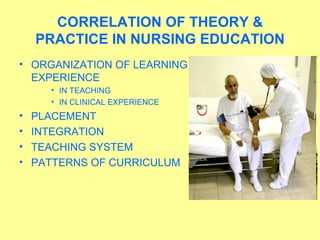
CORRELATION OF THEORY &
    PRACTICE IN NURSING EDUCATION
• ORGANIZATION OF LEARNING
  EXPERIENCE
      • IN TEACHING
      • IN CLINICAL EXPERIENCE
•   PLACEMENT
•   INTEGRATION
•   TEACHING SYSTEM
•   PATTERNS OF CURRICULUM
Organization of Learning Experience

Course Content
• The content of Nursing Curriculum
      • Foundation Content
      • Nursing related Content


• Basic Sciences
      •   Physics
      •   Chemistry
      •   Sociology
      •   Anatomy & Physiology
• Professional Understanding
     •   Professional Adjustment
     •   Trends & Issues
     •   Communication
     •   Administration
     •   History of Nursing
• Nursing Sciences
     • Nursing Principles
     • Medical
     • Paediatrics
Distribution of Contents
• Humanities ( 16.5 %)
       •   Administration
       •   Communication
       •   Psycho
       •   Counseling
       •   Trends & Issues
• Behavioural Sciences ( 16.5 %)
       • Sociology
       • Psychology
• Biological Sciences ( 16.5 %)
       • Physics
       • Chemistry
       • Anatomy & Physiology
• Nursing Subjects ( 50%)
Placement :-
Total   subject as well as practical
    experience must be placed in such
    a way by utilizing the educational
    Psychology distributed to all four
    years, is called as placement.

•    Criteria for organizing Learning
     Experience
4.   Continuity
5.   Sequence
6.   Integration
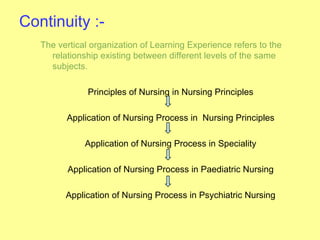
Continuity :-
   The vertical organization of Learning Experience refers to the
     relationship existing between different levels of the same
     subjects.

               Principles of Nursing in Nursing Principles

         Application of Nursing Process in Nursing Principles

              Application of Nursing Process in Speciality

         Application of Nursing Process in Paediatric Nursing

         Application of Nursing Process in Psychiatric Nursing
Sequence :-
Each successive experience not only is built
  upon the last one but also goes more deeply
  and broadly into the subject. It emphasizes
  on higher levels of understanding.
      –   Simple to Complex
      –   Easy to Tuff
      –   Known to Unknown
      –   Normal to Abnormal

Eg.        Psychology – Psychiatry
           Sociology   - Community
Three levels of Sequence
• Logical Order
• Chronological Order
• Difficulty

Logical Order : It is based on concepts or principles of
                       primacy. (Eg.) Trends in Nsg,
   Biochemistry


Chronological Order : It places events in successions in terms
    of
time in which they occur. (Eg.)History of Nsg


Difficulty :-
Lessons are arranged in such a way as simple to complex
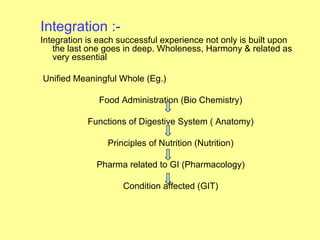
Integration :-
Integration is each successful experience not only is built upon
   the last one goes in deep. Wholeness, Harmony & related as
   very essential

Unified Meaningful Whole (Eg.)

              Food Administration (Bio Chemistry)

            Functions of Digestive System ( Anatomy)

                 Principles of Nutrition (Nutrition)

              Pharma related to GI (Pharmacology)

                     Condition affected (GIT)
Organization of Learning Experience

Clinical Area :
       Master Rotation Plan
       Clinical Rotation Plan


• Class Room
       Teaching Block           Course Outline
       Study Day System               Unit Plan
       Daily Class                    Lesson Plan
Organization : Clinical Experience
Principles :-
2. Each block of Learning Experience being used in the
   rotation should be of the same rotation through ( No.of
   days)
3. Each students must rotate to each block
4. No block can be missed by students
5. All students should be enter and leave the block at the time
   scheduled.
6. Each block of experience can be further sub divided so that
   the students can be rotated through the related experience
7. A block may consist of 2 or 3 unrelated experience which
   have been fitted in to make up the length of block to
   facilitate rotation.
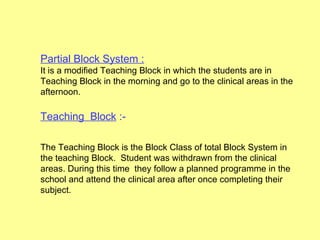
Teaching System

Three common methods are used
   in Teaching System.
2. Teaching Block
       –   Full Block
       –   Partial Block

3. Study Day System
4. Daily Classes
Partial Block System :
It is a modified Teaching Block in which the students are in
Teaching Block in the morning and go to the clinical areas in the
afternoon.

Teaching Block :-

The Teaching Block is the Block Class of total Block System in
the teaching Block. Student was withdrawn from the clinical
areas. During this time they follow a planned programme in the
school and attend the clinical area after once completing their
subject.
Advantages :

•    The students are freed from ward responsibilities while
     having a concentrated period of instruction.

•    Classes can conveniently be given to the whole group

•    Curriculum Planning is facilitated and the planning of co-
     related teaching made easier

•    Students can have uninterrupted periods of Clinical
     Experience.

•    Ward administration is made easier when students do not
     have to leave the ward daily to attend classes.

j)   Attention is drawn to the educational status of the students
     although she does not necessarily spend any less time on
     the wards.
Study Day System :

The study day system is literally a complete day spend
   by the students in a week.
(Eg.) The students those who go for the clinical
   experience in all days except Monday & Friday.
   These days are called as study day.
(Eg.) The Midwifery students (8th Sem.) will be much
   benefited in the semester. There are 5 months
  (5x4 = 20 weeks). They will get 20 study days.
   (20 x 8 Hrs = 160 Hrs). 160 hours classes can be
   given throughout the semester to fulfill their theory
   requirement.
Advantages :-
2. The teacher have contact with the
   student all throughout the semester
3. All the students can clarify the doubt
   when come for study days
Daily Classes :-

If neither of the above two system is used the third possibility
    is holding single classes daily or several times per week.
    During the first and second years frequents scheduling of
    classes will be required to cover the Curriculum and
    problems sometimes wise when a number of students
    have to be relieved on time from different wards .
    However when the schedules are planned with a view to
    service needs and normal ward routine it is possible to
    arrange times which are reasonably convenient to the
    ward the school and the student. Daily classes will still be
    necessary.

Now and then during the course even the other systems are
  operating but will not be needed so frequently.
PATTERNS OF CURRICULUM
In different patterns of curriculum

3. Swap block
4. Progressive block
5. Concept block
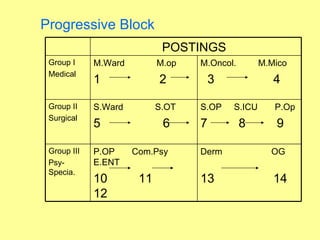
Progressive Block
                             POSTINGS
 Group I     M.Ward         M.op   M.Oncol.        M.Mico
 Medical
             1              2          3              4

 Group II    S.Ward         S.OT   S.OP    S.ICU      P.Op
 Surgical
             5               6     7          8       9

 Group III   P.OP     Com.Psy      Derm              OG
 Psy-        E.ENT
 Specia.
             10        11          13                 14
             12
Progressive Block :
In this pattern of Curriculum students are
   divided into 3 major groups and they are
   rotated into different areas of learning
   experience.
(eg.) V semester students :
   I group will be in Medical Area
   II group will be in Surgical Area
   III group will be in Psychiatry & Speciality
I group after finishing their postings will get
   exchange with II group and then with III
   group,
With in a particular level all the students will
   expose to all the areas
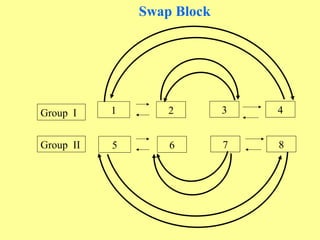
Swap Block


Group I    1       2        3   4


Group II   5       6        7   8
Swap Block :
This pattern of curriculum is most in VI semester
   students. They are divided into
        I – Paediatrics
        II – Community
In the Paediatric area they will be further divided into
   smaller groups to complete Paed.Med, Paed.Sur,
   NICU,Communicable Ward and so on. In
   Community Survey,Immunization Camps, Family
   visits, School health, PHC Visits etc.,
They get inter exchange after completing the specific
   needed hours, in each small blocks.
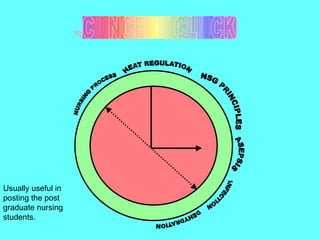
Concept Clock :
This pattern of curriculum is used in PG(M.Sc) nursing
   students. They are being posted in different wards
   so as to fulfill deepest understanding of the concept
   rather than specific condition.
Usually useful in
posting the post
graduate nursing
students.
THANK U…

Organization of learning experience

  • 1.
    E Presentation By OM E E LC O M W E LC W E O M E LC O M E LC W E W E O M E LC O M E LC W E W E OM E LC E W OM E LC Mrs. C. Jothi Sophia, M.Sc(N), Ph.D W Principal, CSI JACON, Madurai
  • 2.
    CORRELATION OF THEORY& PRACTICE IN NURSING EDUCATION • ORGANIZATION OF LEARNING EXPERIENCE • IN TEACHING • IN CLINICAL EXPERIENCE • PLACEMENT • INTEGRATION • TEACHING SYSTEM • PATTERNS OF CURRICULUM
  • 3.
    Organization of LearningExperience Course Content • The content of Nursing Curriculum • Foundation Content • Nursing related Content • Basic Sciences • Physics • Chemistry • Sociology • Anatomy & Physiology
  • 4.
    • Professional Understanding • Professional Adjustment • Trends & Issues • Communication • Administration • History of Nursing • Nursing Sciences • Nursing Principles • Medical • Paediatrics
  • 5.
    Distribution of Contents •Humanities ( 16.5 %) • Administration • Communication • Psycho • Counseling • Trends & Issues • Behavioural Sciences ( 16.5 %) • Sociology • Psychology • Biological Sciences ( 16.5 %) • Physics • Chemistry • Anatomy & Physiology • Nursing Subjects ( 50%)
  • 6.
    Placement :- Total subject as well as practical experience must be placed in such a way by utilizing the educational Psychology distributed to all four years, is called as placement. • Criteria for organizing Learning Experience 4. Continuity 5. Sequence 6. Integration
  • 7.
    Continuity :- The vertical organization of Learning Experience refers to the relationship existing between different levels of the same subjects. Principles of Nursing in Nursing Principles Application of Nursing Process in Nursing Principles Application of Nursing Process in Speciality Application of Nursing Process in Paediatric Nursing Application of Nursing Process in Psychiatric Nursing
  • 8.
    Sequence :- Each successiveexperience not only is built upon the last one but also goes more deeply and broadly into the subject. It emphasizes on higher levels of understanding. – Simple to Complex – Easy to Tuff – Known to Unknown – Normal to Abnormal Eg. Psychology – Psychiatry Sociology - Community
  • 9.
    Three levels ofSequence • Logical Order • Chronological Order • Difficulty Logical Order : It is based on concepts or principles of primacy. (Eg.) Trends in Nsg, Biochemistry Chronological Order : It places events in successions in terms of time in which they occur. (Eg.)History of Nsg Difficulty :- Lessons are arranged in such a way as simple to complex
  • 10.
    Integration :- Integration iseach successful experience not only is built upon the last one goes in deep. Wholeness, Harmony & related as very essential Unified Meaningful Whole (Eg.) Food Administration (Bio Chemistry) Functions of Digestive System ( Anatomy) Principles of Nutrition (Nutrition) Pharma related to GI (Pharmacology) Condition affected (GIT)
  • 11.
    Organization of LearningExperience Clinical Area : Master Rotation Plan Clinical Rotation Plan • Class Room Teaching Block Course Outline Study Day System Unit Plan Daily Class Lesson Plan
  • 12.
    Organization : ClinicalExperience Principles :- 2. Each block of Learning Experience being used in the rotation should be of the same rotation through ( No.of days) 3. Each students must rotate to each block 4. No block can be missed by students 5. All students should be enter and leave the block at the time scheduled. 6. Each block of experience can be further sub divided so that the students can be rotated through the related experience 7. A block may consist of 2 or 3 unrelated experience which have been fitted in to make up the length of block to facilitate rotation.
  • 13.
    Teaching System Three commonmethods are used in Teaching System. 2. Teaching Block – Full Block – Partial Block 3. Study Day System 4. Daily Classes
  • 14.
    Partial Block System: It is a modified Teaching Block in which the students are in Teaching Block in the morning and go to the clinical areas in the afternoon. Teaching Block :- The Teaching Block is the Block Class of total Block System in the teaching Block. Student was withdrawn from the clinical areas. During this time they follow a planned programme in the school and attend the clinical area after once completing their subject.
  • 15.
    Advantages : • The students are freed from ward responsibilities while having a concentrated period of instruction. • Classes can conveniently be given to the whole group • Curriculum Planning is facilitated and the planning of co- related teaching made easier • Students can have uninterrupted periods of Clinical Experience. • Ward administration is made easier when students do not have to leave the ward daily to attend classes. j) Attention is drawn to the educational status of the students although she does not necessarily spend any less time on the wards.
  • 16.
    Study Day System: The study day system is literally a complete day spend by the students in a week. (Eg.) The students those who go for the clinical experience in all days except Monday & Friday. These days are called as study day. (Eg.) The Midwifery students (8th Sem.) will be much benefited in the semester. There are 5 months (5x4 = 20 weeks). They will get 20 study days. (20 x 8 Hrs = 160 Hrs). 160 hours classes can be given throughout the semester to fulfill their theory requirement.
  • 17.
    Advantages :- 2. Theteacher have contact with the student all throughout the semester 3. All the students can clarify the doubt when come for study days
  • 18.
    Daily Classes :- Ifneither of the above two system is used the third possibility is holding single classes daily or several times per week. During the first and second years frequents scheduling of classes will be required to cover the Curriculum and problems sometimes wise when a number of students have to be relieved on time from different wards . However when the schedules are planned with a view to service needs and normal ward routine it is possible to arrange times which are reasonably convenient to the ward the school and the student. Daily classes will still be necessary. Now and then during the course even the other systems are operating but will not be needed so frequently.
  • 19.
    PATTERNS OF CURRICULUM Indifferent patterns of curriculum 3. Swap block 4. Progressive block 5. Concept block
  • 20.
    Progressive Block POSTINGS Group I M.Ward M.op M.Oncol. M.Mico Medical 1 2 3 4 Group II S.Ward S.OT S.OP S.ICU P.Op Surgical 5 6 7 8 9 Group III P.OP Com.Psy Derm OG Psy- E.ENT Specia. 10 11 13 14 12
  • 21.
    Progressive Block : Inthis pattern of Curriculum students are divided into 3 major groups and they are rotated into different areas of learning experience. (eg.) V semester students : I group will be in Medical Area II group will be in Surgical Area III group will be in Psychiatry & Speciality I group after finishing their postings will get exchange with II group and then with III group, With in a particular level all the students will expose to all the areas
  • 22.
    Swap Block Group I 1 2 3 4 Group II 5 6 7 8
  • 23.
    Swap Block : Thispattern of curriculum is most in VI semester students. They are divided into I – Paediatrics II – Community In the Paediatric area they will be further divided into smaller groups to complete Paed.Med, Paed.Sur, NICU,Communicable Ward and so on. In Community Survey,Immunization Camps, Family visits, School health, PHC Visits etc., They get inter exchange after completing the specific needed hours, in each small blocks. Concept Clock : This pattern of curriculum is used in PG(M.Sc) nursing students. They are being posted in different wards so as to fulfill deepest understanding of the concept rather than specific condition.
  • 24.
    Usually useful in postingthe post graduate nursing students.
  • 25.