‘I structure my classes
around the coursebook,
but there may be whole
lessons where we don't
       even open it.’
‘Nowadays learners expect schools to
  have state-of-the-art resources and
  they also expect that teachers will
   use them. Not to do so might be
     considered unprofessional.’
‘I coul te ach
        d
 anywhe re , so
l
ong as I had a
  bl ackb oard .’
'A lot of the boring stuff associated
 with language learning can now be
done by the learners working on their
 own, using computers, for example.
 This frees up the classroom for the
        really interesting stuff.'
EFL Teaching Materials and
       Resources
     Eliane Carolina de Oliveira
• Resources are tools every ESL, EFL or
  TESOL teacher uses daily in order to enhance
  the language learning environment, motivate
  students or assist in student comprehension.
  (HINES, 2010)

• They are tools to help teachers in whatever
  approaches and techniques they have chosen
  to use and offer students an amazing variety
  of routes for learning and discovery.
  (HARMER, 2007)
• What     teaching resources   and
  materials have you / your teachers
  used?
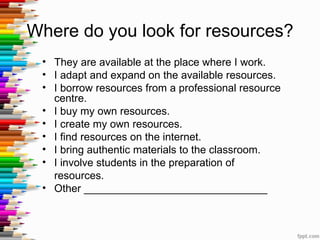
Where do you look for resources?
 • They are available at the place where I work.
 • I adapt and expand on the available resources.
 • I borrow resources from a professional resource
   centre.
 • I buy my own resources.
 • I create my own resources.
 • I find resources on the internet.
 • I bring authentic materials to the classroom.
 • I involve students in the preparation of
   resources.
 • Other _______________________________
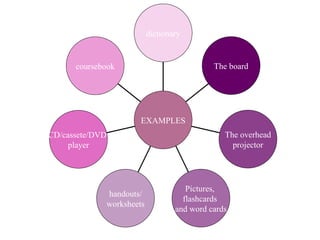
dictionary


      coursebook                                The board


                          EXAMPLES
CD/cassete/DVD                                     The overhead
     player                                          projector


                                         Pictures,
                 handouts/
                                        flashcards
                 worksheets
                                      and word cards
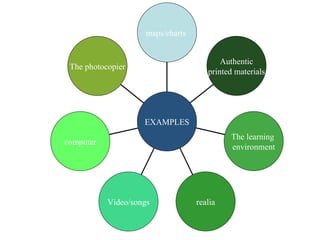
maps/charts


                                          Authentic
 The photocopier
                                      printed materials


                    EXAMPLES
                                            The learning
computer
                                            environment


           Video/songs             realia
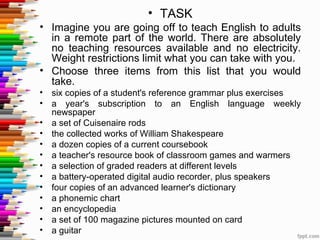
• TASK
• Imagine you are going off to teach English to adults
  in a remote part of the world. There are absolutely
  no teaching resources available and no electricity.
  Weight restrictions limit what you can take with you.
• Choose three items from this list that you would
  take.
•   six copies of a student's reference grammar plus exercises
•   a year's subscription to an English language weekly
    newspaper
•   a set of Cuisenaire rods
•   the collected works of William Shakespeare
•   a dozen copies of a current coursebook
•   a teacher's resource book of classroom games and warmers
•   a selection of graded readers at different levels
•   a battery-operated digital audio recorder, plus speakers
•   four copies of an advanced learner's dictionary
•   a phonemic chart
•   an encyclopedia
•   a set of 100 magazine pictures mounted on card
•   a guitar
• TASK
• Imagine that you are to be given a grant of enough
  money to buy a package of supplementary
  materials for your institution out of the list below.
  The question is: in what order will you buy them,
  and how will you decide? Work out an order of
  priority together with a colleague.

• PACKAGES OF SUPPLEMENTARY MATERIALS
• Package 1: A set of computers for learners use, with
  accompaning language learning programs on a DVD.
• Package 2: A set of reference books for the teachers
  including grammars, dictionaries, various specialized
  textbooks, handbooks of activities and a subscription of
  a teachers journal of your choice.
• Package 3: A number of overhead projectors and slide
  projectors with all necessary film, slides and markers.
• Package 4: Video equipment with assorted cassettes
  including language-learning material and films in the
  target language.
• Package 5: Computers and printers for teachers use;
  each computer has a hard disk with the latest word
  processor and various programs that enable you to
  compose your own computer tasks for learners.
• Package 6: Several cassette recorders with
  accompaning ear phones (so that several learners can
  listen quietly to one machine) a selection of
  accompanying cassettes for language learning.
• Package 7: A wide variety of posters and sets of
  coloured pictures plus board and card games for
  language learning,
• Package 8: A library of simplified readers in the target
  language ranging from very simple to advanced. There
  would be enough books in this library to enable all
  students to borrow freely.
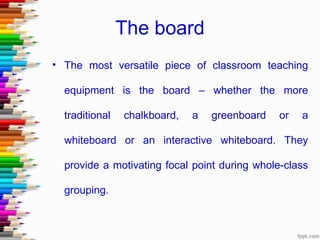
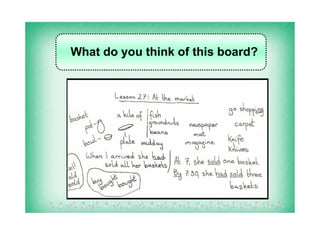
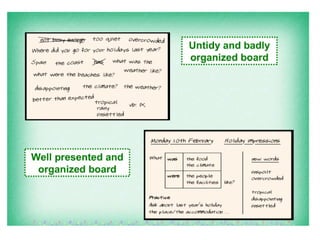
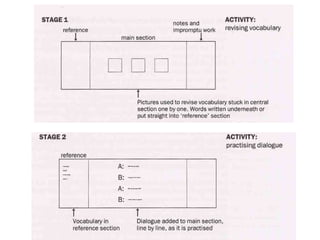
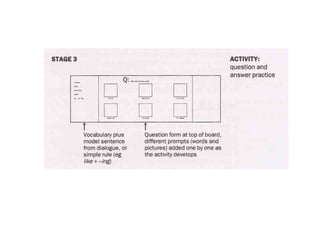
The board
• The most versatile piece of classroom teaching

  equipment is the board – whether the more

  traditional   chalkboard,   a   greenboard   or   a

  whiteboard or an interactive whiteboard. They

  provide a motivating focal point during whole-class

  grouping.
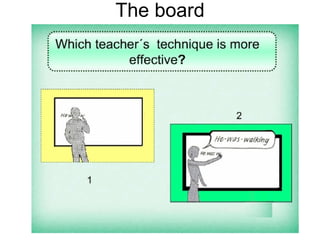
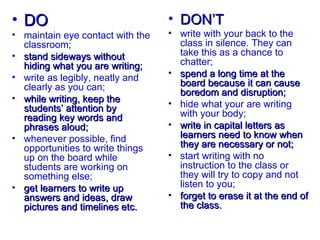
The board
• DO                              • DON’T
• maintain eye contact with the   • write with your back to the
  classroom;                        class in silence. They can
• stand sideways without            take this as a chance to
  hiding what you are writing;      chatter;
• write as legibly, neatly and    • spend a long time at the
  clearly as you can;               board because it can cause
                                    boredom and disruption;
• while writing, keep the
  students’ attention by          • hide what your are writing
  reading key words and             with your body;
  phrases aloud;                  • write in capital letters as
• whenever possible, find           learners need to know when
  opportunities to write things     they are necessary or not;
  up on the board while           • start writing with no
  students are working on           instruction to the class or
  something else;                   they will try to copy and not
• get learners to write up          listen to you;
  answers and ideas, draw         • forget to erase it at the end of
  pictures and timelines etc.       the class.
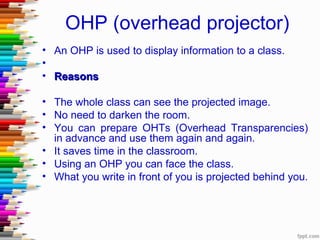
OHP (overhead projector)
• An OHP is used to display information to a class.
•
• Reasons

• The whole class can see the projected image.
• No need to darken the room.
• You can prepare OHTs (Overhead Transparencies)
  in advance and use them again and again.
• It saves time in the classroom.
• Using an OHP you can face the class.
• What you write in front of you is projected behind you.
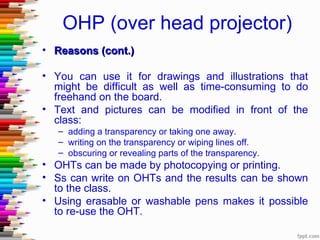
OHP (over head projector)
• Reasons (cont.)

• You can use it for drawings and illustrations that
  might be difficult as well as time-consuming to do
  freehand on the board.
• Text and pictures can be modified in front of the
  class:
   – adding a transparency or taking one away.
   – writing on the transparency or wiping lines off.
   – obscuring or revealing parts of the transparency.
• OHTs can be made by photocopying or printing.
• Ss can write on OHTs and the results can be shown
  to the class.
• Using erasable or washable pens makes it possible
  to re-use the OHT.
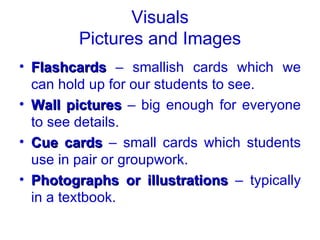
Visuals
        Pictures and Images
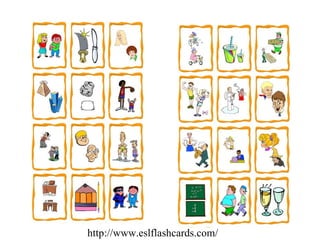
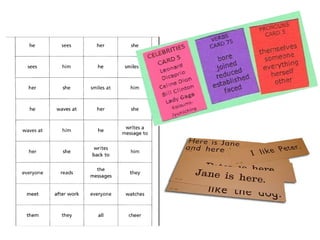
• Flashcards – smallish cards which we
  can hold up for our students to see.
• Wall pictures – big enough for everyone
  to see details.
• Cue cards – small cards which students
  use in pair or groupwork.
• Photographs or illustrations – typically
  in a textbook.
http://www.eslflashcards.com/
Visuals
     Pictures and Images
• Take pictures from magazines;
• Draw them;
• Buy them;

  – Stick them on card
  – Transparent covering
  – Make sure they are big enough, appropriate to
    the Ss’ age, level and culture;
  – Copyright
  – Storing
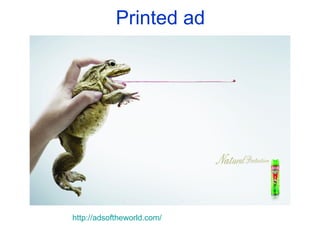
Printed ad


http://adsoftheworld.com/
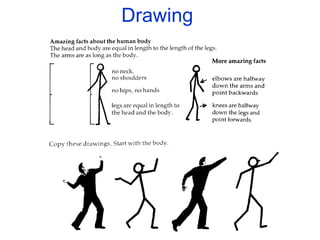
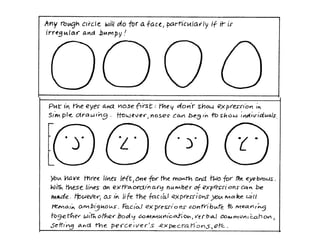
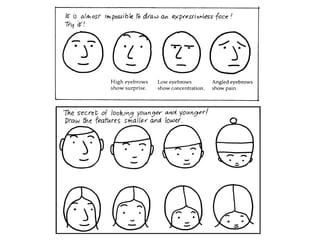
Drawing
Realia
• Which of the following definition best
  describes “realia”?
  (   ) real objects
  (   ) examples of the world outside brought into
        the classroom
  (   ) things made out of natural materials
  (   ) everyday objects that most of us recognize
  (   ) all of the above
• Reasons why adding real life materials
  makes class even better!

• Kinesthetics ... it's always better to have
  something to hold, touch, smell or feel.
• It makes the learning experience more
  enjoyable.
• Real-life connection.
• It generates excitement.
• Breaking out of the worksheet monotony is
  always beneficial.
• There is no limit to the things you can create.
• Ideas
• A lesson on food?
  – snacks, fruits, or canned goods.
• Teaching about shopping/prices?
  – fliers or coupons.
• Teaching about nutrition?
  – real food labels.
• Teaching about finding a job?
  – real job applications.
• Practicing making an appointment or leaving a
  message?
  – real telephones
• Teaching about cultures?
  – have a cultural day where the students must bring
    an item from a specific culture.
TV, DVD and Video
• What have the TV, DVD and Video got that the
  classroom / board / textbook / CD player /
  other visuals haven’t got?
  –   Sound
  –   Moving pictures
  –   A ‘reward’ button
  –   A ‘pause’ button
  –   A volume control
  –   Subtitles
  –   Background      context,   eye     contact,    facial
      expressions, gestures, physical relationship
• Below is a list of 6 video techniques. What are the
  possible pedagogical implications and objectives of
  each technique?

• Videos can generally be presented in 6 forms:
• 1. With sound only (sound on / vision off: only
  listening with the screen covered with a cloth, a
  newspaper or turned away from the Ss’ vision).
• 2. Without sound (sound off / vision on: silent
  viewing).
• 3. Right through from beginning to end (complete
  viewing: sound and vision on).
• 4. In parts (jumbling sequences).
• 5. Freeze-frame (motionless pictures: pause
  control).
• 6. Split viewing (jigsaw-viewing: some of the class
  listen without watching while the others watch
  without listening).
• Viewing should not be introduced for its own
  sake;
• It should be an active viewing;
• tasks and activities - help learners
  understand, and guide their viewing and
  comprehension.
• To foster active viewing:
  – three types of activities
     • pre-viewing activities;
     • (while) viewing activities;
     • post-viewing activities.


• ELT materials vs. Non-ELT materials
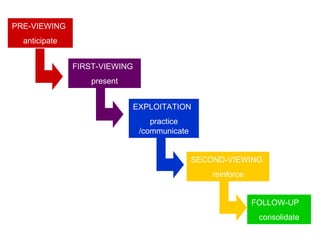
PRE-VIEWING
  anticipate


               FIRST-VIEWING
                   present


                             EXPLOITATION
                                  practice
                               /communicate


                                              SECOND-VIEWING
                                                  reinforce


                                                              FOLLOW-UP
                                                               consolidate
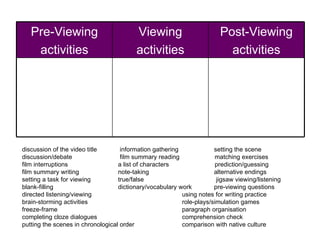
Pre-Viewing                            Viewing                       Post-Viewing
    activities                            activities                      activities


discussion of the video title       information gathering             setting the scene
discussion/debate                   film summary reading              matching exercises
film interruptions                 a list of characters                prediction/guessing
film summary writing               note-taking                        alternative endings
setting a task for viewing         true/false                          jigsaw viewing/listening
blank-filling                      dictionary/vocabulary work         pre-viewing questions
directed listening/viewing                                using notes for writing practice
brain-storming activities                                 role-plays/simulation games
freeze-frame                                              paragraph organisation
completing cloze dialogues                                comprehension check
putting the scenes in chronological order                 comparison with native culture
• Teaching without technology
• Imagine you are teaching in a place where
  resources are limited. How could you manage
  without coursebooks, audio or video equipment,
  or photocopying facilities? Suggest ways to do
  the following:
  –   grammar presentation
  –   grammar practice
  –   listening activities
  –   reading activities
  –   testing
• TASK 1: Discuss
• a) some reasons of heavy reliance on the
  textbook.
• b) the effect of heavy reliance on the
  textbook.
• TASK 2:
• Read the following statements and decide
  which ones you agree with.
• The textbook:
   – 1. Indicates to teachers and students
     where they are going, where they are and
     where they have been.
• 2. Provides both teachers and students with
  a sense of security and self-confidence.
• 3. Predicts the content to be learned.
• 4. Saves teachers money and frees them
  from the time consuming task of preparing
  teaching materials.
• 5. Saves learners from our deficiencies as
  teachers.
• 6. Specifies teachers and students needs.
• 7. Standardizes the teaching practices
  regardless of the teachers various training
  backgrounds.
• 8. Specifies in advance what is to be taught
  and what is to be learned.
References
•   HARMER, J. The practice of English language teaching. London:
    Longman, 2008.
•   HINES, M. Evaluating ESL, TEFL, TESOL Resources For Use in
    the Classroom
    Available at <http://EzineArticles.com/81446> Access on May,
    2010.
•   GOWER, R. et al. Teaching Practice Handbook. Heinemann.
    1995.
•   SCRIVENER, J. Learning Teaching: a guidebook for English language
    teachers, 2nd Edition, Oxford: Macmillan, 2005.

Teaching materials and resources

  • 1.
    ‘I structure myclasses around the coursebook, but there may be whole lessons where we don't even open it.’
  • 2.
    ‘Nowadays learners expectschools to have state-of-the-art resources and they also expect that teachers will use them. Not to do so might be considered unprofessional.’
  • 3.
    ‘I coul teach d anywhe re , so l ong as I had a bl ackb oard .’
  • 4.
    'A lot ofthe boring stuff associated with language learning can now be done by the learners working on their own, using computers, for example. This frees up the classroom for the really interesting stuff.'
  • 5.
    EFL Teaching Materialsand Resources Eliane Carolina de Oliveira
  • 6.
    • Resources aretools every ESL, EFL or TESOL teacher uses daily in order to enhance the language learning environment, motivate students or assist in student comprehension. (HINES, 2010) • They are tools to help teachers in whatever approaches and techniques they have chosen to use and offer students an amazing variety of routes for learning and discovery. (HARMER, 2007)
  • 7.
    • What teaching resources and materials have you / your teachers used?
  • 8.
    Where do youlook for resources? • They are available at the place where I work. • I adapt and expand on the available resources. • I borrow resources from a professional resource centre. • I buy my own resources. • I create my own resources. • I find resources on the internet. • I bring authentic materials to the classroom. • I involve students in the preparation of resources. • Other _______________________________
  • 9.
    dictionary coursebook The board EXAMPLES CD/cassete/DVD The overhead player projector Pictures, handouts/ flashcards worksheets and word cards
  • 10.
    maps/charts Authentic The photocopier printed materials EXAMPLES The learning computer environment Video/songs realia
  • 11.
    • TASK • Imagineyou are going off to teach English to adults in a remote part of the world. There are absolutely no teaching resources available and no electricity. Weight restrictions limit what you can take with you. • Choose three items from this list that you would take. • six copies of a student's reference grammar plus exercises • a year's subscription to an English language weekly newspaper • a set of Cuisenaire rods • the collected works of William Shakespeare • a dozen copies of a current coursebook • a teacher's resource book of classroom games and warmers • a selection of graded readers at different levels • a battery-operated digital audio recorder, plus speakers • four copies of an advanced learner's dictionary • a phonemic chart • an encyclopedia • a set of 100 magazine pictures mounted on card • a guitar
  • 12.
    • TASK • Imaginethat you are to be given a grant of enough money to buy a package of supplementary materials for your institution out of the list below. The question is: in what order will you buy them, and how will you decide? Work out an order of priority together with a colleague. • PACKAGES OF SUPPLEMENTARY MATERIALS • Package 1: A set of computers for learners use, with accompaning language learning programs on a DVD. • Package 2: A set of reference books for the teachers including grammars, dictionaries, various specialized textbooks, handbooks of activities and a subscription of a teachers journal of your choice.
  • 13.
    • Package 3:A number of overhead projectors and slide projectors with all necessary film, slides and markers. • Package 4: Video equipment with assorted cassettes including language-learning material and films in the target language. • Package 5: Computers and printers for teachers use; each computer has a hard disk with the latest word processor and various programs that enable you to compose your own computer tasks for learners. • Package 6: Several cassette recorders with accompaning ear phones (so that several learners can listen quietly to one machine) a selection of accompanying cassettes for language learning. • Package 7: A wide variety of posters and sets of coloured pictures plus board and card games for language learning, • Package 8: A library of simplified readers in the target language ranging from very simple to advanced. There would be enough books in this library to enable all students to borrow freely.
  • 14.
    The board • Themost versatile piece of classroom teaching equipment is the board – whether the more traditional chalkboard, a greenboard or a whiteboard or an interactive whiteboard. They provide a motivating focal point during whole-class grouping.
  • 15.
  • 20.
    • DO • DON’T • maintain eye contact with the • write with your back to the classroom; class in silence. They can • stand sideways without take this as a chance to hiding what you are writing; chatter; • write as legibly, neatly and • spend a long time at the clearly as you can; board because it can cause boredom and disruption; • while writing, keep the students’ attention by • hide what your are writing reading key words and with your body; phrases aloud; • write in capital letters as • whenever possible, find learners need to know when opportunities to write things they are necessary or not; up on the board while • start writing with no students are working on instruction to the class or something else; they will try to copy and not • get learners to write up listen to you; answers and ideas, draw • forget to erase it at the end of pictures and timelines etc. the class.
  • 21.
    OHP (overhead projector) •An OHP is used to display information to a class. • • Reasons • The whole class can see the projected image. • No need to darken the room. • You can prepare OHTs (Overhead Transparencies) in advance and use them again and again. • It saves time in the classroom. • Using an OHP you can face the class. • What you write in front of you is projected behind you.
  • 22.
    OHP (over headprojector) • Reasons (cont.) • You can use it for drawings and illustrations that might be difficult as well as time-consuming to do freehand on the board. • Text and pictures can be modified in front of the class: – adding a transparency or taking one away. – writing on the transparency or wiping lines off. – obscuring or revealing parts of the transparency. • OHTs can be made by photocopying or printing. • Ss can write on OHTs and the results can be shown to the class. • Using erasable or washable pens makes it possible to re-use the OHT.
  • 23.
    Visuals Pictures and Images • Flashcards – smallish cards which we can hold up for our students to see. • Wall pictures – big enough for everyone to see details. • Cue cards – small cards which students use in pair or groupwork. • Photographs or illustrations – typically in a textbook.
  • 24.
  • 26.
    Visuals Pictures and Images • Take pictures from magazines; • Draw them; • Buy them; – Stick them on card – Transparent covering – Make sure they are big enough, appropriate to the Ss’ age, level and culture; – Copyright – Storing
  • 27.
  • 28.
  • 33.
    Realia • Which ofthe following definition best describes “realia”? ( ) real objects ( ) examples of the world outside brought into the classroom ( ) things made out of natural materials ( ) everyday objects that most of us recognize ( ) all of the above
  • 34.
    • Reasons whyadding real life materials makes class even better! • Kinesthetics ... it's always better to have something to hold, touch, smell or feel. • It makes the learning experience more enjoyable. • Real-life connection. • It generates excitement. • Breaking out of the worksheet monotony is always beneficial. • There is no limit to the things you can create.
  • 35.
    • Ideas • Alesson on food? – snacks, fruits, or canned goods. • Teaching about shopping/prices? – fliers or coupons. • Teaching about nutrition? – real food labels. • Teaching about finding a job? – real job applications. • Practicing making an appointment or leaving a message? – real telephones • Teaching about cultures? – have a cultural day where the students must bring an item from a specific culture.
  • 36.
    TV, DVD andVideo • What have the TV, DVD and Video got that the classroom / board / textbook / CD player / other visuals haven’t got? – Sound – Moving pictures – A ‘reward’ button – A ‘pause’ button – A volume control – Subtitles – Background context, eye contact, facial expressions, gestures, physical relationship
  • 37.
    • Below isa list of 6 video techniques. What are the possible pedagogical implications and objectives of each technique? • Videos can generally be presented in 6 forms: • 1. With sound only (sound on / vision off: only listening with the screen covered with a cloth, a newspaper or turned away from the Ss’ vision). • 2. Without sound (sound off / vision on: silent viewing). • 3. Right through from beginning to end (complete viewing: sound and vision on). • 4. In parts (jumbling sequences). • 5. Freeze-frame (motionless pictures: pause control). • 6. Split viewing (jigsaw-viewing: some of the class listen without watching while the others watch without listening).
  • 38.
    • Viewing shouldnot be introduced for its own sake; • It should be an active viewing; • tasks and activities - help learners understand, and guide their viewing and comprehension. • To foster active viewing: – three types of activities • pre-viewing activities; • (while) viewing activities; • post-viewing activities. • ELT materials vs. Non-ELT materials
  • 39.
    PRE-VIEWING anticipate FIRST-VIEWING present EXPLOITATION practice /communicate SECOND-VIEWING reinforce FOLLOW-UP consolidate
  • 41.
    Pre-Viewing Viewing Post-Viewing activities activities activities discussion of the video title information gathering setting the scene discussion/debate film summary reading matching exercises film interruptions a list of characters prediction/guessing film summary writing note-taking alternative endings setting a task for viewing true/false jigsaw viewing/listening blank-filling dictionary/vocabulary work pre-viewing questions directed listening/viewing using notes for writing practice brain-storming activities role-plays/simulation games freeze-frame paragraph organisation completing cloze dialogues comprehension check putting the scenes in chronological order comparison with native culture
  • 42.
    • Teaching withouttechnology • Imagine you are teaching in a place where resources are limited. How could you manage without coursebooks, audio or video equipment, or photocopying facilities? Suggest ways to do the following: – grammar presentation – grammar practice – listening activities – reading activities – testing
  • 43.
    • TASK 1:Discuss • a) some reasons of heavy reliance on the textbook. • b) the effect of heavy reliance on the textbook. • TASK 2: • Read the following statements and decide which ones you agree with. • The textbook: – 1. Indicates to teachers and students where they are going, where they are and where they have been.
  • 44.
    • 2. Providesboth teachers and students with a sense of security and self-confidence. • 3. Predicts the content to be learned. • 4. Saves teachers money and frees them from the time consuming task of preparing teaching materials. • 5. Saves learners from our deficiencies as teachers. • 6. Specifies teachers and students needs. • 7. Standardizes the teaching practices regardless of the teachers various training backgrounds. • 8. Specifies in advance what is to be taught and what is to be learned.
  • 46.
    References • HARMER, J. The practice of English language teaching. London: Longman, 2008. • HINES, M. Evaluating ESL, TEFL, TESOL Resources For Use in the Classroom Available at <http://EzineArticles.com/81446> Access on May, 2010. • GOWER, R. et al. Teaching Practice Handbook. Heinemann. 1995. • SCRIVENER, J. Learning Teaching: a guidebook for English language teachers, 2nd Edition, Oxford: Macmillan, 2005.