Course Code : EM 504
Course Title : School Executive
Development
Professor : Mario C. Pasion,
Ed. D. Ffp
Reporter : Cherrymay C.
Molde
Republic of the Philippines
LAGUNA STATE POLYTECHNIC
UNIVERSITY
MAIN CAMPUS
Sta. Cruz, Laguna
GRADUATESTUDIESANDAPPLIEDRESEARCH
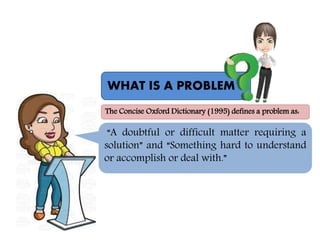
WHAT IS A PROBLEM ?
“A doubtful or difficult matter requiring a
solution” and “Something hard to understand
or accomplish or deal with.”
The Concise Oxford Dictionary (1995) defines a problem as:
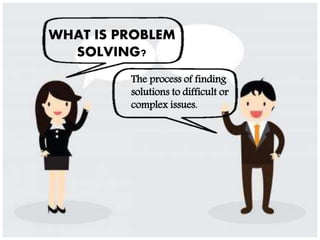
WHAT IS PROBLEM
SOLVING?
The process of finding
solutions to difficult or
complex issues.
TYPES OF PROBLEM SOLVING ENCOUNTERED AT
THE WORKPLACE
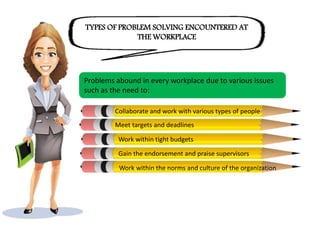
Problems abound in every workplace due to various issues
such as the need to:
Collaborate and work with various types of people
Meet targets and deadlines
Work within tight budgets
Gain the endorsement and praise supervisors
Work within the norms and culture of the organization
There are specific problems which are common to every
workplace because workplaces are human institutions and
human beings ate the same everywhere.
Communication problem
Attitude problem
Interpersonal challenges between supervisor and
subordinates or among your subordinates
Ethical problems
Poor performance
Discrimination and harassment
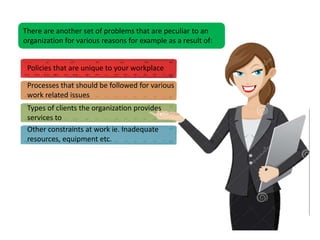
Policies that are unique to your workplace
There are another set of problems that are peculiar to an
organization for various reasons for example as a result of:
Processes that should be followed for various
work related issues
Types of clients the organization provides
services to
Other constraints at work ie. Inadequate
resources, equipment etc.
APPROACH TO PROBLEM SOLVING
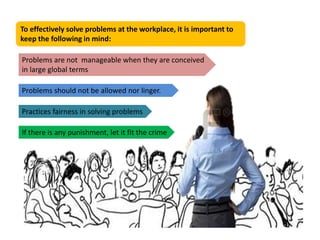
To effectively solve problems at the workplace, it is important to
keep the following in mind:
Problems are not manageable when they are conceived
in large global terms
Problems should not be allowed nor linger.
Practices fairness in solving problems
If there is any punishment, let it fit the crime
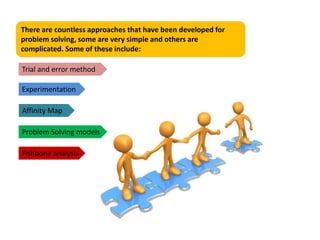
There are countless approaches that have been developed for
problem solving, some are very simple and others are
complicated. Some of these include:
Trial and error method
Experimentation
Affinity Map
Problem Solving models
Fishbone analysis
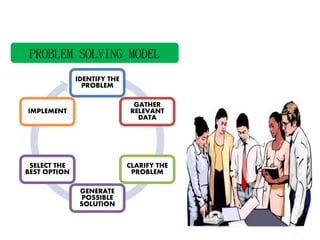
PROBLEM SOLVING MODEL
IDENTIFY THE
PROBLEM
GATHER
RELEVANT
DATA
CLARIFY THE
PROBLEM
GENERATE
POSSIBLE
SOLUTION
SELECT THE
BEST OPTION
IMPLEMENT
FISHBONE ANALYSIS
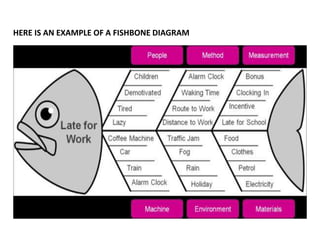
What is the fishbone analysis tool?
Fishbone diagram is an analysis tool which
provides a systematic way of understanding
problems and the root causes of those
problems.
It is used when
• You need to study a problem to determine the root
cause
• You want to study all the possible reasons why a
process is having difficulties or problems
• to study why a process is not performing properly
and/or producing the expected results
HERE IS AN EXAMPLE OF A FISHBONE DIAGRAM
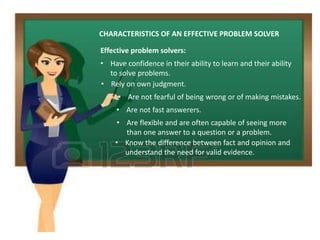
• Have confidence in their ability to learn and their ability
to solve problems.
CHARACTERISTICS OF AN EFFECTIVE PROBLEM SOLVER
Effective problem solvers:
• Rely on own judgment.
• Are not fearful of being wrong or of making mistakes.
• Are not fast answerers.
• Are flexible and are often capable of seeing more
than one answer to a question or a problem.
• Know the difference between fact and opinion and
understand the need for valid evidence.
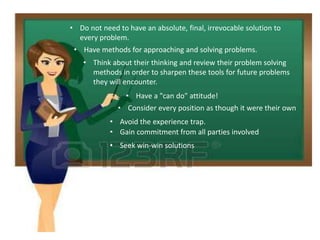
• Do not need to have an absolute, final, irrevocable solution to
every problem.
• Have methods for approaching and solving problems.
• Think about their thinking and review their problem solving
methods in order to sharpen these tools for future problems
they will encounter.
• Have a "can do" attitude!
• Consider every position as though it were their own
• Avoid the experience trap.
• Gain commitment from all parties involved
• Seek win-win solutions
As part of problem solving…
• The supervisor is not expected to solve ALL
problems instead s/he should know how to:
▫ refer the problem to the proper people,
▫ delegate appropriately, and
▫ keep work moving.
• The supervisor needs to take complete
responsibility for getting the facts needed.
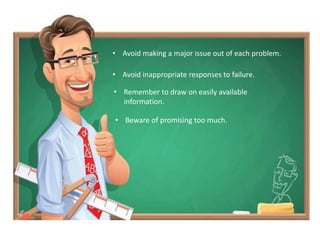
• Avoid making a major issue out of each problem.
• Avoid inappropriate responses to failure.
• Remember to draw on easily available
information.
• Beware of promising too much.

Problem solving

  • 1.
    Course Code :EM 504 Course Title : School Executive Development Professor : Mario C. Pasion, Ed. D. Ffp Reporter : Cherrymay C. Molde Republic of the Philippines LAGUNA STATE POLYTECHNIC UNIVERSITY MAIN CAMPUS Sta. Cruz, Laguna GRADUATESTUDIESANDAPPLIEDRESEARCH
  • 2.
    WHAT IS APROBLEM ? “A doubtful or difficult matter requiring a solution” and “Something hard to understand or accomplish or deal with.” The Concise Oxford Dictionary (1995) defines a problem as:
  • 3.
    WHAT IS PROBLEM SOLVING? Theprocess of finding solutions to difficult or complex issues.
  • 4.
    TYPES OF PROBLEMSOLVING ENCOUNTERED AT THE WORKPLACE Problems abound in every workplace due to various issues such as the need to: Collaborate and work with various types of people Meet targets and deadlines Work within tight budgets Gain the endorsement and praise supervisors Work within the norms and culture of the organization
  • 5.
    There are specificproblems which are common to every workplace because workplaces are human institutions and human beings ate the same everywhere. Communication problem Attitude problem Interpersonal challenges between supervisor and subordinates or among your subordinates Ethical problems Poor performance Discrimination and harassment
  • 6.
    Policies that areunique to your workplace There are another set of problems that are peculiar to an organization for various reasons for example as a result of: Processes that should be followed for various work related issues Types of clients the organization provides services to Other constraints at work ie. Inadequate resources, equipment etc.
  • 7.
  • 8.
    To effectively solveproblems at the workplace, it is important to keep the following in mind: Problems are not manageable when they are conceived in large global terms Problems should not be allowed nor linger. Practices fairness in solving problems If there is any punishment, let it fit the crime
  • 9.
    There are countlessapproaches that have been developed for problem solving, some are very simple and others are complicated. Some of these include: Trial and error method Experimentation Affinity Map Problem Solving models Fishbone analysis
  • 10.
    PROBLEM SOLVING MODEL IDENTIFYTHE PROBLEM GATHER RELEVANT DATA CLARIFY THE PROBLEM GENERATE POSSIBLE SOLUTION SELECT THE BEST OPTION IMPLEMENT
  • 11.
  • 12.
    What is thefishbone analysis tool? Fishbone diagram is an analysis tool which provides a systematic way of understanding problems and the root causes of those problems.
  • 13.
    It is usedwhen • You need to study a problem to determine the root cause • You want to study all the possible reasons why a process is having difficulties or problems • to study why a process is not performing properly and/or producing the expected results
  • 14.
    HERE IS ANEXAMPLE OF A FISHBONE DIAGRAM
  • 15.
    • Have confidencein their ability to learn and their ability to solve problems. CHARACTERISTICS OF AN EFFECTIVE PROBLEM SOLVER Effective problem solvers: • Rely on own judgment. • Are not fearful of being wrong or of making mistakes. • Are not fast answerers. • Are flexible and are often capable of seeing more than one answer to a question or a problem. • Know the difference between fact and opinion and understand the need for valid evidence.
  • 16.
    • Do notneed to have an absolute, final, irrevocable solution to every problem. • Have methods for approaching and solving problems. • Think about their thinking and review their problem solving methods in order to sharpen these tools for future problems they will encounter. • Have a "can do" attitude! • Consider every position as though it were their own • Avoid the experience trap. • Gain commitment from all parties involved • Seek win-win solutions
  • 17.
    As part ofproblem solving… • The supervisor is not expected to solve ALL problems instead s/he should know how to: ▫ refer the problem to the proper people, ▫ delegate appropriately, and ▫ keep work moving. • The supervisor needs to take complete responsibility for getting the facts needed.
  • 18.
    • Avoid makinga major issue out of each problem. • Avoid inappropriate responses to failure. • Remember to draw on easily available information. • Beware of promising too much.