Management Decisions-Making
What is management?

• Act of getting people together to accomplish
  desired goals.
• An art and science as well.
• Encompasses an array of different functions.
• ‘Getting things done.’


                                                 2
Decision Making in Management

• A major concern in
  management.
• Sound and rational
  decision -making.
• Key part of manager’s
  activities.


                                 3
Characteristics of Decision-Making

• Decision making implies choice.
• Continuous activity/process.
• Intellectual activity.
• Based on reliable information/
  feedback.
• Goal oriented process.
• A ‘means’ and not the end.
                                    4
Characteristics of
         Decision-Making (..ctd)
•   Related to specific problem.
•   Time consuming activity.
•   Needs effective communication.
•   Pervasive process.
•   Responsible job.


                                     5
Decision-Making process
• Defining / Identifying
  the managerial problem.
• Analyzing the problem
• Developing alternative solutions.
• Selecting the best solution out of the available
  alternatives.
• Converting the decision into action
• Ensuring feedback for follow-up.
                                                 6
Decision-Making process (..ctd)


                                  7
Approaches to Decision Making

• Approaches by psychologists:
  – Divide and Conquer strategy (problem
    decomposition) – Benjamin Franklin.
  – Normative Analyses.
  – Descriptive Analyses.


                                           8
Normative Analyses

• Certain Outcomes
  – Multi-atribute utility.
  – Linear models.
• Uncertain Outcomes
  – Decision Tree Analysis.
  – Bayesian Networks.


                              9
Normative Analyses (..ctd)

• Certain Outcomes
  – Multi-atribute utility.
     • Decisions made with more or less
       certain outcomes.
  – Linear models
     • Weights assigned to the cue.


                                          10
Normative Analyses (..ctd)

• Uncertain Outcomes
  – Decision Tree Analysis.
     • Sequence of decisions.
  – Bayesian Networks.
     • Bayesian probability theory+ artificial
       intelligence+graphical analysis


                                                 11
DescriptiveAnalyses

•   Social Judgement Theory (SJT).
•   Information Integration Theory (IIT).
•   Image Theory.
•   Heuristics and Biases.
•   Fast and Frugal Heuristics.
•   Naturalistic Decision Making.
•    Expert Decision Making.

                                       12
DescriptiveAnalyses (..ctd)

• Social Judgement Theory (SJT)
  – Elements of normative + descriptive
    analyses.
• Information Integration Theory (IIT)
  – Averaging rule.
• Image Theory
  – Views decision maker as processing
    value image+tragectory image+strategic
    image.
                                          13
DescriptiveAnalyses (..ctd)
• Heuristic and Biases
  – Physiological shortcuts or “heuristics”.
• Fast and Frugal Heuristics
  – Bounded rationality.
• Naturalistic Decision Making
  – Online decision making.
• Expert Decision Making
  – Need for research for better decisions.

                                          14
Three Decision Making Models


Political Model
Political Model


                   Administrative Model
                   Administrative Model


                                           Classical Model
                                           Classical Model


                                                              15
Political Model
 Closely resembles the real environment in
  which most managers and decision
  makers operate.
 Decisions are complex.
 Disagreement and conflict over problems
  and solutions are normal.
 Coalition building is important.

                                              16
Administrative Model
• How managers actually make decisions in situations
  characterized by non-programmed decisions, uncertainty, and
  ambiguity.
• Focuses on organizational, rather than economic.
• Two concepts are instrumental in shaping the administrative
  model.
   • bounded rationality: means that people have limits or
      boundaries on how rational they can be.
   • satisficing: means that decision makers choose the first
      solution alternative that satisfies minimal decision criteria.
• Is considered to be descriptive.
• It is considered intuitive.
                                                                   17
Classical Model

Accomplishes goals that are known and agreed
 upon.
Strives for certainty by gathering complete
 information.
Criteria for evaluating alternatives are known.
Decision maker is rational and uses logic.

                                               18
Classical Models

Based on economic conditions

Is considered to be normative


                                 19
Diagnosis Questions
                 (Kepner & Tregoe)
 What is the state of disequilibrium affecting us?
 When did it occur?
 Where did it occur?
 How did it occur?
 To whom did it occur?
 What is the urgency of the problem?
 What is the interconnectedness of events?
 What result came from what activity?
                                                  20
7 Popular Methods
           for Making Decisions
•   Decision by running out of time.
•   Decision by chos.
•   Decision by fiat.
•   Decision by coercion.
•   Decision by competition.
•   Decision by voting.
•   Decision by inertia.
                                       21
Advantages of Decision Making

•   Primary function of management.
•   Facilitates the entire management process.
•   Continuous managerial function.
•   Essential to face new problems and challenges.
•   Delicate and responsible job.


                                                 22
Techniques for improving Decision Making

   Brainstorming – idea generation for decision
    making.
   Nominal group technique (NGT)- problem
    outlined, presentation of solution in written form,
    discussion over written solutions, and final
    decision.
   Delphi technique- decision made on the basis of
    questionnaire filled by the respondents.
   Consensus mapping- decision made on the basis
    of the report presented by the representative of each
    group after                                           23
Guideline for making decision
         more effective
 Categorical interpretation- the problem should be defined
  properly.
 Application of limiting factor- limiting factor should be
  taken into account in order to analyze the external S & W.
 Adequate information-           more quantity of reliable
  information leads to effective decision making.
 Considering other views- various views at the same point
  are taken into account for quality decision.
 Timeliness- decision should be ,made at proper time to meet
  the competitive advantages.


                                                            24
Simple Practical Test On
   Decision-Making


                           25
Suppose that you are a manager
              & running your organization.

               Few questions will be asked.

              Think & answer the questions
              as though you are the manager!

       The default choices (to all questions) will be:
a) Not at all b)Rarely c)Sometimes d)Often e)Very often


                                                         26
Ready?


         27
Practice


1. I evaluate the risks associated with each alternative
   before making a decision.
2. After I make a decision, it's final – because I know
   my process is strong.
3. I try to determine the real issue before starting a
   decision-making process.
4. I rely on my own experience to find potential
   solutions to a problem.
5. I tend to have a strong "gut instinct" about problems,
   and I rely on it in decision-making.
6. I am sometimes surprised by the actual
   consequences of my decisions.
                                                        28
Practice

7. I think that involving many stakeholders to generate
    solutions can make the process more complicated than it
    needs to be.
8. If I have doubts about my decision, I go back and
    recheck my assumptions and my process.
9. I take the time needed to choose the best decision-
    making tool for each specific decision.
10. I consider a variety of potential solutions before I make
    my decision.
11. Before I communicate my decision, I create an
    implementation plan.
12. In a group decision-making process, I tend to support
    my friends' proposals and try to find ways to make them
    work.
                                                            29
Practice

13. I use a well-defined process to structure my
    decisions.
14. When communicating my decision, I include my
    rationale and justification.
15. Some of the options I've chosen have been much
    more difficult to implement than I had expected.
16. I prefer to make decisions on my own, and then let
    other people know what I've decided.
17. I determine the factors most important to the
    decision, and then use those factors to evaluate my
    choices.
18. I emphasize how confident I am in my decision as a
    way to gain support for my plans.
                                                          30
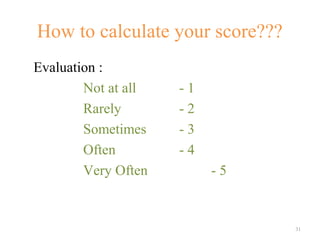
How to calculate your score???
Evaluation :
        Not at all   -1
        Rarely       -2
        Sometimes    -3
        Often        -4
        Very Often        -5


                                 31
Check out your score and
   comments friends


                           32
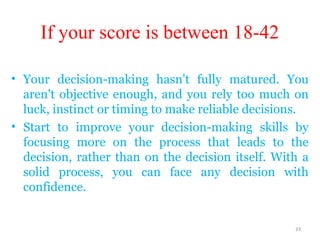
If your score is between 18-42

• Your decision-making hasn't fully matured. You
  aren't objective enough, and you rely too much on
  luck, instinct or timing to make reliable decisions.
• Start to improve your decision-making skills by
  focusing more on the process that leads to the
  decision, rather than on the decision itself. With a
  solid process, you can face any decision with
  confidence.


                                                   33
If your score is between 43-66
•   Your decision-making process is OK. You have a
    good understanding of the basics, but now you
    need to improve your process and be more
    proactive.
•   Concentrate on finding lots of options and
    discovering as many risks and consequences as
    you can. The better your analysis, the better your
    decision will be in the long term.
•   Focus specifically on the areas where you lost
    points, and develop a system that will work for
    you across a wide variety of situations.
                                                    34
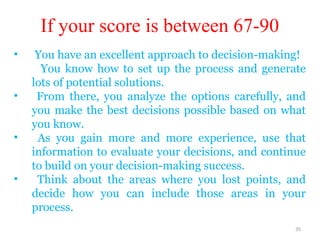
If your score is between 67-90
•    You have an excellent approach to decision-making!
      You know how to set up the process and generate
    lots of potential solutions.
•    From there, you analyze the options carefully, and
    you make the best decisions possible based on what
    you know.
•    As you gain more and more experience, use that
    information to evaluate your decisions, and continue
    to build on your decision-making success.
•    Think about the areas where you lost points, and
    decide how you can include those areas in your
    process.
                                                      35
Six essential steps in the decision-
          making process
• Establishing a positive decision-making
  environment.
• Generating potential solutions.
• Evaluating the solutions.
• Deciding.
• Checking the decision.
• Communicating and implementing.
                                            36
37

Management Decision Making

  • 1.
  • 2.
    What is management? •Act of getting people together to accomplish desired goals. • An art and science as well. • Encompasses an array of different functions. • ‘Getting things done.’ 2
  • 3.
    Decision Making inManagement • A major concern in management. • Sound and rational decision -making. • Key part of manager’s activities. 3
  • 4.
    Characteristics of Decision-Making •Decision making implies choice. • Continuous activity/process. • Intellectual activity. • Based on reliable information/ feedback. • Goal oriented process. • A ‘means’ and not the end. 4
  • 5.
    Characteristics of Decision-Making (..ctd) • Related to specific problem. • Time consuming activity. • Needs effective communication. • Pervasive process. • Responsible job. 5
  • 6.
    Decision-Making process • Defining/ Identifying the managerial problem. • Analyzing the problem • Developing alternative solutions. • Selecting the best solution out of the available alternatives. • Converting the decision into action • Ensuring feedback for follow-up. 6
  • 7.
  • 8.
    Approaches to DecisionMaking • Approaches by psychologists: – Divide and Conquer strategy (problem decomposition) – Benjamin Franklin. – Normative Analyses. – Descriptive Analyses. 8
  • 9.
    Normative Analyses • CertainOutcomes – Multi-atribute utility. – Linear models. • Uncertain Outcomes – Decision Tree Analysis. – Bayesian Networks. 9
  • 10.
    Normative Analyses (..ctd) •Certain Outcomes – Multi-atribute utility. • Decisions made with more or less certain outcomes. – Linear models • Weights assigned to the cue. 10
  • 11.
    Normative Analyses (..ctd) •Uncertain Outcomes – Decision Tree Analysis. • Sequence of decisions. – Bayesian Networks. • Bayesian probability theory+ artificial intelligence+graphical analysis 11
  • 12.
    DescriptiveAnalyses • Social Judgement Theory (SJT). • Information Integration Theory (IIT). • Image Theory. • Heuristics and Biases. • Fast and Frugal Heuristics. • Naturalistic Decision Making. • Expert Decision Making. 12
  • 13.
    DescriptiveAnalyses (..ctd) • SocialJudgement Theory (SJT) – Elements of normative + descriptive analyses. • Information Integration Theory (IIT) – Averaging rule. • Image Theory – Views decision maker as processing value image+tragectory image+strategic image. 13
  • 14.
    DescriptiveAnalyses (..ctd) • Heuristicand Biases – Physiological shortcuts or “heuristics”. • Fast and Frugal Heuristics – Bounded rationality. • Naturalistic Decision Making – Online decision making. • Expert Decision Making – Need for research for better decisions. 14
  • 15.
    Three Decision MakingModels Political Model Political Model Administrative Model Administrative Model Classical Model Classical Model 15
  • 16.
    Political Model  Closelyresembles the real environment in which most managers and decision makers operate.  Decisions are complex.  Disagreement and conflict over problems and solutions are normal.  Coalition building is important. 16
  • 17.
    Administrative Model • Howmanagers actually make decisions in situations characterized by non-programmed decisions, uncertainty, and ambiguity. • Focuses on organizational, rather than economic. • Two concepts are instrumental in shaping the administrative model. • bounded rationality: means that people have limits or boundaries on how rational they can be. • satisficing: means that decision makers choose the first solution alternative that satisfies minimal decision criteria. • Is considered to be descriptive. • It is considered intuitive. 17
  • 18.
    Classical Model Accomplishes goalsthat are known and agreed upon. Strives for certainty by gathering complete information. Criteria for evaluating alternatives are known. Decision maker is rational and uses logic. 18
  • 19.
    Classical Models Based oneconomic conditions Is considered to be normative 19
  • 20.
    Diagnosis Questions (Kepner & Tregoe)  What is the state of disequilibrium affecting us?  When did it occur?  Where did it occur?  How did it occur?  To whom did it occur?  What is the urgency of the problem?  What is the interconnectedness of events?  What result came from what activity? 20
  • 21.
    7 Popular Methods for Making Decisions • Decision by running out of time. • Decision by chos. • Decision by fiat. • Decision by coercion. • Decision by competition. • Decision by voting. • Decision by inertia. 21
  • 22.
    Advantages of DecisionMaking • Primary function of management. • Facilitates the entire management process. • Continuous managerial function. • Essential to face new problems and challenges. • Delicate and responsible job. 22
  • 23.
    Techniques for improvingDecision Making  Brainstorming – idea generation for decision making.  Nominal group technique (NGT)- problem outlined, presentation of solution in written form, discussion over written solutions, and final decision.  Delphi technique- decision made on the basis of questionnaire filled by the respondents.  Consensus mapping- decision made on the basis of the report presented by the representative of each group after 23
  • 24.
    Guideline for makingdecision more effective  Categorical interpretation- the problem should be defined properly.  Application of limiting factor- limiting factor should be taken into account in order to analyze the external S & W.  Adequate information- more quantity of reliable information leads to effective decision making.  Considering other views- various views at the same point are taken into account for quality decision.  Timeliness- decision should be ,made at proper time to meet the competitive advantages. 24
  • 25.
    Simple Practical TestOn Decision-Making 25
  • 26.
    Suppose that youare a manager & running your organization. Few questions will be asked. Think & answer the questions as though you are the manager! The default choices (to all questions) will be: a) Not at all b)Rarely c)Sometimes d)Often e)Very often 26
  • 27.
  • 28.
    Practice 1. I evaluatethe risks associated with each alternative before making a decision. 2. After I make a decision, it's final – because I know my process is strong. 3. I try to determine the real issue before starting a decision-making process. 4. I rely on my own experience to find potential solutions to a problem. 5. I tend to have a strong "gut instinct" about problems, and I rely on it in decision-making. 6. I am sometimes surprised by the actual consequences of my decisions. 28
  • 29.
    Practice 7. I thinkthat involving many stakeholders to generate solutions can make the process more complicated than it needs to be. 8. If I have doubts about my decision, I go back and recheck my assumptions and my process. 9. I take the time needed to choose the best decision- making tool for each specific decision. 10. I consider a variety of potential solutions before I make my decision. 11. Before I communicate my decision, I create an implementation plan. 12. In a group decision-making process, I tend to support my friends' proposals and try to find ways to make them work. 29
  • 30.
    Practice 13. I usea well-defined process to structure my decisions. 14. When communicating my decision, I include my rationale and justification. 15. Some of the options I've chosen have been much more difficult to implement than I had expected. 16. I prefer to make decisions on my own, and then let other people know what I've decided. 17. I determine the factors most important to the decision, and then use those factors to evaluate my choices. 18. I emphasize how confident I am in my decision as a way to gain support for my plans. 30
  • 31.
    How to calculateyour score??? Evaluation : Not at all -1 Rarely -2 Sometimes -3 Often -4 Very Often -5 31
  • 32.
    Check out yourscore and comments friends 32
  • 33.
    If your scoreis between 18-42 • Your decision-making hasn't fully matured. You aren't objective enough, and you rely too much on luck, instinct or timing to make reliable decisions. • Start to improve your decision-making skills by focusing more on the process that leads to the decision, rather than on the decision itself. With a solid process, you can face any decision with confidence. 33
  • 34.
    If your scoreis between 43-66 • Your decision-making process is OK. You have a good understanding of the basics, but now you need to improve your process and be more proactive. • Concentrate on finding lots of options and discovering as many risks and consequences as you can. The better your analysis, the better your decision will be in the long term. • Focus specifically on the areas where you lost points, and develop a system that will work for you across a wide variety of situations. 34
  • 35.
    If your scoreis between 67-90 • You have an excellent approach to decision-making! You know how to set up the process and generate lots of potential solutions. • From there, you analyze the options carefully, and you make the best decisions possible based on what you know. • As you gain more and more experience, use that information to evaluate your decisions, and continue to build on your decision-making success. • Think about the areas where you lost points, and decide how you can include those areas in your process. 35
  • 36.
    Six essential stepsin the decision- making process • Establishing a positive decision-making environment. • Generating potential solutions. • Evaluating the solutions. • Deciding. • Checking the decision. • Communicating and implementing. 36
  • 37.

Editor's Notes