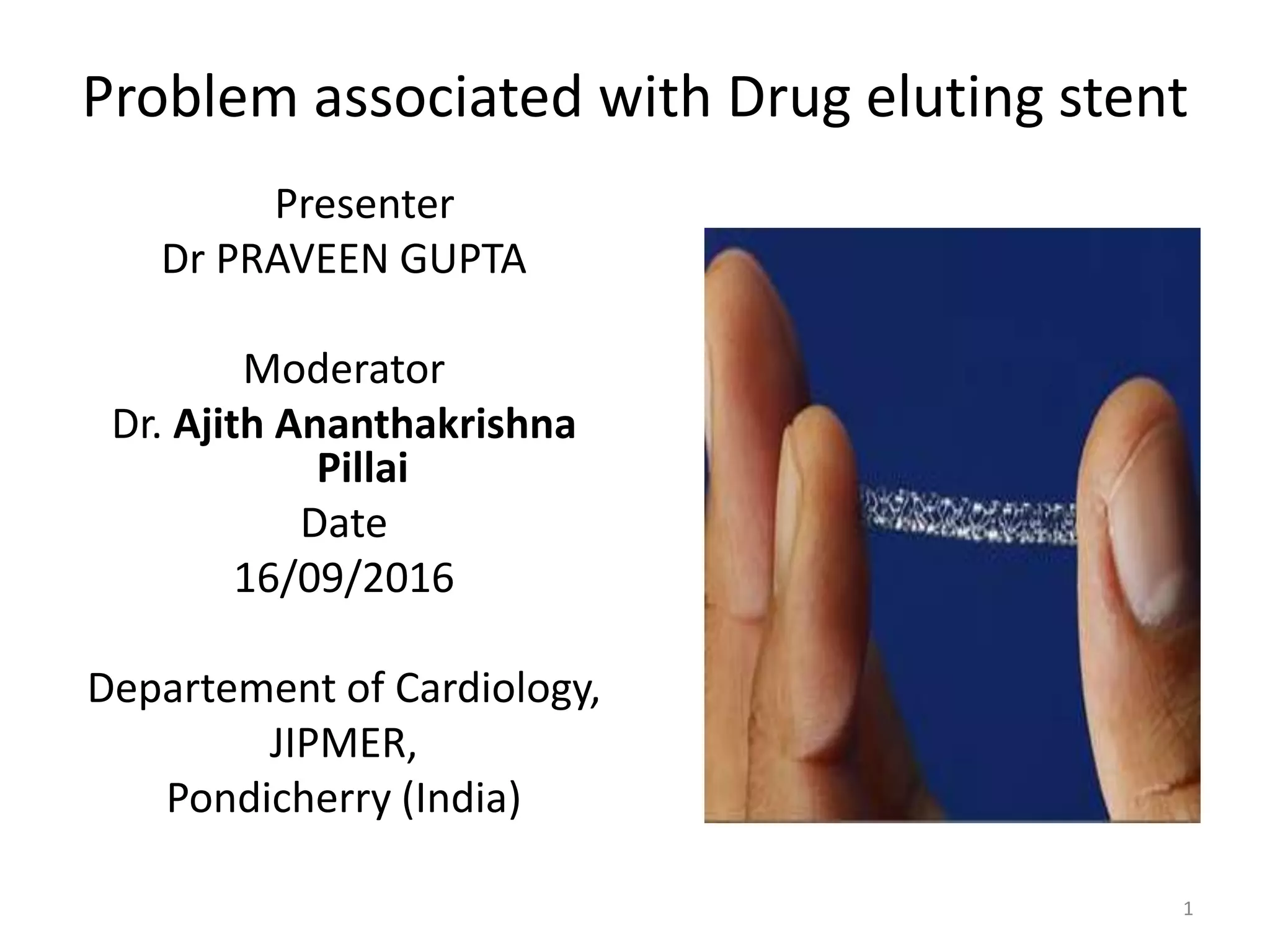
Problem associated with Drug eluting stent
Presenter
Dr PRAVEEN GUPTA
Moderator
Dr. Ajith Ananthakrishna
Pillai
Date
16/09/2016
Departement of Cardiology,
JIPMER,
Pondicherry (India)
1
Stent thrombosis
Introduction
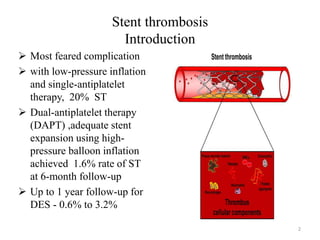
 Most feared complication
 with low-pressure inflation
and single-antiplatelet
therapy, 20% ST
 Dual-antiplatelet therapy
(DAPT) ,adequate stent
expansion using high-
pressure balloon inflation
achieved 1.6% rate of ST
at 6-month follow-up
 Up to 1 year follow-up for
DES - 0.6% to 3.2%
2
Stent thrombosis
Introduction
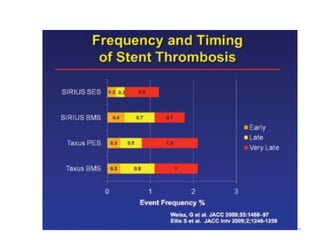
• very late ST may occur steadily at an annual rate of 0.4% to
0.6% after first-generation DES implantation
3
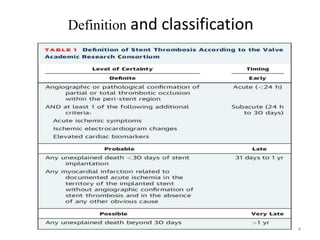
Definition and classification
4
5
6
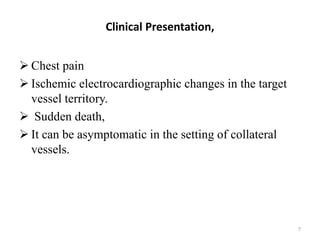
Clinical Presentation,
 Chest pain
 Ischemic electrocardiographic changes in the target
vessel territory.
 Sudden death,
 It can be asymptomatic in the setting of collateral
vessels.
7
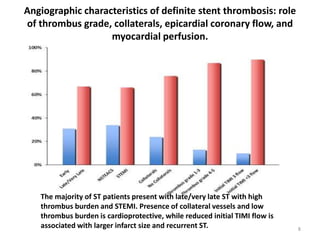
Angiographic characteristics of definite stent thrombosis: role
of thrombus grade, collaterals, epicardial coronary flow, and
myocardial perfusion.
8
The majority of ST patients present with late/very late ST with high
thrombus burden and STEMI. Presence of collateral vessels and low
thrombus burden is cardioprotective, while reduced initial TIMI flow is
associated with larger infarct size and recurrent ST.
Diagnosis
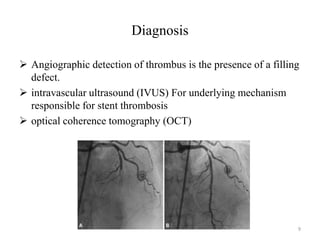
 Angiographic detection of thrombus is the presence of a filling
defect.
 intravascular ultrasound (IVUS) For underlying mechanism
responsible for stent thrombosis
 optical coherence tomography (OCT)
9
Mechanisms
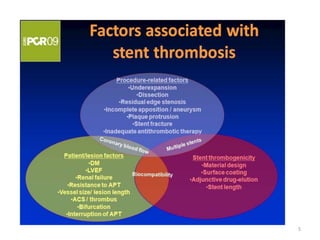
 DES induce platelet adhesion, activation and thrombus
formation
 Cytotoxic drugs-inhibit endothelialisation .
 Sirolimus & paclitaxel -activation of the coagulation system.
 The polymers -hypersensitivity reaction / prothrombotic
environment
10
Mechanisms
 Persistent slow coronary blood flow and low shear stress
leading to activation of the intrinsic pathway;
 Premature discontinuation of DAPT
 Systemic prothrombotic state (e.g., due to ACS or
malignancy).
• Most consistently reported predictors are early DAPT
discontinuation, the extent of coronary artery disease, and
total stent length
11
Early ST
 technical and procedural
factors are important.
 A suboptimal procedural
result
 slow flow,
 inadequate post-procedural
lumen dimensions,
 residual dissection,
 tissue prolapse
 discontinuation of
DAPT
 Stenting in
prothrombotic
conditions in patients
with ACS/malignancy
12
Late and very late ST
 Delayed endothelial coverage, persistent fibrin deposition, &
ongoing vessel inflammation
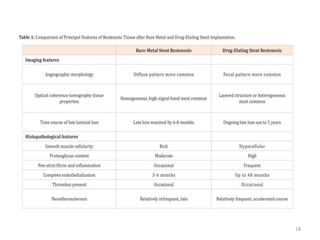
 DES compared with BMS
 Late stent malapposition more commonly in DES compared
with BMS
 neoatherosclerotic plaques - rupture, causing ST
13
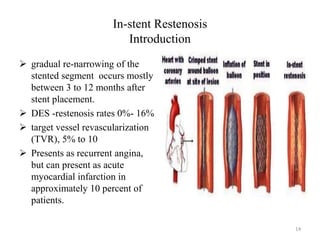
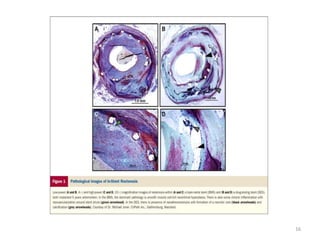
In-stent Restenosis
Introduction
 gradual re-narrowing of the
stented segment occurs mostly
between 3 to 12 months after
stent placement.
 DES -restenosis rates 0%- 16%
 target vessel revascularization
(TVR), 5% to 10
 Presents as recurrent angina,
but can present as acute
myocardial infarction in
approximately 10 percent of
patients.
14
Definition
 Angiographic” restenosis means recurrent diameter stenosis
(late lumen loss – LLL) >50% within the stent segment or its
edges (5 mm segments adjacent to the stent) in follow-up
 “Clinical” restenosis, symptoms or ischemia recurrence with
>50% diameter stenosis or >70% diameter stenosis without
symptoms
15
16
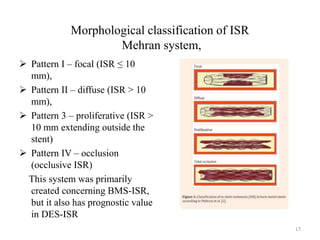
Morphological classification of ISR
Mehran system,
 Pattern I – focal (ISR ≤ 10
mm),
 Pattern II – diffuse (ISR > 10
mm),
 Pattern 3 – proliferative (ISR >
10 mm extending outside the
stent)
 Pattern IV – occlusion
(occlusive ISR)
This system was primarily
created concerning BMS-ISR,
but it also has prognostic value
in DES-ISR
17
18
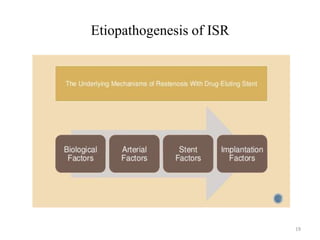
Etiopathogenesis of ISR
19
Biological factors
 Resistance to antiproliferative drugs.
 Mutations of the gene polymorphism that encode mTOR -
resistance to sirolimus (rapamycin).
 Hypersensitivity reactions to the polymer
 Inflammatory response associated with sirolimus eluting stents
(SES) /everolimus-eluting stent (EES)
 Hypersensitivity reactions to the metallic stent platform
20
Arterial factors
 High-shear stress areas like carina of the bifurcation can
potentially limit progression of atherosclerosis,
 Low-shear stress areas like ostium of a bifurcation may lead to
promotion of atherosclerosis or enhancement of neointimal
proliferation.
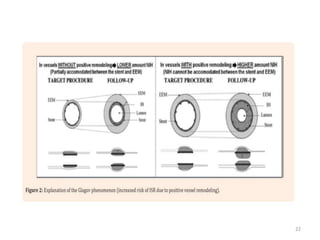
 Positive vessel remodeling may be also a contributable factor
for development of DES-ISR.
21
22
Stent factors
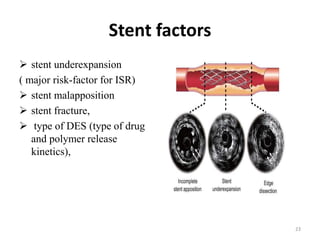
 stent underexpansion
( major risk-factor for ISR)
 stent malapposition
 stent fracture,
 type of DES (type of drug
and polymer release
kinetics),
23
Stent factors
 nonuniform drug deposition/ distribution,
 strut thickness and polymer disruption or peeling.
 Type of drug and polymer release kinetics
24
Stent factors
 thicker stent struts -increased risk from ISR
 Polymer disruption, peeling and cracking -increasing the risk
for ISR
 aggressive kissing-balloon postdilatation
 After using non-compliant balloons on high pressure
atmospheres.
25
Implantation (technical) factors
 Barotrauma outside stented segment
 Stent gap
 Residual uncovered atherosclerotic plaques
26
Noncardiac surgery after percutaneous coronary
intervention
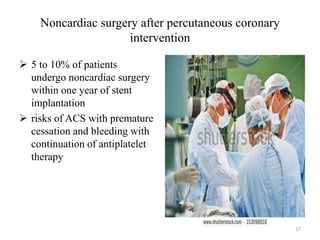
 5 to 10% of patients
undergo noncardiac surgery
within one year of stent
implantation
 risks of ACS with premature
cessation and bleeding with
continuation of antiplatelet
therapy
27
COMPLICATIONS
 patients who undergo major noncardiac surgery within six
weeks, and particularly within two weeks, of PCI with bare-
metal (BMS) or drug-eluting stents (DES) have an increased
risk of adverse cardiovascular events.
 These events are often due to stent thrombosis, which lead to
high rates of myocardial infarction (50 to 70 percent) and
death (10 to 40 percent
28
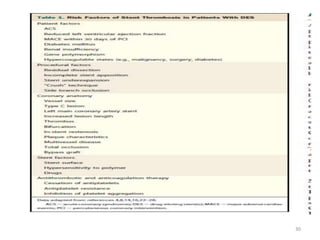
Causes
• Premature cessation of antiplatelet therapy
• Prothrombotic and proinflammatory effects of surgery
• Incomplete strut coverage
29
30
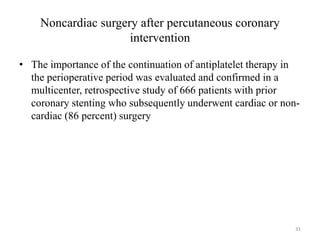
Noncardiac surgery after percutaneous coronary
intervention
• The importance of the continuation of antiplatelet therapy in
the perioperative period was evaluated and confirmed in a
multicenter, retrospective study of 666 patients with prior
coronary stenting who subsequently underwent cardiac or non-
cardiac (86 percent) surgery
31
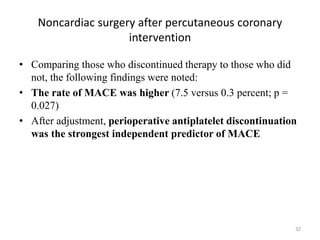
Noncardiac surgery after percutaneous coronary
intervention
• Comparing those who discontinued therapy to those who did
not, the following findings were noted:
• The rate of MACE was higher (7.5 versus 0.3 percent; p =
0.027)
• After adjustment, perioperative antiplatelet discontinuation
was the strongest independent predictor of MACE
32
Noncardiac surgery after percutaneous coronary intervention
• Continuation of aspirin was associated with a significantly
lower risk of MACE
• For non-CABG surgical patients, aspirin alone or with
P2Y12 receptor blocker increases the risk of bleeding by as
much as 20 and 50 percent, respectively, and these rates are
dependent on the location of the surgery . This excess bleeding
leads to an increase in red blood cell transfusion, but not to an
increase in surgical mortality or morbidity
33
Approach to a patient for major surgery following recent
coronary artery stenting
• No accepted standard approach
• Multidisciplinary discussion should take place.
• The key questions are
• When was the PCI done?
• What is the type of stent?
• How many stents were placed?
• Was the revascularization complete?
34
Approach to a patient for major surgery following recent
coronary artery stenting
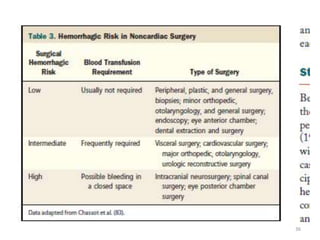
• Drug regime and any irregularities of the treatment?
• History of any adverse cardiac event/stent thrombosis?
• Urgency of surgery? / Can the surgery be delayed?
• Bleeding risk during surgery?
• History of conditions prone to stent thrombosis
• Whether antiplatelet medication is to be maintained in
perioperative period or stopped before operation?
• Investigations for platelet count and platelet function should be
undertaken. Whole blood and platelet concentrates should be
arranged prior to surgery.
35
36
37
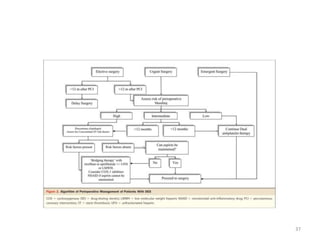
Approach to a patient for major surgery following recent
coronary artery stenting
• low risk for bleeding, continue DAPT
• Intermediate-bleeding-risk case-by-case basis.
• complex stent procedures and co-morbidities,
continue DAPT
38
Approach to a patient for major surgery following
recent coronary artery stenting
• High-bleeding-risk surgical procedures Patients with 12
months completed of DAPT and low risk for thrombosis of the
coronary artery stents can stop clopidogrel and ticagrelor 5
days prior to surgery and prasugrel 7 days before surgery
while continuing ASA.
• DAPT should be restarted as soon as possible postoperatively
(ideally within 24 hours) with a loading dose of 300 mg - 600
mg clopidogrel, or prasugrel 60 mg, or ticagrelor 180 mg.
39
Approach to a patient for major surgery following
recent coronary artery stenting
• For patients with coronary stents with high risk for thrombosis
presenting for high-risk bleeding surgical procedures, “bridge”
therapy has been suggested.
• Short-acting GP IIb/IIIa inhibitors, -tirofiban or eptifibatide,
as a bridge between the time of the thienopyridine
discontinuation and surgery.
• Given as infusion and requires patient admission to the
hospital 3 days after the discontinuation of thienopyridines
40
Approach to a patient for major surgery following recent
coronary artery stenting
• Infusion is stopped 4 to 6 hours prior to surgical
procedure and restarted as soon as possible after the
surgery
41
Approach to a patient for major surgery following recent
coronary artery stenting
• Cangrelor, an investigational parenteral, reversible,
direct P2Y12 platelet inhibitor with its extremely
short (5 to 9 minutes) half-life, may present an
alternative for “bridge” therapy in the near future.
42
Approach to a patient for major surgery following
recent coronary artery stenting
• Platelet Transfusion
• Blood transfusions
• hemorrhage that continues despite the usual
hemostatic techniques, however, platelet
transfusion may be considered as a strategy to
reverse bleeding, even if platelet count is
normal.
43
Take home message
• Stent thrombosis -Most
feared complication
• DES -restenosis rates 0%-
16%
• Perioperatvie cardiac
events are often due to
stent thrombosis
• Most consistently
reported predictors are
early DAPT
discontinuation
44
Take home message
• low risk for bleeding, continue DAPT
• Intermediate-bleeding-risk case-by-case basis.
• complex stent procedures and co-morbidities,
continue DAPT
• patients with stents in need of urgent surgical
procedures If the time is less than one year (or less
than one month for BMS), then the DAPT has to be
continued throughout, except for surgeries in
enclosed spaces.
45
46
47

Problem associated with drug eluting stent

  • 1.
    Problem associated withDrug eluting stent Presenter Dr PRAVEEN GUPTA Moderator Dr. Ajith Ananthakrishna Pillai Date 16/09/2016 Departement of Cardiology, JIPMER, Pondicherry (India) 1
  • 2.
    Stent thrombosis Introduction  Mostfeared complication  with low-pressure inflation and single-antiplatelet therapy, 20% ST  Dual-antiplatelet therapy (DAPT) ,adequate stent expansion using high- pressure balloon inflation achieved 1.6% rate of ST at 6-month follow-up  Up to 1 year follow-up for DES - 0.6% to 3.2% 2
  • 3.
    Stent thrombosis Introduction • verylate ST may occur steadily at an annual rate of 0.4% to 0.6% after first-generation DES implantation 3
  • 4.
  • 5.
  • 6.
  • 7.
    Clinical Presentation,  Chestpain  Ischemic electrocardiographic changes in the target vessel territory.  Sudden death,  It can be asymptomatic in the setting of collateral vessels. 7
  • 8.
    Angiographic characteristics ofdefinite stent thrombosis: role of thrombus grade, collaterals, epicardial coronary flow, and myocardial perfusion. 8 The majority of ST patients present with late/very late ST with high thrombus burden and STEMI. Presence of collateral vessels and low thrombus burden is cardioprotective, while reduced initial TIMI flow is associated with larger infarct size and recurrent ST.
  • 9.
    Diagnosis  Angiographic detectionof thrombus is the presence of a filling defect.  intravascular ultrasound (IVUS) For underlying mechanism responsible for stent thrombosis  optical coherence tomography (OCT) 9
  • 10.
    Mechanisms  DES induceplatelet adhesion, activation and thrombus formation  Cytotoxic drugs-inhibit endothelialisation .  Sirolimus & paclitaxel -activation of the coagulation system.  The polymers -hypersensitivity reaction / prothrombotic environment 10
  • 11.
    Mechanisms  Persistent slowcoronary blood flow and low shear stress leading to activation of the intrinsic pathway;  Premature discontinuation of DAPT  Systemic prothrombotic state (e.g., due to ACS or malignancy). • Most consistently reported predictors are early DAPT discontinuation, the extent of coronary artery disease, and total stent length 11
  • 12.
    Early ST  technicaland procedural factors are important.  A suboptimal procedural result  slow flow,  inadequate post-procedural lumen dimensions,  residual dissection,  tissue prolapse  discontinuation of DAPT  Stenting in prothrombotic conditions in patients with ACS/malignancy 12
  • 13.
    Late and verylate ST  Delayed endothelial coverage, persistent fibrin deposition, & ongoing vessel inflammation  DES compared with BMS  Late stent malapposition more commonly in DES compared with BMS  neoatherosclerotic plaques - rupture, causing ST 13
  • 14.
    In-stent Restenosis Introduction  gradualre-narrowing of the stented segment occurs mostly between 3 to 12 months after stent placement.  DES -restenosis rates 0%- 16%  target vessel revascularization (TVR), 5% to 10  Presents as recurrent angina, but can present as acute myocardial infarction in approximately 10 percent of patients. 14
  • 15.
    Definition  Angiographic” restenosismeans recurrent diameter stenosis (late lumen loss – LLL) >50% within the stent segment or its edges (5 mm segments adjacent to the stent) in follow-up  “Clinical” restenosis, symptoms or ischemia recurrence with >50% diameter stenosis or >70% diameter stenosis without symptoms 15
  • 16.
  • 17.
    Morphological classification ofISR Mehran system,  Pattern I – focal (ISR ≤ 10 mm),  Pattern II – diffuse (ISR > 10 mm),  Pattern 3 – proliferative (ISR > 10 mm extending outside the stent)  Pattern IV – occlusion (occlusive ISR) This system was primarily created concerning BMS-ISR, but it also has prognostic value in DES-ISR 17
  • 18.
  • 19.
  • 20.
    Biological factors  Resistanceto antiproliferative drugs.  Mutations of the gene polymorphism that encode mTOR - resistance to sirolimus (rapamycin).  Hypersensitivity reactions to the polymer  Inflammatory response associated with sirolimus eluting stents (SES) /everolimus-eluting stent (EES)  Hypersensitivity reactions to the metallic stent platform 20
  • 21.
    Arterial factors  High-shearstress areas like carina of the bifurcation can potentially limit progression of atherosclerosis,  Low-shear stress areas like ostium of a bifurcation may lead to promotion of atherosclerosis or enhancement of neointimal proliferation.  Positive vessel remodeling may be also a contributable factor for development of DES-ISR. 21
  • 22.
  • 23.
    Stent factors  stentunderexpansion ( major risk-factor for ISR)  stent malapposition  stent fracture,  type of DES (type of drug and polymer release kinetics), 23
  • 24.
    Stent factors  nonuniformdrug deposition/ distribution,  strut thickness and polymer disruption or peeling.  Type of drug and polymer release kinetics 24
  • 25.
    Stent factors  thickerstent struts -increased risk from ISR  Polymer disruption, peeling and cracking -increasing the risk for ISR  aggressive kissing-balloon postdilatation  After using non-compliant balloons on high pressure atmospheres. 25
  • 26.
    Implantation (technical) factors Barotrauma outside stented segment  Stent gap  Residual uncovered atherosclerotic plaques 26
  • 27.
    Noncardiac surgery afterpercutaneous coronary intervention  5 to 10% of patients undergo noncardiac surgery within one year of stent implantation  risks of ACS with premature cessation and bleeding with continuation of antiplatelet therapy 27
  • 28.
    COMPLICATIONS  patients whoundergo major noncardiac surgery within six weeks, and particularly within two weeks, of PCI with bare- metal (BMS) or drug-eluting stents (DES) have an increased risk of adverse cardiovascular events.  These events are often due to stent thrombosis, which lead to high rates of myocardial infarction (50 to 70 percent) and death (10 to 40 percent 28
  • 29.
    Causes • Premature cessationof antiplatelet therapy • Prothrombotic and proinflammatory effects of surgery • Incomplete strut coverage 29
  • 30.
  • 31.
    Noncardiac surgery afterpercutaneous coronary intervention • The importance of the continuation of antiplatelet therapy in the perioperative period was evaluated and confirmed in a multicenter, retrospective study of 666 patients with prior coronary stenting who subsequently underwent cardiac or non- cardiac (86 percent) surgery 31
  • 32.
    Noncardiac surgery afterpercutaneous coronary intervention • Comparing those who discontinued therapy to those who did not, the following findings were noted: • The rate of MACE was higher (7.5 versus 0.3 percent; p = 0.027) • After adjustment, perioperative antiplatelet discontinuation was the strongest independent predictor of MACE 32
  • 33.
    Noncardiac surgery afterpercutaneous coronary intervention • Continuation of aspirin was associated with a significantly lower risk of MACE • For non-CABG surgical patients, aspirin alone or with P2Y12 receptor blocker increases the risk of bleeding by as much as 20 and 50 percent, respectively, and these rates are dependent on the location of the surgery . This excess bleeding leads to an increase in red blood cell transfusion, but not to an increase in surgical mortality or morbidity 33
  • 34.
    Approach to apatient for major surgery following recent coronary artery stenting • No accepted standard approach • Multidisciplinary discussion should take place. • The key questions are • When was the PCI done? • What is the type of stent? • How many stents were placed? • Was the revascularization complete? 34
  • 35.
    Approach to apatient for major surgery following recent coronary artery stenting • Drug regime and any irregularities of the treatment? • History of any adverse cardiac event/stent thrombosis? • Urgency of surgery? / Can the surgery be delayed? • Bleeding risk during surgery? • History of conditions prone to stent thrombosis • Whether antiplatelet medication is to be maintained in perioperative period or stopped before operation? • Investigations for platelet count and platelet function should be undertaken. Whole blood and platelet concentrates should be arranged prior to surgery. 35
  • 36.
  • 37.
  • 38.
    Approach to apatient for major surgery following recent coronary artery stenting • low risk for bleeding, continue DAPT • Intermediate-bleeding-risk case-by-case basis. • complex stent procedures and co-morbidities, continue DAPT 38
  • 39.
    Approach to apatient for major surgery following recent coronary artery stenting • High-bleeding-risk surgical procedures Patients with 12 months completed of DAPT and low risk for thrombosis of the coronary artery stents can stop clopidogrel and ticagrelor 5 days prior to surgery and prasugrel 7 days before surgery while continuing ASA. • DAPT should be restarted as soon as possible postoperatively (ideally within 24 hours) with a loading dose of 300 mg - 600 mg clopidogrel, or prasugrel 60 mg, or ticagrelor 180 mg. 39
  • 40.
    Approach to apatient for major surgery following recent coronary artery stenting • For patients with coronary stents with high risk for thrombosis presenting for high-risk bleeding surgical procedures, “bridge” therapy has been suggested. • Short-acting GP IIb/IIIa inhibitors, -tirofiban or eptifibatide, as a bridge between the time of the thienopyridine discontinuation and surgery. • Given as infusion and requires patient admission to the hospital 3 days after the discontinuation of thienopyridines 40
  • 41.
    Approach to apatient for major surgery following recent coronary artery stenting • Infusion is stopped 4 to 6 hours prior to surgical procedure and restarted as soon as possible after the surgery 41
  • 42.
    Approach to apatient for major surgery following recent coronary artery stenting • Cangrelor, an investigational parenteral, reversible, direct P2Y12 platelet inhibitor with its extremely short (5 to 9 minutes) half-life, may present an alternative for “bridge” therapy in the near future. 42
  • 43.
    Approach to apatient for major surgery following recent coronary artery stenting • Platelet Transfusion • Blood transfusions • hemorrhage that continues despite the usual hemostatic techniques, however, platelet transfusion may be considered as a strategy to reverse bleeding, even if platelet count is normal. 43
  • 44.
    Take home message •Stent thrombosis -Most feared complication • DES -restenosis rates 0%- 16% • Perioperatvie cardiac events are often due to stent thrombosis • Most consistently reported predictors are early DAPT discontinuation 44
  • 45.
    Take home message •low risk for bleeding, continue DAPT • Intermediate-bleeding-risk case-by-case basis. • complex stent procedures and co-morbidities, continue DAPT • patients with stents in need of urgent surgical procedures If the time is less than one year (or less than one month for BMS), then the DAPT has to be continued throughout, except for surgeries in enclosed spaces. 45
  • 46.
  • 47.