Drug Coated Balloons
Dr Aniruddha Dharmadhikari
Interventional Cardiologist
Ex Prof of Medicine, MVP Medical College, Nashik.
Cardiologist, Shree Sai Baba Heart Institute, Nashik.
1.Vascular inflammation, hypersensitivity to metal/polymer leading
to Acute stent thrombosis
2.Unequal drug distribution
3.Late occurrence of neoathersclerosis and stent thrombosis
4.Hampers future CABG options
5.Late luminal enlargement and restoration of vasomotor function
are both compromised by the permanent metallic cage
6.Long term requirement of DAPT
Limitations of DES
Drug coated balloons (DCBs) โ€“ Fast and homogenous transfer of
antiproliferative drugs into vessel wall during single balloon
inflation by means of lipophilic matrix
DCB-only PCI is the concept of treating coronary stenoses while
limiting need for permanent/semipermanent implants
Potentially every PCI should aim at using the DCB-only strategy
โ€œLeave nothing behindโ€
DCB Concept
OCT studies have shown 40 โ€“ 56% lesions treated with DCB had
late luminal enlargement at 6 โ€“ 8 month follow up
DCB: A balloon catheter, a highly lipophilic drug and a coating
matrix that regulates local drug delivery to the vessel wall
Requirements of successful non stent โ€“ based approaches for
local drug delivery
1. Rapid drug uptake by the tissue
2. Drug persistence in the vessel wall to compensate short
contact time
DCB Concept
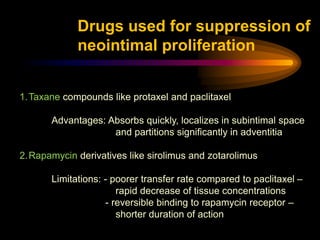
1.Taxane compounds like protaxel and paclitaxel
Advantages: Absorbs quickly, localizes in subintimal space
and partitions significantly in adventitia
2.Rapamycin derivatives like sirolimus and zotarolimus
Limitations: - poorer transfer rate compared to paclitaxel โ€“
rapid decrease of tissue concentrations
- reversible binding to rapamycin receptor โ€“
shorter duration of action
Drugs used for suppression of
neointimal proliferation
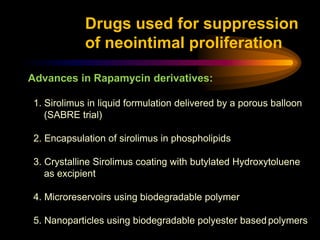
Advances in Rapamycin derivatives:
1. Sirolimus in liquid formulation delivered by a porous balloon
(SABRE trial)
2. Encapsulation of sirolimus in phospholipids
3. Crystalline Sirolimus coating with butylated Hydroxytoluene
as excipient
4. Microreservoirs using biodegradable polymer
5. Nanoparticles using biodegradable polyester basedpolymers
Drugs used for suppression
of neointimal proliferation
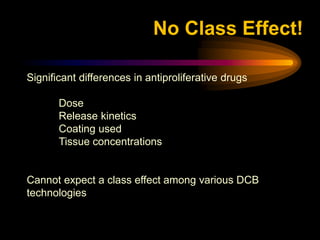
Significant differences in antiproliferative drugs
Dose
Release kinetics
Coating used
Tissue concentrations
Cannot expect a class effect among various DCB
technologies
No Class Effect!
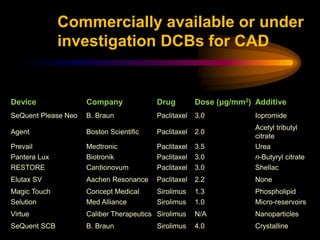
Device Company Drug Dose (ฮผg/mm2) Additive
SeQuent Please Neo B. Braun Paclitaxel 3.0 Iopromide
Agent Boston Scientific Paclitaxel 2.0
Acetyl tributyl
citrate
Prevail Medtronic Paclitaxel 3.5 Urea
Pantera Lux Biotronik Paclitaxel 3.0 n-Butyryl citrate
RESTORE Cardionovum Paclitaxel 3.0 Shellac
Elutax SV Aachen Resonance Paclitaxel 2.2 None
Magic Touch Concept Medical Sirolimus 1.3 Phospholipid
Selution Med Alliance Sirolimus 1.0 Micro-reservoirs
Virtue Caliber Therapeutics Sirolimus N/A Nanoparticles
SeQuent SCB B. Braun Sirolimus 4.0 Crystalline
Commercially available or under
investigation DCBs for CAD
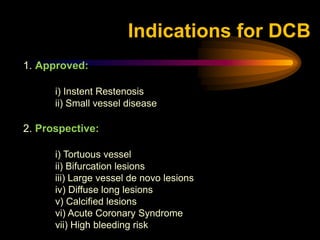
1. Approved:
i) Instent Restenosis
ii) Small vessel disease
2. Prospective:
i) Tortuous vessel
ii) Bifurcation lesions
iii) Large vessel de novo lesions
iv) Diffuse long lesions
v) Calcified lesions
vi) Acute Coronary Syndrome
vii) High bleeding risk
Indications for DCB
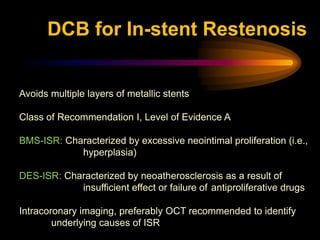
Avoids multiple layers of metallic stents
Class of Recommendation I, Level of Evidence A
BMS-ISR: Characterized by excessive neointimal proliferation (i.e.,
hyperplasia)
DES-ISR: Characterized by neoatherosclerosis as a result of
insufficient effect or failure of antiproliferative drugs
Intracoronary imaging, preferably OCT recommended to identify
underlying causes of ISR
DCB for In-stent Restenosis
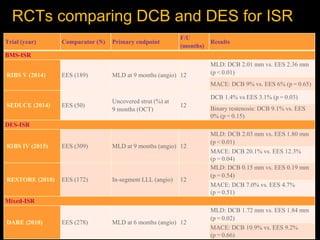
Trial (year) Comparator (N) Primary endpoint
F/U
(months)
Results
BMS-ISR
RIBS V (2014) EES (189) MLD at 9 months (angio) 12
MLD: DCB 2.01 mm vs. EES 2.36 mm
(p < 0.01)
MACE: DCB 9% vs. EES 6% (p = 0.65)
SEDUCE (2014) EES (50)
Uncovered strut (%) at
9 months (OCT)
12
DCB 1.4% vs EES 3.1% (p = 0.03)
Binary restenosis: DCB 9.1% vs. EES
0% (p = 0.15)
DES-ISR
RIBS IV (2015) EES (309) MLD at 9 months (angio) 12
MLD: DCB 2.03 mm vs. EES 1.80 mm
(p < 0.01)
MACE: DCB 20.1% vs. EES 12.3%
(p = 0.04)
RESTORE (2018) EES (172) In-segment LLL (angio) 12
MLD: DCB 0.15 mm vs. EES 0.19 mm
(p = 0.54)
MACE: DCB 7.0% vs. EES 4.7%
(p = 0.51)
Mixed-ISR
DARE (2018) EES (278) MLD at 6 months (angio) 12
MLD: DCB 1.72 mm vs. EES 1.84 mm
(p = 0.02)
MACE: DCB 10.9% vs. EES 9.2%
(p = 0.66)
RCTs comparing DCB and DES for ISR
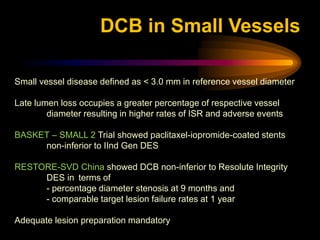
Small vessel disease defined as < 3.0 mm in reference vessel diameter
Late lumen loss occupies a greater percentage of respective vessel
diameter resulting in higher rates of ISR and adverse events
BASKET โ€“ SMALL 2 Trial showed paclitaxel-iopromide-coated stents
non-inferior to IInd Gen DES
RESTORE-SVD China showed DCB non-inferior to Resolute Integrity
DES in terms of
- percentage diameter stenosis at 9 months and
- comparable target lesion failure rates at 1 year
Adequate lesion preparation mandatory
DCB in Small Vessels
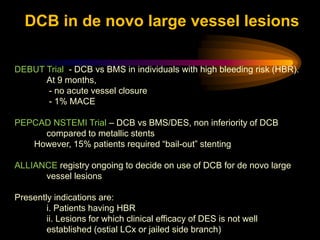
DEBUT Trial - DCB vs BMS in individuals with high bleeding risk (HBR).
At 9 months,
- no acute vessel closure
- 1% MACE
PEPCAD NSTEMI Trial โ€“ DCB vs BMS/DES, non inferiority of DCB
compared to metallic stents
However, 15% patients required โ€œbail-outโ€ stenting
ALLIANCE registry ongoing to decide on use of DCB for de novo large
vessel lesions
Presently indications are:
i. Patients having HBR
ii. Lesions for which clinical efficacy of DES is not well
established (ostial LCx or jailed side branch)
DCB in de novo large vessel lesions
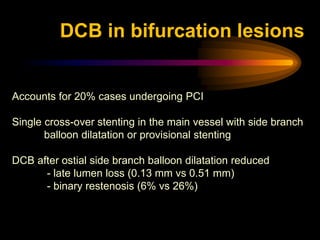
Accounts for 20% cases undergoing PCI
Single cross-over stenting in the main vessel with side branch
balloon dilatation or provisional stenting
DCB after ostial side branch balloon dilatation reduced
- late lumen loss (0.13 mm vs 0.51 mm)
- binary restenosis (6% vs 26%)
DCB in bifurcation lesions
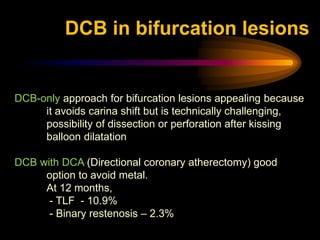
DCB-only approach for bifurcation lesions appealing because
it avoids carina shift but is technically challenging,
possibility of dissection or perforation after kissing
balloon dilatation
DCB with DCA (Directional coronary atherectomy) good
option to avoid metal.
At 12 months,
- TLF - 10.9%
- Binary restenosis โ€“ 2.3%
DCB in bifurcation lesions
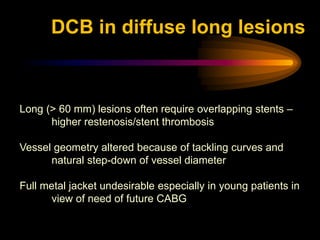
Long (> 60 mm) lesions often require overlapping stents โ€“
higher restenosis/stent thrombosis
Vessel geometry altered because of tackling curves and
natural step-down of vessel diameter
Full metal jacket undesirable especially in young patients in
view of need of future CABG
DCB in diffuse long lesions
โ€œHybrid approachโ€ โ€“ combines DES (proximal) and DCB
(distal)
DCB-only vs Hybrid approach โ€“ comparable rate of
- MACE (20.8% vs 22.7%; p = 0.74)
- TLR (9.6% vs 9.3%; p = 0.84)
HYPER pilot study will evaluate 12 month clinical outcomes of
a Hybrid (DES/DCB) approach in 100 patients with
diffuse CAD
DCB in diffuse long lesions
โ€œAchilles heelโ€ of PCI even in DES era due to
- stent underexpansion
- vessel wall overstretch leading to medial injury or
disruption
- damaged polymer coatings
- strut fractures
- delayed arterial healing response
DCB-only approach under investigation but appears
promising as metal free artery leaves additional
therapeutic choices
DCB in calcified lesions
REVELATION trial found DCB-only strategy is not inferior to
DES in terms of FFR at 9 months in 120 pts with STEMI
undergoing primary PCI
- 1 case had abrupt closure
- 1 case required TLR
PEPCAD NSTEMI trial showed no difference in TLF
DCB in Acute Coronary Syndromes
Limitations of DCB in ACS
- Thrombus could obstruct distribution of
antiproliferative drugs to vessel wall
- Dissection
- Elastic recoil
- Vasospasm
- Thrombus formation
Metallic DES reported to be more frequently associated with
incomplete stent apposition and uncovered struts in
STEMI than CCS
DCB in Acute Coronary Syndromes
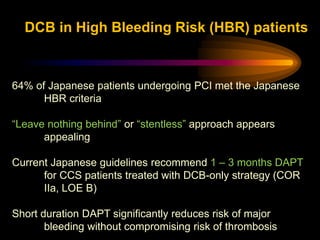
64% of Japanese patients undergoing PCI met the Japanese
HBR criteria
โ€œLeave nothing behindโ€ or โ€œstentlessโ€ approach appears
appealing
Current Japanese guidelines recommend 1 โ€“ 3 months DAPT
for CCS patients treated with DCB-only strategy (COR
IIa, LOE B)
Short duration DAPT significantly reduces risk of major
bleeding without compromising risk of thrombosis
DCB in High Bleeding Risk (HBR) patients
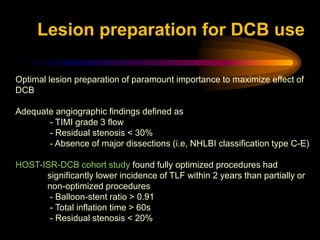
Optimal lesion preparation of paramount importance to maximize effect of
DCB
Adequate angiographic findings defined as
- TIMI grade 3 flow
- Residual stenosis < 30%
- Absence of major dissections (i.e, NHLBI classification type C-E)
HOST-ISR-DCB cohort study found fully optimized procedures had
significantly lower incidence of TLF within 2 years than partially or
non-optimized procedures
- Balloon-stent ratio > 0.91
- Total inflation time > 60s
- Residual stenosis < 20%
Lesion preparation for DCB use
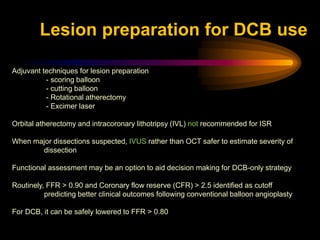
Adjuvant techniques for lesion preparation
- scoring balloon
- cutting balloon
- Rotational atherectomy
- Excimer laser
Orbital atherectomy and intracoronary lithotripsy (IVL) not recommended for ISR
When major dissections suspected, IVUS rather than OCT safer to estimate severity of
dissection
Functional assessment may be an option to aid decision making for DCB-only strategy
Routinely, FFR > 0.90 and Coronary flow reserve (CFR) > 2.5 identified as cutoff
predicting better clinical outcomes following conventional balloon angioplasty
For DCB, it can be safely lowered to FFR > 0.80
Lesion preparation for DCB use
Defined as an injured area not covered by radiation/stent, potential
substrate of recurrent restenosis (candy wrapper effect) during
brachytherapy/covered stent era
Unfavourable edge vascular responses (EVR) problem in DES era also
Modified balloons (cutting balloon or scoring balloon) associated with
significantly lower rates of TLR rates in REDUCE III trial
These balloons recommended for better lesion preparation to reduce risk
of balloon slippage or unplanned โ€œbail-outโ€ stenting
Predilated segments should be thoroughly covered by DCB considering
mechanical damage to vessel wall
Geographic Miss
1. Larger profile than that of conventional balloons.
- Possibility of system delivery failure to the lesion
- Drug loss due to friction with irregular vessel surface
Use of guide extension catheters (GEC) for quick and easy delivery
of DCB system
2. Higher mortality observed in patients with lower extremity arterial disease
(LEAD) treated with paclitaxel stents or balloons
- DAEDALUS study showed that incidence of all-cause mortality
was comparable btn paclitaxel DCBs and repeat stenting with DES
- A study showed paclitaxel DCBs did not have increased mortality
at 2 yrs & had lower all-cause mortality at 3 yrs as compared to DES
Rapamycin based DCBs expected to alleviate safety concerns associated
with Paclitaxel DCBs
Limitations/Concerns regarding DCB
Temporary halt in development of bioresorbable scaffold (BRS) might
motivate to maintain the โ€œleave nothing behindโ€ concept using DCB
Currently, 3 indications for DCBs are evidence based
ISR
HBR
Small vessels
Studies are underway to evaluate DCBs in other situations like
De novo lesions in large vessels
Bifurcation lesions
Calcified lesions
Acute coronary syndrome
Diffuse long lesions
Take home message

Drug Coated Balloons.pptx

  • 1.
    Drug Coated Balloons DrAniruddha Dharmadhikari Interventional Cardiologist Ex Prof of Medicine, MVP Medical College, Nashik. Cardiologist, Shree Sai Baba Heart Institute, Nashik.
  • 2.
    1.Vascular inflammation, hypersensitivityto metal/polymer leading to Acute stent thrombosis 2.Unequal drug distribution 3.Late occurrence of neoathersclerosis and stent thrombosis 4.Hampers future CABG options 5.Late luminal enlargement and restoration of vasomotor function are both compromised by the permanent metallic cage 6.Long term requirement of DAPT Limitations of DES
  • 3.
    Drug coated balloons(DCBs) โ€“ Fast and homogenous transfer of antiproliferative drugs into vessel wall during single balloon inflation by means of lipophilic matrix DCB-only PCI is the concept of treating coronary stenoses while limiting need for permanent/semipermanent implants Potentially every PCI should aim at using the DCB-only strategy โ€œLeave nothing behindโ€ DCB Concept
  • 4.
    OCT studies haveshown 40 โ€“ 56% lesions treated with DCB had late luminal enlargement at 6 โ€“ 8 month follow up DCB: A balloon catheter, a highly lipophilic drug and a coating matrix that regulates local drug delivery to the vessel wall Requirements of successful non stent โ€“ based approaches for local drug delivery 1. Rapid drug uptake by the tissue 2. Drug persistence in the vessel wall to compensate short contact time DCB Concept
  • 5.
    1.Taxane compounds likeprotaxel and paclitaxel Advantages: Absorbs quickly, localizes in subintimal space and partitions significantly in adventitia 2.Rapamycin derivatives like sirolimus and zotarolimus Limitations: - poorer transfer rate compared to paclitaxel โ€“ rapid decrease of tissue concentrations - reversible binding to rapamycin receptor โ€“ shorter duration of action Drugs used for suppression of neointimal proliferation
  • 6.
    Advances in Rapamycinderivatives: 1. Sirolimus in liquid formulation delivered by a porous balloon (SABRE trial) 2. Encapsulation of sirolimus in phospholipids 3. Crystalline Sirolimus coating with butylated Hydroxytoluene as excipient 4. Microreservoirs using biodegradable polymer 5. Nanoparticles using biodegradable polyester basedpolymers Drugs used for suppression of neointimal proliferation
  • 7.
    Significant differences inantiproliferative drugs Dose Release kinetics Coating used Tissue concentrations Cannot expect a class effect among various DCB technologies No Class Effect!
  • 8.
    Device Company DrugDose (ฮผg/mm2) Additive SeQuent Please Neo B. Braun Paclitaxel 3.0 Iopromide Agent Boston Scientific Paclitaxel 2.0 Acetyl tributyl citrate Prevail Medtronic Paclitaxel 3.5 Urea Pantera Lux Biotronik Paclitaxel 3.0 n-Butyryl citrate RESTORE Cardionovum Paclitaxel 3.0 Shellac Elutax SV Aachen Resonance Paclitaxel 2.2 None Magic Touch Concept Medical Sirolimus 1.3 Phospholipid Selution Med Alliance Sirolimus 1.0 Micro-reservoirs Virtue Caliber Therapeutics Sirolimus N/A Nanoparticles SeQuent SCB B. Braun Sirolimus 4.0 Crystalline Commercially available or under investigation DCBs for CAD
  • 9.
    1. Approved: i) InstentRestenosis ii) Small vessel disease 2. Prospective: i) Tortuous vessel ii) Bifurcation lesions iii) Large vessel de novo lesions iv) Diffuse long lesions v) Calcified lesions vi) Acute Coronary Syndrome vii) High bleeding risk Indications for DCB
  • 10.
    Avoids multiple layersof metallic stents Class of Recommendation I, Level of Evidence A BMS-ISR: Characterized by excessive neointimal proliferation (i.e., hyperplasia) DES-ISR: Characterized by neoatherosclerosis as a result of insufficient effect or failure of antiproliferative drugs Intracoronary imaging, preferably OCT recommended to identify underlying causes of ISR DCB for In-stent Restenosis
  • 11.
    Trial (year) Comparator(N) Primary endpoint F/U (months) Results BMS-ISR RIBS V (2014) EES (189) MLD at 9 months (angio) 12 MLD: DCB 2.01 mm vs. EES 2.36 mm (p < 0.01) MACE: DCB 9% vs. EES 6% (p = 0.65) SEDUCE (2014) EES (50) Uncovered strut (%) at 9 months (OCT) 12 DCB 1.4% vs EES 3.1% (p = 0.03) Binary restenosis: DCB 9.1% vs. EES 0% (p = 0.15) DES-ISR RIBS IV (2015) EES (309) MLD at 9 months (angio) 12 MLD: DCB 2.03 mm vs. EES 1.80 mm (p < 0.01) MACE: DCB 20.1% vs. EES 12.3% (p = 0.04) RESTORE (2018) EES (172) In-segment LLL (angio) 12 MLD: DCB 0.15 mm vs. EES 0.19 mm (p = 0.54) MACE: DCB 7.0% vs. EES 4.7% (p = 0.51) Mixed-ISR DARE (2018) EES (278) MLD at 6 months (angio) 12 MLD: DCB 1.72 mm vs. EES 1.84 mm (p = 0.02) MACE: DCB 10.9% vs. EES 9.2% (p = 0.66) RCTs comparing DCB and DES for ISR
  • 12.
    Small vessel diseasedefined as < 3.0 mm in reference vessel diameter Late lumen loss occupies a greater percentage of respective vessel diameter resulting in higher rates of ISR and adverse events BASKET โ€“ SMALL 2 Trial showed paclitaxel-iopromide-coated stents non-inferior to IInd Gen DES RESTORE-SVD China showed DCB non-inferior to Resolute Integrity DES in terms of - percentage diameter stenosis at 9 months and - comparable target lesion failure rates at 1 year Adequate lesion preparation mandatory DCB in Small Vessels
  • 13.
    DEBUT Trial -DCB vs BMS in individuals with high bleeding risk (HBR). At 9 months, - no acute vessel closure - 1% MACE PEPCAD NSTEMI Trial โ€“ DCB vs BMS/DES, non inferiority of DCB compared to metallic stents However, 15% patients required โ€œbail-outโ€ stenting ALLIANCE registry ongoing to decide on use of DCB for de novo large vessel lesions Presently indications are: i. Patients having HBR ii. Lesions for which clinical efficacy of DES is not well established (ostial LCx or jailed side branch) DCB in de novo large vessel lesions
  • 14.
    Accounts for 20%cases undergoing PCI Single cross-over stenting in the main vessel with side branch balloon dilatation or provisional stenting DCB after ostial side branch balloon dilatation reduced - late lumen loss (0.13 mm vs 0.51 mm) - binary restenosis (6% vs 26%) DCB in bifurcation lesions
  • 15.
    DCB-only approach forbifurcation lesions appealing because it avoids carina shift but is technically challenging, possibility of dissection or perforation after kissing balloon dilatation DCB with DCA (Directional coronary atherectomy) good option to avoid metal. At 12 months, - TLF - 10.9% - Binary restenosis โ€“ 2.3% DCB in bifurcation lesions
  • 16.
    Long (> 60mm) lesions often require overlapping stents โ€“ higher restenosis/stent thrombosis Vessel geometry altered because of tackling curves and natural step-down of vessel diameter Full metal jacket undesirable especially in young patients in view of need of future CABG DCB in diffuse long lesions
  • 17.
    โ€œHybrid approachโ€ โ€“combines DES (proximal) and DCB (distal) DCB-only vs Hybrid approach โ€“ comparable rate of - MACE (20.8% vs 22.7%; p = 0.74) - TLR (9.6% vs 9.3%; p = 0.84) HYPER pilot study will evaluate 12 month clinical outcomes of a Hybrid (DES/DCB) approach in 100 patients with diffuse CAD DCB in diffuse long lesions
  • 18.
    โ€œAchilles heelโ€ ofPCI even in DES era due to - stent underexpansion - vessel wall overstretch leading to medial injury or disruption - damaged polymer coatings - strut fractures - delayed arterial healing response DCB-only approach under investigation but appears promising as metal free artery leaves additional therapeutic choices DCB in calcified lesions
  • 19.
    REVELATION trial foundDCB-only strategy is not inferior to DES in terms of FFR at 9 months in 120 pts with STEMI undergoing primary PCI - 1 case had abrupt closure - 1 case required TLR PEPCAD NSTEMI trial showed no difference in TLF DCB in Acute Coronary Syndromes
  • 20.
    Limitations of DCBin ACS - Thrombus could obstruct distribution of antiproliferative drugs to vessel wall - Dissection - Elastic recoil - Vasospasm - Thrombus formation Metallic DES reported to be more frequently associated with incomplete stent apposition and uncovered struts in STEMI than CCS DCB in Acute Coronary Syndromes
  • 21.
    64% of Japanesepatients undergoing PCI met the Japanese HBR criteria โ€œLeave nothing behindโ€ or โ€œstentlessโ€ approach appears appealing Current Japanese guidelines recommend 1 โ€“ 3 months DAPT for CCS patients treated with DCB-only strategy (COR IIa, LOE B) Short duration DAPT significantly reduces risk of major bleeding without compromising risk of thrombosis DCB in High Bleeding Risk (HBR) patients
  • 22.
    Optimal lesion preparationof paramount importance to maximize effect of DCB Adequate angiographic findings defined as - TIMI grade 3 flow - Residual stenosis < 30% - Absence of major dissections (i.e, NHLBI classification type C-E) HOST-ISR-DCB cohort study found fully optimized procedures had significantly lower incidence of TLF within 2 years than partially or non-optimized procedures - Balloon-stent ratio > 0.91 - Total inflation time > 60s - Residual stenosis < 20% Lesion preparation for DCB use
  • 23.
    Adjuvant techniques forlesion preparation - scoring balloon - cutting balloon - Rotational atherectomy - Excimer laser Orbital atherectomy and intracoronary lithotripsy (IVL) not recommended for ISR When major dissections suspected, IVUS rather than OCT safer to estimate severity of dissection Functional assessment may be an option to aid decision making for DCB-only strategy Routinely, FFR > 0.90 and Coronary flow reserve (CFR) > 2.5 identified as cutoff predicting better clinical outcomes following conventional balloon angioplasty For DCB, it can be safely lowered to FFR > 0.80 Lesion preparation for DCB use
  • 24.
  • 25.
    Defined as aninjured area not covered by radiation/stent, potential substrate of recurrent restenosis (candy wrapper effect) during brachytherapy/covered stent era Unfavourable edge vascular responses (EVR) problem in DES era also Modified balloons (cutting balloon or scoring balloon) associated with significantly lower rates of TLR rates in REDUCE III trial These balloons recommended for better lesion preparation to reduce risk of balloon slippage or unplanned โ€œbail-outโ€ stenting Predilated segments should be thoroughly covered by DCB considering mechanical damage to vessel wall Geographic Miss
  • 26.
    1. Larger profilethan that of conventional balloons. - Possibility of system delivery failure to the lesion - Drug loss due to friction with irregular vessel surface Use of guide extension catheters (GEC) for quick and easy delivery of DCB system 2. Higher mortality observed in patients with lower extremity arterial disease (LEAD) treated with paclitaxel stents or balloons - DAEDALUS study showed that incidence of all-cause mortality was comparable btn paclitaxel DCBs and repeat stenting with DES - A study showed paclitaxel DCBs did not have increased mortality at 2 yrs & had lower all-cause mortality at 3 yrs as compared to DES Rapamycin based DCBs expected to alleviate safety concerns associated with Paclitaxel DCBs Limitations/Concerns regarding DCB
  • 27.
    Temporary halt indevelopment of bioresorbable scaffold (BRS) might motivate to maintain the โ€œleave nothing behindโ€ concept using DCB Currently, 3 indications for DCBs are evidence based ISR HBR Small vessels Studies are underway to evaluate DCBs in other situations like De novo lesions in large vessels Bifurcation lesions Calcified lesions Acute coronary syndrome Diffuse long lesions Take home message