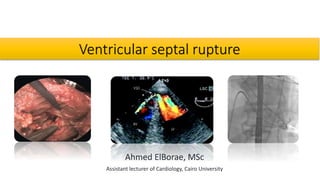
Ventricular septal rupture
Ahmed ElBorae, MSc
Assistant lecturer of Cardiology, Cairo University
Introduction
• (VSR) remains a devastating complication following MI
• Incidence: Decreased from 1-3% “pre-reperfusion era” to “0.17-0.31%” post
1ry PCI, [RCA in 46%- LAD in 42%]
• Onset: Average 2-8 days post MI, yet might occur earlier
• Risk factors: Old age-female-Late presentation-extensive MI HTN-Lytic therapy
• Diagnosis: Acute deterioration-auscultation “V.important”- Echo- MSCT
• Management: Hybrid approach (1ry PTCA of culprit- transient mechanical
support e.g. IABP) then definitive (Surgical or percutaneous)
• Prognosis: Without treatment > 90% mortality at 1 year
Venu M, et al. Contemporary Management of Post-MI Ventricular Septal Rupture. JACC 2018
Hemodynamics
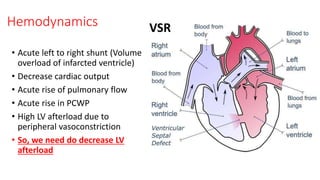
• Acute left to right shunt (Volume
overload of infarcted ventricle)
• Decrease cardiac output
• Acute rise of pulmonary flow
• Acute rise in PCWP
• High LV afterload due to
peripheral vasoconstriction
• So, we need do decrease LV
afterload
VSR
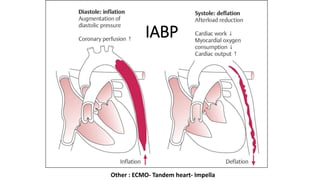
IABP
Other : ECMO- Tandem heart- Impella
Challenges
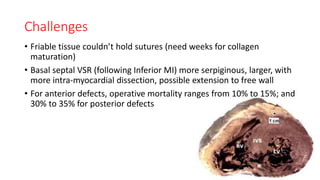
• Friable tissue couldn’t hold sutures (need weeks for collagen
maturation)
• Basal septal VSR (following Inferior MI) more serpiginous, larger, with
more intra-myocardial dissection, possible extension to free wall
• For anterior defects, operative mortality ranges from 10% to 15%; and
30% to 35% for posterior defects
Early ? Late ?
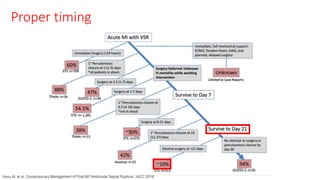
Proper timing of intervention
Proper timing
Venu M, et al. Contemporary Management of Post-MI Ventricular Septal Rupture. JACC 2018
How to interpret these numbers?
• Patients with more hemodynamic compromise > more urgent
intervention> higher operative mortality
• Patients with more stable hemodynamic > delayed intervention>
more stable tissue and dynamics> lower operative mortality
• No data about the mortality rate in patients awaiting delayed surgery
strategy
Natural selection
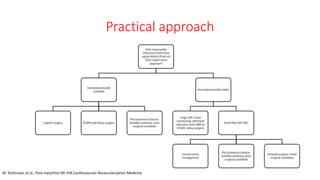
M. Shahreyar, et al., Post-myocPost-MI VSR.Cardiovascular Revascularization Medicine
Practical approach
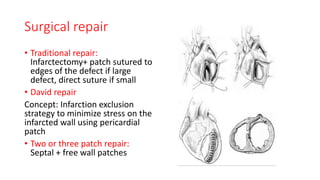
Surgical repair
• Traditional repair:
Infarctectomy+ patch sutured to
edges of the defect if large
defect, direct suture if small
• David repair
Concept: Infarction exclusion
strategy to minimize stress on the
infarcted wall using pericardial
patch
• Two or three patch repair:
Septal + free wall patches
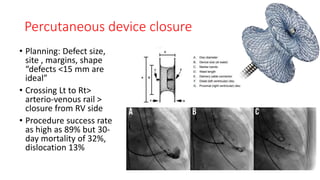
Percutaneous device closure
• Planning: Defect size,
site , margins, shape
“defects <15 mm are
ideal”
• Crossing Lt to Rt>
arterio-venous rail >
closure from RV side
• Procedure success rate
as high as 89% but 30-
day mortality of 32%,
dislocation 13%
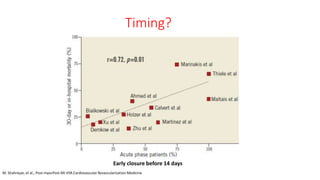
Timing?
Early closure before 14 days
M. Shahreyar, et al., Post-myocPost-MI VSR.Cardiovascular Revascularization Medicine
Thank You
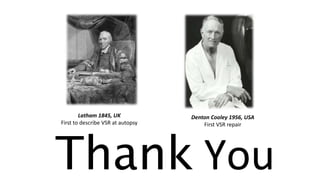
Latham 1845, UK
First to describe VSR at autopsy
Denton Cooley 1956, USA
First VSR repair

Ventricular septal rupture .pptx

  • 1.
    Ventricular septal rupture AhmedElBorae, MSc Assistant lecturer of Cardiology, Cairo University
  • 2.
    Introduction • (VSR) remainsa devastating complication following MI • Incidence: Decreased from 1-3% “pre-reperfusion era” to “0.17-0.31%” post 1ry PCI, [RCA in 46%- LAD in 42%] • Onset: Average 2-8 days post MI, yet might occur earlier • Risk factors: Old age-female-Late presentation-extensive MI HTN-Lytic therapy • Diagnosis: Acute deterioration-auscultation “V.important”- Echo- MSCT • Management: Hybrid approach (1ry PTCA of culprit- transient mechanical support e.g. IABP) then definitive (Surgical or percutaneous) • Prognosis: Without treatment > 90% mortality at 1 year Venu M, et al. Contemporary Management of Post-MI Ventricular Septal Rupture. JACC 2018
  • 3.
    Hemodynamics • Acute leftto right shunt (Volume overload of infarcted ventricle) • Decrease cardiac output • Acute rise of pulmonary flow • Acute rise in PCWP • High LV afterload due to peripheral vasoconstriction • So, we need do decrease LV afterload VSR
  • 4.
    IABP Other : ECMO-Tandem heart- Impella
  • 5.
    Challenges • Friable tissuecouldn’t hold sutures (need weeks for collagen maturation) • Basal septal VSR (following Inferior MI) more serpiginous, larger, with more intra-myocardial dissection, possible extension to free wall • For anterior defects, operative mortality ranges from 10% to 15%; and 30% to 35% for posterior defects
  • 6.
    Early ? Late? Proper timing of intervention
  • 7.
    Proper timing Venu M,et al. Contemporary Management of Post-MI Ventricular Septal Rupture. JACC 2018
  • 8.
    How to interpretthese numbers? • Patients with more hemodynamic compromise > more urgent intervention> higher operative mortality • Patients with more stable hemodynamic > delayed intervention> more stable tissue and dynamics> lower operative mortality • No data about the mortality rate in patients awaiting delayed surgery strategy Natural selection
  • 9.
    M. Shahreyar, etal., Post-myocPost-MI VSR.Cardiovascular Revascularization Medicine Practical approach
  • 10.
    Surgical repair • Traditionalrepair: Infarctectomy+ patch sutured to edges of the defect if large defect, direct suture if small • David repair Concept: Infarction exclusion strategy to minimize stress on the infarcted wall using pericardial patch • Two or three patch repair: Septal + free wall patches
  • 11.
    Percutaneous device closure •Planning: Defect size, site , margins, shape “defects <15 mm are ideal” • Crossing Lt to Rt> arterio-venous rail > closure from RV side • Procedure success rate as high as 89% but 30- day mortality of 32%, dislocation 13%
  • 12.
    Timing? Early closure before14 days M. Shahreyar, et al., Post-myocPost-MI VSR.Cardiovascular Revascularization Medicine
  • 13.
    Thank You Latham 1845,UK First to describe VSR at autopsy Denton Cooley 1956, USA First VSR repair