LEFT MAIN STENTING
Dr Mahendra
Cardiology,JIPMER
introduction
• Significant unprotected left main coronary artery (ULMCA) disease occurs in 5–7% of pts
undergoing CAG.
• ULMCA disease treated medically have a 3-year mortality rate of 50%.
Why left main lesion is important?
• supplying 75% of the left ventricular (LV) cardiac mass with right dominant type or balanced type
and 100% in the case of left dominant type.
• severe LMCA disease will reduce flow to a large portion of the myocardium.
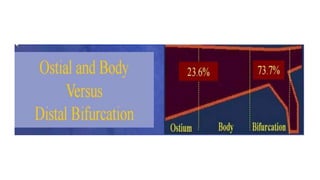
• divided into three anatomic regions-ostium or origin of the LMCA from the aorta, a mid-portion,
and the distal portion.
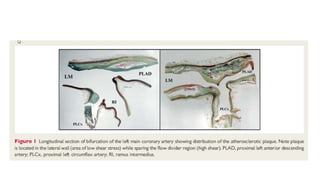
• Atherosclerotic lesions tend to form at specific regions of the coronary vasculature where flow is
disturbed, particularly in area of low shear stress.
• LMCA bifurcation, intimal atherosclerosis is accelerated primarily in area of low shear stress in the
lateral wall close to the LAD and LCx bifurcation
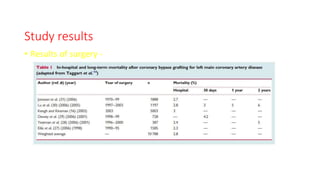
Study results
• Results of surgery -
Results of BMS in left main stenosis
• first reported balloon angioplasty of the LMCA was performed in 1979 by Gruntzig.
• After the first series of 129 patients, reported by Hartzler and O’Keefe in 1989, showed a 10% in-
hospital mortality and 64% 3-year mortality.
• Stenting of the LM with bare-metal stents (BMS) was characterized by high procedural success
rates, a 17– 20% target lesion revascularization (TLR), and a 10– 20% mortality rate at 1 year.
Result of DES
• Intracoronary Stenting and Angiographic Results: Drug-eluting Stents for Unprotected LM Lesions’
(ISAR-LM) randomized trial,59 comparing PCI with sirolimus-eluting stent (SES) vs. paclitaxel-eluting
stent (PES).
 no significant differences -
• composite outcome of death
• myocardial infarction (MI)
• TLR at 12-month follow-up
• restenosis
• 2-year LM-specific revascularization.
 LEMAX non-randomized registry, 173 patients with ULMCA disease treated with everolimus-eluting
stent (EES) were compared with a historical cohort of 291 patients treated with PES for ULMCA
stenosis.
• At 12-month clinical follow-up, EES was associated with lower target lesion failure (a composite of
cardiac death, target vessel MI, and TLR) and ST when compared with PES.
Drug-eluting stent versus coronary bypass grafting
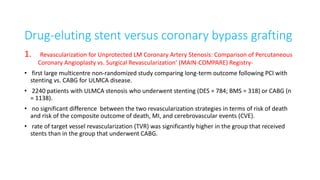
1. Revascularization for Unprotected LM Coronary Artery Stenosis: Comparison of Percutaneous
Coronary Angioplasty vs. Surgical Revascularization’ (MAIN-COMPARE) Registry-
• first large multicentre non-randomized study comparing long-term outcome following PCI with
stenting vs. CABG for ULMCA disease.
• 2240 patients with ULMCA stenosis who underwent stenting (DES = 784; BMS = 318) or CABG (n
= 1138).
• no significant difference between the two revascularization strategies in terms of risk of death
and risk of the composite outcome of death, MI, and cerebrovascular events (CVE).
• rate of target vessel revascularization (TVR) was significantly higher in the group that received
stents than in the group that underwent CABG.
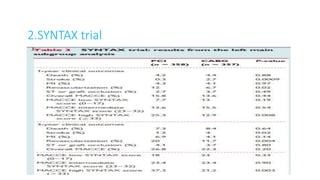
2.SYNTAX trial
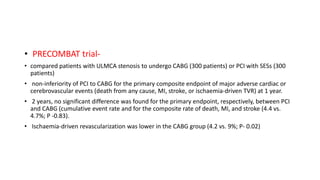
• PRECOMBAT trial-
• compared patients with ULMCA stenosis to undergo CABG (300 patients) or PCI with SESs (300
patients)
• non-inferiority of PCI to CABG for the primary composite endpoint of major adverse cardiac or
cerebrovascular events (death from any cause, MI, stroke, or ischaemia-driven TVR) at 1 year.
• 2 years, no significant difference was found for the primary endpoint, respectively, between PCI
and CABG (cumulative event rate and for the composite rate of death, MI, and stroke (4.4 vs.
4.7%; P -0.83).
• Ischaemia-driven revascularization was lower in the CABG group (4.2 vs. 9%; P- 0.02)
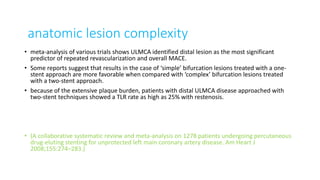
anatomic lesion complexity
• meta-analysis of various trials shows ULMCA identified distal lesion as the most significant
predictor of repeated revascularization and overall MACE.
• Some reports suggest that results in the case of ‘simple’ bifurcation lesions treated with a one-
stent approach are more favorable when compared with ‘complex’ bifurcation lesions treated
with a two-stent approach.
• because of the extensive plaque burden, patients with distal ULMCA disease approached with
two-stent techniques showed a TLR rate as high as 25% with restenosis.
• (A collaborative systematic review and meta-analysis on 1278 patients undergoing percutaneous
drug-eluting stenting for unprotected left main coronary artery disease. Am Heart J
2008;155:274–283.)
Result of IVUS
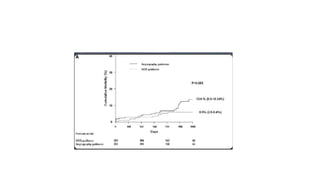
• MAIN-COMPARE registry reported that IVUS guidance was associated with improved 3-year
mortality compared with a conventional angiography-guided procedure.
• Pts receiving DES, IVUS-guided PCI associated with a significantly lower 3-year incidence of
mortality compared with angio-guided PCI (4.7% IVUS vs. 16% angiography).
Different strategies and techniques
for of left main PCI
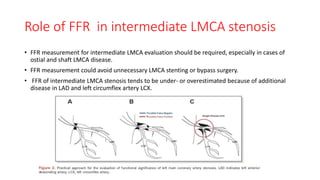
Role of FFR in intermediate LMCA stenosis
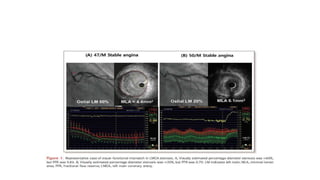
• FFR measurement for intermediate LMCA evaluation should be required, especially in cases of
ostial and shaft LMCA disease.
• FFR measurement could avoid unnecessary LMCA stenting or bypass surgery.
• FFR of intermediate LMCA stenosis tends to be under- or overestimated because of additional
disease in LAD and left circumflex artery LCX.
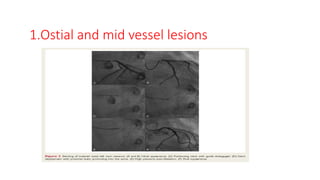
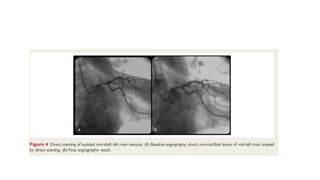
1.Ostial and mid vessel lesions
Distal left main lesions
• treated by either as a single-stent or by a two-stent strategy.
• Choice of strategy is based on-
• vessel and lesion characteristics (plaque distribution, diameter of the branches and the angle
between them, anatomy of the side branch)
• operator experience and expertise.
• majority (80%) UPLM distal lesions are bifurcation lesions
Single-stent strategy
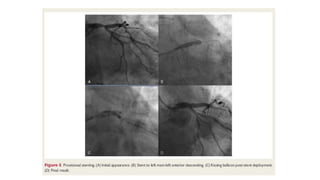
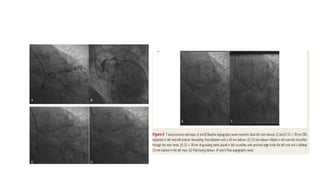
• Provisional stenting-
• allows the positioning of a second stent if required. The main vessel (almost always the LAD) is
wired.
• A second wire is usually placed in the side branch. The stent is deployed in the LM-LAD and post-
dilated as required.
• LCx may be left untouched or treated by a kissing balloon inflation.If necessary, a second stent
may be deployed into the ostial LCx using the ‘T’ technique.
Double Stenting Techniques
• T Stenting
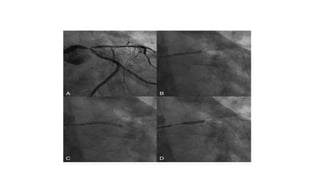
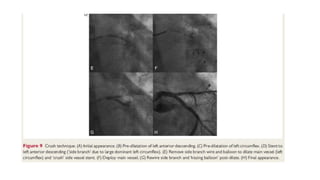
• Crush Technique
• Culotte Technique
• V stenting
• Simultaneous Kissing Stenting (SKS)
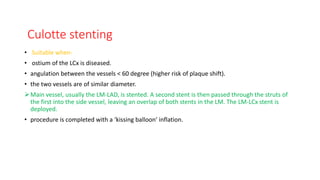
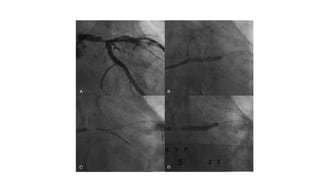
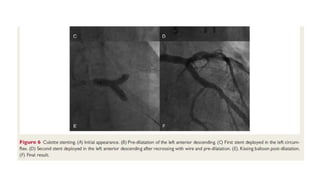
Culotte stenting
• Suitable when-
• ostium of the LCx is diseased.
• angulation between the vessels < 60 degree (higher risk of plaque shift).
• the two vessels are of similar diameter.
Main vessel, usually the LM-LAD, is stented. A second stent is then passed through the struts of
the first into the side vessel, leaving an overlap of both stents in the LM. The LM-LCx stent is
deployed.
• procedure is completed with a ‘kissing balloon’ inflation.
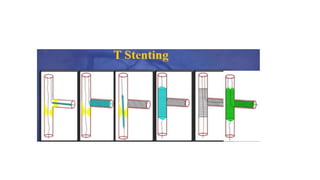
T stenting
• two-stent strategy is required but the angulation between the two vessels approached 90 degree.
• A stent is deployed in the side vessel, making sure to cover the ostium with only minimal
protrusion into the LAD.
• LM-LAD lesion is then stented followed by a ‘kissing balloon’ inflation.
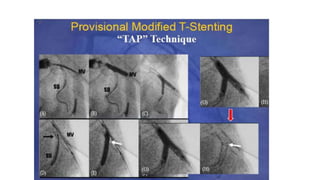
T and protrusion (TAP) technique
• used in majority of the bifurcation lesions especially when the bifurcation angle is less than 90
degrees .
• provide a good reconstruction of distal LM bifurcation with minimal stent overlap.
• main vessel (LM-LAD) is stented.
• Then, a stent is placed at the ostium of the side branch (LCx) with a balloon left in the main stent.
• After positioning the proximal edge of the side branch stent 1–2 mm inside the main stent, the
side branch stent is delivered at high pressure while a deflated balloon is left in the main stent.
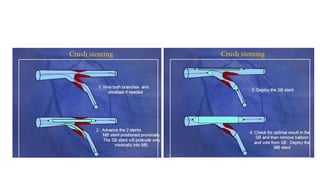
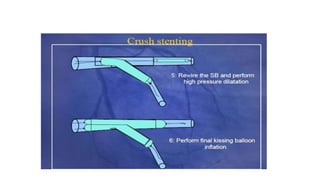
crush stenting
• when the diameter of the main vessel is greater than the side branch and the angulation is
favourable approximately ≤60%
• side branch is stented first, positioning the stent to allow 1–2 mm (minicrush) to protrude into the
LM.
• main vessel is then stented.
• Deployment of the main vessel stent crushes the proximal side branch stent against the LM wall.
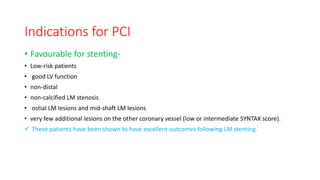
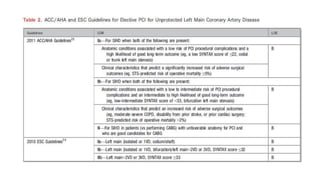
Indications for PCI
• Favourable for stenting-
• Low-risk patients
• good LV function
• non-distal
• non-calcified LM stenosis
• ostial LM lesions and mid-shaft LM lesions
• very few additional lesions on the other coronary vessel (low or intermediate SYNTAX score).
 These patients have been shown to have excellent outcomes following LM stenting.
• Percutaneous coronary intervention could be considered in-
• elderly patients
• patients with small left circumflex artery
• patients without any complex additional lesions (low or intermediate
SYNTAX score)
• non-diabetic patients
• poor surgical candidates
• distal coronary disease unfavourable to CABG
• high surgical risk (high EuroSCORE)
• co-morbidity (chronic obstructive lung disease)
• emergency clinical situation, i.e. acute LM occlusion
• CABG-
• patients with heavy calcified LM disease
• reduced LV function
• diabetic patients particularly with insulin-dependent diabetes
• MVD suitable for CABG (particularly with low EuroSCORE).
• distal LM bifurcation lesion with reduced LV function or with occluded RCA or with additional
complex lesions on the other coronary vessels (high SYNTAX score)
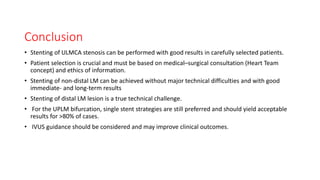
Conclusion
• Stenting of ULMCA stenosis can be performed with good results in carefully selected patients.
• Patient selection is crucial and must be based on medical–surgical consultation (Heart Team
concept) and ethics of information.
• Stenting of non-distal LM can be achieved without major technical difficulties and with good
immediate- and long-term results
• Stenting of distal LM lesion is a true technical challenge.
• For the UPLM bifurcation, single stent strategies are still preferred and should yield acceptable
results for >80% of cases.
• IVUS guidance should be considered and may improve clinical outcomes.
THANK YOU
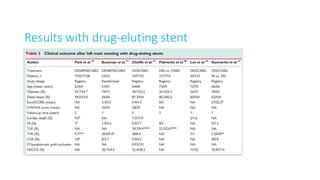
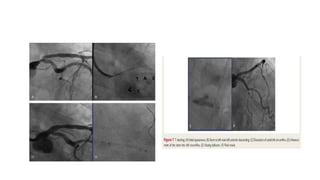
Results with drug-eluting stent
Left main stenting
Left main stenting
Left main stenting
Left main stenting
Left main stenting

Left main stenting

  • 1.
    LEFT MAIN STENTING DrMahendra Cardiology,JIPMER
  • 2.
    introduction • Significant unprotectedleft main coronary artery (ULMCA) disease occurs in 5–7% of pts undergoing CAG. • ULMCA disease treated medically have a 3-year mortality rate of 50%.
  • 3.
    Why left mainlesion is important? • supplying 75% of the left ventricular (LV) cardiac mass with right dominant type or balanced type and 100% in the case of left dominant type. • severe LMCA disease will reduce flow to a large portion of the myocardium. • divided into three anatomic regions-ostium or origin of the LMCA from the aorta, a mid-portion, and the distal portion. • Atherosclerotic lesions tend to form at specific regions of the coronary vasculature where flow is disturbed, particularly in area of low shear stress. • LMCA bifurcation, intimal atherosclerosis is accelerated primarily in area of low shear stress in the lateral wall close to the LAD and LCx bifurcation
  • 6.
  • 7.
    Results of BMSin left main stenosis • first reported balloon angioplasty of the LMCA was performed in 1979 by Gruntzig. • After the first series of 129 patients, reported by Hartzler and O’Keefe in 1989, showed a 10% in- hospital mortality and 64% 3-year mortality. • Stenting of the LM with bare-metal stents (BMS) was characterized by high procedural success rates, a 17– 20% target lesion revascularization (TLR), and a 10– 20% mortality rate at 1 year.
  • 8.
    Result of DES •Intracoronary Stenting and Angiographic Results: Drug-eluting Stents for Unprotected LM Lesions’ (ISAR-LM) randomized trial,59 comparing PCI with sirolimus-eluting stent (SES) vs. paclitaxel-eluting stent (PES).  no significant differences - • composite outcome of death • myocardial infarction (MI) • TLR at 12-month follow-up • restenosis • 2-year LM-specific revascularization.  LEMAX non-randomized registry, 173 patients with ULMCA disease treated with everolimus-eluting stent (EES) were compared with a historical cohort of 291 patients treated with PES for ULMCA stenosis. • At 12-month clinical follow-up, EES was associated with lower target lesion failure (a composite of cardiac death, target vessel MI, and TLR) and ST when compared with PES.
  • 9.
    Drug-eluting stent versuscoronary bypass grafting 1. Revascularization for Unprotected LM Coronary Artery Stenosis: Comparison of Percutaneous Coronary Angioplasty vs. Surgical Revascularization’ (MAIN-COMPARE) Registry- • first large multicentre non-randomized study comparing long-term outcome following PCI with stenting vs. CABG for ULMCA disease. • 2240 patients with ULMCA stenosis who underwent stenting (DES = 784; BMS = 318) or CABG (n = 1138). • no significant difference between the two revascularization strategies in terms of risk of death and risk of the composite outcome of death, MI, and cerebrovascular events (CVE). • rate of target vessel revascularization (TVR) was significantly higher in the group that received stents than in the group that underwent CABG.
  • 10.
  • 11.
    • PRECOMBAT trial- •compared patients with ULMCA stenosis to undergo CABG (300 patients) or PCI with SESs (300 patients) • non-inferiority of PCI to CABG for the primary composite endpoint of major adverse cardiac or cerebrovascular events (death from any cause, MI, stroke, or ischaemia-driven TVR) at 1 year. • 2 years, no significant difference was found for the primary endpoint, respectively, between PCI and CABG (cumulative event rate and for the composite rate of death, MI, and stroke (4.4 vs. 4.7%; P -0.83). • Ischaemia-driven revascularization was lower in the CABG group (4.2 vs. 9%; P- 0.02)
  • 12.
    anatomic lesion complexity •meta-analysis of various trials shows ULMCA identified distal lesion as the most significant predictor of repeated revascularization and overall MACE. • Some reports suggest that results in the case of ‘simple’ bifurcation lesions treated with a one- stent approach are more favorable when compared with ‘complex’ bifurcation lesions treated with a two-stent approach. • because of the extensive plaque burden, patients with distal ULMCA disease approached with two-stent techniques showed a TLR rate as high as 25% with restenosis. • (A collaborative systematic review and meta-analysis on 1278 patients undergoing percutaneous drug-eluting stenting for unprotected left main coronary artery disease. Am Heart J 2008;155:274–283.)
  • 13.
    Result of IVUS •MAIN-COMPARE registry reported that IVUS guidance was associated with improved 3-year mortality compared with a conventional angiography-guided procedure. • Pts receiving DES, IVUS-guided PCI associated with a significantly lower 3-year incidence of mortality compared with angio-guided PCI (4.7% IVUS vs. 16% angiography).
  • 15.
    Different strategies andtechniques for of left main PCI
  • 16.
    Role of FFRin intermediate LMCA stenosis • FFR measurement for intermediate LMCA evaluation should be required, especially in cases of ostial and shaft LMCA disease. • FFR measurement could avoid unnecessary LMCA stenting or bypass surgery. • FFR of intermediate LMCA stenosis tends to be under- or overestimated because of additional disease in LAD and left circumflex artery LCX.
  • 18.
    1.Ostial and midvessel lesions
  • 20.
    Distal left mainlesions • treated by either as a single-stent or by a two-stent strategy. • Choice of strategy is based on- • vessel and lesion characteristics (plaque distribution, diameter of the branches and the angle between them, anatomy of the side branch) • operator experience and expertise. • majority (80%) UPLM distal lesions are bifurcation lesions
  • 21.
    Single-stent strategy • Provisionalstenting- • allows the positioning of a second stent if required. The main vessel (almost always the LAD) is wired. • A second wire is usually placed in the side branch. The stent is deployed in the LM-LAD and post- dilated as required. • LCx may be left untouched or treated by a kissing balloon inflation.If necessary, a second stent may be deployed into the ostial LCx using the ‘T’ technique.
  • 23.
    Double Stenting Techniques •T Stenting • Crush Technique • Culotte Technique • V stenting • Simultaneous Kissing Stenting (SKS)
  • 24.
    Culotte stenting • Suitablewhen- • ostium of the LCx is diseased. • angulation between the vessels < 60 degree (higher risk of plaque shift). • the two vessels are of similar diameter. Main vessel, usually the LM-LAD, is stented. A second stent is then passed through the struts of the first into the side vessel, leaving an overlap of both stents in the LM. The LM-LCx stent is deployed. • procedure is completed with a ‘kissing balloon’ inflation.
  • 27.
    T stenting • two-stentstrategy is required but the angulation between the two vessels approached 90 degree. • A stent is deployed in the side vessel, making sure to cover the ostium with only minimal protrusion into the LAD. • LM-LAD lesion is then stented followed by a ‘kissing balloon’ inflation.
  • 29.
    T and protrusion(TAP) technique • used in majority of the bifurcation lesions especially when the bifurcation angle is less than 90 degrees . • provide a good reconstruction of distal LM bifurcation with minimal stent overlap. • main vessel (LM-LAD) is stented. • Then, a stent is placed at the ostium of the side branch (LCx) with a balloon left in the main stent. • After positioning the proximal edge of the side branch stent 1–2 mm inside the main stent, the side branch stent is delivered at high pressure while a deflated balloon is left in the main stent.
  • 33.
    crush stenting • whenthe diameter of the main vessel is greater than the side branch and the angulation is favourable approximately ≤60% • side branch is stented first, positioning the stent to allow 1–2 mm (minicrush) to protrude into the LM. • main vessel is then stented. • Deployment of the main vessel stent crushes the proximal side branch stent against the LM wall.
  • 36.
    Indications for PCI •Favourable for stenting- • Low-risk patients • good LV function • non-distal • non-calcified LM stenosis • ostial LM lesions and mid-shaft LM lesions • very few additional lesions on the other coronary vessel (low or intermediate SYNTAX score).  These patients have been shown to have excellent outcomes following LM stenting.
  • 37.
    • Percutaneous coronaryintervention could be considered in- • elderly patients • patients with small left circumflex artery • patients without any complex additional lesions (low or intermediate SYNTAX score) • non-diabetic patients • poor surgical candidates • distal coronary disease unfavourable to CABG • high surgical risk (high EuroSCORE) • co-morbidity (chronic obstructive lung disease) • emergency clinical situation, i.e. acute LM occlusion
  • 38.
    • CABG- • patientswith heavy calcified LM disease • reduced LV function • diabetic patients particularly with insulin-dependent diabetes • MVD suitable for CABG (particularly with low EuroSCORE). • distal LM bifurcation lesion with reduced LV function or with occluded RCA or with additional complex lesions on the other coronary vessels (high SYNTAX score)
  • 41.
    Conclusion • Stenting ofULMCA stenosis can be performed with good results in carefully selected patients. • Patient selection is crucial and must be based on medical–surgical consultation (Heart Team concept) and ethics of information. • Stenting of non-distal LM can be achieved without major technical difficulties and with good immediate- and long-term results • Stenting of distal LM lesion is a true technical challenge. • For the UPLM bifurcation, single stent strategies are still preferred and should yield acceptable results for >80% of cases. • IVUS guidance should be considered and may improve clinical outcomes.
  • 42.
  • 43.