Clinical evaluation of new drug eluting
coronary stent system in the treatment
of patients with coronary artery disease
Century study
Emanuele Barbato, MD, PhD, FESC
Cardiovascular Center OLV Aalst (Belgium)
On behalf of the Century investigators
Potential conflicts of interest
Speaker's name: Emanuele Barbato
 Istitutional grants and investigator’s fee from Terumo to the
Cardiovascular Resarch Foundation Aalst
Background and aim
• Despite excellent efficacy and safety clinical profile of DES,
remaining issues of potential untoward effects are related
to the permanently implanted polymer (i.e. late
inflammation)
• A reduced polymer dwelling time could prevent these
potential side-effects, contributing also to shorten the
duration of dual antiplatelet therapy
• Century study assessed safety and efficacy of the newly
developed Ultimaster DES with biodegradable polymer
• Results were compared to patient’s level historical data of
Kaname BMS platform from the KARE study of similar
design
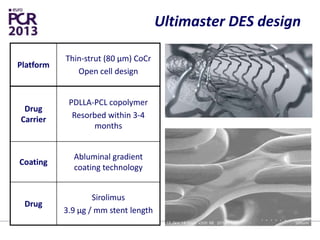
Ultimaster DES design
Platform
Thin-strut (80 µm) CoCr
Open cell design
Drug
Carrier
PDLLA-PCL copolymer
Resorbed within 3-4
months
Coating
Abluminal gradient
coating technology
Drug
Sirolimus
3.9 µg / mm stent length
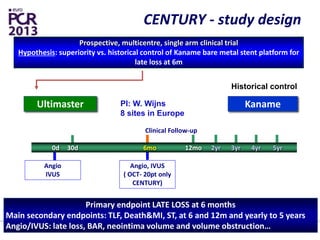
Primary endpoint LATE LOSS at 6 months
Main secondary endpoints: TLF, Death&MI, ST, at 6 and 12m and yearly to 5 years
Angio/IVUS: late loss, BAR, neointima volume and volume obstruction…
Ultimaster Kaname
Clinical Follow-up
30d 4yr3yr2yr6mo 12mo 5yr
Angio
IVUS
0d
Angio, IVUS
( OCT- 20pt only
CENTURY)
CENTURY - study design
PI: W. Wijns
8 sites in Europe
Historical control
Prospective, multicentre, single arm clinical trial
Hypothesis: superiority vs. historical control of Kaname bare metal stent platform for
late loss at 6m
Study Management
PI – William Wijns
Steering Committee
• William Wijns
• Emanuele Barbato
• Branko Beleslin
CEC & DMC, genae, Belgium
• Claude Hanet
• Rainer Hoffmann
• Benno Rensing
QCA, IVUS, OCT Corelab
• Cardialysis, The Netherlands
Statistical Analysis
• SBD ANALYTICS, Belgium
Study sites and investigators:
Belgium
• E. Barbato, OLV Ziekenhuis, Aalst
• M. Vrolix, ZOL Campus St. Jan, Aalst
• S. Verheye, ZNA, Campus Middelheim,
Antwerpen
Serbia
• S. Salinger-Martinovic, Clinical Center
Nis
• B. Beleslin, Clinical Centre Serbia,
Belgrade
• A. Neskovic, Clinical Hospital Zemun
• D. Sagic, Institute for cardiovascular
disease, Belgrade
• N. Jagic, Clinical centre Kragujevac
CENTURY Study
patient population
• Main Inclusion Criteria
– Up to two de-novo lesions located in two epicardial vessels
– Target lesion length <25 mm, RVD: 2.5-4.0 mm
• Main Exclusion Criteria
– Intolerance to common PCI associated medications, or limus like
drugs
– Left main CAD
– CTO, ostial, bifurcation, SVG lesions
– Prior PCI with stenting (within 1 month before enrolment)
– Planned major surgery within 6 m post procedure
– STEMI <72h before procedure
Historical control: Patient level data of KARE study. Inclusion and
exclusion criteria were comparable between two trials, except only single
lesion in KARE study and up to two lesions in two epicardial vessels in
CENTURY study
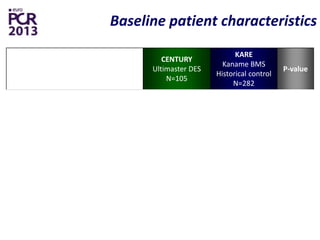
Baseline patient characteristics
CENTURY
Ultimaster DES
N=105
KARE
Kaname BMS
Historical control
N=282
P-value
Age, Mean±SD 60.6±8.4 64.9±11.5 <0.001
Gender, Male, % 76.2 73.0 0.60
Smoking, current, % 29.5 27.0 0.70
History of Diabetes Mellitus, % 23.8 22.7 0.89
Dyslipidemia requiring treatment, % 85.6 67.7 <0.001
Hypertension requiring treatment, % 81.6 70.2 0.06
Family history of CAD, % 58.8 32.2 <0.001
History of revascularization, % 19.1 22.7 0.42
History of MI, % 48.6 33.3 0.007
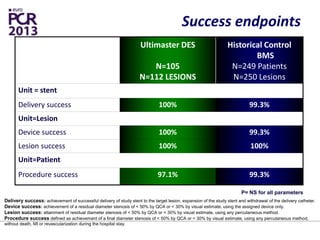
Success endpoints
Ultimaster DES
N=105
N=112 LESIONS
Historical Control
BMS
N=249 Patients
N=250 Lesions
Unit = stent
Delivery success 100% 99.3%
Unit=Lesion
Device success 100% 99.3%
Lesion success 100% 100%
Unit=Patient
Procedure success 97.1% 99.3%
Delivery success: achievement of successful delivery of study stent to the target lesion, expansion of the study stent and withdrawal of the delivery catheter.
Device success: achievement of a residual diameter stenosis of < 50% by QCA or < 30% by visual estimate, using the assigned device only.
Lesion success: attainment of residual diameter stenosis of < 50% by QCA or < 30% by visual estimate, using any percutaneous method.
Procedure success defined as achievement of a final diameter stenosis of < 50% by QCA or < 30% by visual estimate, using any percutaneous method,
without death, MI or revascularization during the hospital stay.
P= NS for all parameters
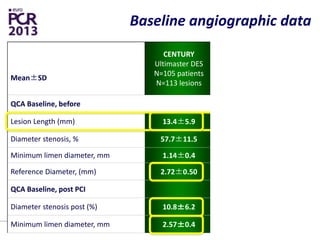
Mean±SD
CENTURY
Ultimaster DES
N=105 patients
N=113 lesions
KARE
Kaname CoCr
Historical control
N=282 patients
N=284 lesions
P-value
QCA Baseline, before
Lesion Length (mm) 13.4±5.9 11.6±4.8 0.005
Diameter stenosis, % 57.7±11.5 58.8±11.0 0.344
Minimum limen diameter, mm 1.14±0.4 1.10±0.4 0.483
Reference Diameter, (mm) 2.72±0.50 2.69±0.52 0.497
QCA Baseline, post PCI
Diameter stenosis post (%) 10.8±6.2 11.0±5.3 0.950
Minimum limen diameter, mm 2.57±0.4 2.51±0.4 0.186
Baseline angiographic data
Primary Endpoint
Late Loss result
Kaname : 0.75±0.43 mm
Ultimaster : 0.04±0.35 mm
0 0.50
LL (mm)
Based upon estimated Kaname Late Loss
0.90±0.50 mm
0.40 mm improvement considered as clinically significant
Late loss of 0.50 mm (0.90-0.40 mm) is considered upper limit for
CENTURY study
Result:
Ultimaster = SUPERIOR p<0.0001
CENTURY
0.04
[-0.02 , 0.11] [0.70 , 0.81]
0.75
KARE
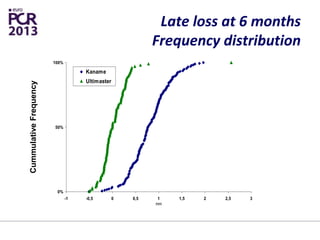
Late loss at 6 months
Frequency distribution
0%
50%
100%
-1 -0,5 0 0,5 1 1,5 2 2,5 3
mm
Kaname
Ultimaster
CummulativeFrequency
Mean±SD
CENTURY
Ultimaster DES
N=112 Lesions
KARE
Kaname BMS
Historical control
N=284 Lesions
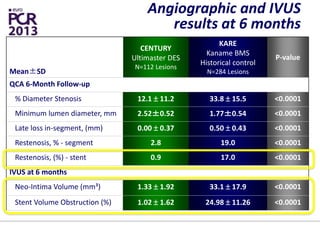
P-value
QCA 6-Month Follow-up
% Diameter Stenosis 12.1  11.2 33.8  15.5 <0.0001
Minimum lumen diameter, mm 2.52±0.52 1.77±0.54 <0.0001
Late loss in-segment, (mm) 0.00  0.37 0.50  0.43 <0.0001
Restenosis, % - segment 2.8 19.0 <0.0001
Restenosis, (%) - stent 0.9 17.0 <0.0001
IVUS at 6 months
Neo-Intima Volume (mm³) 1.33  1.92 33.1  17.9 <0.0001
Stent Volume Obstruction (%) 1.02  1.62 24.98  11.26 <0.0001
Angiographic and IVUS
results at 6 months
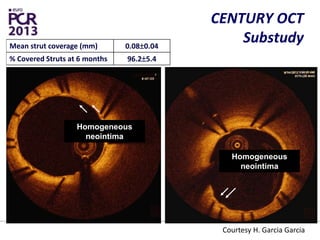
CENTURY OCT
Substudy
Homogeneous
neointima
Homogeneous
neointima
Courtesy H. Garcia Garcia
Mean strut coverage (mm) 0.080.04
% Covered Struts at 6 months 96.25.4
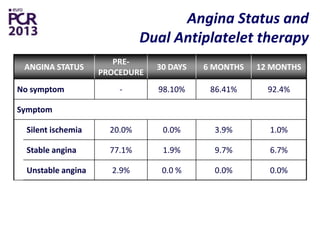
Angina Status and
Dual Antiplatelet therapy
ANGINA STATUS
PRE-
PROCEDURE
30 DAYS 6 MONTHS 12 MONTHS
No symptom - 98.10% 86.41% 92.4%
Symptom
Silent ischemia 20.0% 0.0% 3.9% 1.0%
Stable angina 77.1% 1.9% 9.7% 6.7%
Unstable angina 2.9% 0.0 % 0.0% 0.0%
Dual antiplatelet
therapy
99.0% 96.2% 63.9%
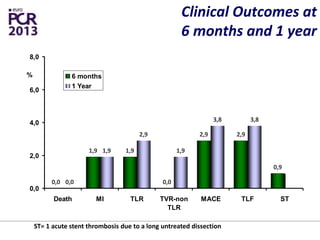
Clinical Outcomes at
6 months and 1 year
0,0
1,9 1,9
0,0
2,9 2,9
0,9
0,0
1,9
2,9
1,9
3,8 3,8
0,0
2,0
4,0
6,0
8,0
Death MI TLR TVR-non
TLR
MACE TLF ST
% 6 months
1 Year
ST= 1 acute stent thrombosis due to a long untreated dissection
Conclusion
• Ultimaster DES showed superior efficacy versus
bare metal stent (historical control) by reducing
late loss at 6 months by 95%
• The rate of adverse events up to 1 year was low
• Larger randomized studies are underway and
they are expected to confirm promising initial
data of Ultimaster DES and value of shorter
polymer degradation time

CENTURY: resultados clínicos del nuevo stent liberador de sirolimus y polímero degradable

  • 1.
    Clinical evaluation ofnew drug eluting coronary stent system in the treatment of patients with coronary artery disease Century study Emanuele Barbato, MD, PhD, FESC Cardiovascular Center OLV Aalst (Belgium) On behalf of the Century investigators
  • 2.
    Potential conflicts ofinterest Speaker's name: Emanuele Barbato  Istitutional grants and investigator’s fee from Terumo to the Cardiovascular Resarch Foundation Aalst
  • 3.
    Background and aim •Despite excellent efficacy and safety clinical profile of DES, remaining issues of potential untoward effects are related to the permanently implanted polymer (i.e. late inflammation) • A reduced polymer dwelling time could prevent these potential side-effects, contributing also to shorten the duration of dual antiplatelet therapy • Century study assessed safety and efficacy of the newly developed Ultimaster DES with biodegradable polymer • Results were compared to patient’s level historical data of Kaname BMS platform from the KARE study of similar design
  • 4.
    Ultimaster DES design Platform Thin-strut(80 µm) CoCr Open cell design Drug Carrier PDLLA-PCL copolymer Resorbed within 3-4 months Coating Abluminal gradient coating technology Drug Sirolimus 3.9 µg / mm stent length
  • 5.
    Primary endpoint LATELOSS at 6 months Main secondary endpoints: TLF, Death&MI, ST, at 6 and 12m and yearly to 5 years Angio/IVUS: late loss, BAR, neointima volume and volume obstruction… Ultimaster Kaname Clinical Follow-up 30d 4yr3yr2yr6mo 12mo 5yr Angio IVUS 0d Angio, IVUS ( OCT- 20pt only CENTURY) CENTURY - study design PI: W. Wijns 8 sites in Europe Historical control Prospective, multicentre, single arm clinical trial Hypothesis: superiority vs. historical control of Kaname bare metal stent platform for late loss at 6m
  • 6.
    Study Management PI –William Wijns Steering Committee • William Wijns • Emanuele Barbato • Branko Beleslin CEC & DMC, genae, Belgium • Claude Hanet • Rainer Hoffmann • Benno Rensing QCA, IVUS, OCT Corelab • Cardialysis, The Netherlands Statistical Analysis • SBD ANALYTICS, Belgium Study sites and investigators: Belgium • E. Barbato, OLV Ziekenhuis, Aalst • M. Vrolix, ZOL Campus St. Jan, Aalst • S. Verheye, ZNA, Campus Middelheim, Antwerpen Serbia • S. Salinger-Martinovic, Clinical Center Nis • B. Beleslin, Clinical Centre Serbia, Belgrade • A. Neskovic, Clinical Hospital Zemun • D. Sagic, Institute for cardiovascular disease, Belgrade • N. Jagic, Clinical centre Kragujevac
  • 7.
    CENTURY Study patient population •Main Inclusion Criteria – Up to two de-novo lesions located in two epicardial vessels – Target lesion length <25 mm, RVD: 2.5-4.0 mm • Main Exclusion Criteria – Intolerance to common PCI associated medications, or limus like drugs – Left main CAD – CTO, ostial, bifurcation, SVG lesions – Prior PCI with stenting (within 1 month before enrolment) – Planned major surgery within 6 m post procedure – STEMI <72h before procedure Historical control: Patient level data of KARE study. Inclusion and exclusion criteria were comparable between two trials, except only single lesion in KARE study and up to two lesions in two epicardial vessels in CENTURY study
  • 8.
    Baseline patient characteristics CENTURY UltimasterDES N=105 KARE Kaname BMS Historical control N=282 P-value Age, Mean±SD 60.6±8.4 64.9±11.5 <0.001 Gender, Male, % 76.2 73.0 0.60 Smoking, current, % 29.5 27.0 0.70 History of Diabetes Mellitus, % 23.8 22.7 0.89 Dyslipidemia requiring treatment, % 85.6 67.7 <0.001 Hypertension requiring treatment, % 81.6 70.2 0.06 Family history of CAD, % 58.8 32.2 <0.001 History of revascularization, % 19.1 22.7 0.42 History of MI, % 48.6 33.3 0.007
  • 9.
    Success endpoints Ultimaster DES N=105 N=112LESIONS Historical Control BMS N=249 Patients N=250 Lesions Unit = stent Delivery success 100% 99.3% Unit=Lesion Device success 100% 99.3% Lesion success 100% 100% Unit=Patient Procedure success 97.1% 99.3% Delivery success: achievement of successful delivery of study stent to the target lesion, expansion of the study stent and withdrawal of the delivery catheter. Device success: achievement of a residual diameter stenosis of < 50% by QCA or < 30% by visual estimate, using the assigned device only. Lesion success: attainment of residual diameter stenosis of < 50% by QCA or < 30% by visual estimate, using any percutaneous method. Procedure success defined as achievement of a final diameter stenosis of < 50% by QCA or < 30% by visual estimate, using any percutaneous method, without death, MI or revascularization during the hospital stay. P= NS for all parameters
  • 10.
    Mean±SD CENTURY Ultimaster DES N=105 patients N=113lesions KARE Kaname CoCr Historical control N=282 patients N=284 lesions P-value QCA Baseline, before Lesion Length (mm) 13.4±5.9 11.6±4.8 0.005 Diameter stenosis, % 57.7±11.5 58.8±11.0 0.344 Minimum limen diameter, mm 1.14±0.4 1.10±0.4 0.483 Reference Diameter, (mm) 2.72±0.50 2.69±0.52 0.497 QCA Baseline, post PCI Diameter stenosis post (%) 10.8±6.2 11.0±5.3 0.950 Minimum limen diameter, mm 2.57±0.4 2.51±0.4 0.186 Baseline angiographic data
  • 11.
    Primary Endpoint Late Lossresult Kaname : 0.75±0.43 mm Ultimaster : 0.04±0.35 mm 0 0.50 LL (mm) Based upon estimated Kaname Late Loss 0.90±0.50 mm 0.40 mm improvement considered as clinically significant Late loss of 0.50 mm (0.90-0.40 mm) is considered upper limit for CENTURY study Result: Ultimaster = SUPERIOR p<0.0001 CENTURY 0.04 [-0.02 , 0.11] [0.70 , 0.81] 0.75 KARE
  • 12.
    Late loss at6 months Frequency distribution 0% 50% 100% -1 -0,5 0 0,5 1 1,5 2 2,5 3 mm Kaname Ultimaster CummulativeFrequency
  • 13.
    Mean±SD CENTURY Ultimaster DES N=112 Lesions KARE KanameBMS Historical control N=284 Lesions P-value QCA 6-Month Follow-up % Diameter Stenosis 12.1  11.2 33.8  15.5 <0.0001 Minimum lumen diameter, mm 2.52±0.52 1.77±0.54 <0.0001 Late loss in-segment, (mm) 0.00  0.37 0.50  0.43 <0.0001 Restenosis, % - segment 2.8 19.0 <0.0001 Restenosis, (%) - stent 0.9 17.0 <0.0001 IVUS at 6 months Neo-Intima Volume (mm³) 1.33  1.92 33.1  17.9 <0.0001 Stent Volume Obstruction (%) 1.02  1.62 24.98  11.26 <0.0001 Angiographic and IVUS results at 6 months
  • 14.
    CENTURY OCT Substudy Homogeneous neointima Homogeneous neointima Courtesy H.Garcia Garcia Mean strut coverage (mm) 0.080.04 % Covered Struts at 6 months 96.25.4
  • 15.
    Angina Status and DualAntiplatelet therapy ANGINA STATUS PRE- PROCEDURE 30 DAYS 6 MONTHS 12 MONTHS No symptom - 98.10% 86.41% 92.4% Symptom Silent ischemia 20.0% 0.0% 3.9% 1.0% Stable angina 77.1% 1.9% 9.7% 6.7% Unstable angina 2.9% 0.0 % 0.0% 0.0% Dual antiplatelet therapy 99.0% 96.2% 63.9%
  • 16.
    Clinical Outcomes at 6months and 1 year 0,0 1,9 1,9 0,0 2,9 2,9 0,9 0,0 1,9 2,9 1,9 3,8 3,8 0,0 2,0 4,0 6,0 8,0 Death MI TLR TVR-non TLR MACE TLF ST % 6 months 1 Year ST= 1 acute stent thrombosis due to a long untreated dissection
  • 17.
    Conclusion • Ultimaster DESshowed superior efficacy versus bare metal stent (historical control) by reducing late loss at 6 months by 95% • The rate of adverse events up to 1 year was low • Larger randomized studies are underway and they are expected to confirm promising initial data of Ultimaster DES and value of shorter polymer degradation time